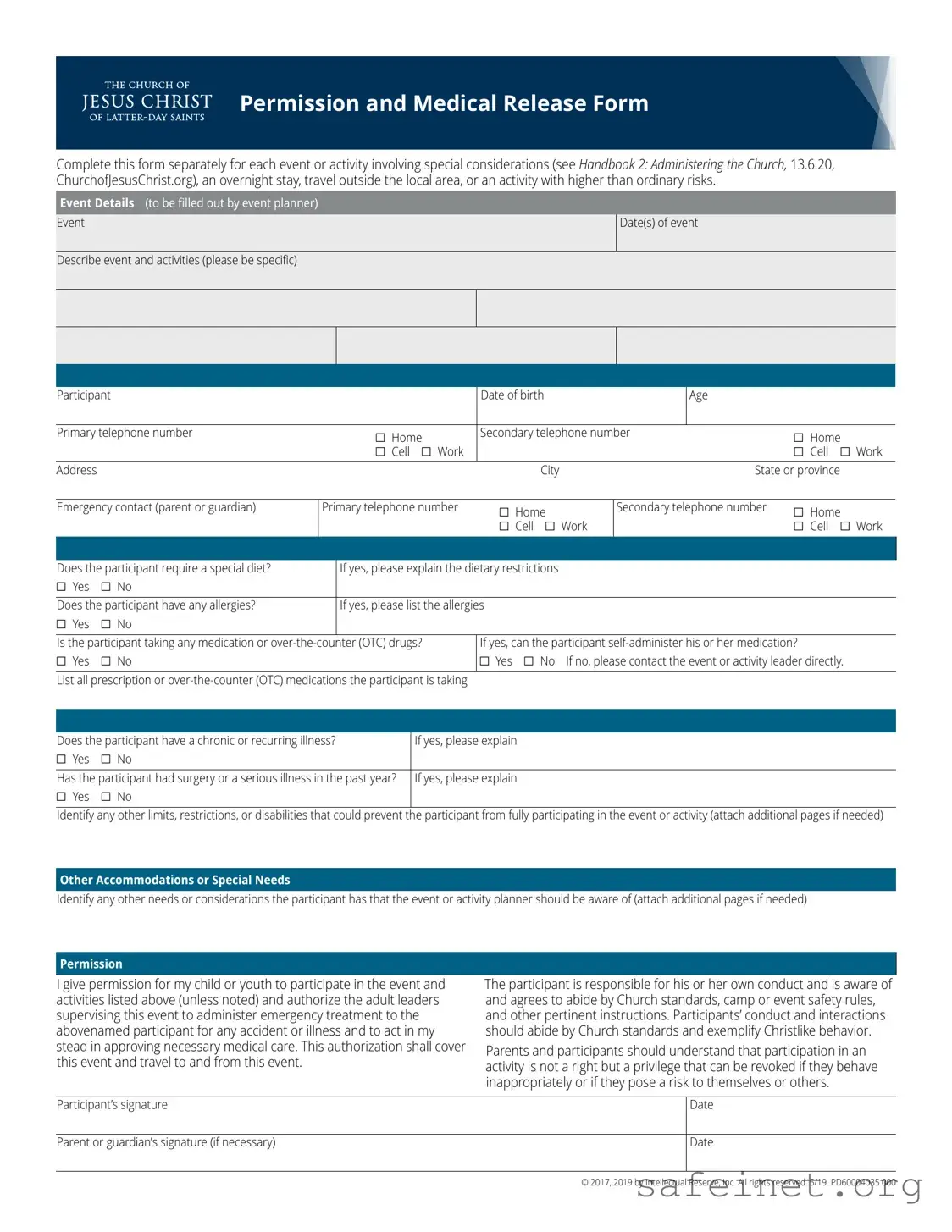
The LDS Permission and Medical Release Form serves as a crucial document for participants in various church-related events and activities. Designed to ensure the safety and well-being of minors and youth, this form must be completed for each event that involves special considerations, such as overnight stays, travel outside the local area, or activities with higher-than-normal risks. The form collects essential details about the event, including the date, description, and contact information for the event leader. It also gathers personal information about the participant, such as their date of birth, age, and emergency contact details. Important health-related questions address dietary restrictions, allergies, medications, and any chronic conditions that may affect participation. By signing the form, parents or guardians grant permission for their child to participate and authorize adult leaders to provide emergency treatment if necessary. This authorization extends to travel associated with the event. Furthermore, the form emphasizes the importance of adhering to church standards and safety rules, reminding participants that their conduct reflects their commitment to these values.

THE CHURCH OF |
|
Permission and Medical Release Form |
I |
OF |
|
||
JESUS CHRIST |
|
|
|
l
Complete this form separately for each event or activity involving special considerations (see Handbook 2: Administering the Church, 13.6.20, ChurchofJesusChrist.org), an overnight stay, travel outside the local area, or an activity with higher than ordinary risks.
Event Details (to be filled out by event planner) |
|
|
|
|
|
|
|
|
Event |
|
|
|
|
Date(s) of event |
|
|
|
|
|
|
|
|
|
|
|
|
Describe event and activities (please be specific) |
|
|
|
|
|
|
|
|
|
|
|
|
|
|
|
|
|
Ward |
|
|
|
Stake |
|
|
|
|
|
|
|
|
|
|
|
|
|
Event or activity leader |
|
Event or activity leader’s phone number |
Event or activity leader’s email |
|
|
|||
|
|
|
|
|
|
|
|
|
|
|
|
|
|
|
|
|
|
Participant |
|
|
|
Date of birth |
|
Age |
|
|
|
|
|
|
|
|
|
|
|
Primary telephone number |
|
□ Home |
Secondary telephone number |
|
□ Home |
|
||
|
|
□ Cell □ Work |
|
|
|
□ Cell □ Work |
|
|
Address |
|
|
|
City |
|
State or province |
|
|
|
|
|
|
|
|
|
|
|
Emergency contact (parent or guardian) |
Primary telephone number |
□ Home |
Secondary telephone number |
□ Home |
|
|||
|
|
|
|
□ Cell □ Work |
|
|
□ Cell □ Work |
|
|
|
|
|
|
|
|
|
|
Does the participant require a special diet? |
|
If yes, please explain the dietary restrictions |
|
|
|
|
||
□ Yes □ No |
|
|
|
|
|
|
|
|
Does the participant have any allergies? |
|
If yes, please list the allergies |
|
|
|
|
||
□ Yes □ No |
|
|
|
|
|
|
|
|
Is the participant taking any medication or |
If yes, can the participant |
|
||||||
□ Yes □ No |
|
|
|
□ Yes □ No If no, please contact the event or activity leader directly. |
|
|||
List all prescription or |
|
|
|
|
|
|||
|
|
|
|
|
|
|
||
|
|
|
|
|
|
|
||
Does the participant have a chronic or recurring illness? |
|
If yes, please explain |
|
|
|
|
||
□ Yes □ No |
|
|
|
|
|
|
|
|
Has the participant had surgery or a serious illness in the past year? |
If yes, please explain |
|
|
|
|
|||
□ Yes □ No |
|
|
|
|
|
|
|
|
Identify any other limits, restrictions, or disabilities that could prevent the participant from fully participating in the event or activity (attach additional pages if needed) |
|
|||||||
Other Accommodations or Special Needs
Identify any other needs or considerations the participant has that the event or activity planner should be aware of (attach additional pages if needed)
Permission
I give permission for my child or youth to participate in the event and activities listed above (unless noted) and authorize the adult leaders supervising this event to administer emergency treatment to the abovenamed participant for any accident or illness and to act in my stead in approving necessary medical care. This authorization shall cover this event and travel to and from this event.
The participant is responsible for his or her own conduct and is aware of and agrees to abide by Church standards, camp or event safety rules, and other pertinent instructions. Participants’ conduct and interactions should abide by Church standards and exemplify Christlike behavior. Parents and participants should understand that participation in an activity is not a right but a privilege that can be revoked if they behave inappropriately or if they pose a risk to themselves or others.
Participant’s signature
Parent or guardian’s signature (if necessary)
Date
Date
© 2017, 2019 by Intellectual Reserve, Inc. All rights reserved. 5/19. PD60004035 000
| Fact Name | Details |
|---|---|
| Purpose of the Form | The LDS Permission and Medical Release Form is designed to ensure that participants are safe and accounted for during events, especially those with special considerations or higher risks. |
| Event Specificity | This form must be completed for each event or activity that involves overnight stays, travel outside the local area, or activities that may present higher than ordinary risks. |
| Emergency Medical Authorization | By signing the form, parents or guardians grant permission for adult leaders to administer emergency treatment and make medical decisions if necessary during the event. |
| State-Specific Laws | In states like California, the governing law regarding medical consent for minors requires that a parent or guardian provide written consent for medical treatment, which this form satisfies. |
Filling out the LDS Permission and Medical Release Form is essential for ensuring that all necessary information is collected for a participant's involvement in church events. This form requires specific details about the participant, their health, and their emergency contacts. Completing this form accurately helps event leaders provide appropriate care and supervision.
What is the LDS Permission Form used for?
The LDS Permission Form is designed to ensure that parents or guardians give their consent for children and youth to participate in specific church events or activities. It covers important details about the event, the participant, and any special needs or considerations that may be necessary for safe participation. This form is particularly important for events that involve travel, overnight stays, or activities that carry higher risks.
Who needs to fill out the form?
Parents or guardians must complete the form for each child or youth participating in the event. Each event may require a separate form, especially if there are different activities or considerations involved. This ensures that all relevant information is captured for the safety and well-being of the participants.
What information is required on the form?
The form asks for various details, including the event date, description of activities, participant’s personal information (like age and contact numbers), and emergency contact details. Additionally, it inquires about dietary restrictions, allergies, medications, chronic illnesses, and any other special needs that may affect participation.
Why is it important to disclose medical information?
Disclosing medical information is crucial for ensuring the safety of participants. If a participant has allergies, takes medication, or has a chronic illness, this information helps event leaders prepare and respond appropriately in case of an emergency. It also allows for any necessary accommodations to be made, ensuring everyone can participate safely.
What happens if a participant misbehaves during the event?
Participation in church activities is considered a privilege. If a participant behaves inappropriately or poses a risk to themselves or others, event leaders have the authority to revoke that privilege. This policy helps maintain a safe and respectful environment for all attendees.
Can participants self-administer their medications?
The form asks whether participants can self-administer their medications. If they can, it allows for greater independence during the event. If they cannot, parents or guardians should communicate directly with the event leader to ensure proper care and supervision are in place.
What if a participant has special dietary needs?
If a participant has dietary restrictions, it is essential to indicate this on the form. This information helps event planners prepare meals that accommodate those needs, ensuring that all participants can enjoy the event without health concerns related to food.
Is the form necessary for all church events?
Not every church event requires a permission form. However, it is mandatory for events involving overnight stays, travel outside the local area, or activities with higher than ordinary risks. Always check with the event leader if you are unsure whether a form is needed.
How does the form protect the rights of participants?
The form includes a section where participants and their parents or guardians acknowledge that participation is a privilege. By signing, they agree to abide by Church standards and event safety rules. This mutual understanding helps foster a respectful and safe atmosphere for everyone involved.
Neglecting to fill out separate forms for different events: Many individuals mistakenly use a single form for multiple activities. Each event requires its own permission form due to varying details and considerations.
Failing to provide accurate event details: Participants often overlook the importance of specifying the event date, type of activity, and location. This information is crucial for proper planning and emergency preparedness.
Inadequate emergency contact information: Some forms lack complete contact details for a parent or guardian. Providing both primary and secondary phone numbers ensures that event leaders can reach someone in case of an emergency.
Overlooking dietary restrictions and allergies: Participants frequently skip the section on dietary needs or allergies. This can lead to serious health risks during the event if specific needs are not communicated.
Not mentioning medications: It is common for individuals to forget to list medications or fail to indicate whether a participant can self-administer. This information is vital for the safety and well-being of the participant.
Ignoring chronic illnesses or past surgeries: Some forms do not disclose chronic conditions or recent surgeries. This oversight can hinder proper care and attention during the event.
Inadequate signatures: Occasionally, forms are submitted without the necessary signatures from parents or guardians. This can render the form invalid and prevent participation in the event.
Not reviewing the form before submission: Many individuals rush through the process and submit the form without a thorough review. Taking the time to double-check can prevent mistakes and ensure all necessary information is included.
When planning events or activities, especially those involving minors, several important forms and documents may be required alongside the LDS Permission Form. Each document serves a specific purpose and helps ensure that all necessary information is collected and understood by participants and their guardians. Below are four common forms that are often used in conjunction with the LDS Permission Form.
Utilizing these forms alongside the LDS Permission Form helps create a comprehensive approach to event planning. This ensures that all parties involved are informed and prepared, fostering a safe and enjoyable experience for everyone. Always remember to review each document carefully and keep them accessible during the event.
The Medical Release Form is a document commonly used in various organizations, similar to the LDS Permission Form. It serves to authorize medical treatment for minors when parents or guardians are not present. This form typically includes sections for emergency contact information, medical history, and consent for treatment. Just like the LDS form, it emphasizes the need for clear communication about any medical conditions or allergies, ensuring that caregivers can make informed decisions in emergencies.
The Consent Form for Field Trips is another document that shares similarities with the LDS Permission Form. This form is often required by schools and organizations when students participate in off-site activities. It includes details about the trip, emergency contacts, and medical information. Both forms prioritize safety and accountability, ensuring that parents understand the risks involved and grant permission for their child’s participation.
Sports Participation Forms are frequently used by schools and athletic organizations. These documents require parents to provide consent for their children to engage in sports activities. They typically ask for medical history, emergency contacts, and any necessary waivers. Like the LDS Permission Form, these forms aim to protect both the organization and the participants by outlining expectations and responsibilities.
Summer Camp Registration Forms often include elements similar to the LDS Permission Form. These documents typically require detailed information about the camper, including medical history and emergency contacts. They also seek parental consent for participation in camp activities, ensuring that the camp staff is aware of any special needs or health concerns, much like the considerations outlined in the LDS form.
The Volunteer Release Form is another document that bears resemblance to the LDS Permission Form. Organizations often use this form to protect themselves from liability when individuals volunteer for events or activities. It usually requires volunteers to disclose any medical conditions and provides consent for emergency treatment. Both forms emphasize the importance of understanding risks and responsibilities involved in participation.
Field Trip Permission Slips are commonly used in educational settings and share similarities with the LDS Permission Form. These slips ask for parental consent for students to attend specific outings, detailing the event and any associated risks. They also typically include emergency contact information and medical considerations, ensuring that teachers and organizers are prepared for any situation that may arise.
The Parental Consent Form for Medical Treatment is another document akin to the LDS Permission Form. This form is used when a child requires medical care, and parents are not available to give consent. It includes information about the child’s medical history, allergies, and emergency contacts. Both forms aim to ensure that caregivers can act swiftly and responsibly in medical situations.
The Travel Consent Form is often required for minors traveling without their parents, resembling the LDS Permission Form in its purpose. It includes details about the travel itinerary, emergency contacts, and medical information. This document ensures that guardians authorize travel plans and are informed about the child’s health needs, similar to the considerations outlined in the LDS form.
Event Liability Waivers are also similar to the LDS Permission Form. These waivers protect organizations from legal claims in the event of an accident during an activity. They often require participants to disclose medical information and provide consent for emergency treatment. Both forms emphasize the importance of safety and informed consent, ensuring that participants understand the risks involved.
Lastly, the Youth Activity Consent Form is used by many organizations to obtain permission for minors to participate in various activities. This form typically includes sections for emergency contacts, medical history, and consent for treatment. Like the LDS Permission Form, it seeks to ensure that parents are informed and involved in their child's participation in activities that may pose risks.
When filling out the LDS Permission form, it's essential to get it right. Here’s a list of things to do and avoid:
By following these guidelines, you can help ensure a smooth experience for everyone involved.
Misconceptions about the LDS Permission Form can lead to confusion and misunderstanding. Here are seven common misconceptions clarified:
Filling out the Lds Permission form is an important step for participation in church-related activities. Here are some key takeaways to keep in mind: