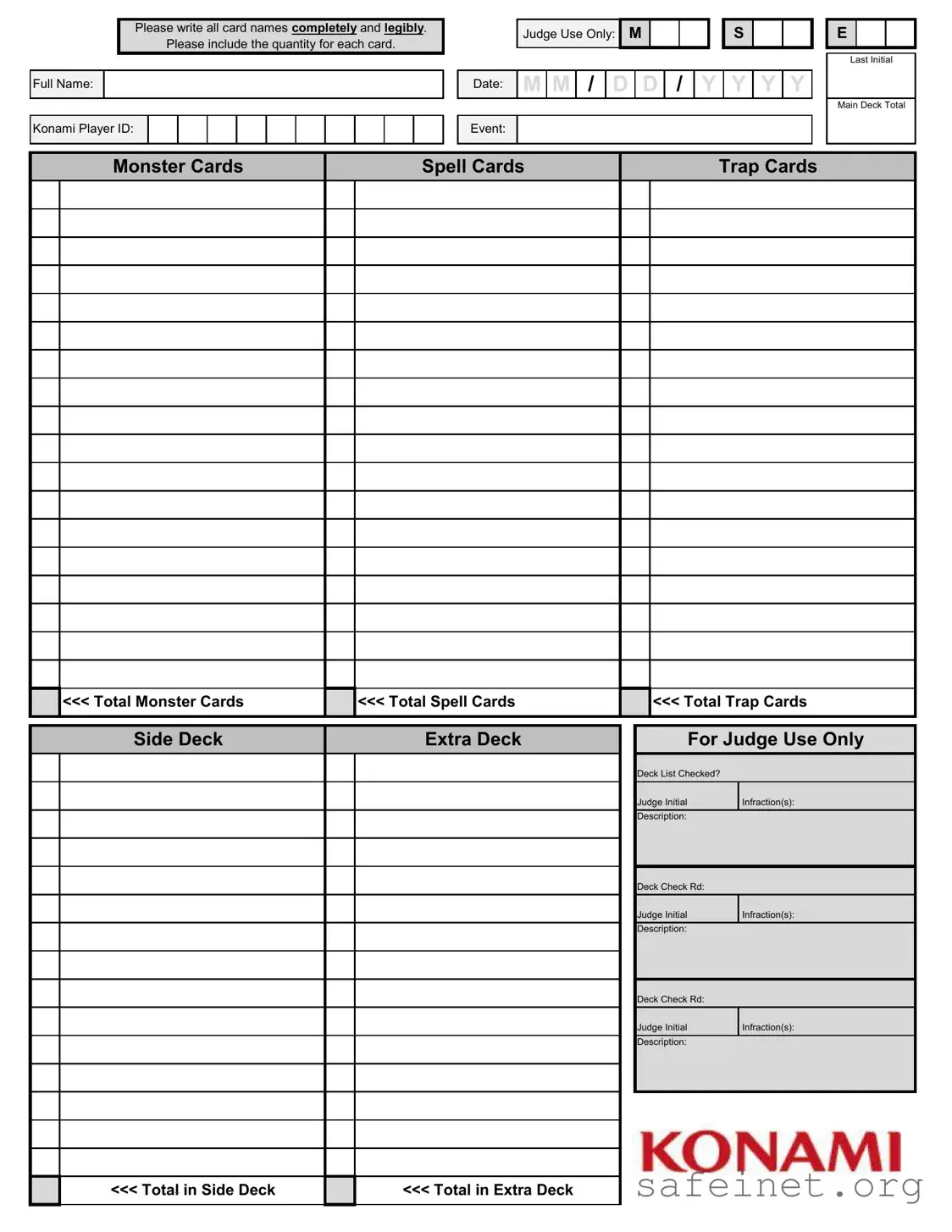
The Konami Decklist form plays a crucial role in competitive card gaming, serving as a vital tool for players and judges alike. This form ensures that all participants provide clear and complete information about their decks, which is essential for maintaining the integrity of the game. Players are required to write down the names of their cards legibly, along with the quantity of each card included in their decks. This attention to detail helps prevent misunderstandings and promotes fair play. Additionally, the form collects important player information, such as their full name and Konami Player ID, while also designating sections for judges to record any infractions or issues that may arise during deck checks. The structure of the form includes designated areas for the main deck, side deck, and extra deck, allowing for a comprehensive overview of a player’s card choices. By ensuring that all these details are captured, the Konami Decklist form supports a smooth and organized event experience for everyone involved.
Please write all card names completely and legibly.
Please include the quantity for each card.
Full Name:
Konami Player ID:
Judge Use Only: |
M |
|
|
|
S |
|
|
|
|
|
|
|
|
|
|
Date: M M / D D / Y Y Y Y
Event:
E
Last Initial
Main Deck Total
Monster Cards
Spell Cards
Trap Cards
<<< Total Monster Cards
<<< Total Spell Cards
<<< Total Trap Cards
Side Deck
Extra Deck
For Judge Use Only
Deck List Checked?
Judge Initial |
Infraction(s): |
|
|
Description: |
|
Deck Check Rd:
Judge Initial |
Infraction(s): |
Description: |
|
Deck Check Rd:
Judge Initial |
Infraction(s): |
|
|
Description: |
|
<<< Total in Side Deck
<<< Total in Extra Deck
| Fact Name | Fact Description |
|---|---|
| Card Name Requirement | All card names must be written completely and legibly on the form. |
| Quantity Specification | The quantity for each card included in the deck must be specified. |
| Personal Information | Players are required to provide their full name and Konami Player ID. |
| Judge Use Section | A section labeled "Judge Use Only" is included for judge-related notes. |
| Date Format | The date must be entered in the format of MM/DD/YYYY. |
| Event Identification | The event for which the deck is being submitted must be indicated. |
| Deck Totals | Totals for monster cards, spell cards, and trap cards must be calculated and recorded. |
| Side Deck and Extra Deck | Sections for the side deck and extra deck are provided, with totals required for both. |
| Judge Initials | Judges must initial and note any infractions during the deck check process. |
Filling out the Konami Decklist form requires attention to detail and accuracy. This form is essential for organizing your deck information during an event. Follow the steps below to ensure that all necessary information is correctly recorded.
What information do I need to include on the Konami Decklist form?
When filling out the Konami Decklist form, it’s essential to provide complete and legible card names. You must also indicate the quantity for each card. Additionally, you will need to fill in your full name, Konami Player ID, and details about the event, including the date. Make sure to specify the total counts for monster cards, spell cards, and trap cards in your main deck, as well as for your side deck and extra deck.
Why is it important to write card names legibly?
Legibility is crucial because judges need to read and verify your deck list accurately. If card names are unclear or incomplete, it can lead to confusion during deck checks. This confusion might result in penalties or disqualifications, especially if there are discrepancies between your deck and your submitted list. Clear writing ensures a smooth process and helps maintain the integrity of the event.
What happens if I make a mistake on the Decklist form?
If you notice a mistake after submitting your Decklist form, it’s important to inform a judge immediately. Depending on the nature of the mistake, they may allow you to correct it. However, significant errors could lead to penalties, so it’s best to double-check your form before submission. Always ensure that all information is accurate to avoid any complications during the event.
What do the sections for "Judge Use Only" mean?
The "Judge Use Only" sections are designated for judges to record their observations during deck checks. This includes initialing the deck list to confirm it has been checked and noting any infractions or issues that arise. These sections help maintain a record of compliance and ensure that all players adhere to the rules. Understanding this part of the form can help you appreciate the importance of following the guidelines set forth by the event organizers.
Not writing card names completely and legibly. This can lead to confusion and errors in the deck list.
Failing to include the quantity for each card. Each card must have a specified number to ensure the deck is accurately represented.
Neglecting to fill in personal information like Full Name and Konami Player ID. Missing this information can result in disqualification or inability to participate.
Forgetting to check the Judge Use Only section. This area is crucial for judges to track any infractions and ensure fair play.
Overlooking the Main Deck Total calculations. Ensure that the total number of cards in each category (Monster, Spell, Trap) adds up correctly.
Not completing the Side Deck and Extra Deck sections. These are essential for the judge to assess the full scope of your deck.
Leaving the Deck List Checked? box unchecked. This indicates whether the deck has been reviewed, which is important for compliance.
Failing to provide detailed descriptions for any infractions. Clear explanations help judges understand the context and make fair decisions.
The Konami Decklist form is essential for players in various card games, particularly in organized tournaments. However, several other documents accompany it to ensure a smooth and fair event. Below is a list of these forms, each serving a unique purpose in the tournament setting.
Each of these documents plays a vital role in the overall structure and success of a tournament. Understanding their purposes helps players navigate the competitive landscape more effectively and ensures a fair environment for everyone involved.
The first document similar to the Konami Decklist form is the Magic: The Gathering Deck Registration form. This document requires players to list their card names and quantities, ensuring that all information is clear and legible. Like the Konami Decklist, it also includes sections for player identification and event details, providing a structured format for judges to review and verify compliance with tournament rules.
Another comparable document is the Pokémon Trading Card Game Deck List. Players must fill out their card names and quantities, similar to the Konami Decklist. This form also includes fields for player information and event specifics. The purpose remains consistent: to facilitate the organization and integrity of the tournament by ensuring that all decks are properly registered and verified.
The Yu-Gi-Oh! Event Registration form shares similarities with the Konami Decklist. This document captures essential player details and requires a clear listing of card names and quantities. It serves to maintain transparency and fairness in competitive play, as it allows judges to easily assess each player's deck for adherence to tournament guidelines.
The Vanguard Deck Registration form is another document that mirrors the structure of the Konami Decklist. Participants must provide a complete list of card names and their respective quantities. The form also includes sections for player identification and event details, which aids in the efficient management of tournaments and ensures that all players comply with the rules.
The MTG Event Deck List is akin to the Konami Decklist in that it mandates players to submit a detailed account of their decks. This document requires complete and legible card names along with quantities. It also captures player information and event specifics, reinforcing the importance of accuracy and compliance in tournament settings.
Similarly, the Flesh and Blood Deck Registration form functions in a manner akin to the Konami Decklist. Players must clearly list their cards and quantities, along with personal and event information. This structured approach helps judges verify that all decks meet the necessary criteria for competitive play.
The Cardfight!! Vanguard Deck List serves a purpose similar to that of the Konami Decklist. Players are required to provide a comprehensive list of their cards and quantities. This document also includes essential player and event details, ensuring that the tournament runs smoothly and that all participants adhere to the established rules.
The Duel Masters Deck Registration form aligns closely with the Konami Decklist. It requires players to list their card names and quantities in a clear format. Additionally, it collects player identification and event information, which helps maintain the integrity of the tournament and ensures compliance with all relevant regulations.
Finally, the Gwent Deck List bears similarities to the Konami Decklist. Players must submit a detailed list of cards and their quantities, ensuring clarity and legibility. The document also includes sections for player identification and event specifics, reinforcing the importance of accurate deck registration in maintaining fair play during competitions.
When filling out the Konami Decklist form, it is important to follow certain guidelines to ensure accuracy and clarity. Here are six things you should and shouldn't do:
Misconceptions about the Konami Decklist form can lead to confusion and potential issues during tournaments. Here are four common misunderstandings:
When filling out the Konami Decklist form, attention to detail is crucial. Here are some key takeaways to ensure accuracy and compliance:
By following these guidelines, you can ensure that your Konami Decklist form is filled out correctly, which will contribute to a smoother experience during your event.