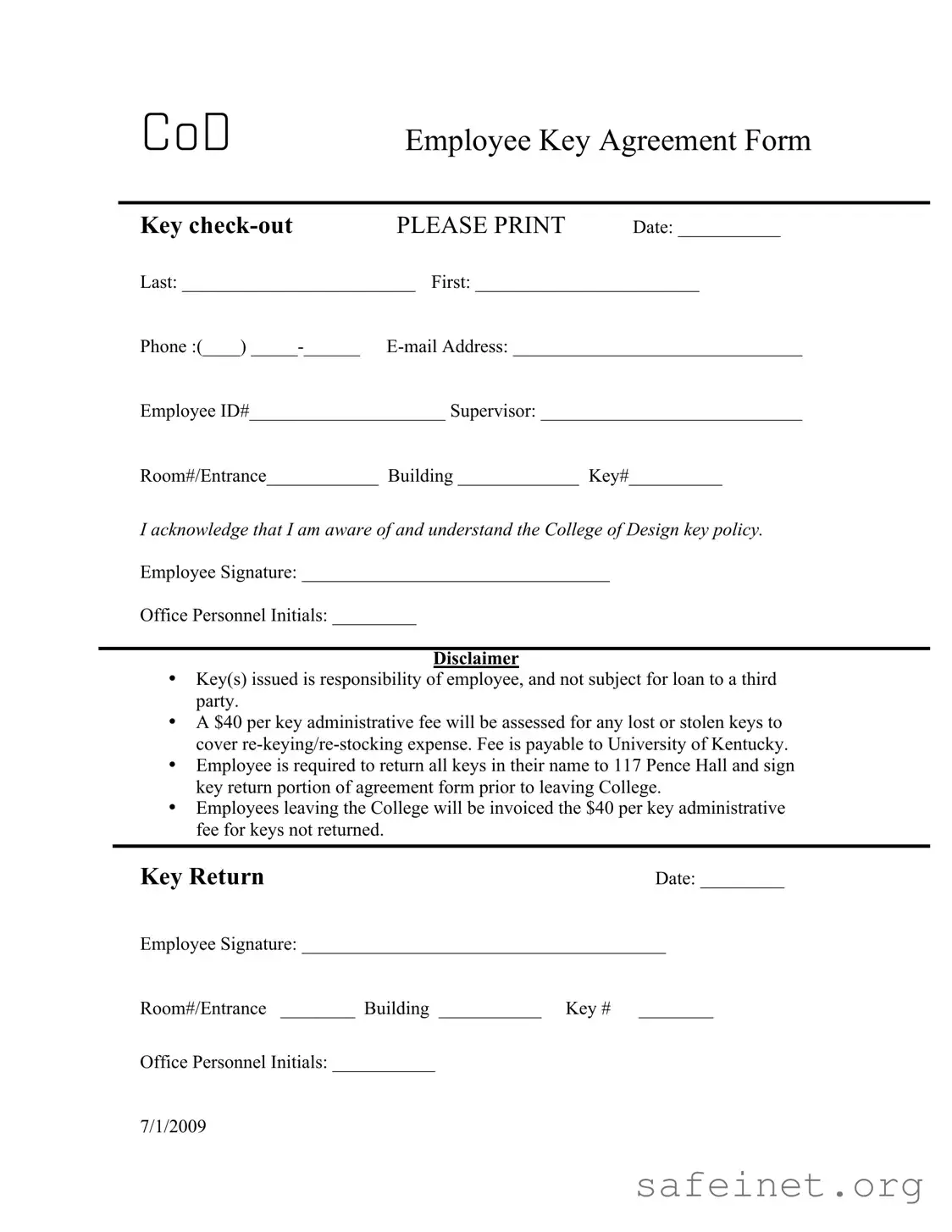
The Key Agreement form serves as a crucial document for employees at the College of Design, outlining the responsibilities and procedures associated with key issuance and return. This form requires personal information, including the employee's name, contact details, and identification number, ensuring accurate record-keeping. It highlights the importance of adhering to the College's key policy, which employees must acknowledge by signing the form. Notably, the document stipulates that the issued keys are the sole responsibility of the employee and cannot be loaned to others. In the event of a lost or stolen key, a $40 administrative fee is imposed to cover re-keying and restocking expenses, emphasizing the need for careful handling. Additionally, the form mandates that all keys must be returned to designated personnel before an employee leaves the College, reinforcing accountability. Failure to return keys will result in an invoice for the associated fees. The Key Agreement form is not merely a procedural requirement; it serves to protect both the College's assets and the integrity of its security measures.

COD
Employee Key Agreement Form
Key |
PLEASE PRINT |
Date: ___________ |
Last: _________________________ First: ________________________ |
||
Phone :(____) |
||
Employee ID#_____________________ Supervisor: ____________________________
Room#/Entrance____________ Building _____________ Key#__________
I acknowledge that I am aware of and understand the College of Design key policy.
Employee Signature: _________________________________
Office Personnel Initials: _________
Disclaimer
•Key(s) issued is responsibility of employee, and not subject for loan to a third party.
•A $40 per key administrative fee will be assessed for any lost or stolen keys to cover
•Employee is required to return all keys in their name to 117 Pence Hall and sign key return portion of agreement form prior to leaving College.
•Employees leaving the College will be invoiced the $40 per key administrative fee for keys not returned.
Key Return |
Date: _________ |
Employee Signature: _______________________________________ |
|
Room#/Entrance ________ Building ___________ Key # |
________ |
Office Personnel Initials: ___________ |
|
7/1/2009 |
|
| Fact Name | Details |
|---|---|
| Form Title | COD Employee Key Agreement Form |
| Date Requirement | The form requires the employee to provide the date of completion. |
| Employee Information | Employees must include their last name, first name, phone number, email address, and employee ID number. |
| Supervisor Information | Employees need to list their supervisor's name on the form. |
| Key Details | Information about the key, including its number and the room/entrance and building it corresponds to, must be provided. |
| Key Policy Acknowledgment | Employees must acknowledge understanding of the College of Design key policy by signing the form. |
| Lost Key Fee | A fee of $40 will be charged for any lost or stolen keys to cover re-keying or restocking expenses. |
| Key Return Requirement | All keys must be returned to 117 Pence Hall before leaving the College, and employees must sign the key return portion of the agreement. |
| Invoicing for Unreturned Keys | Employees who leave the College without returning keys will be invoiced for the administrative fee of $40 per key. |
Filling out the Key Agreement form is an important step in ensuring proper management of keys issued to employees. Once completed, the form will be submitted to the appropriate office personnel for processing. Below are the steps to guide you through the process of filling out the form accurately.
What is the Key Agreement form?
The Key Agreement form is a document that employees at the College of Design must complete when checking out keys. It outlines the responsibilities of the employee regarding the keys issued to them and includes important information about the key policy.
What information do I need to provide on the form?
You will need to provide your last name, first name, phone number, email address, employee ID number, supervisor's name, room or entrance number, building name, and the specific key number you are checking out. Ensure that all fields are filled out clearly.
What are my responsibilities as an employee regarding the keys?
As an employee, you are responsible for the keys issued to you. This means you cannot loan them to anyone else. If a key is lost or stolen, you will incur a $40 administrative fee to cover re-keying or restocking expenses.
What happens if I lose a key?
If you lose a key, you will be charged a $40 fee. This fee is intended to cover the costs associated with re-keying or replacing the key. It is important to report the loss to your supervisor as soon as possible.
How do I return the keys?
To return your keys, you must go to 117 Pence Hall and complete the key return section of the Key Agreement form. Make sure to sign it and provide the necessary details, such as the key number and your room or entrance information.
What happens if I forget to return my keys?
If you do not return your keys, you will be invoiced for the $40 administrative fee per key. It is crucial to return all keys before leaving the College to avoid these charges.
Can I borrow keys from other employees?
No, you cannot borrow keys from other employees. Each key is assigned to a specific individual, and sharing or loaning keys is against the key policy.
Where can I find more information about the key policy?
For more information about the key policy, you should contact your supervisor or the administrative office at the College of Design. They can provide you with the necessary details and answer any further questions you may have.
Failing to print clearly when filling out the form can lead to misunderstandings or errors in processing.
Not including the date on the form can cause confusion regarding when the keys were issued.
Leaving out the employee ID number can complicate tracking and accountability for the keys.
Neglecting to provide accurate contact information, such as phone number and email address, makes it difficult for the college to reach the employee if needed.
Overlooking the supervisor's name can lead to issues with authorization and key distribution.
Not signing the form can render it invalid, as the employee's acknowledgment of the key policy is crucial.
Failing to return keys to the designated location before leaving the college can result in unnecessary fees and complications.
Ignoring the administrative fee for lost or stolen keys can lead to unexpected financial obligations.
The Key Agreement form is a crucial document for employees who are issued keys to access specific areas within an organization. Along with this form, several other documents and forms are often utilized to ensure proper management and accountability regarding key issuance and return. Below is a list of these related documents.
These documents collectively support the effective management of key distribution and return, ensuring accountability and security within the organization.
The Employee Key Agreement form is similar to a Rental Agreement. Both documents establish terms and conditions regarding the use of property, whether it be keys or rental units. They outline the responsibilities of the individual receiving the property, including the obligation to return it in good condition. In both cases, there are penalties for loss or damage, ensuring accountability and protecting the interests of the issuing party.
Another document that shares similarities is the Equipment Checkout Form. This form also requires individuals to acknowledge their responsibility for the items they borrow. Just like the Key Agreement, it includes details such as the item description, checkout date, and return date. Both forms emphasize the importance of returning the items and may impose fees for lost or damaged equipment.
The Non-Disclosure Agreement (NDA) is another comparable document. While it deals with confidential information rather than physical items, both agreements require signatures to confirm understanding and acceptance of responsibilities. Each document serves to protect the interests of the organization, ensuring that sensitive information or property is not misused or disclosed without permission.
Similar to the Key Agreement is the Access Control Agreement. This document outlines the terms under which an individual can access certain areas or resources. Both agreements require individuals to acknowledge their understanding of policies and procedures related to access. They also specify the consequences of failing to adhere to these terms, reinforcing the importance of compliance.
The Loan Agreement is yet another document that bears resemblance to the Key Agreement. It details the terms under which an item is loaned, including the responsibilities of the borrower. Both agreements require the borrower to return the item in its original condition and may include financial penalties for any loss or damage incurred during the loan period.
The User Agreement for software access is also similar in nature. Both documents require users to agree to specific terms before gaining access to resources. They outline the responsibilities of the user, including adherence to policies and potential penalties for misuse. Both agreements serve to protect the organization’s assets and ensure proper usage.
The Facility Use Agreement shares key characteristics with the Key Agreement. Both documents establish rules and guidelines for using a facility or resource. They require the individual to acknowledge their understanding of these rules and may impose fees for any violations or damages incurred during the use period. Each document aims to ensure responsible use and protect the facility’s integrity.
The Service Agreement also bears similarities. This document outlines the terms under which services will be provided, including responsibilities and expectations. Like the Key Agreement, it requires a signature to confirm understanding and acceptance of the terms. Both documents aim to protect the interests of the parties involved and ensure accountability.
Lastly, the Membership Agreement is comparable. This document outlines the terms of membership in an organization or group, including rights and responsibilities. Both agreements require individuals to acknowledge their understanding of policies and procedures, and they may include penalties for non-compliance. Each serves to protect the organization and its members by establishing clear expectations.
When filling out the Key Agreement form, it is essential to follow specific guidelines to ensure accuracy and compliance. Below is a list of things to do and avoid:
Here are six misconceptions about the Key Agreement form:
This is incorrect. The form clearly states that the keys issued are the responsibility of the employee and cannot be loaned to a third party.
In reality, a $40 administrative fee will be charged for any lost or stolen keys. This fee covers the costs associated with re-keying and restocking.
Employees must return all keys before leaving the College. Failure to do so will result in an invoice for the $40 fee per key not returned.
The form requires employees to acknowledge their understanding of the College of Design key policy. Compliance is mandatory.
All employees who are issued keys must sign the Key Agreement form, regardless of their position or role within the College.
The return process is formal. Employees must return keys to 117 Pence Hall and sign the key return portion of the agreement form.
When filling out and using the Key Agreement form, keep the following key takeaways in mind: