In the realm of estate planning, ensuring a smooth transition of assets can significantly ease the burden on loved ones during a difficult time. One effective tool available to Kentucky residents is the Transfer-on-Death (TOD) Deed form. This unique legal document allows property owners to designate a beneficiary who will automatically receive the property upon the owner’s death, bypassing the often lengthy and costly probate process. By using the TOD Deed, individuals can maintain control over their property during their lifetime while providing clarity and certainty for their heirs. The form is straightforward and typically requires basic information, including the property’s legal description and the designated beneficiary’s details. Importantly, the TOD Deed must be properly executed and recorded to be valid, ensuring that the owner's intentions are honored without complications. Understanding how this form works and the benefits it offers can empower property owners to make informed decisions that reflect their wishes for the future.
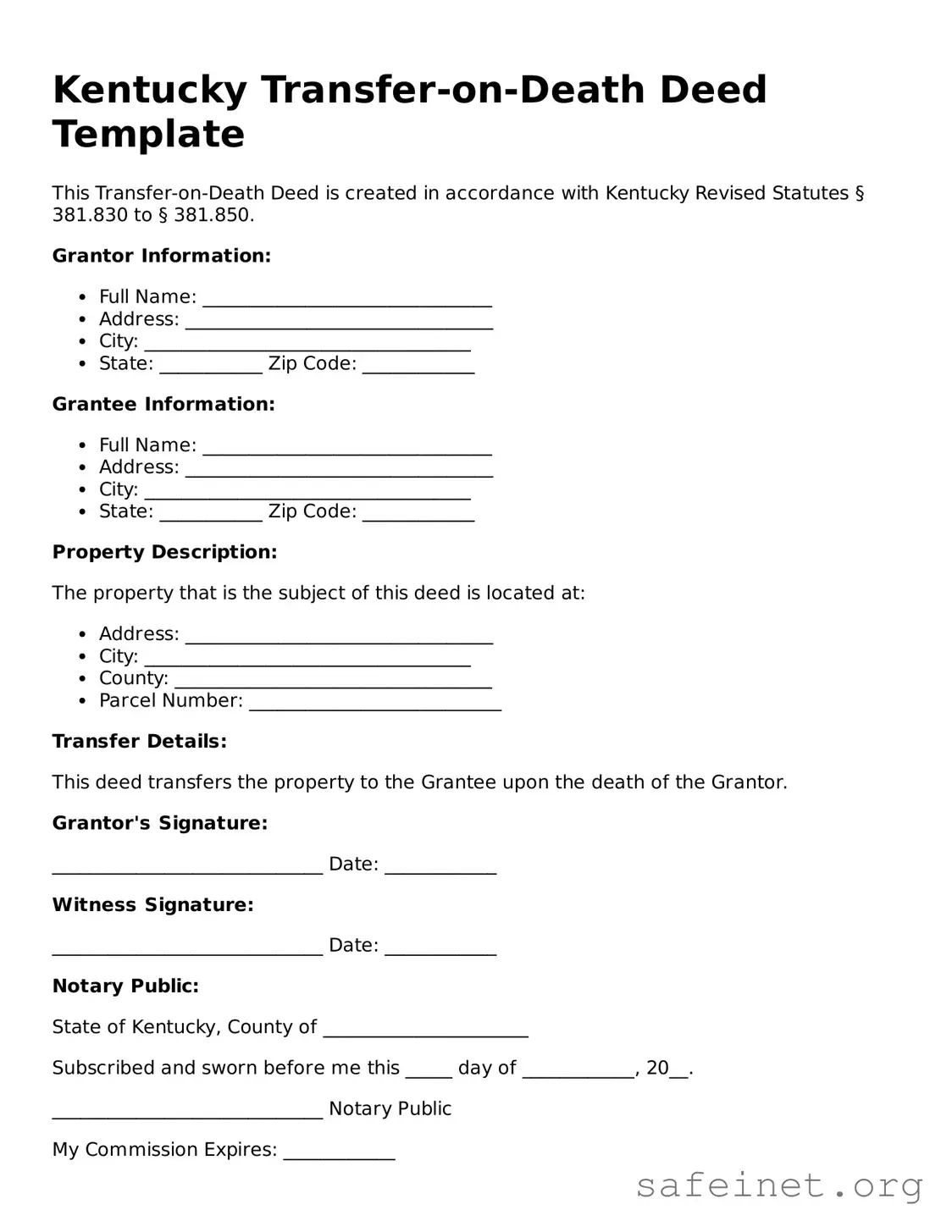
Kentucky Transfer-on-Death Deed Template
This Transfer-on-Death Deed is created in accordance with Kentucky Revised Statutes § 381.830 to § 381.850.
Grantor Information:
Grantee Information:
Property Description:
The property that is the subject of this deed is located at:
Transfer Details:
This deed transfers the property to the Grantee upon the death of the Grantor.
Grantor's Signature:
_____________________________ Date: ____________
Witness Signature:
_____________________________ Date: ____________
Notary Public:
State of Kentucky, County of ______________________
Subscribed and sworn before me this _____ day of ____________, 20__.
_____________________________ Notary Public
My Commission Expires: ____________
| Fact Name | Details |
|---|---|
| Definition | A Transfer-on-Death Deed allows property owners to transfer real estate to beneficiaries upon their death without going through probate. |
| Governing Law | Kentucky Revised Statutes, Chapter 381.705 to 381.730 outlines the legal framework for Transfer-on-Death Deeds in Kentucky. |
| Eligibility | Any individual who owns real property in Kentucky can create a Transfer-on-Death Deed. |
| Revocation | The property owner can revoke the deed at any time before their death by executing a new deed or a written revocation. |
| Beneficiary Rights | Beneficiaries have no rights to the property until the death of the owner; they cannot sell or mortgage the property during the owner's lifetime. |
| Filing Requirement | The deed must be recorded in the county where the property is located to be effective. |
After you have gathered all necessary information, you are ready to fill out the Kentucky Transfer-on-Death Deed form. This form allows you to designate a beneficiary who will receive your property upon your passing, without the need for probate. Follow these steps carefully to ensure that the form is completed correctly.
What is a Transfer-on-Death Deed in Kentucky?
A Transfer-on-Death Deed (TOD Deed) in Kentucky allows a property owner to transfer real estate to a designated beneficiary upon their death. This deed does not take effect until the owner's death, allowing the owner to retain full control of the property during their lifetime.
Who can use a Transfer-on-Death Deed?
Any individual who owns real estate in Kentucky can use a Transfer-on-Death Deed. This includes homeowners and property owners. However, it is essential to ensure that the property is not subject to any liens or other encumbrances that could complicate the transfer.
How do I create a Transfer-on-Death Deed?
To create a TOD Deed, you must fill out the appropriate form with details such as the property description, your name as the grantor, and the beneficiary's name. After completing the form, you must sign it in front of a notary public and then record it with the county clerk's office where the property is located.
Can I change the beneficiary on a Transfer-on-Death Deed?
Yes, you can change the beneficiary at any time before your death. To do this, you must create a new Transfer-on-Death Deed that names the new beneficiary and record it with the county clerk. The previous deed will be revoked once the new deed is recorded.
Is there a cost associated with recording a Transfer-on-Death Deed?
Yes, there is typically a fee for recording a Transfer-on-Death Deed. The fee varies by county, so it is advisable to check with your local county clerk's office for the exact amount.
What happens if I do not record the Transfer-on-Death Deed?
If you do not record the Transfer-on-Death Deed, it will not be effective upon your death. The property will be treated as part of your estate, and it will go through the probate process. This could lead to delays and additional costs for your heirs.
Can a Transfer-on-Death Deed be contested?
Yes, a Transfer-on-Death Deed can be contested, similar to a will. If someone believes they have a valid claim to the property or that the deed was executed under duress or without proper understanding, they may challenge it in court.
Does a Transfer-on-Death Deed affect my taxes?
A Transfer-on-Death Deed does not affect your property taxes while you are alive. However, upon your death, the property may receive a step-up in basis, which could affect capital gains taxes for the beneficiary when they sell the property.
What if I have multiple properties?
You can create a separate Transfer-on-Death Deed for each property you own. Each deed must be recorded individually, and you can designate different beneficiaries for each property if desired.
Is legal assistance recommended when creating a Transfer-on-Death Deed?
While it is possible to create a Transfer-on-Death Deed without legal assistance, it is often wise to consult with an attorney. They can help ensure that the deed is completed correctly and that it aligns with your overall estate planning goals.
Failing to include the correct property description. It's essential to provide a clear and accurate description of the property being transferred. Without this, the deed may be invalid.
Not signing the deed in front of a notary. The Kentucky Transfer-on-Death Deed must be notarized to be legally binding. Skipping this step can lead to complications.
Overlooking the need for witnesses. In Kentucky, at least two witnesses are required to sign the deed. Missing this requirement can invalidate the transfer.
Using outdated forms. Laws and requirements can change, so it's crucial to ensure you're using the most current version of the Transfer-on-Death Deed form.
Neglecting to record the deed. After completing the deed, it must be filed with the appropriate county clerk's office. Failing to do so means the transfer won't be recognized.
Not considering tax implications. It's wise to consult a tax professional about any potential tax consequences that may arise from transferring property through a Transfer-on-Death Deed.
The Kentucky Transfer-on-Death Deed form allows property owners to designate beneficiaries to receive their property upon their death without going through probate. However, several other documents often accompany this deed to ensure a smooth transfer process and to clarify intentions. Understanding these documents is crucial for anyone considering this option.
Each of these documents plays a vital role in ensuring that the property transfer process is seamless and legally sound. Consulting with a legal expert can help clarify any questions and guide you through the necessary steps for a successful transfer of property in Kentucky.
The Kentucky Transfer-on-Death Deed form shares similarities with a Last Will and Testament. Both documents allow individuals to dictate how their property will be distributed upon their death. However, a key difference lies in the timing of the transfer. A Last Will takes effect only after probate, which can be a lengthy and public process. In contrast, a Transfer-on-Death Deed allows property to transfer directly to the designated beneficiary without going through probate, ensuring a quicker and more private transition of ownership.
An Affidavit of Heirship is another document comparable to the Transfer-on-Death Deed. It serves to establish the heirs of a deceased person when there is no will. While an Affidavit can simplify the transfer of property, it often requires additional steps to prove the heirs' rights. The Transfer-on-Death Deed, on the other hand, provides a clear, pre-determined path for property transfer, eliminating disputes among potential heirs and simplifying the process for all parties involved.
The General Power of Attorney (POA) can also be compared to the Transfer-on-Death Deed. A POA allows an individual to designate someone to make decisions on their behalf while they are alive. This can include managing property and financial matters. However, a POA ceases to be effective upon the individual's death, whereas the Transfer-on-Death Deed specifically addresses property transfer after death, ensuring that the designated beneficiary receives the property without delay.
A Joint Tenancy with Right of Survivorship (JTWROS) is another document that functions similarly to the Transfer-on-Death Deed. Both allow for the seamless transfer of property upon death. In a JTWROS, two or more individuals own the property together, and upon the death of one owner, their share automatically passes to the surviving owner(s). The Transfer-on-Death Deed, however, allows for a single owner to designate a beneficiary without requiring co-ownership, providing more flexibility in estate planning.
Finally, the Beneficiary Designation form is akin to the Transfer-on-Death Deed, particularly in relation to financial accounts and insurance policies. Both documents allow individuals to specify who will receive their assets upon death. However, while a Beneficiary Designation applies primarily to accounts and policies, the Transfer-on-Death Deed specifically addresses real property. This distinction makes the Transfer-on-Death Deed a more targeted tool for real estate transfer, while Beneficiary Designations cover a broader range of assets.
When filling out the Kentucky Transfer-on-Death Deed form, it is essential to approach the task with care and attention. Here are some important do's and don'ts to keep in mind:
By following these guidelines, you can help ensure a smoother process when filling out the Transfer-on-Death Deed form in Kentucky. Your attention to detail can make a significant difference in the outcome of your estate planning efforts.
The Kentucky Transfer-on-Death Deed (TOD) form can be a valuable tool for estate planning, yet several misconceptions surround its use. Understanding these misconceptions can help individuals make informed decisions about their property and beneficiaries. Here are eight common misunderstandings:
By dispelling these misconceptions, individuals can better understand the benefits and limitations of the Kentucky Transfer-on-Death Deed, ultimately leading to more effective estate planning.
Filling out and using the Kentucky Transfer-on-Death Deed form can be a straightforward process if you keep the following key points in mind: