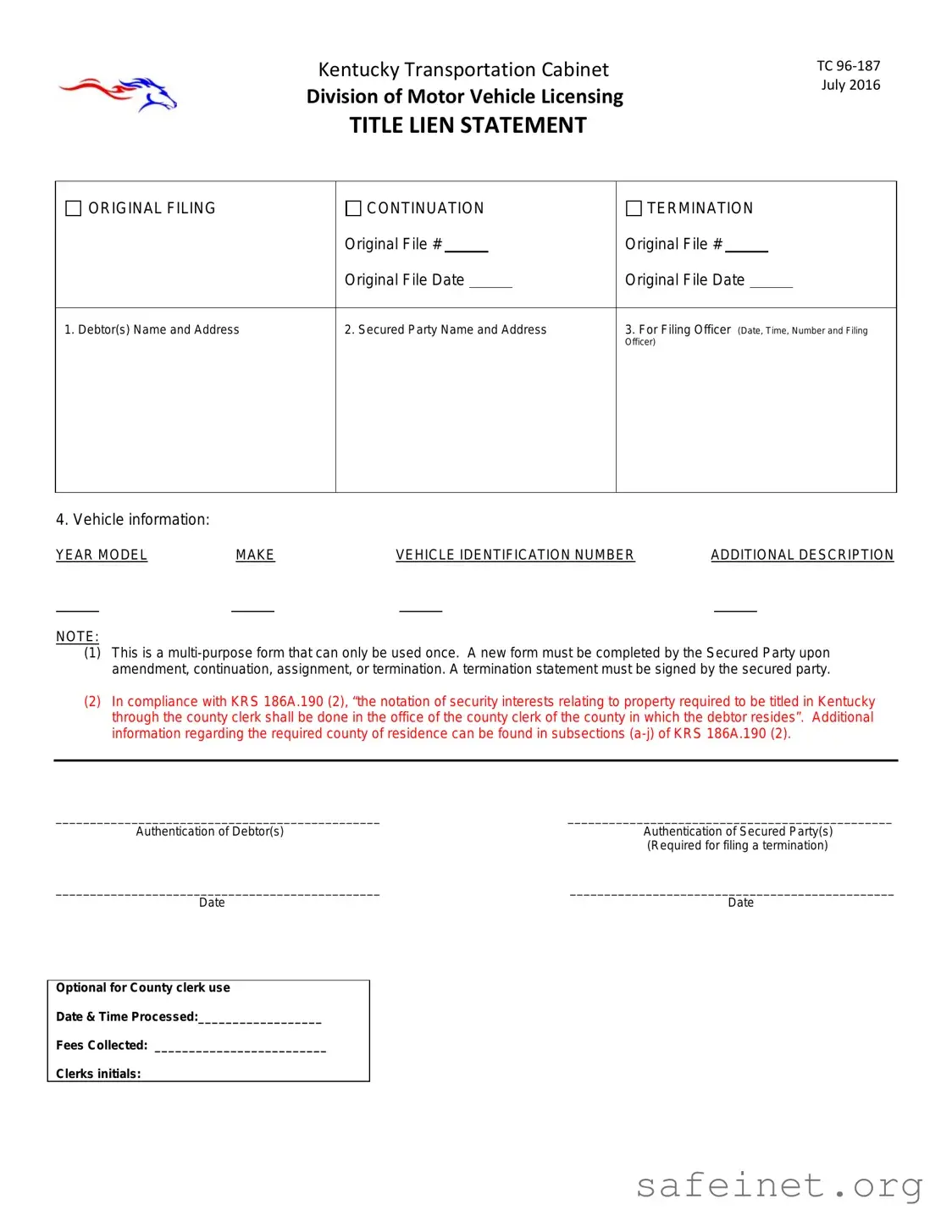
The Kentucky TC 96 187 form is an essential document for anyone involved in securing a lien on a vehicle in the state of Kentucky. This multi-purpose form serves several functions, including the original filing of a lien, continuation of an existing lien, and termination of a lien. It requires specific information, such as the names and addresses of both the debtor and the secured party, as well as detailed vehicle information like the year, model, make, and vehicle identification number. Proper completion of this form is critical, as it must be filed with the county clerk's office in the county where the debtor resides. Notably, the form can only be used once for each transaction, meaning that any amendments or changes will necessitate the completion of a new form. Additionally, the secured party must sign a termination statement when a lien is no longer in effect. Understanding the requirements and processes associated with the TC 96 187 form can help ensure that all parties involved are protected and that their interests are properly documented.

Kentucky Transportation Cabinet |
TC 96‐187 |
Division of Motor Vehicle Licensing |
July 2016 |
|
TITLE LIEN STATEMENT
ORIGINAL FILING |
CONTINUATION |
TERMINATION |
||||||||
|
Original File # |
|
|
Original File # |
|
|
||||
|
Original File Date |
|
|
Original File Date |
|
|
||||
|
|
|
||||||||
1. Debtor(s) Name and Address |
2. Secured Party Name and Address |
3. For Filing Officer (Date, Time, Number and Filing |
||||||||
|
|
|
|
|
|
Officer) |
||||
|
|
|
|
|
|
|
|
|
|
|
4. Vehicle information:
YEAR MODEL |
MAKE |
VEHICLE IDENTIFICATION NUMBER |
ADDITIONAL DESCRIPTION |
NOTE:
(1)This is a
(2)In compliance with KRS 186A.190 (2), “the notation of security interests relating to property required to be titled in Kentucky through the county clerk shall be done in the office of the county clerk of the county in which the debtor resides”. Additional information regarding the required county of residence can be found in subsections
_______________________________________________ |
_______________________________________________ |
Authentication of Debtor(s) |
Authentication of Secured Party(s) |
|
(Required for filing a termination) |
_______________________________________________ |
_______________________________________________ |
Date |
Date |
Optional for County clerk use
Date & Time Processed:__________________
Fees Collected: _________________________
Clerks initials:
| Fact Name | Details |
|---|---|
| Purpose of the Form | The Kentucky TC 96-187 form is used to file a title lien statement for vehicles in Kentucky. It can be utilized for original filings, continuations, or terminations of liens. |
| Governing Law | This form is governed by KRS 186A.190 (2), which outlines the requirements for filing security interests related to titled property in Kentucky. |
| Filing Requirements | Each lien statement must be filed in the county clerk's office where the debtor resides. The form must be completed by the secured party and signed for termination filings. |
| Form Limitations | The TC 96-187 is a one-time use form. Any amendments or changes require a new form to be completed by the secured party. |
Completing the Kentucky TC 96-187 form is essential for filing a lien statement related to vehicle ownership. After filling out the form, it will need to be submitted to the appropriate county clerk’s office for processing.
What is the Kentucky TC 96 187 form used for?
The Kentucky TC 96 187 form is a Title Lien Statement used to file, continue, or terminate a lien on a vehicle. It serves to notify interested parties of the secured party's interest in the vehicle, ensuring that the lien is officially recorded with the county clerk.
Who needs to fill out the TC 96 187 form?
The secured party, typically a lender or financial institution, is responsible for completing the TC 96 187 form. This form must be filled out whenever a lien is established, amended, continued, or terminated.
What information is required on the TC 96 187 form?
The form requires the names and addresses of both the debtor and the secured party. Additionally, it asks for vehicle information, including the year, model, make, and vehicle identification number (VIN). The original file number and date are also necessary for processing.
Can the TC 96 187 form be used multiple times?
No, the TC 96 187 form is a one-time-use document. A new form must be completed for any amendments, continuations, assignments, or terminations of the lien.
What is the process for terminating a lien using the TC 96 187 form?
To terminate a lien, the secured party must sign the termination statement on the TC 96 187 form. This signed form should then be filed with the county clerk in the debtor's county of residence.
Where should the TC 96 187 form be filed?
The form must be filed in the office of the county clerk in the county where the debtor resides. This is in accordance with KRS 186A.190 (2), which outlines the requirements for recording security interests in Kentucky.
What happens if the TC 96 187 form is not filed?
If the TC 96 187 form is not filed, the secured party may lose their legal claim to the vehicle. This could result in complications during the sale or transfer of the vehicle, as potential buyers may not be aware of the existing lien.
Are there any fees associated with filing the TC 96 187 form?
Yes, there are fees associated with filing the TC 96 187 form. The exact amount can vary by county, so it is advisable to check with the local county clerk’s office for specific fee information.
Is there a specific timeframe for filing the TC 96 187 form?
While there is no strict deadline for filing the TC 96 187 form, it is recommended to file it as soon as possible after the lien is established. Prompt filing helps protect the secured party's interest in the vehicle.
Incomplete Information: One of the most common mistakes is failing to provide complete information in the required fields. Ensure that all sections, including the debtor's name and address, are filled out accurately.
Incorrect Vehicle Identification Number (VIN): Double-check the VIN for accuracy. An incorrect VIN can lead to significant delays or even rejection of the form.
Not Using the Latest Version: Always use the most recent version of the TC 96-187 form. Using outdated forms can result in processing issues.
Missing Signatures: Ensure that all required signatures are present. The form requires authentication from both the debtor(s) and the secured party(s), especially for termination filings.
Filing in the Wrong County: According to Kentucky law, the filing must occur in the county where the debtor resides. Failing to comply can lead to complications in securing the lien.
Ignoring Fees: Be aware of any fees associated with the filing. Omitting payment details can delay processing or result in rejection.
Not Keeping Copies: Always retain copies of the completed form for your records. This can be invaluable for future reference or in case of disputes.
Overlooking Additional Descriptions: If there are any additional descriptions of the vehicle, be sure to include them. This can help clarify details and prevent misunderstandings.
The Kentucky TC 96-187 form is crucial for documenting a lien on a vehicle. However, several other forms and documents often accompany it to ensure proper compliance with state regulations. Each of these documents serves a specific purpose in the lien process and can help clarify the rights and responsibilities of the parties involved.
Understanding these accompanying documents is essential for anyone involved in the lien process in Kentucky. Each form plays a vital role in protecting the interests of both debtors and secured parties, ensuring that all transactions are documented accurately and legally.
The Kentucky TC 96-187 form is similar to the UCC-1 Financing Statement. Both documents are used to establish a security interest in personal property. The UCC-1 is filed at the state level and serves to notify creditors about a secured party's interest in the debtor's assets. Like the TC 96-187, the UCC-1 requires information about the debtor and secured party, as well as a description of the collateral. Both forms must be properly completed and filed to protect the rights of the secured party.
Another document similar to the TC 96-187 is the UCC-3 Financing Statement Amendment. This form is used to amend, continue, or terminate a previously filed UCC-1 statement. Like the TC 96-187, the UCC-3 requires specific information about the original filing and the parties involved. It is important to file the UCC-3 to keep the public record accurate and up-to-date, just as the TC 96-187 must be updated for any changes in the security interest.
The Vehicle Title Application is also comparable to the TC 96-187. This form is used to apply for a title for a vehicle in Kentucky. While the TC 96-187 focuses on the lien aspect, the Vehicle Title Application includes details about ownership and vehicle identification. Both documents are essential in the process of vehicle ownership and financing, ensuring that all parties are informed of any liens or claims against the vehicle.
The Notice of Lien is another document that shares similarities with the TC 96-187. This notice is filed to inform third parties that a lien exists on a debtor's property. Like the TC 96-187, the Notice of Lien includes details about the debtor and the secured party, as well as a description of the property. Both documents serve to protect the interests of the secured party by making their claim known to others.
The Termination Statement is closely related to the TC 96-187 as well. This document is filed to officially terminate a security interest in a vehicle. While the TC 96-187 is used to establish a lien, the Termination Statement serves to release that lien once the debt has been satisfied. Both forms require the signatures of the secured party, ensuring that the process is documented and legally binding.
The Security Agreement is another document that complements the TC 96-187. This agreement outlines the terms of the loan or credit arrangement between the debtor and secured party. It details the obligations of both parties and specifies the collateral involved. While the TC 96-187 is used to file the lien, the Security Agreement lays the groundwork for that lien by defining the relationship and responsibilities of the parties.
The Lien Release form is similar to the TC 96-187 in that it serves to remove a lien from public record. Once a debt is paid, the secured party files this form to notify others that the lien has been satisfied. Just as the TC 96-187 must be filed to establish a lien, the Lien Release form must be filed to officially terminate it, ensuring clarity and transparency in ownership.
The Certificate of Title is another important document that relates to the TC 96-187. This certificate serves as proof of ownership for a vehicle. While the TC 96-187 focuses on the lien aspect, the Certificate of Title provides a complete picture of ownership and any existing liens. Both documents are essential in the transfer and management of vehicle ownership, protecting the rights of all parties involved.
Lastly, the Assignment of Lien form is similar to the TC 96-187 as it allows a secured party to transfer their interest in a lien to another party. This document must include details about the original lien and the new secured party. Like the TC 96-187, the Assignment of Lien ensures that all parties are aware of the current status of the lien, maintaining the integrity of the public record.
When filling out the Kentucky TC 96-187 form, it’s important to be thorough and accurate. Here are some guidelines to help you navigate the process.
By following these steps, you can ensure that your filing is correct and compliant with Kentucky regulations. Taking the time to carefully complete the form can help avoid delays and complications in the future.
When it comes to the Kentucky TC 96 187 form, there are several misconceptions that can lead to confusion. Here are five common misunderstandings:
Understanding these misconceptions can help ensure that you complete the TC 96 187 form accurately and in compliance with Kentucky law.
Filling out and using the Kentucky TC 96-187 form involves several important steps and considerations. Below are key takeaways to keep in mind:
Understanding these points will help ensure that the form is filled out correctly and submitted in accordance with Kentucky regulations.