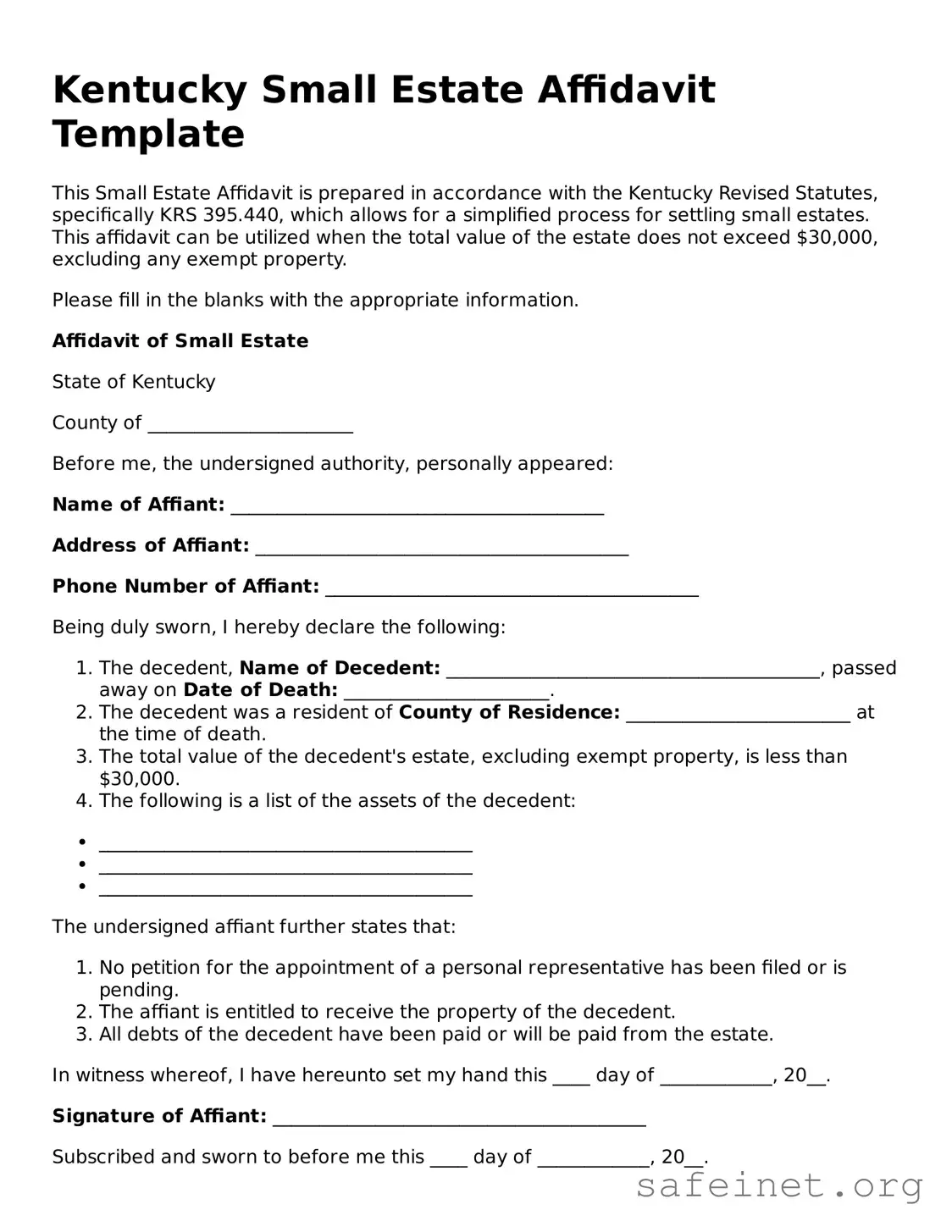
The Kentucky Small Estate Affidavit form serves as a streamlined process for settling the estates of deceased individuals with limited assets. This form is particularly beneficial for heirs who wish to avoid the lengthy and costly probate process. In Kentucky, individuals can utilize this affidavit when the total value of the estate does not exceed a specific threshold, making it accessible for many families facing the loss of a loved one. By completing the Small Estate Affidavit, heirs can claim personal property, bank accounts, and other assets without the need for formal court proceedings. This document requires essential information, including the decedent's details, a list of assets, and the names of the heirs. Additionally, the affidavit must be signed and notarized, ensuring its validity and legal standing. Understanding the requirements and implications of the Small Estate Affidavit can significantly ease the burden during a challenging time, allowing families to focus on healing while efficiently managing their loved one's estate.
Kentucky Small Estate Affidavit Template
This Small Estate Affidavit is prepared in accordance with the Kentucky Revised Statutes, specifically KRS 395.440, which allows for a simplified process for settling small estates. This affidavit can be utilized when the total value of the estate does not exceed $30,000, excluding any exempt property.
Please fill in the blanks with the appropriate information.
Affidavit of Small Estate
State of Kentucky
County of ______________________
Before me, the undersigned authority, personally appeared:
Name of Affiant: ________________________________________
Address of Affiant: ________________________________________
Phone Number of Affiant: ________________________________________
Being duly sworn, I hereby declare the following:
The undersigned affiant further states that:
In witness whereof, I have hereunto set my hand this ____ day of ____________, 20__.
Signature of Affiant: ________________________________________
Subscribed and sworn to before me this ____ day of ____________, 20__.
Notary Public: ________________________________________
My Commission Expires: ________________________
| Fact Name | Description |
|---|---|
| Purpose | The Kentucky Small Estate Affidavit allows heirs to claim property without going through probate. |
| Eligibility | The total value of the estate must be less than $30,000 for individuals or $60,000 for married couples. |
| Governing Law | Kentucky Revised Statutes, Chapter 391.030 governs the use of the Small Estate Affidavit. |
| Required Information | The form requires details about the deceased, including their name, date of death, and a list of assets. |
| Signature Requirement | The affidavit must be signed by all heirs entitled to the estate. |
| Filing Process | No court filing is necessary; the affidavit can be presented to financial institutions or other entities holding the deceased's assets. |
| Notarization | The affidavit must be notarized to ensure its authenticity. |
| Time Limit | There is no specific time limit to file the Small Estate Affidavit after the death of the individual. |
| Limitations | This process cannot be used for real estate; a different procedure is required for transferring real property. |
After gathering the necessary information and documents, you are ready to fill out the Kentucky Small Estate Affidavit form. This form will help you manage the estate of a deceased person without going through the full probate process. Follow these steps carefully to ensure that you complete the form accurately.
Once you have completed the form, you will need to file it with the appropriate court along with any required supporting documents. Be sure to keep copies for your records.
What is the Kentucky Small Estate Affidavit?
The Kentucky Small Estate Affidavit is a legal document that allows individuals to settle the estate of a deceased person without going through the lengthy and often expensive probate process. This form is particularly useful for estates that fall below a certain value threshold, making it easier for heirs to claim their inheritance quickly and efficiently.
Who is eligible to use the Small Estate Affidavit?
In Kentucky, the Small Estate Affidavit can be used by heirs or beneficiaries of an estate where the total value of the estate's assets does not exceed $30,000. This limit applies to estates without real property. If the estate includes real property, the limit is $60,000. It’s important to ensure that you meet these criteria before proceeding with the affidavit.
What assets can be included in the Small Estate Affidavit?
The affidavit can include various types of assets, such as bank accounts, personal property, and certain investments. However, it generally excludes real estate unless the total value of the estate is under the specified limits. Always assess the types of assets involved to determine if they qualify.
How do I complete the Small Estate Affidavit?
To complete the Small Estate Affidavit, you must fill out the form with accurate information about the deceased, the heirs, and the assets involved. You will need to provide details such as the name of the deceased, their date of death, and a description of the assets. After completing the form, it must be signed in front of a notary public.
Do I need to file the Small Estate Affidavit with the court?
No, you do not need to file the Small Estate Affidavit with the court. Instead, you present it directly to institutions or individuals holding the deceased's assets, such as banks or insurance companies. They will use the affidavit to release the assets to the heirs listed.
Is there a deadline for using the Small Estate Affidavit?
There is no specific deadline for filing a Small Estate Affidavit in Kentucky. However, it is advisable to act promptly after the death of the individual to ensure that assets are distributed in a timely manner. Delays could complicate the process, especially if creditors or other claims arise.
Can multiple heirs use the Small Estate Affidavit?
Yes, multiple heirs can use the Small Estate Affidavit. All heirs must agree on the distribution of the assets and sign the affidavit. It’s essential that everyone involved is on the same page to avoid disputes later on.
What happens if the estate exceeds the Small Estate limit?
If the estate exceeds the Small Estate limit, the heirs will need to go through the formal probate process. This process involves filing a petition with the court and may require the appointment of an executor. While it can be more complex and time-consuming, it ensures that all debts and claims against the estate are properly addressed.
Not verifying eligibility: Many individuals overlook the requirement that the estate must meet specific criteria, such as having a total value under $30,000. It's essential to confirm that the estate qualifies before proceeding.
Incomplete information: Failing to provide all necessary details can lead to delays or rejections. Ensure that all sections of the affidavit are filled out completely and accurately.
Missing signatures: Some forget to sign the affidavit or have it notarized. A signature from the affiant is crucial for the document to be valid.
Incorrect property descriptions: Describing the property inaccurately can create confusion. Be precise when detailing the assets included in the estate.
Ignoring additional documentation: Often, people neglect to attach required supporting documents, such as death certificates or proof of ownership. These documents are vital for the affidavit's acceptance.
Failing to notify heirs: Some individuals do not inform all heirs of the affidavit's filing. Communication is key to ensure that everyone is aware of the process and their rights.
Not understanding the process: Many people do not take the time to fully understand the implications of filing a Small Estate Affidavit. It’s important to know how this affects the distribution of assets.
The Kentucky Small Estate Affidavit is a useful tool for settling the estates of individuals who have passed away, provided their total assets fall below a certain threshold. When utilizing this form, there are several other documents that may be required to ensure a smooth process. Here’s a brief overview of those documents.
Having these documents prepared and organized can facilitate the estate settlement process, ensuring that everything is handled efficiently and in accordance with Kentucky law. It's always a good idea to consult with a professional if there are any uncertainties about the requirements or procedures involved.
The Kentucky Small Estate Affidavit form is similar to the Affidavit of Heirship, which is often used in probate cases. This document allows heirs to declare their relationship to the deceased and assert their right to inherit property. Both forms streamline the process of transferring assets without going through full probate, thus saving time and reducing costs. Heirs can use the Affidavit of Heirship to establish their claim to the decedent's assets, similar to how the Small Estate Affidavit facilitates the transfer of smaller estates.
Another comparable document is the Will. While a Will outlines a person's wishes regarding asset distribution after death, the Small Estate Affidavit is used when the decedent did not leave a Will or when the estate qualifies as small. Both documents aim to ensure that the decedent's assets are distributed according to their wishes or legal guidelines. The Small Estate Affidavit can serve as a simpler alternative to executing a Will in cases where the estate value falls below a certain threshold.
The Personal Representative's Affidavit is also similar to the Kentucky Small Estate Affidavit. This document is utilized when a personal representative is appointed to manage the estate. It provides a way to confirm the representative's authority and outlines their responsibilities. Like the Small Estate Affidavit, it can expedite the process of asset distribution, ensuring that the estate is settled efficiently. Both documents help clarify the roles of those involved in the estate management process.
The Declaration of Trust shares similarities with the Small Estate Affidavit, particularly in how both documents facilitate the transfer of assets. A Declaration of Trust outlines how assets held in trust should be managed and distributed. In contrast, the Small Estate Affidavit is focused on transferring assets directly to heirs. Both documents aim to simplify the transfer process, reducing the need for lengthy court procedures and ensuring that beneficiaries receive their inheritance without unnecessary delays.
Lastly, the Affidavit of Distribution is akin to the Small Estate Affidavit. This document is used to confirm the distribution of assets among heirs after the estate has been settled. It serves as proof that the assets have been distributed according to the decedent's wishes or applicable laws. Similar to the Small Estate Affidavit, the Affidavit of Distribution helps ensure transparency and accountability in the estate settlement process, allowing heirs to receive their rightful shares without complications.
When dealing with the Kentucky Small Estate Affidavit form, it is essential to approach the process with care and attention to detail. Below is a list of things you should and shouldn't do while filling out this important document.
The Kentucky Small Estate Affidavit is a useful tool for simplifying the transfer of assets after someone's passing. However, several misconceptions can lead to confusion. Here are seven common misunderstandings:
This is not true. The Small Estate Affidavit is specifically designed for smaller estates, typically those valued at less than $30,000, excluding certain types of property. It allows for a more straightforward process in settling smaller estates.
While it applies to many assets, there are limitations. Certain assets, such as real estate or those held in a trust, cannot be transferred using this affidavit.
This is a misconception. Only the person who is claiming the assets needs to sign the affidavit. However, it is advisable to inform all heirs about the process to maintain transparency.
In reality, the Small Estate Affidavit is a simplified alternative to probate. It avoids the lengthy and often costly probate process, making it quicker and more efficient for small estates.
This is misleading. After filing the affidavit, the person claiming the assets must still present it to the financial institutions or entities holding the assets. They may require additional documentation before transferring ownership.
While the form is specific to Kentucky, many states have similar procedures. However, the requirements and processes can vary significantly from one state to another.
This is not advisable. While the affidavit simplifies the process, consulting with a legal professional can help ensure that all requirements are met and that the process goes smoothly.
The Kentucky Small Estate Affidavit is a useful legal tool for settling the estates of deceased individuals with limited assets. Below are key takeaways regarding its use and completion.