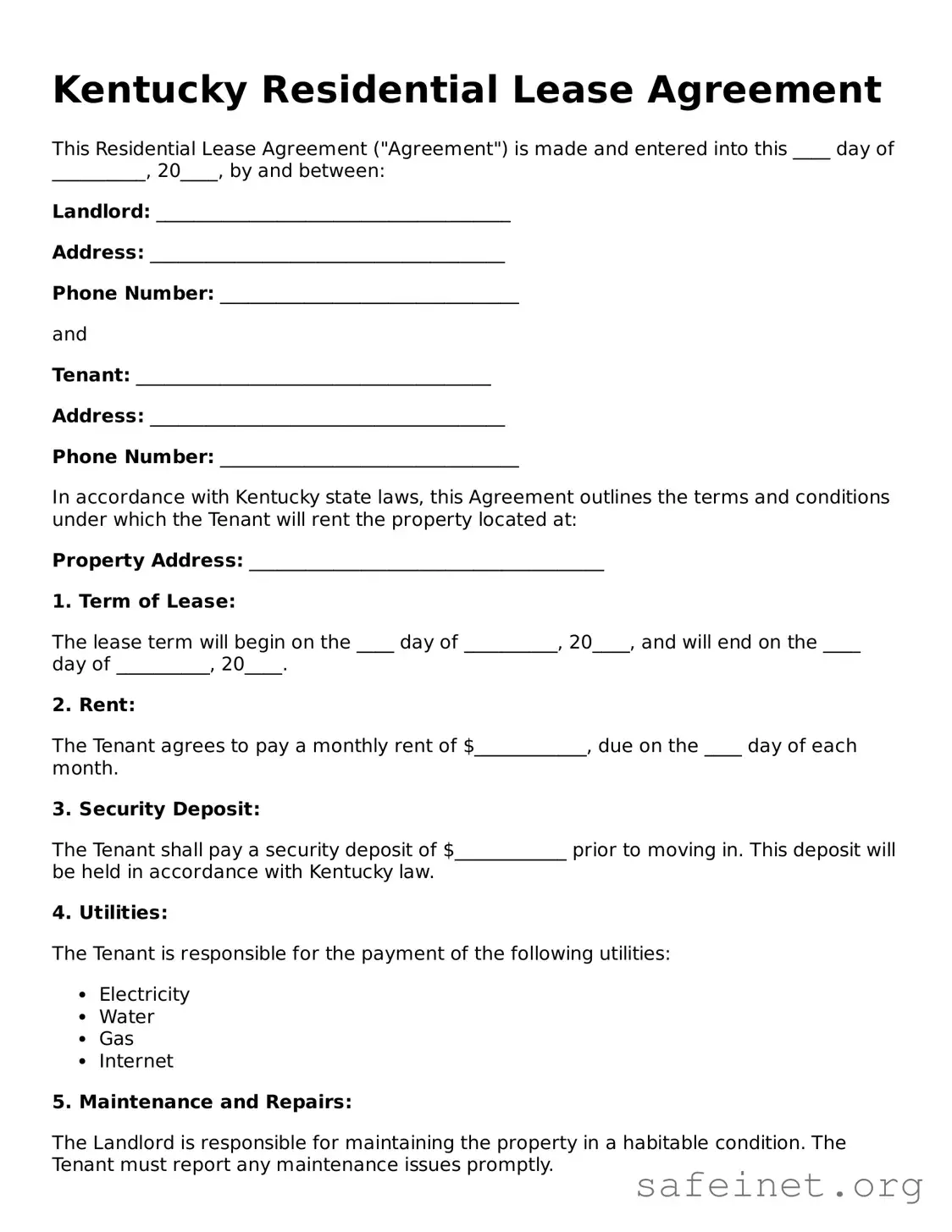
The Kentucky Residential Lease Agreement is a crucial document for both landlords and tenants, providing a clear framework for the rental relationship. This form outlines essential details such as the duration of the lease, rental payment terms, and security deposit requirements. It also specifies the responsibilities of both parties, including maintenance obligations and rules regarding property use. Additionally, the agreement covers procedures for termination and renewal, ensuring that both landlords and tenants understand their rights and obligations. By addressing these key aspects, the Kentucky Residential Lease Agreement helps prevent misunderstandings and disputes, fostering a smoother rental experience for everyone involved.
Kentucky Residential Lease Agreement
This Residential Lease Agreement ("Agreement") is made and entered into this ____ day of __________, 20____, by and between:
Landlord: ______________________________________
Address: ______________________________________
Phone Number: ________________________________
and
Tenant: ______________________________________
Address: ______________________________________
Phone Number: ________________________________
In accordance with Kentucky state laws, this Agreement outlines the terms and conditions under which the Tenant will rent the property located at:
Property Address: ______________________________________
1. Term of Lease:
The lease term will begin on the ____ day of __________, 20____, and will end on the ____ day of __________, 20____.
2. Rent:
The Tenant agrees to pay a monthly rent of $____________, due on the ____ day of each month.
3. Security Deposit:
The Tenant shall pay a security deposit of $____________ prior to moving in. This deposit will be held in accordance with Kentucky law.
4. Utilities:
The Tenant is responsible for the payment of the following utilities:
5. Maintenance and Repairs:
The Landlord is responsible for maintaining the property in a habitable condition. The Tenant must report any maintenance issues promptly.
6. Use of Property:
The Tenant agrees to use the property solely as a residential dwelling. No illegal activities are permitted.
7. Termination:
Either party may terminate this Agreement by providing written notice at least ____ days prior to the desired termination date.
8. Governing Law:
This Agreement shall be governed by the laws of the Commonwealth of Kentucky.
IN WITNESS WHEREOF, the parties hereto have executed this Agreement as of the day and year first above written.
Landlord Signature: ___________________________
Date: ___________________________
Tenant Signature: ___________________________
Date: ___________________________
| Fact Name | Details |
|---|---|
| Governing Law | The Kentucky Residential Lease Agreement is governed by Kentucky Revised Statutes, Chapter 383. |
| Parties Involved | The agreement typically involves a landlord and a tenant, both of whom must sign the document. |
| Duration | The lease can be for a fixed term, such as one year, or it can be month-to-month. |
| Security Deposit | Landlords may require a security deposit, which is usually limited to one month's rent. |
| Notice Requirements | Both parties must provide written notice for termination, typically 30 days for month-to-month leases. |
| Habitability Standards | The property must meet basic habitability standards, ensuring it is safe and livable. |
Completing the Kentucky Residential Lease Agreement form is an important step in establishing a clear understanding between landlords and tenants. This process ensures that both parties are aware of their rights and responsibilities. Follow these steps to fill out the form accurately.
What is a Kentucky Residential Lease Agreement?
A Kentucky Residential Lease Agreement is a legal document that outlines the terms and conditions under which a landlord rents property to a tenant. It includes details about the rental amount, duration of the lease, and responsibilities of both parties. This agreement protects the rights of both the landlord and tenant.
What should be included in the lease agreement?
The lease should contain essential information such as the names of the landlord and tenant, property address, rental amount, payment due dates, security deposit details, maintenance responsibilities, and any rules regarding pets or smoking. Clearly outlining these terms helps prevent misunderstandings later on.
How long does a typical lease last?
In Kentucky, residential leases can vary in length. Most commonly, leases are for one year, but they can also be month-to-month or for a shorter or longer duration. The specific term should be clearly stated in the lease agreement.
Can a lease be terminated early?
Yes, but the conditions for early termination must be specified in the lease. Common reasons for early termination include job relocation, health issues, or violations of lease terms. Tenants may be required to give notice and possibly pay a fee for breaking the lease.
What happens if a tenant does not pay rent?
If rent is not paid on time, the landlord may issue a notice to the tenant. In Kentucky, landlords can start the eviction process if rent remains unpaid after a specific period, typically five days. It’s crucial for tenants to communicate with their landlords if they encounter financial difficulties.
Are there any restrictions on security deposits?
Yes, Kentucky law limits security deposits to one month's rent for most residential leases. The lease should specify the amount and the conditions under which the deposit will be returned at the end of the tenancy. Proper documentation is essential to ensure a smooth return process.
Can landlords enter the rental property without notice?
Generally, landlords must provide reasonable notice before entering the property, except in emergencies. In Kentucky, 24 hours' notice is considered reasonable. This protects the tenant's right to privacy while allowing landlords to fulfill their responsibilities.
What are the tenant's rights in Kentucky?
Tenants in Kentucky have several rights, including the right to a habitable living environment, the right to privacy, and protection against retaliation for exercising their rights. Understanding these rights can empower tenants to advocate for themselves effectively.
Is it necessary to have a written lease?
While verbal agreements can be legally binding, having a written lease is highly recommended. A written lease provides clear evidence of the terms agreed upon and serves as a reference in case of disputes. It minimizes misunderstandings and protects both parties.
Where can I obtain a Kentucky Residential Lease Agreement form?
Kentucky Residential Lease Agreement forms can be obtained from various sources, including real estate offices, legal aid organizations, or online legal form providers. Ensure that the form you choose complies with Kentucky laws and is tailored to your specific needs.
Failing to provide accurate personal information. Many individuals overlook the importance of entering correct names, addresses, and contact details. This can lead to confusion and potential legal issues.
Not specifying the lease term. A common mistake is neglecting to clearly state the duration of the lease. This omission can create uncertainty for both the landlord and tenant.
Ignoring the rental amount and payment details. It is crucial to include the exact monthly rent and the due date. Failure to do so may result in disputes over payments.
Overlooking security deposit terms. Many people forget to outline the amount of the security deposit and the conditions for its return, which can lead to misunderstandings.
Not addressing maintenance responsibilities. Landlords and tenants should clearly define who is responsible for repairs and maintenance. Ambiguities can lead to frustration and conflict.
Failing to include pet policies. If pets are allowed, the agreement should specify any restrictions or additional fees. Omitting this information can lead to disputes later.
Neglecting to outline rules for subletting. If subletting is permitted, the lease should include conditions. This helps prevent unauthorized tenants from occupying the property.
Not specifying utilities and services. It is important to clarify which utilities are included in the rent and which are the tenant's responsibility. This can prevent confusion over bills.
Failing to include termination clauses. Both parties should understand the process for ending the lease. Without clear terms, either party may face unexpected challenges.
Not reviewing the agreement thoroughly. Rushing through the lease can lead to overlooking critical details. Taking the time to read and understand the entire document is essential.
When entering into a rental agreement in Kentucky, several other forms and documents may be necessary to ensure that both landlords and tenants understand their rights and responsibilities. These documents complement the Kentucky Residential Lease Agreement and help clarify various aspects of the rental relationship.
Understanding these documents can significantly enhance the rental experience for both landlords and tenants. By being informed and prepared, all parties can foster a more positive and transparent rental relationship.
The Kentucky Residential Lease Agreement shares similarities with the standard Lease Agreement used across many states. Like the Kentucky form, this document outlines the terms and conditions under which a tenant may occupy a rental property. Both agreements typically specify the duration of the lease, the amount of rent due, and the responsibilities of both the landlord and tenant. Additionally, both documents often include clauses related to security deposits, maintenance obligations, and procedures for terminating the lease. The focus on clear communication of rights and responsibilities is a common thread in both agreements.
Another document that resembles the Kentucky Residential Lease Agreement is the Commercial Lease Agreement. While the primary purpose of a commercial lease is to govern the rental of business properties, it shares key elements with residential leases. Both types of agreements detail the terms of occupancy, including rent, duration, and maintenance responsibilities. However, commercial leases may also include provisions specific to business operations, such as zoning compliance and permitted use of the property. Despite these differences, the foundational structure of both agreements remains similar, emphasizing the importance of clear expectations between parties.
The Sublease Agreement is another document that parallels the Kentucky Residential Lease Agreement. This type of agreement allows a tenant to rent out their leased property to another individual, known as the subtenant. Like the original lease, a sublease outlines the terms of occupancy, including rent payment and duration. It typically requires the approval of the landlord, ensuring that the original lease terms are upheld. Both agreements aim to protect the interests of the parties involved while facilitating the use of the property.
A Rental Application form also shares similarities with the Kentucky Residential Lease Agreement, albeit at an earlier stage of the rental process. While the lease agreement formalizes the rental relationship, the application serves to gather information about potential tenants. Both documents focus on establishing terms and conditions, although the application primarily assesses the qualifications of the tenant. Information such as employment history, rental history, and creditworthiness is often requested, laying the groundwork for the subsequent lease agreement.
Lastly, the Roommate Agreement can be compared to the Kentucky Residential Lease Agreement in its function to govern shared living arrangements. This document outlines the rights and responsibilities of each roommate, similar to how a lease agreement does for tenants and landlords. Both agreements cover aspects such as rent payment, utility responsibilities, and house rules. The key difference lies in the fact that a roommate agreement is typically used when multiple individuals share a rental property, whereas a lease agreement involves a tenant and landlord relationship. Nonetheless, both documents emphasize the importance of clear communication to prevent disputes.
When filling out the Kentucky Residential Lease Agreement form, it is important to be careful and thorough. Here are some guidelines to follow:
Understanding the Kentucky Residential Lease Agreement form is essential for both landlords and tenants. However, there are several misconceptions that can lead to confusion. Here is a list of common misconceptions along with clarifications.
Each lease agreement can vary significantly based on specific terms, conditions, and local laws. It's important to read each agreement carefully.
While oral agreements may seem valid, they can lead to misunderstandings. A written lease provides clear documentation of the terms agreed upon.
In Kentucky, there are specific laws regarding security deposits, including how much can be charged and how it must be handled.
Breaking a lease can result in penalties, including losing the security deposit or being liable for remaining rent payments.
Landlords must provide notice before entering a tenant's property, except in emergencies. This protects the tenant's right to privacy.
Landlords are generally responsible for maintaining the property and ensuring it is habitable. Tenants should report issues promptly.
Changes to the lease terms must be agreed upon by both parties and documented in writing. Unilateral changes are not valid.
Landlords must follow specific legal procedures to evict a tenant, including providing notice and a chance to remedy the situation.
Increases in rent must comply with the lease terms and local laws, often requiring notice before the change takes effect.
Pet policies vary by lease agreement. Tenants should confirm whether pets are permitted and any associated fees or restrictions.
By addressing these misconceptions, both landlords and tenants can navigate their agreements more effectively and avoid potential disputes.
When filling out and using the Kentucky Residential Lease Agreement form, there are several important points to keep in mind. Here are some key takeaways:
Following these guidelines can help ensure a smooth rental experience for both landlords and tenants.