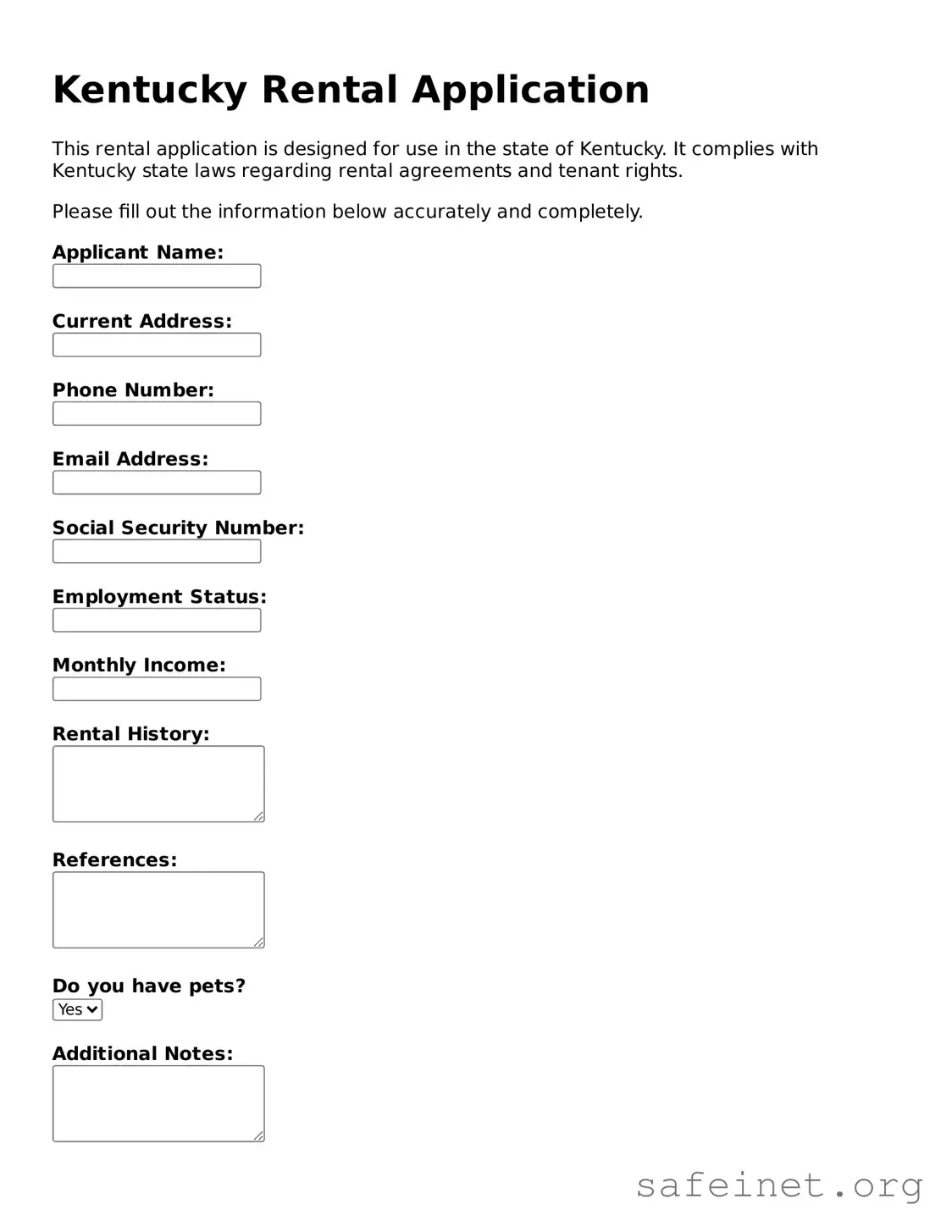
The Kentucky Rental Application form serves as a vital tool for both landlords and potential tenants in the rental process. This form collects essential information from applicants, helping landlords assess their suitability for a rental property. Key components of the form include personal details such as the applicant's name, contact information, and social security number. Additionally, it requests employment history and income verification to ensure that applicants can meet rental obligations. Rental history is another important aspect, as it allows landlords to gauge an applicant's previous behavior as a tenant. The form may also include questions about pets, smoking habits, and references, providing a comprehensive view of the applicant's lifestyle. By filling out this form, prospective tenants can demonstrate their qualifications while landlords can make informed decisions based on the information provided.
Kentucky Rental Application
This rental application is designed for use in the state of Kentucky. It complies with Kentucky state laws regarding rental agreements and tenant rights.
Please fill out the information below accurately and completely.
Thank you for your application. We will review your information and get back to you soon.
| Fact Name | Description |
|---|---|
| Purpose | The Kentucky Rental Application form is used by landlords to screen potential tenants. It helps gather important information about the applicant's background and financial status. |
| Required Information | Applicants typically need to provide personal details such as name, contact information, employment history, and rental history. |
| Application Fee | Landlords may charge an application fee to cover the costs of processing the application. This fee is generally non-refundable. |
| Background Checks | Landlords often conduct background checks on applicants, which may include credit checks and criminal history evaluations. |
| Governing Law | The Kentucky Rental Application is governed by Kentucky Revised Statutes (KRS) Chapter 383, which outlines tenant and landlord rights. |
| Fair Housing Compliance | All rental applications must comply with the Fair Housing Act, ensuring that applicants are not discriminated against based on race, color, religion, sex, national origin, familial status, or disability. |
Completing the Kentucky Rental Application form is an important step in securing a rental property. After filling out the application, you will typically submit it to the landlord or property management for review. They will assess your information, which may include a background check and credit evaluation, to determine your eligibility for the rental.
What is a Kentucky Rental Application form?
The Kentucky Rental Application form is a document used by landlords to collect essential information from prospective tenants. It typically includes personal details, rental history, employment information, and references. This form helps landlords assess the suitability of applicants for renting their property.
What information is required on the application?
A standard Kentucky Rental Application form generally requires the applicant's full name, contact information, Social Security number, employment details, income, rental history, and references. Some landlords may also request additional information such as background checks or credit history.
Can a landlord deny an application?
Yes, a landlord can deny an application based on various factors. Common reasons include poor credit history, insufficient income, negative rental history, or failure to provide accurate information. However, landlords must comply with fair housing laws and cannot discriminate based on race, gender, religion, or other protected characteristics.
Is there a fee associated with the rental application?
Many landlords charge a non-refundable application fee to cover the costs of background checks and processing. This fee can vary by property and location. It is important for applicants to inquire about the fee before submitting their application.
How long does it take to process a rental application?
The processing time for a rental application can vary. Typically, it takes anywhere from a few hours to several days, depending on the landlord's procedures and the thoroughness of the background checks. Applicants should ask the landlord for an estimated timeline during the application process.
What happens if my application is approved?
If your application is approved, the landlord will usually contact you to discuss the next steps. This may include signing a lease agreement and paying the security deposit and first month's rent. Be prepared to provide any additional documentation requested at this stage.
What if my application is denied?
If your application is denied, the landlord is required to provide a reason for the denial, especially if it is based on information from a credit report. You have the right to request a copy of the report and dispute any inaccuracies. Understanding the reason for denial can help you address issues for future applications.
Can I appeal a rental application denial?
While there is no formal process for appealing a rental application denial, you can communicate with the landlord to discuss the reasons for denial. If you believe there was an error or misunderstanding, providing additional documentation or clarification may help your case.
Is a rental application legally binding?
Submitting a rental application is not a legally binding agreement. It is merely a request to rent the property. However, once the landlord accepts the application and both parties sign a lease agreement, that document becomes legally binding.
Can I withdraw my application after submission?
Yes, you can withdraw your application after submission. However, it is advisable to communicate your decision to the landlord as soon as possible. Depending on the landlord's policies, you may or may not be entitled to a refund of any application fees paid.
Incomplete Information: Many applicants fail to provide all the required details. Missing sections such as employment history or rental history can lead to delays or even denial of the application.
Incorrect Contact Information: Providing outdated or incorrect phone numbers and email addresses can hinder communication. Landlords need to reach applicants quickly, and incorrect information can create unnecessary obstacles.
Failure to Disclose Background Information: Some applicants overlook the importance of transparency. Not disclosing past evictions or criminal history can result in automatic disqualification if discovered later.
Neglecting to Sign the Application: It may seem minor, but forgetting to sign the application can invalidate it. A signature confirms that the applicant agrees to the terms and conditions laid out in the application.
When renting a property in Kentucky, several documents may accompany the rental application form. These documents help landlords assess potential tenants and ensure a smooth leasing process. Below are five common forms and documents often used alongside the Kentucky Rental Application.
These documents collectively provide a clearer picture of the applicant's qualifications and suitability for renting a property. Having them prepared can streamline the application process and facilitate a positive landlord-tenant relationship.
The Kentucky Rental Application form shares similarities with the standard lease agreement. Both documents serve as foundational tools in the rental process. While the application collects essential information about prospective tenants, the lease agreement formalizes the terms of occupancy once a tenant is approved. Each document typically includes details about the parties involved, property description, and rental terms, ensuring clarity and mutual understanding between landlords and tenants.
Another document that resembles the Kentucky Rental Application is the tenant screening report. This report often accompanies the application and provides landlords with a comprehensive background check on potential tenants. It includes credit history, rental history, and criminal background information. Both documents aim to help landlords assess the suitability of applicants, but the screening report offers deeper insights into an applicant’s reliability.
The rental reference form is also similar to the Kentucky Rental Application. This document requests information from previous landlords or personal references about the applicant's rental behavior. Like the application, it seeks to verify the applicant’s reliability and responsibility as a tenant. Both documents are crucial in establishing trust and making informed decisions about potential renters.
The employment verification form bears resemblance to the rental application as well. This document provides landlords with proof of a tenant's income and employment status. Both forms are essential in assessing an applicant's financial stability, which is critical for meeting rental obligations. Landlords often require this information to ensure that applicants can afford the rent.
Similar to the Kentucky Rental Application is the pet application form. For properties that allow pets, this document gathers information about an applicant's pets, including breed, size, and vaccination records. Both forms aim to ensure that tenants meet specific criteria, whether related to general rental history or pet ownership, thereby protecting the property and community.
The co-signer agreement is another document that parallels the rental application. When an applicant lacks sufficient income or rental history, a co-signer may be required. This agreement outlines the responsibilities of the co-signer, similar to how the rental application outlines the tenant's obligations. Both documents are designed to mitigate risk for landlords and ensure that rent will be paid.
The move-in checklist is also akin to the Kentucky Rental Application. This document is completed at the beginning of a tenancy to document the condition of the property. While the application assesses potential tenants, the checklist helps protect both parties by providing a record of the property's state upon move-in. This can prevent disputes over security deposits later on.
The eviction notice is another document that shares some similarities with the rental application. While the application is used to establish a tenancy, the eviction notice is a formal communication regarding the termination of that tenancy. Both documents are essential in the landlord-tenant relationship, with the application providing the groundwork for occupancy and the eviction notice outlining the consequences of failing to adhere to rental terms.
The security deposit agreement also resembles the rental application in its purpose. This document outlines the terms regarding the security deposit required from tenants. Like the application, it serves to protect the landlord’s interests by ensuring that tenants understand their financial obligations. Both documents emphasize the importance of financial responsibility in the rental arrangement.
Finally, the rental agreement addendum can be compared to the Kentucky Rental Application. An addendum modifies or adds to the terms of the original rental agreement, similar to how the application provides specific details about the tenant's qualifications. Both documents are essential for clarifying expectations and responsibilities, ensuring that all parties are on the same page regarding the rental arrangement.
Filling out a rental application can feel overwhelming, but it doesn't have to be. Knowing what to do and what to avoid can make the process smoother and increase your chances of securing that perfect rental. Here’s a handy list to guide you:
By following these guidelines, you can present yourself as a responsible and reliable tenant. Good luck with your rental application!
When it comes to the Kentucky Rental Application form, several misconceptions can lead to confusion for both landlords and tenants. Here are six common misunderstandings:
Many people believe that rental applications are uniform across the board. In reality, each landlord or property management company may have their own specific requirements and questions tailored to their needs.
Some tenants think they can skip the application process. However, most landlords require a completed rental application to assess a potential tenant's suitability for their property.
Filling out an application does not mean automatic acceptance. Landlords evaluate applications based on various criteria, including credit history, income, and rental history.
While personal details are important, rental applications often require additional information, such as employment history and references, to provide a complete picture of the applicant.
Some individuals believe that charging an application fee is against the law. In Kentucky, landlords can charge a fee to cover the cost of processing the application, as long as it is disclosed upfront.
Tenants may think that they cannot modify their application after submission. However, if there are errors or changes in circumstances, it is often possible to update the application with the landlord’s consent.
Understanding these misconceptions can help both landlords and tenants navigate the rental process more smoothly and effectively.
When filling out and using the Kentucky Rental Application form, keep these key takeaways in mind:
By keeping these points in mind, you can navigate the rental application process with confidence and clarity.