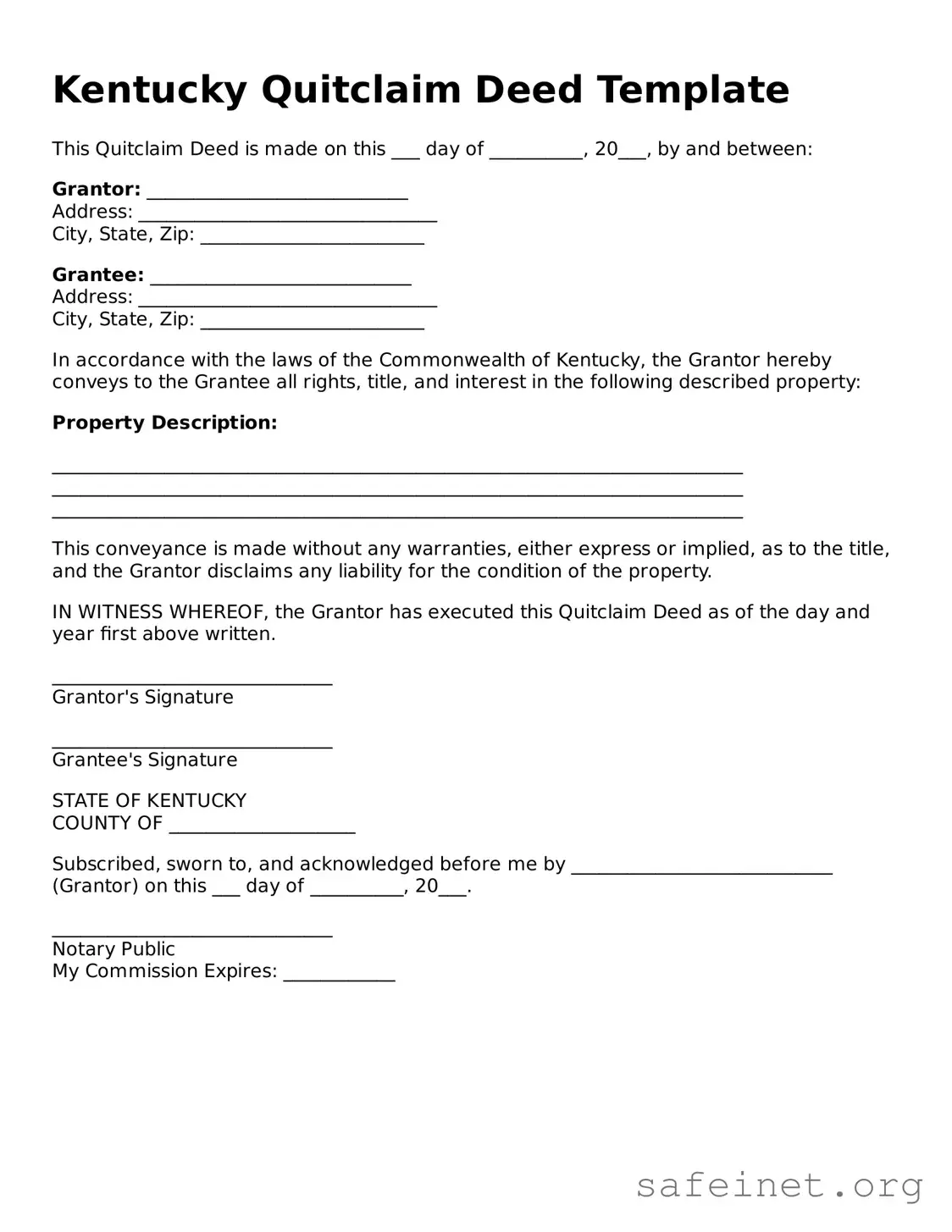
In the realm of real estate transactions, the Kentucky Quitclaim Deed form stands out as a straightforward tool for transferring property rights. This document allows one party, known as the grantor, to convey their interest in a property to another party, called the grantee, without making any guarantees about the title's validity. It is especially useful in situations where the parties have a pre-existing relationship, such as family transfers or settling estates. Unlike other types of deeds, a quitclaim deed does not require extensive title searches or warranties, making it a quicker and often less costly option. However, it’s crucial for both parties to understand that this form does not protect against potential claims or liens on the property. As such, while it simplifies the transfer process, it also places the onus on the grantee to conduct due diligence before proceeding. Whether you’re looking to gift property, resolve ownership disputes, or facilitate a divorce settlement, knowing how to properly utilize the Kentucky Quitclaim Deed can streamline your real estate dealings.
Kentucky Quitclaim Deed Template
This Quitclaim Deed is made on this ___ day of __________, 20___, by and between:
Grantor: ____________________________
Address: ________________________________
City, State, Zip: ________________________
Grantee: ____________________________
Address: ________________________________
City, State, Zip: ________________________
In accordance with the laws of the Commonwealth of Kentucky, the Grantor hereby conveys to the Grantee all rights, title, and interest in the following described property:
Property Description:
__________________________________________________________________________
__________________________________________________________________________
__________________________________________________________________________
This conveyance is made without any warranties, either express or implied, as to the title, and the Grantor disclaims any liability for the condition of the property.
IN WITNESS WHEREOF, the Grantor has executed this Quitclaim Deed as of the day and year first above written.
______________________________
Grantor's Signature
______________________________
Grantee's Signature
STATE OF KENTUCKY
COUNTY OF ____________________
Subscribed, sworn to, and acknowledged before me by ____________________________ (Grantor) on this ___ day of __________, 20___.
______________________________
Notary Public
My Commission Expires: ____________
| Fact Name | Description |
|---|---|
| Definition | A Kentucky Quitclaim Deed is a legal document that allows a property owner to transfer their interest in a property to another person without making any guarantees about the title. |
| Governing Law | The Kentucky Quitclaim Deed is governed by Kentucky Revised Statutes, Chapter 381. |
| Use Cases | This form is often used between family members or in situations where the grantor does not want to be liable for any title defects. |
| Requirements | The deed must be signed by the grantor, and it should be notarized to be legally effective. |
| Filing | After completion, the Quitclaim Deed must be filed with the county clerk's office where the property is located to make the transfer official. |
After obtaining the Kentucky Quitclaim Deed form, it is essential to carefully fill it out to ensure that the transfer of property is executed correctly. Once completed, the form will need to be signed and notarized before being filed with the appropriate county clerk's office.
What is a Kentucky Quitclaim Deed?
A Kentucky Quitclaim Deed is a legal document used to transfer ownership of real estate from one party to another. Unlike a warranty deed, a quitclaim deed does not guarantee that the grantor has clear title to the property. Instead, it simply conveys whatever interest the grantor may have in the property at the time of the transfer. This type of deed is often used among family members or in situations where the parties know each other well, as it carries a higher risk for the grantee.
How do I complete a Quitclaim Deed in Kentucky?
To complete a Quitclaim Deed in Kentucky, you will need to provide specific information. This includes the names of the grantor (the person transferring the property) and the grantee (the person receiving the property), a legal description of the property, and the date of the transfer. It is crucial to ensure that all information is accurate and that the deed is signed by the grantor in the presence of a notary public. Once completed, the deed must be filed with the county clerk in the county where the property is located to make the transfer official.
Are there any fees associated with filing a Quitclaim Deed in Kentucky?
Yes, there are fees associated with filing a Quitclaim Deed in Kentucky. The exact amount can vary by county, but generally, you can expect to pay a recording fee. Additionally, if the property is being transferred as part of a sale, there may be transfer taxes involved. It is advisable to check with your local county clerk’s office for the most accurate and up-to-date fee schedule before filing.
Can a Quitclaim Deed be contested in Kentucky?
Yes, a Quitclaim Deed can be contested in Kentucky. If there are disputes regarding the validity of the deed, such as claims of fraud, lack of capacity, or improper execution, the grantee may challenge the deed in court. It is important to keep in mind that since a quitclaim deed does not guarantee clear title, any claims against the property may still exist. Consulting with a legal professional can provide guidance on how to proceed if you believe a deed is being contested.
Incorrect Property Description: One common mistake is failing to provide a complete and accurate legal description of the property. This description should include details such as the lot number, block number, and any relevant geographic identifiers. Without this, the deed may not be valid.
Missing Signatures: All parties involved in the transaction must sign the Quitclaim Deed. If even one signature is missing, the document may be deemed incomplete. It's crucial to ensure that all grantors (those transferring the property) have signed before submitting the form.
Not Notarizing the Document: In Kentucky, Quitclaim Deeds must be notarized to be legally binding. Failing to have the document notarized can lead to issues with property transfer and may affect the validity of the deed.
Incorrectly Filling Out the Grantee Information: The grantee is the person or entity receiving the property. Mistakes in spelling the name or providing incorrect addresses can create problems later. Ensure that the grantee's information is accurate and complete.
The Kentucky Quitclaim Deed form is often accompanied by several other documents that facilitate the transfer of property rights. Below is a list of commonly used forms and documents that may be necessary or helpful during this process.
These documents serve various purposes in ensuring a smooth and legally compliant transfer of property ownership in Kentucky. It is advisable to review each document carefully and consult with a professional if needed.
The Kentucky Quitclaim Deed is often compared to a Warranty Deed, which provides a greater level of protection for the buyer. In a Warranty Deed, the seller guarantees that they hold clear title to the property and have the right to sell it. This means that if any issues arise regarding the title after the sale, the seller is legally responsible for resolving them. In contrast, a Quitclaim Deed does not offer such assurances. It simply transfers whatever interest the seller may have in the property, without any guarantees about the quality of the title.
Another document similar to the Quitclaim Deed is the Bargain and Sale Deed. This type of deed implies that the seller has the right to transfer the property but does not provide any warranties against defects in the title. Like the Quitclaim Deed, it is often used in transactions where the buyer is willing to accept some risk regarding the title. However, a Bargain and Sale Deed may offer slightly more assurance than a Quitclaim Deed, as it implies that the seller has not encumbered the property with any liens or claims.
The Special Warranty Deed is also comparable to the Quitclaim Deed, though it includes some additional protections for the buyer. In a Special Warranty Deed, the seller guarantees that they have not caused any title defects during their ownership of the property. However, this guarantee does not extend to issues that may have existed prior to the seller's ownership. This type of deed can provide some peace of mind for buyers, as it assures them that the seller is responsible for any problems that arose while they owned the property.
Another document that shares similarities with the Quitclaim Deed is the Deed of Trust. While a Quitclaim Deed is primarily used for transferring ownership, a Deed of Trust is used in real estate transactions to secure a loan. In this arrangement, the borrower conveys the property to a trustee, who holds the title until the loan is repaid. If the borrower defaults, the trustee has the authority to sell the property to recover the loan amount. Although the purposes of these two documents differ, both involve the transfer of property interests and can have significant implications for the parties involved.
Lastly, the Affidavit of Title can be likened to the Quitclaim Deed in that it is often used to clarify ownership issues. This document is a sworn statement by the seller affirming that they hold clear title to the property and disclosing any potential claims or liens against it. While it does not transfer ownership like a Quitclaim Deed, it serves to provide transparency in a real estate transaction. Buyers may request an Affidavit of Title to gain confidence in the seller's claim to the property, similar to how they might approach a Quitclaim Deed when seeking to understand the seller's interest.
When filling out the Kentucky Quitclaim Deed form, it's important to follow specific guidelines to ensure the document is valid and effective. Here’s a list of what to do and what to avoid:
The Kentucky Quitclaim Deed form is often misunderstood. Here are six common misconceptions about it:
When considering the use of a Kentucky Quitclaim Deed form, it is essential to understand its purpose and the steps involved in completing it. Below are key takeaways that can help guide you through the process.
Understanding these key aspects can simplify the process of filling out and using a Kentucky Quitclaim Deed form. Proper attention to detail will help facilitate a smooth transfer of property ownership.