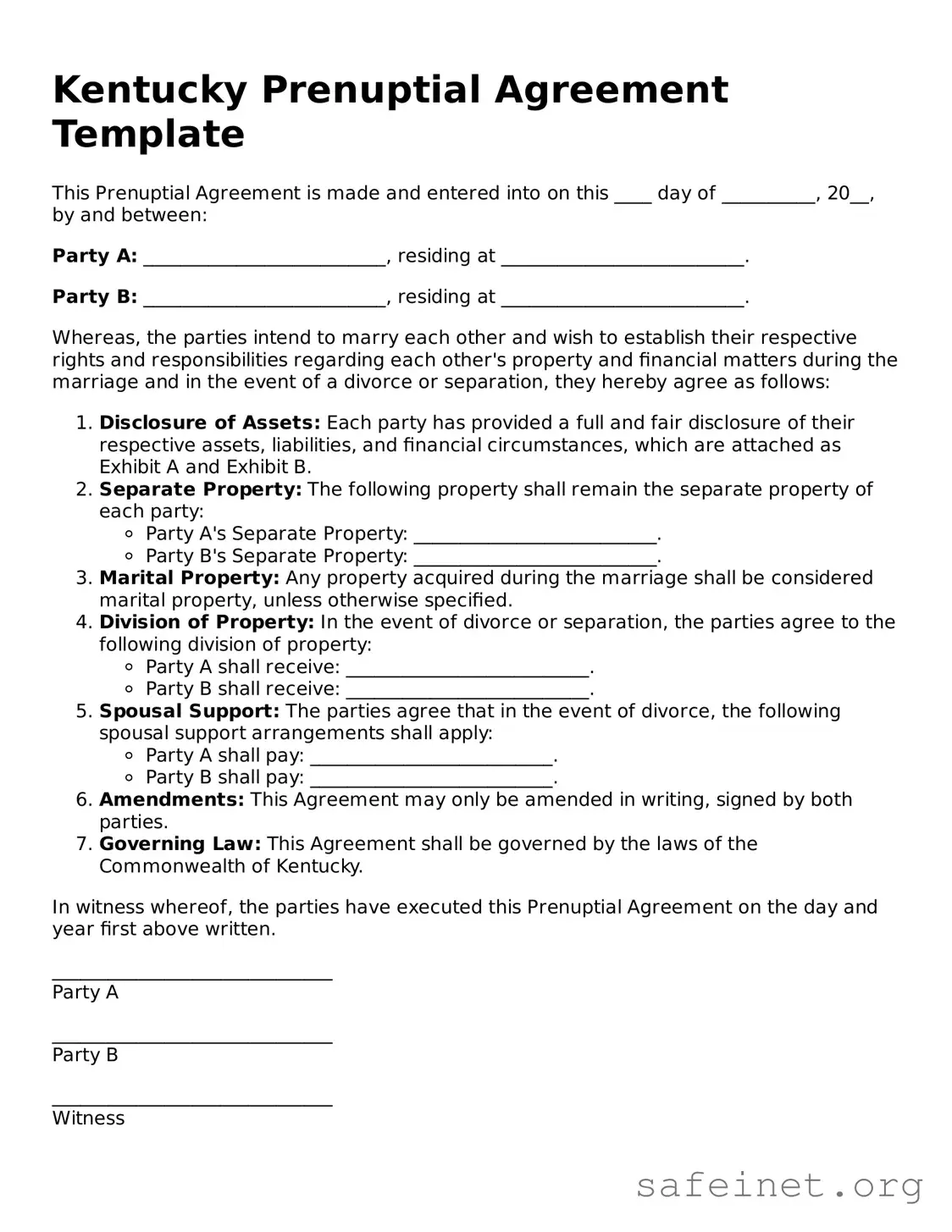
When couples decide to tie the knot, they often focus on the joyous aspects of wedding planning, but it’s also essential to consider the practical side of marriage. A Kentucky Prenuptial Agreement form can play a significant role in this process, allowing partners to outline their financial rights and responsibilities before they say "I do." This legal document serves to protect individual assets, clarify how property will be divided in the event of a divorce, and address issues like spousal support. By discussing these matters upfront, couples can foster open communication and reduce potential conflicts down the road. It's a proactive step that not only safeguards personal interests but also promotes a healthier partnership. Understanding the components of this agreement, such as the disclosure of assets and the stipulations regarding debts, is crucial for anyone considering marriage in Kentucky. As you navigate this important decision, having a solid grasp of the prenuptial agreement process can provide peace of mind and a stronger foundation for your future together.
Kentucky Prenuptial Agreement Template
This Prenuptial Agreement is made and entered into on this ____ day of __________, 20__, by and between:
Party A: __________________________, residing at __________________________.
Party B: __________________________, residing at __________________________.
Whereas, the parties intend to marry each other and wish to establish their respective rights and responsibilities regarding each other's property and financial matters during the marriage and in the event of a divorce or separation, they hereby agree as follows:
In witness whereof, the parties have executed this Prenuptial Agreement on the day and year first above written.
______________________________
Party A
______________________________
Party B
______________________________
Witness
______________________________
Witness
| Fact Name | Details |
|---|---|
| Definition | A prenuptial agreement in Kentucky is a legal document that outlines the distribution of assets and responsibilities of each partner in the event of a divorce or separation. |
| Governing Law | Kentucky Revised Statutes, Chapter 403 governs prenuptial agreements in the state. |
| Enforceability | For a prenuptial agreement to be enforceable, it must be in writing and signed by both parties before marriage. |
| Disclosure Requirements | Each party must fully disclose their financial situation, including assets and debts, to ensure fairness in the agreement. |
| Modification | Prenuptial agreements can be modified or revoked at any time, but such changes must also be in writing and signed by both parties. |
Filling out the Kentucky Prenuptial Agreement form is a straightforward process. It involves gathering necessary information about both parties and clearly stating the terms of the agreement. Once completed, the form should be signed and dated by both parties, ideally in the presence of a notary public to ensure its validity.
What is a prenuptial agreement in Kentucky?
A prenuptial agreement, often referred to as a prenup, is a legal document that a couple creates before getting married. It outlines the division of assets and responsibilities in the event of divorce or separation. In Kentucky, this agreement can help protect individual property and clarify financial arrangements, ensuring both parties understand their rights and obligations.
Who should consider a prenuptial agreement?
Individuals with significant assets, debts, or business interests may find a prenuptial agreement particularly beneficial. Additionally, those entering a second marriage or who have children from previous relationships may wish to ensure that their assets are protected for their heirs. Ultimately, anyone looking for clarity and security in their financial future may consider a prenup.
How is a prenuptial agreement created in Kentucky?
Creating a prenuptial agreement involves several steps. First, both parties should discuss their financial situations and goals openly. Then, they can draft the agreement, ensuring it includes all relevant details about asset division and financial responsibilities. It is advisable for each party to seek independent legal counsel to ensure their rights are protected and that the agreement is fair and enforceable.
Can a prenuptial agreement be modified after marriage?
Yes, a prenuptial agreement can be modified after marriage. Both parties must agree to the changes, and the modifications should be documented in writing. It is essential to follow the same legal formalities as the original agreement to ensure that the modifications are enforceable.
What happens if one spouse does not comply with the prenuptial agreement?
If one spouse fails to comply with the terms of the prenuptial agreement, the other party may seek legal recourse. This could involve filing a motion in court to enforce the agreement. Courts generally uphold prenuptial agreements as long as they were created fairly and both parties had the opportunity to review and understand the terms.
Are there any limitations to what can be included in a prenuptial agreement?
Yes, certain topics cannot be included in a prenuptial agreement. For example, agreements concerning child custody and child support cannot be predetermined in a prenup, as these issues are subject to court approval based on the best interests of the child at the time of divorce. Additionally, any provisions that are illegal or against public policy will not be enforceable.
Is a prenuptial agreement enforceable in Kentucky?
Yes, prenuptial agreements are generally enforceable in Kentucky, provided they meet specific legal requirements. The agreement must be in writing and signed by both parties. It should also be entered into voluntarily, without coercion, and should be fair and reasonable at the time of signing. If these conditions are met, the agreement is likely to be upheld in court.
What are the benefits of having a prenuptial agreement?
A prenuptial agreement offers several benefits. It provides clarity and peace of mind regarding financial matters, helps protect individual assets, and can reduce conflict during a divorce. By establishing clear expectations, couples can focus on building their relationship rather than worrying about potential financial disputes in the future.
Failing to fully disclose assets and liabilities. Each party must provide a complete picture of their financial situation. Omitting significant debts or assets can lead to the agreement being challenged later.
Using vague or unclear language. Specificity is crucial. General terms can cause confusion and may not hold up in court.
Not considering future changes in circumstances. A prenuptial agreement should account for potential changes, such as career advancements or children, to remain relevant.
Rushing the process. Taking the time to carefully review and discuss the terms can prevent misunderstandings and ensure both parties feel comfortable.
Neglecting to consult legal professionals. Each party should have independent legal advice to ensure their rights are protected and the agreement is enforceable.
Ignoring state laws. Kentucky has specific requirements for prenuptial agreements. Familiarity with these laws is essential to avoid invalidation.
Failing to update the agreement. Life changes, such as marriage, divorce, or the birth of children, may necessitate revisions to the agreement.
Not having both parties sign the agreement. Without signatures from both individuals, the document may not be legally binding.
A prenuptial agreement is an important document for couples planning to marry, as it outlines the financial arrangements and responsibilities during the marriage and in the event of a divorce. However, there are several other forms and documents that can complement a prenuptial agreement, ensuring that both parties are protected and informed. Here’s a list of commonly used documents that may accompany a Kentucky Prenuptial Agreement.
Utilizing these documents alongside a Kentucky Prenuptial Agreement can provide clarity and security for both parties. Each document serves a unique purpose, helping to establish a solid foundation for the marriage and addressing potential future concerns. It is advisable to consult with a legal professional to ensure that all necessary documents are properly drafted and executed.
The Kentucky Prenuptial Agreement form shares similarities with a Cohabitation Agreement. Both documents serve to outline the rights and responsibilities of partners, whether they are married or living together. A Cohabitation Agreement is particularly useful for unmarried couples who want to clarify financial arrangements, property rights, and other personal matters. Just as a prenuptial agreement prepares couples for the potential of divorce, a cohabitation agreement helps partners navigate their relationship while protecting their individual interests.
Another document akin to the Prenuptial Agreement is the Postnuptial Agreement. While a prenuptial agreement is established before marriage, a postnuptial agreement is created after the wedding. This document can address similar issues, such as asset division and spousal support, in the event of a divorce. Couples might choose a postnuptial agreement when their financial situation changes or when they want to formalize their arrangements after marriage.
The Separation Agreement also bears resemblance to the Prenuptial Agreement. This document comes into play when a couple decides to separate but is not yet divorced. A separation agreement outlines the terms of the couple's separation, including asset division, child custody, and support obligations. Like a prenuptial agreement, it aims to minimize conflict and provide clarity during a challenging time.
A Living Will is another document that, while not directly related to marriage, shares the theme of planning for the future. A living will specifies an individual's wishes regarding medical treatment in case they become incapacitated. Just as a prenuptial agreement addresses financial matters in the event of divorce, a living will ensures that personal health decisions align with one’s values and preferences. Both documents reflect a proactive approach to managing life’s uncertainties.
Similarly, a Trust Agreement can be compared to a Prenuptial Agreement in terms of asset protection. A trust allows individuals to manage their assets during their lifetime and determine how those assets will be distributed after death. Both documents help safeguard personal property, ensuring that assets are handled according to the individual’s wishes, whether in the context of marriage or beyond.
Lastly, the Will is a fundamental document that complements a Prenuptial Agreement. While a prenuptial agreement focuses on the division of assets in the event of a divorce, a will outlines how a person’s assets will be distributed upon their death. Both documents require careful consideration and planning, reflecting an individual’s intentions and priorities regarding their assets and loved ones.
When filling out the Kentucky Prenuptial Agreement form, it is important to follow certain guidelines to ensure that the document is valid and meets your needs. Below is a list of things you should and shouldn't do.
Prenuptial agreements are only for the wealthy. Many people believe that only those with significant assets need a prenuptial agreement. In reality, anyone entering a marriage can benefit from this legal document, regardless of their financial status.
Prenuptial agreements are unromantic. Some view prenuptial agreements as a sign of distrust. However, they can actually promote open communication about finances and expectations, which can strengthen a relationship.
All prenuptial agreements are the same. Each prenuptial agreement is unique and should be tailored to the specific needs and circumstances of the couple. A one-size-fits-all approach does not work.
Prenuptial agreements are not enforceable. While some may think that these agreements lack legal weight, in Kentucky, prenuptial agreements can be enforceable if they meet certain legal requirements.
You cannot change a prenuptial agreement once it's signed. Couples can modify their prenuptial agreements at any time, as long as both parties agree to the changes and follow the proper legal process.
Prenuptial agreements only cover financial matters. While financial issues are a primary focus, prenuptial agreements can also address other aspects of a marriage, such as property rights and responsibilities.
Only one spouse needs to hire a lawyer. It is advisable for both parties to seek independent legal advice when drafting a prenuptial agreement. This ensures that both individuals fully understand their rights and obligations.
When considering a prenuptial agreement in Kentucky, there are several important aspects to keep in mind. Here are some key takeaways to guide you through the process:
By keeping these takeaways in mind, you can navigate the prenuptial agreement process more effectively, ensuring a smoother path forward in your marriage.