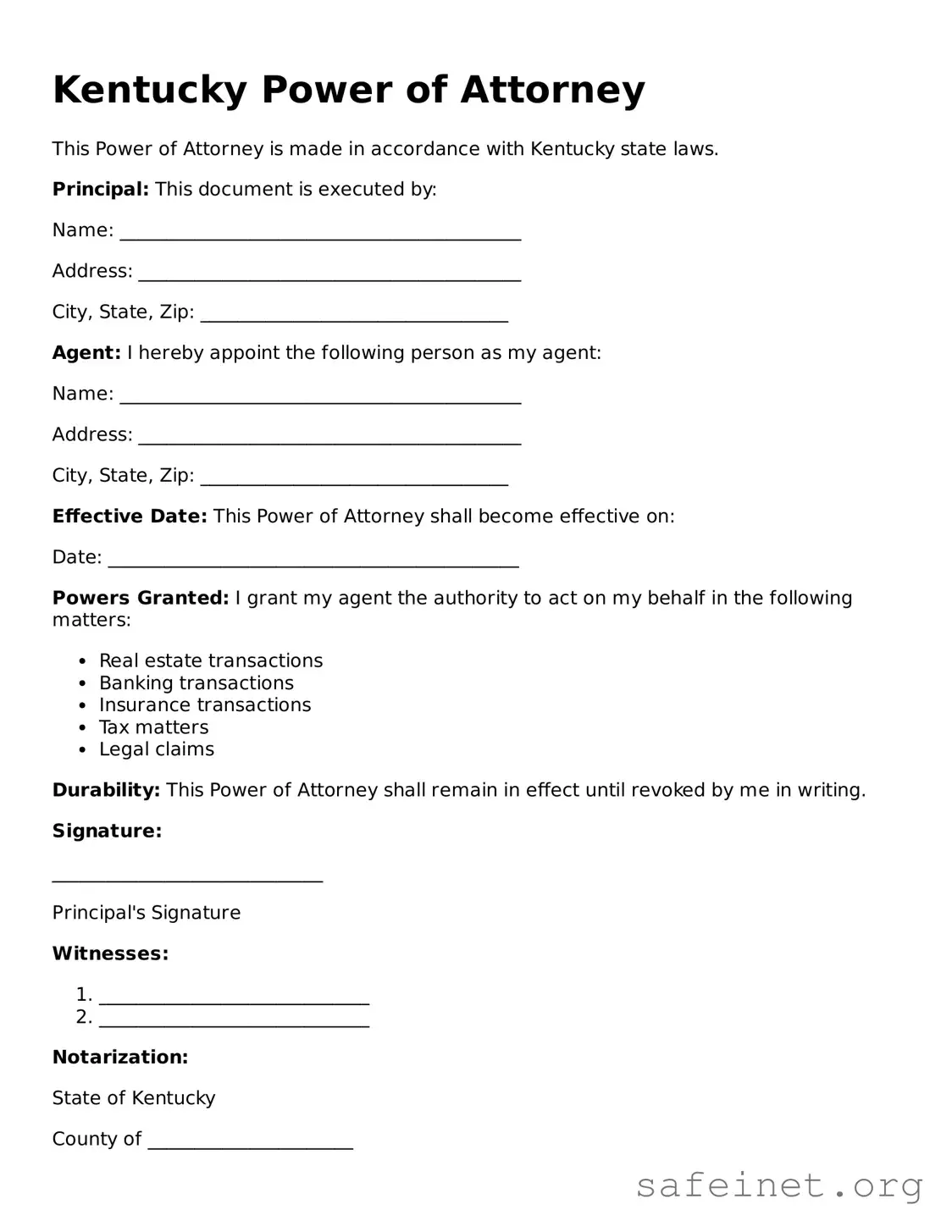
The Kentucky Power of Attorney form is a crucial legal document that allows individuals to appoint someone they trust to make decisions on their behalf. This form can cover a wide range of powers, including financial management, healthcare decisions, and real estate transactions. It is essential to specify the extent of authority granted, as the appointed agent can act in various capacities, depending on the choices made by the principal. In Kentucky, the form must be signed by the principal and witnessed by two individuals or notarized to ensure its validity. Understanding the nuances of this document is vital, as it not only serves to protect the interests of the principal but also provides clarity and direction for the agent. Whether planning for future incapacity or simply streamlining decision-making processes, the Kentucky Power of Attorney form plays a significant role in personal and financial planning.
Kentucky Power of Attorney
This Power of Attorney is made in accordance with Kentucky state laws.
Principal: This document is executed by:
Name: ___________________________________________
Address: _________________________________________
City, State, Zip: _________________________________
Agent: I hereby appoint the following person as my agent:
Name: ___________________________________________
Address: _________________________________________
City, State, Zip: _________________________________
Effective Date: This Power of Attorney shall become effective on:
Date: ____________________________________________
Powers Granted: I grant my agent the authority to act on my behalf in the following matters:
Durability: This Power of Attorney shall remain in effect until revoked by me in writing.
Signature:
_____________________________
Principal's Signature
Witnesses:
Notarization:
State of Kentucky
County of ______________________
Subscribed and sworn before me this _____ day of ______________, 20__.
_____________________________
Notary Public
My commission expires: ____________________
| Fact Name | Details |
|---|---|
| Definition | A Power of Attorney (POA) is a legal document that allows one person to act on behalf of another in legal or financial matters. |
| Governing Law | The Kentucky Power of Attorney form is governed by KRS Chapter 457. |
| Types of POA | There are several types of POA, including durable, non-durable, and medical POA. |
| Durable POA | A durable POA remains effective even if the principal becomes incapacitated. |
| Agent Authority | The agent's authority can be broad or limited, depending on the principal's preferences. |
| Signing Requirements | The document must be signed by the principal and witnessed by two individuals or notarized. |
| Revocation | A Power of Attorney can be revoked at any time by the principal, as long as they are competent. |
| Use of the Form | The Kentucky Power of Attorney form can be used for various purposes, including financial transactions and health care decisions. |
Filling out the Kentucky Power of Attorney form is a straightforward process. After completing the form, it will be ready for signature and notarization, ensuring that your designated agent can act on your behalf as intended.
What is a Power of Attorney in Kentucky?
A Power of Attorney (POA) is a legal document that allows one person to act on behalf of another. In Kentucky, this document can grant broad or limited powers, depending on the needs of the individual granting the authority. It is often used for financial or medical decisions when the principal is unable to make those decisions themselves.
Who can create a Power of Attorney in Kentucky?
Any adult who is of sound mind can create a Power of Attorney in Kentucky. This includes individuals who are at least 18 years old and capable of understanding the nature and consequences of the document they are signing.
What types of Power of Attorney are available in Kentucky?
In Kentucky, there are generally two main types of Power of Attorney: Durable and Non-Durable. A Durable Power of Attorney remains effective even if the principal becomes incapacitated. A Non-Durable Power of Attorney is effective only while the principal is competent. Additionally, a Medical Power of Attorney specifically addresses healthcare decisions.
How do I execute a Power of Attorney in Kentucky?
To execute a Power of Attorney in Kentucky, the principal must sign the document in the presence of a notary public. It is also advisable to have witnesses present, although this is not a legal requirement. The signed document should be kept in a safe place, and copies should be provided to the agent and relevant parties.
Can I revoke a Power of Attorney in Kentucky?
Yes, a Power of Attorney can be revoked at any time as long as the principal is competent. To revoke the POA, the principal should create a written revocation document and notify the agent and any institutions or individuals that were relying on the original Power of Attorney.
What happens if the principal becomes incapacitated?
If the principal becomes incapacitated and has executed a Durable Power of Attorney, the agent can continue to act on their behalf. If a Non-Durable Power of Attorney was used, it would become void upon the principal's incapacity. It is important to consider this when choosing the type of POA to create.
What should I consider when choosing an agent for my Power of Attorney?
Choosing an agent is a critical decision. The agent should be someone you trust to make decisions in your best interest. Consider their ability to handle financial matters, their understanding of your values, and their willingness to act on your behalf. It is also helpful to discuss your wishes with them beforehand.
Not specifying the powers granted: It's essential to clearly outline what powers you are granting to your agent. Vague language can lead to confusion and misinterpretation.
Failing to date the document: A missing date can create complications regarding when the Power of Attorney becomes effective. Always include the date you sign the document.
Not signing in the presence of a notary: In Kentucky, a Power of Attorney must be notarized. Neglecting this step can render the document invalid.
Choosing the wrong agent: It's crucial to select someone trustworthy and capable of handling your affairs. A poor choice can lead to mismanagement of your interests.
Not considering alternate agents: Life is unpredictable. If your primary agent is unavailable, having an alternate ensures your affairs are managed without interruption.
Ignoring specific instructions: If you have particular wishes regarding certain decisions, make sure to include them in the document. This can help avoid potential conflicts.
Failing to review the document regularly: Life changes, and so may your needs. Regularly reviewing your Power of Attorney ensures it remains aligned with your current wishes.
Not discussing the document with the agent: Open communication with your agent about your expectations and wishes is vital. This can prevent misunderstandings in the future.
When creating a Power of Attorney in Kentucky, several other forms and documents may be necessary to ensure that all legal matters are addressed properly. Below is a list of common documents that are often used alongside the Kentucky Power of Attorney form.
These documents can help clarify intentions and ensure that the principal's wishes are honored. It's essential to consider each one carefully when preparing a Power of Attorney in Kentucky.
The Kentucky Power of Attorney form shares similarities with the Living Will. Both documents allow individuals to express their wishes regarding medical treatment and decision-making. A Living Will specifically outlines what kind of medical care a person wants or does not want in case they become incapacitated. While the Power of Attorney appoints someone to make decisions on your behalf, the Living Will serves as a guide for those decisions, ensuring that your preferences are honored when you cannot communicate them yourself.
Another document that resembles the Kentucky Power of Attorney is the Healthcare Proxy. This form designates a person to make healthcare decisions for you if you are unable to do so. Like the Power of Attorney, it empowers someone to act on your behalf, but it is specifically focused on medical decisions. This ensures that your chosen representative can advocate for your health care preferences in situations where you might be unable to express them.
The Durable Power of Attorney is another closely related document. This form allows you to appoint someone to manage your financial affairs, even if you become incapacitated. The key difference is that the Durable Power of Attorney is specifically designed to remain effective in such situations, whereas a standard Power of Attorney may become invalid under certain circumstances. Both documents provide a way to ensure your financial matters are handled according to your wishes.
Lastly, the Guardianship form is similar in that it involves appointing someone to make decisions on your behalf. However, guardianship is typically established through a court process and is often used when someone is unable to care for themselves due to incapacity. Unlike the Power of Attorney, which can be created voluntarily and without court involvement, guardianship requires judicial oversight, making it a more formal and often more restrictive arrangement.
When filling out the Kentucky Power of Attorney form, it is important to follow certain guidelines to ensure the document is valid and effective. Here’s a list of things you should and shouldn’t do:
When it comes to the Kentucky Power of Attorney form, there are several common misconceptions that can lead to confusion. Understanding these misconceptions can help individuals make informed decisions about their legal rights and responsibilities. Here’s a closer look at six of these misunderstandings:
Many people believe that a Power of Attorney (POA) is solely for handling financial transactions. In reality, a POA can also grant authority over healthcare decisions, property management, and other personal affairs.
Some think that only a licensed attorney can serve as an agent under a Power of Attorney. This is not true; anyone you trust, such as a family member or friend, can act as your agent, as long as they are of sound mind and legal age.
Many assume that once a Power of Attorney is created, it cannot be changed or revoked. However, you can revoke a POA at any time, as long as you are mentally competent. This flexibility allows you to adjust your arrangements as needed.
Some believe that a Power of Attorney only comes into play when someone is incapacitated. In fact, a POA can be effective immediately upon signing, allowing your agent to act on your behalf even while you are still capable of making decisions.
There is a misconception that all POA forms are interchangeable. Each state has specific requirements and language for these documents. It’s essential to use the correct Kentucky form to ensure it meets state laws and your specific needs.
While a Power of Attorney grants significant authority, it does not allow the agent to do everything. For instance, an agent cannot make decisions that are against your wishes or that are illegal. The powers granted depend on what you specify in the document.
By clarifying these misconceptions, individuals can better navigate the complexities of a Power of Attorney in Kentucky and ensure that their wishes are accurately represented and respected.
When considering a Power of Attorney (POA) in Kentucky, there are several important aspects to keep in mind. This legal document allows someone to act on your behalf in financial or legal matters. Here are five key takeaways to help you navigate the process:
By keeping these points in mind, you can create a Power of Attorney that effectively meets your needs and provides peace of mind for you and your loved ones.