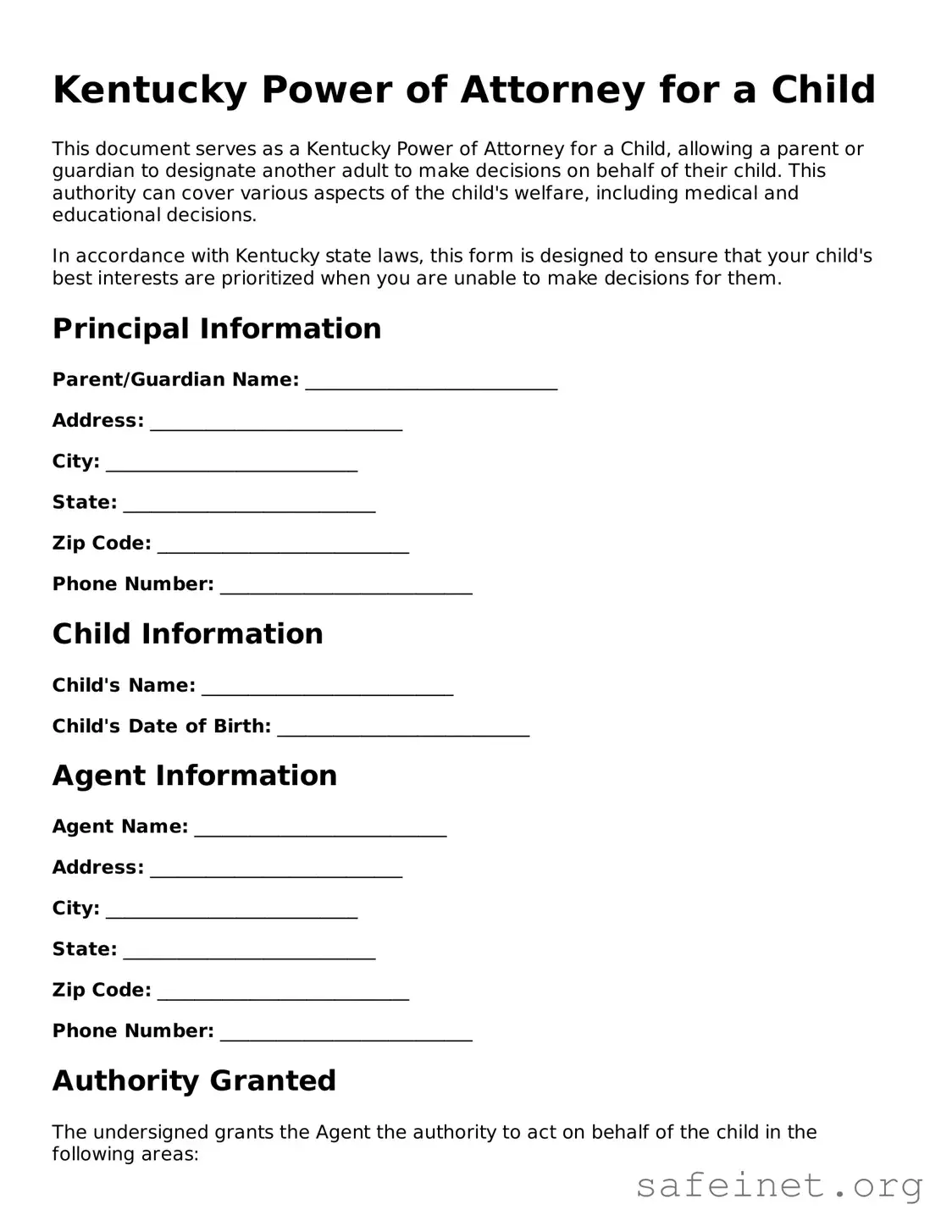
When it comes to ensuring the well-being and care of a child, having the right legal tools in place can make all the difference. In Kentucky, the Power of Attorney for a Child form is an essential document that allows a parent or legal guardian to designate another trusted adult to make decisions on behalf of their child. This arrangement can be particularly useful in situations where the parent may be temporarily unavailable, such as during travel, medical emergencies, or other unforeseen circumstances. The form covers various aspects, including the duration of the power granted, the specific rights and responsibilities of the appointed individual, and any limitations on their authority. By clearly outlining these details, the Power of Attorney for a Child form helps to ensure that the child’s needs are met while providing peace of mind to the parent or guardian. Understanding how to properly complete and utilize this form can empower families to navigate challenging situations with confidence and care.
Kentucky Power of Attorney for a Child
This document serves as a Kentucky Power of Attorney for a Child, allowing a parent or guardian to designate another adult to make decisions on behalf of their child. This authority can cover various aspects of the child's welfare, including medical and educational decisions.
In accordance with Kentucky state laws, this form is designed to ensure that your child's best interests are prioritized when you are unable to make decisions for them.
Principal Information
Parent/Guardian Name: ___________________________
Address: ___________________________
City: ___________________________
State: ___________________________
Zip Code: ___________________________
Phone Number: ___________________________
Child Information
Child's Name: ___________________________
Child's Date of Birth: ___________________________
Agent Information
Agent Name: ___________________________
Address: ___________________________
City: ___________________________
State: ___________________________
Zip Code: ___________________________
Phone Number: ___________________________
Authority Granted
The undersigned grants the Agent the authority to act on behalf of the child in the following areas:
Effective Date
This Power of Attorney shall become effective on ___________________________ and shall remain in effect until ___________________________ or until revoked in writing by the Principal.
Signatures
By signing below, the Principal affirms that they are the legal guardian of the child and that they are granting this Power of Attorney willingly.
Principal Signature: ___________________________
Date: ___________________________
Agent Signature: ___________________________
Date: ___________________________
It is advisable to have this document notarized to ensure its validity.
| Fact Name | Description |
|---|---|
| Purpose | The Kentucky Power of Attorney for a Child form allows a parent or guardian to designate another adult to make decisions for their child. |
| Governing Law | This form is governed by Kentucky Revised Statutes, specifically KRS 403.320. |
| Duration | The authority granted by this form typically lasts until the child turns 18 or until it is revoked by the parent or guardian. |
| Requirements | Both the parent and the designated adult must sign the form in the presence of a notary public. |
After obtaining the Kentucky Power of Attorney for a Child form, you will need to complete it accurately. This form allows a designated individual to make decisions on behalf of a child. Follow these steps to ensure proper completion.
Once the form is filled out and notarized, keep a copy for your records. Provide the original to the attorney-in-fact, and ensure they understand the responsibilities they are taking on.
What is a Kentucky Power of Attorney for a Child form?
The Kentucky Power of Attorney for a Child form allows a parent or legal guardian to grant another adult the authority to make decisions on behalf of their child. This can include decisions about medical care, education, and other important aspects of the child's life. This form is useful when parents are temporarily unable to care for their child due to travel, work commitments, or other reasons.
Who can be appointed as an agent in the Power of Attorney for a Child?
Any responsible adult can be appointed as an agent in the Power of Attorney for a Child. This may include relatives, family friends, or trusted neighbors. It is important to choose someone who will act in the best interest of the child and who is willing to take on this responsibility.
How long is the Power of Attorney for a Child valid?
The Power of Attorney for a Child in Kentucky is typically valid until the specified end date in the document or until the parent or guardian revokes it. If no end date is provided, it may remain in effect until the child reaches the age of 18. Parents should review the document regularly to ensure it meets their current needs.
Do I need to have the Power of Attorney for a Child form notarized?
Yes, the Power of Attorney for a Child form must be signed in the presence of a notary public. This adds a layer of legal protection and ensures that the document is valid. Both the parent or guardian and the agent should keep a copy of the notarized form for their records.
Can the Power of Attorney for a Child be revoked?
Yes, the Power of Attorney for a Child can be revoked at any time by the parent or legal guardian. To do this, a written notice should be provided to the agent and any relevant parties. It is a good idea to create a formal revocation document and have it notarized to avoid any confusion.
Not Specifying the Duration: Many individuals forget to indicate how long the power of attorney will be in effect. This can lead to confusion and potential legal issues.
Failing to Include All Necessary Information: It’s crucial to provide complete details about both the child and the agent. Missing names, addresses, or contact information can invalidate the document.
Not Signing in Front of a Notary: Some people overlook the requirement to have the document notarized. Without a notary's signature, the power of attorney may not be legally recognized.
Using Incorrect Language: Misunderstanding the terms or using vague language can create ambiguity. Clear and precise wording is essential to avoid misinterpretation.
Neglecting to Inform the Child: It’s important to discuss the arrangement with the child, especially if they are old enough to understand. This ensures that they are aware of who will be making decisions on their behalf.
When considering the Kentucky Power of Attorney for a Child form, it's essential to understand that this document often works in conjunction with several other important forms. Each of these documents serves a specific purpose in ensuring the child's welfare and legal representation. Below is a list of other forms that may be used alongside the Power of Attorney for a Child.
Each of these forms plays a vital role in ensuring that a child’s needs are met when a parent or guardian cannot be present. Understanding these documents can help in making informed decisions about a child's care and support.
The Kentucky Power of Attorney for a Child form is similar to a General Power of Attorney. Both documents allow an individual to grant authority to another person to act on their behalf. However, the General Power of Attorney can cover a wide range of financial and legal matters, while the Power of Attorney for a Child is specifically focused on the care and custody of a minor. This document is particularly useful for parents or guardians who need to delegate authority for child-related decisions, such as education and healthcare, to another trusted adult.
Another similar document is the Medical Power of Attorney. This form allows an individual to appoint someone to make healthcare decisions on their behalf if they become unable to do so. While the Medical Power of Attorney is focused solely on medical decisions, the Power of Attorney for a Child encompasses a broader scope, including daily care and educational decisions. Both documents ensure that a trusted individual can make important choices when the primary caregiver is unavailable.
The Child Custody Agreement also shares similarities with the Power of Attorney for a Child. A Child Custody Agreement outlines the terms of custody and visitation between parents or guardians. In contrast, the Power of Attorney for a Child grants temporary authority to another adult to make decisions for the child. While both documents address the child's welfare, the Power of Attorney can be used in situations where parents are unable to care for their child temporarily, such as during travel or illness.
Another related document is the Temporary Guardianship Agreement. This agreement allows a parent to appoint a temporary guardian for their child. It is often used in situations where the parent is unable to care for the child for a limited time. Similar to the Power of Attorney for a Child, it grants authority to another adult to make decisions regarding the child's welfare. However, the Temporary Guardianship Agreement is typically more formal and may require court approval, whereas the Power of Attorney can be executed without court involvement.
The Child Care Authorization form is also comparable to the Power of Attorney for a Child. This document is often used by parents to authorize another adult to provide care for their child, such as during school or daycare. Like the Power of Attorney for a Child, it allows another adult to make decisions related to the child's care. However, the Child Care Authorization is usually more limited in scope and duration compared to the broader authority granted in the Power of Attorney.
The Affidavit of Guardianship is another document that bears resemblance to the Power of Attorney for a Child. This affidavit is used to affirm a person's status as a guardian of a child. While it establishes the legal relationship of guardianship, the Power of Attorney for a Child provides temporary authority for another adult to act on behalf of the child. Both documents aim to protect the child's interests, but they serve different legal purposes and contexts.
Finally, the Consent for Medical Treatment form is similar in that it allows a designated individual to make medical decisions for a child. This form is often used in situations where a parent or guardian cannot be present to give consent for medical treatment. While the Power of Attorney for a Child includes authority for medical decisions, the Consent for Medical Treatment is specifically focused on healthcare scenarios. Both documents ensure that a child receives necessary care when the primary caregiver is unavailable.
When filling out the Kentucky Power of Attorney for a Child form, it is important to approach the process with care. Below is a list of things you should and shouldn't do.
Understanding the Kentucky Power of Attorney for a Child form is crucial for parents and guardians. However, several misconceptions can lead to confusion. Here are nine common misconceptions:
Clearing up these misconceptions can help ensure that parents and guardians make informed decisions regarding their children's care and legal arrangements.
When filling out and using the Kentucky Power of Attorney for a Child form, consider these key takeaways:
Taking these steps can help ensure that the process goes smoothly and that the best interests of the child are prioritized.