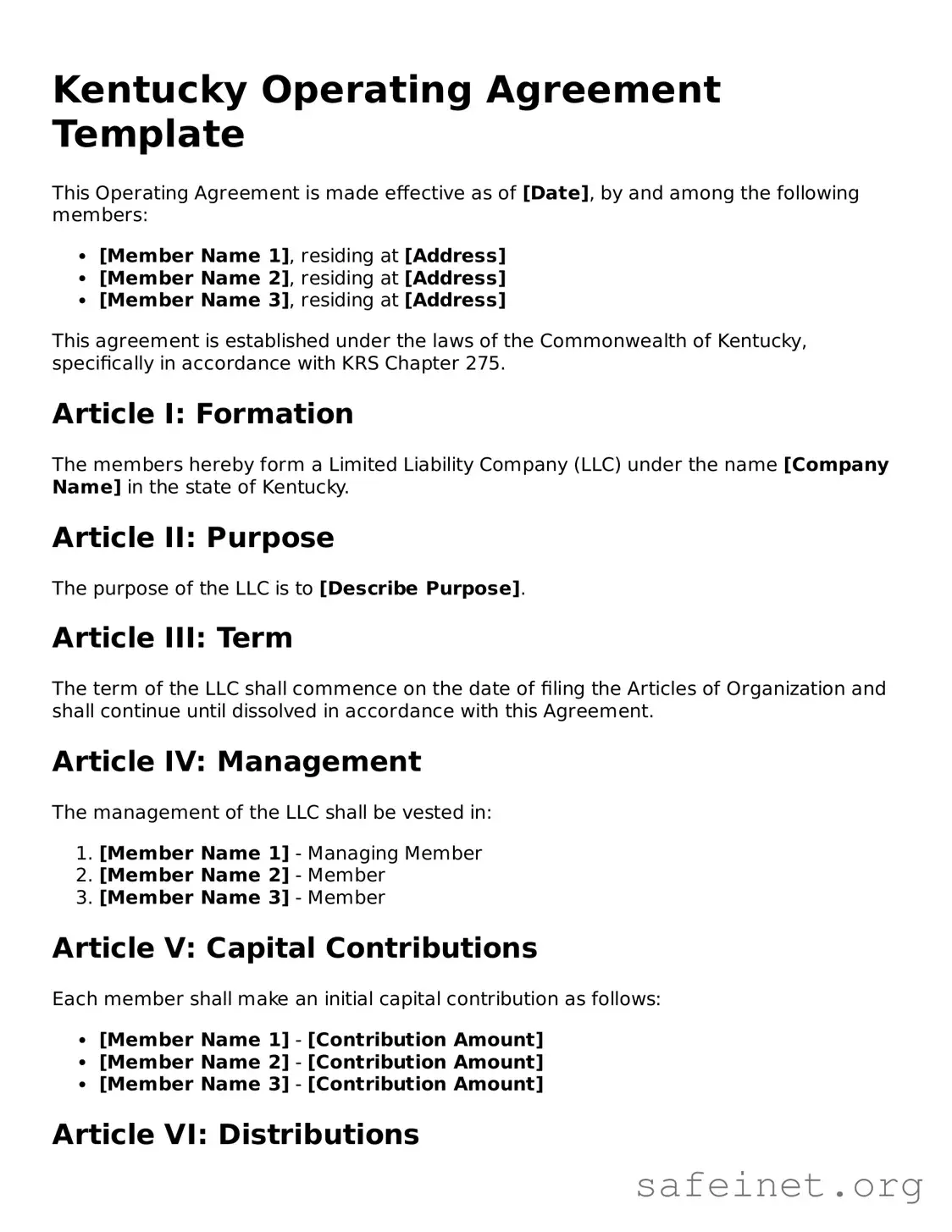
The Kentucky Operating Agreement form serves as a foundational document for limited liability companies (LLCs) operating within the state. This essential agreement outlines the management structure, operational procedures, and ownership interests of the LLC, ensuring that all members are on the same page regarding their rights and responsibilities. By clearly delineating roles, the form helps prevent misunderstandings and disputes among members, fostering a collaborative environment. Key components typically include provisions related to member contributions, profit distribution, decision-making processes, and procedures for adding or removing members. Additionally, the agreement may address the dissolution of the company and the distribution of assets upon winding up its affairs. Utilizing this form not only establishes a clear framework for the LLC's operations but also reinforces its legal standing, providing members with peace of mind as they navigate their business endeavors.
Kentucky Operating Agreement Template
This Operating Agreement is made effective as of [Date], by and among the following members:
This agreement is established under the laws of the Commonwealth of Kentucky, specifically in accordance with KRS Chapter 275.
Article I: Formation
The members hereby form a Limited Liability Company (LLC) under the name [Company Name] in the state of Kentucky.
Article II: Purpose
The purpose of the LLC is to [Describe Purpose].
Article III: Term
The term of the LLC shall commence on the date of filing the Articles of Organization and shall continue until dissolved in accordance with this Agreement.
Article IV: Management
The management of the LLC shall be vested in:
Article V: Capital Contributions
Each member shall make an initial capital contribution as follows:
Article VI: Distributions
Distributions shall be made to members in proportion to their respective ownership interests in the LLC.
Article VII: Indemnification
The LLC shall indemnify any member or manager for any act or omission performed in good faith on behalf of the LLC.
Article VIII: Amendments
This Operating Agreement may be amended only by a written agreement signed by all members.
Article IX: Governing Law
This Agreement shall be governed by and construed in accordance with the laws of the Commonwealth of Kentucky.
IN WITNESS WHEREOF, the members have executed this Operating Agreement as of the date first above written.
______________________________
[Member Name 1]
______________________________
[Member Name 2]
______________________________
[Member Name 3]
| Fact Name | Description |
|---|---|
| Purpose | The Kentucky Operating Agreement outlines the management structure and operational procedures of a limited liability company (LLC). |
| Governing Law | This agreement is governed by the Kentucky Revised Statutes, specifically KRS Chapter 275. |
| Members | All members of the LLC should sign the Operating Agreement to ensure mutual understanding and agreement. |
| Flexibility | The Operating Agreement allows members to customize the management and financial arrangements of the LLC. |
| Dispute Resolution | It often includes provisions for resolving disputes among members, which can help prevent future conflicts. |
| Not Mandatory | While not required by law, having an Operating Agreement is highly recommended for LLCs in Kentucky. |
Filling out the Kentucky Operating Agreement form is a straightforward process. Once you have completed the form, it will serve as a foundational document for your business, outlining the management structure and operational procedures.
What is a Kentucky Operating Agreement?
A Kentucky Operating Agreement is a legal document that outlines the management structure and operational procedures of a limited liability company (LLC) in Kentucky. It serves as a foundational agreement among the members of the LLC, detailing how the business will be run, how profits and losses will be distributed, and the rights and responsibilities of each member. While not required by state law, having an Operating Agreement is highly recommended to prevent misunderstandings and conflicts among members.
Is an Operating Agreement required in Kentucky?
No, Kentucky does not legally require LLCs to have an Operating Agreement. However, it is strongly advisable to create one. An Operating Agreement can help clarify the roles of members, outline decision-making processes, and provide guidelines for resolving disputes. This can be particularly important in protecting the limited liability status of the LLC and ensuring that the members are on the same page regarding the operation of the business.
What should be included in a Kentucky Operating Agreement?
A comprehensive Kentucky Operating Agreement typically includes several key components. First, it should identify the members of the LLC and their ownership percentages. Next, it should outline the management structure, specifying whether the LLC will be member-managed or manager-managed. Additionally, the agreement should detail how profits and losses will be allocated, the process for admitting new members, and procedures for handling member departures or the dissolution of the LLC. It may also include provisions for dispute resolution and amendments to the agreement.
Can I create my own Operating Agreement?
Yes, you can create your own Operating Agreement for your Kentucky LLC. There are many templates available online that can guide you through the process. However, while drafting your own agreement can save money, it’s essential to ensure that it meets the specific needs of your business and complies with Kentucky laws. Consulting with a legal professional can provide valuable insights and help you avoid potential pitfalls.
How does an Operating Agreement protect LLC members?
An Operating Agreement protects LLC members by clearly defining the rules and expectations for the business. It helps to establish a framework for decision-making and conflict resolution, which can reduce the likelihood of disputes. By outlining the financial arrangements and management responsibilities, it ensures that all members understand their rights and obligations. This clarity can be crucial in maintaining the limited liability protection that an LLC provides, as it demonstrates that the business is a separate entity from its owners.
What happens if my LLC does not have an Operating Agreement?
If an LLC does not have an Operating Agreement, it may face several challenges. In the absence of this document, the default rules set by Kentucky state law will apply. These rules may not align with the specific needs or intentions of the members. This can lead to misunderstandings, disputes, and difficulties in decision-making. Moreover, without a clear agreement, members may find it harder to enforce their rights or protect their interests in the event of a disagreement or legal issue.
Not Including All Members: One common mistake is failing to list all members of the LLC. It's essential to include everyone who has an ownership interest in the business. Omitting a member can lead to disputes down the line.
Incorrectly Stating Ownership Percentages: Some people miscalculate or misstate the ownership percentages. Each member's share should reflect their actual investment or contribution. Double-checking these figures can prevent future misunderstandings.
Neglecting to Define Roles and Responsibilities: Another frequent error is not clearly defining each member's role within the company. This can lead to confusion about who is responsible for what tasks. Clearly outlining duties helps keep the business running smoothly.
Forgetting to Include a Dispute Resolution Clause: Many people overlook the importance of having a dispute resolution clause. This clause can provide a clear process for resolving conflicts among members. Including it can save time and money if disagreements arise.
When forming a limited liability company (LLC) in Kentucky, the Operating Agreement is a crucial document. However, several other forms and documents may be necessary to ensure compliance with state regulations and to establish the structure of the business. Below is a list of commonly used documents that accompany the Kentucky Operating Agreement.
In summary, the Kentucky Operating Agreement is just one part of the larger framework of documents necessary for establishing and running an LLC. Each document plays a significant role in ensuring legal compliance and smooth operation of the business.
The Kentucky Operating Agreement is similar to the Limited Liability Company (LLC) Operating Agreement found in other states. Both documents serve the primary purpose of outlining the management structure and operational procedures of an LLC. They detail the rights and responsibilities of members, including how profits and losses are distributed. This ensures that all members are on the same page regarding the functioning of the business, promoting transparency and reducing potential conflicts.
Another document that shares similarities is the Partnership Agreement. This agreement is used by partnerships to define the roles of each partner and the distribution of profits and losses. Like the Operating Agreement, it provides a framework for decision-making and conflict resolution. Both documents aim to protect the interests of the parties involved and ensure smooth operation of the business entity.
The Corporate Bylaws document resembles the Kentucky Operating Agreement in that it governs the internal management of a corporation. Bylaws outline the responsibilities of directors and officers, meeting protocols, and voting procedures. Similar to the Operating Agreement, Corporate Bylaws are essential for maintaining order and clarity within the organization, ensuring that all members understand their rights and obligations.
The Shareholder Agreement is another document that bears resemblance to the Kentucky Operating Agreement. This agreement is often used in corporations to define the relationship between shareholders, including their rights, obligations, and how shares may be transferred. Both documents help to mitigate disputes by clearly outlining expectations and responsibilities, fostering a cooperative environment among stakeholders.
A Joint Venture Agreement also shares common elements with the Kentucky Operating Agreement. This document outlines the terms and conditions under which two or more parties collaborate on a specific project. Like the Operating Agreement, it establishes the roles of each party, profit-sharing arrangements, and how decisions will be made, ensuring that all parties are aligned in their goals and responsibilities.
The Nonprofit Bylaws document is similar to the Kentucky Operating Agreement in that it governs the internal processes of a nonprofit organization. These bylaws define the roles of board members, meeting procedures, and how decisions are made. Both documents aim to provide structure and clarity, ensuring that the organization operates effectively and in accordance with its mission.
The Employment Agreement can also be compared to the Kentucky Operating Agreement. While it focuses on the relationship between an employer and employee, it similarly outlines expectations, responsibilities, and rights. Both documents are essential for establishing clear terms, reducing misunderstandings, and fostering a positive working environment.
The Franchise Agreement shares characteristics with the Kentucky Operating Agreement, as it defines the relationship between a franchisor and franchisee. This document outlines the rights and obligations of both parties, including fees, operational guidelines, and branding requirements. Both agreements aim to ensure that all parties understand their roles and responsibilities, promoting a successful business relationship.
The Service Agreement is another document that resembles the Kentucky Operating Agreement. This agreement outlines the terms of service between a provider and a client. Like the Operating Agreement, it details the scope of work, payment terms, and expectations, helping to prevent disputes and ensuring that both parties are clear on their commitments.
Lastly, the Lease Agreement can be seen as similar to the Kentucky Operating Agreement in that it establishes the terms under which one party rents property from another. This document outlines the rights and responsibilities of both the landlord and tenant, including payment terms and maintenance obligations. Both agreements serve to clarify expectations and protect the interests of the parties involved, fostering a harmonious relationship.
When filling out the Kentucky Operating Agreement form, it's important to be thorough and accurate. Here are some guidelines to help you navigate the process:
Understanding the Kentucky Operating Agreement form is crucial for anyone looking to establish a limited liability company (LLC) in the state. However, several misconceptions can lead to confusion. Below are ten common misconceptions about this important document.
Many believe that an Operating Agreement is not necessary for LLCs in Kentucky. While it is not required by law, having one is highly advisable as it outlines the management structure and operational guidelines of the company.
Some think that every member of the LLC must sign the Operating Agreement for it to be valid. In reality, while it is beneficial for all members to sign, only the members listed in the agreement need to agree to its terms.
This misconception suggests that single-member LLCs do not need an Operating Agreement. However, having one can still provide clarity and help establish the legitimacy of the business.
Some individuals believe that an Operating Agreement is set in stone after it is drafted. In fact, it can be amended as the needs of the business or its members change, provided that the amendment process is outlined within the agreement itself.
Many think that Kentucky offers a one-size-fits-all template for Operating Agreements. While resources may be available, it is crucial for each LLC to create a tailored agreement that reflects its specific needs and circumstances.
Some believe that legal expertise is required to draft an Operating Agreement. While consulting a lawyer can be beneficial, many business owners can create a comprehensive agreement using available resources and templates.
This misconception implies that the agreement only addresses profit distribution. In reality, it encompasses various aspects, including management structure, decision-making processes, and member responsibilities.
Some assume that every member of an LLC has equal voting power. The Operating Agreement can specify different voting rights based on member contributions or other criteria, allowing for flexibility in governance.
This belief suggests that state registration alone is sufficient for an LLC's operation. However, the Operating Agreement is essential for internal governance and can prevent disputes among members.
Many think that the Operating Agreement becomes a public document upon filing with the state. In fact, it remains a private document and is not required to be filed with the state.
Filling out and utilizing the Kentucky Operating Agreement form is an essential step for business owners in the state. Here are some key takeaways to consider:
By keeping these points in mind, business owners can effectively utilize the Kentucky Operating Agreement form to foster a harmonious and productive business environment.