In the realm of landlord-tenant relationships, understanding the legal processes involved can make a significant difference in maintaining harmony and ensuring compliance. One crucial document in Kentucky is the Notice to Quit form, a formal notification that a landlord can issue to a tenant when they have violated the terms of their lease or rental agreement. This form serves as a preliminary step, signaling the tenant that they must vacate the premises by a specified date, often due to non-payment of rent, lease violations, or other significant breaches. It's important to note that the Notice to Quit is not an eviction notice; rather, it initiates a process that could lead to eviction if the tenant does not comply. The form typically outlines the reasons for the notice, the required timeframe for the tenant to respond, and the consequences of failing to vacate. By understanding the nuances of this form, both landlords and tenants can navigate the complexities of rental agreements with greater clarity and confidence.
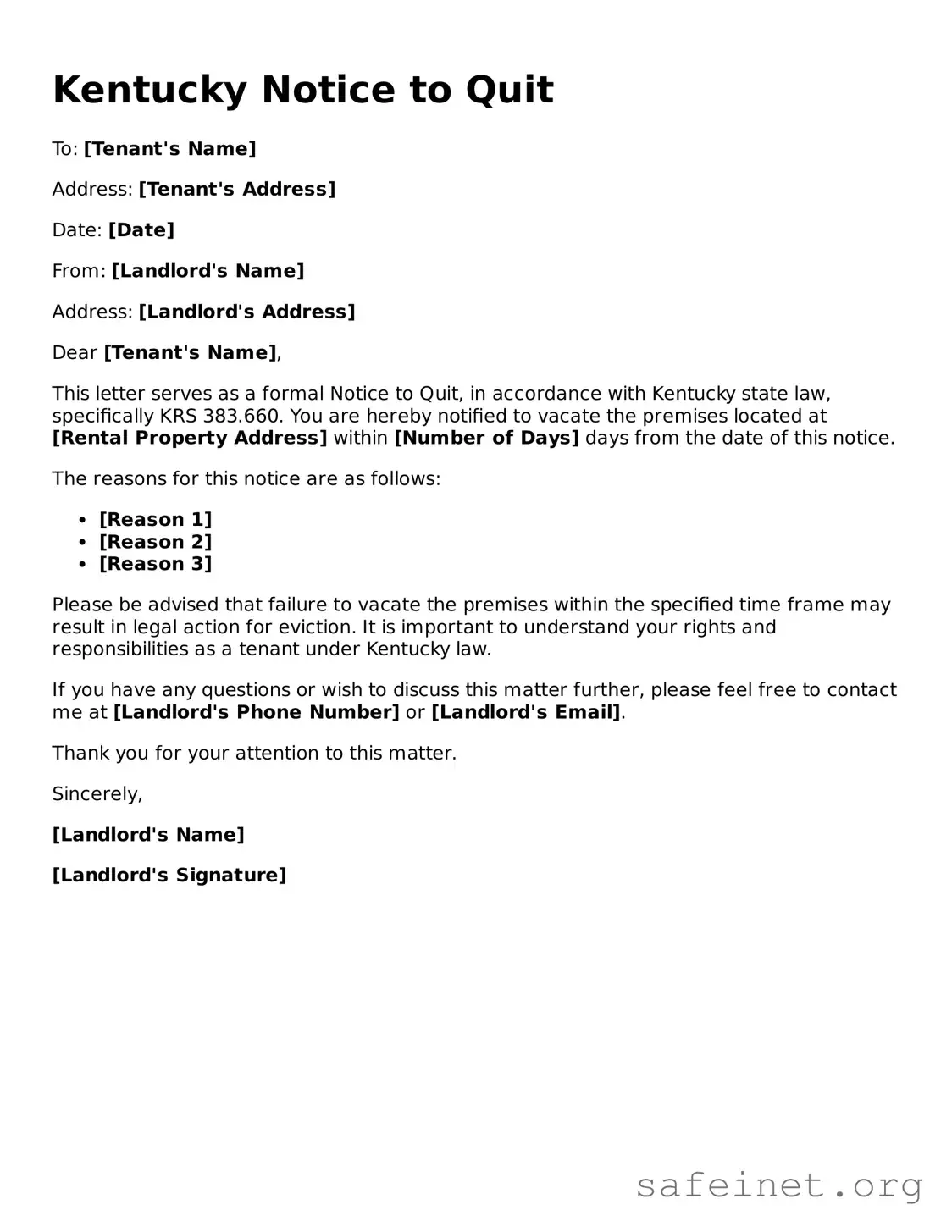
Kentucky Notice to Quit
To: [Tenant's Name]
Address: [Tenant's Address]
Date: [Date]
From: [Landlord's Name]
Address: [Landlord's Address]
Dear [Tenant's Name],
This letter serves as a formal Notice to Quit, in accordance with Kentucky state law, specifically KRS 383.660. You are hereby notified to vacate the premises located at [Rental Property Address] within [Number of Days] days from the date of this notice.
The reasons for this notice are as follows:
Please be advised that failure to vacate the premises within the specified time frame may result in legal action for eviction. It is important to understand your rights and responsibilities as a tenant under Kentucky law.
If you have any questions or wish to discuss this matter further, please feel free to contact me at [Landlord's Phone Number] or [Landlord's Email].
Thank you for your attention to this matter.
Sincerely,
[Landlord's Name]
[Landlord's Signature]
| Fact Name | Description |
|---|---|
| Purpose | The Kentucky Notice to Quit form is used by landlords to formally notify tenants of their intent to terminate a lease agreement. |
| Governing Law | This form is governed by Kentucky Revised Statutes (KRS) Chapter 383, which outlines landlord-tenant relationships. |
| Notice Period | Landlords must provide tenants with a minimum of 7 days' notice for non-payment of rent and 30 days' notice for lease termination without cause. |
| Delivery Methods | The notice can be delivered in person, posted on the property, or sent via certified mail to ensure the tenant receives it. |
| Tenant's Rights | Tenants have the right to contest the notice in court if they believe it was issued improperly or if they have a valid defense. |
| Form Requirements | The form must include the date, the tenant's name, the address of the rental property, and the reason for termination. |
| Legal Consequences | If a tenant fails to vacate after receiving the notice, the landlord may proceed with eviction proceedings in court. |
| Record Keeping | Landlords should keep a copy of the Notice to Quit form and any proof of delivery for their records in case of future disputes. |
After completing the Kentucky Notice to Quit form, you will need to deliver it to the tenant. This step is crucial in ensuring that the tenant is aware of the situation and can take appropriate action. Follow these steps to accurately fill out the form.
Once the form is filled out, ensure it is delivered to the tenant in a manner that complies with local laws. This may include personal delivery, mailing, or posting on the property.
What is a Kentucky Notice to Quit form?
The Kentucky Notice to Quit form is a legal document used by landlords to notify tenants that they must vacate the rental property. This notice is typically issued when a tenant has violated the terms of their lease agreement, such as failing to pay rent or engaging in illegal activities. The form outlines the reasons for the eviction and specifies the time frame in which the tenant must leave the property. It serves as a formal step in the eviction process and is crucial for landlords to follow the proper legal procedures.
How much notice is required in a Kentucky Notice to Quit?
The amount of notice required can vary depending on the reason for the eviction. Generally, landlords must provide a minimum of seven days' notice for non-payment of rent. For other lease violations, such as breach of contract or illegal activity, the notice period may also be seven days. However, if the tenant has engaged in serious illegal conduct, immediate eviction may be pursued without prior notice. It is essential for landlords to comply with these time frames to ensure the eviction process is valid.
Can a tenant contest a Notice to Quit in Kentucky?
Yes, a tenant has the right to contest a Notice to Quit. If a tenant believes the notice is unjust or that they have rectified the issue stated in the notice, they can respond to the landlord. This may involve paying overdue rent or addressing the specific lease violation. If the dispute escalates, the tenant may choose to file a response in court once an eviction lawsuit is initiated. It’s important for tenants to act quickly and seek legal advice if they feel their rights are being violated.
What happens if a tenant does not leave after receiving a Notice to Quit?
If a tenant does not vacate the property by the deadline specified in the Notice to Quit, the landlord may proceed with the eviction process. This usually involves filing an eviction lawsuit in the local court. If the court rules in favor of the landlord, a judgment will be issued, allowing law enforcement to remove the tenant from the property if necessary. Tenants should take the notice seriously and consider their options to avoid further legal complications.
Incomplete Information: Many people forget to fill out all required fields. Missing details can lead to delays or even invalid notices.
Incorrect Dates: It's crucial to specify the correct date for the notice. Using the wrong date can confuse the tenant about when they need to vacate.
Failure to Sign: A signature is essential. Without it, the notice may not be considered valid, leaving the landlord without proper recourse.
Not Following Local Laws: Each jurisdiction may have specific requirements. Ignoring local regulations can result in the notice being thrown out in court.
Using Vague Language: Clear and direct language is important. Ambiguity can lead to misunderstandings and legal challenges.
Not Keeping a Copy: Always retain a copy of the notice for your records. This documentation can be vital if disputes arise later.
Ignoring Delivery Methods: Proper delivery is key. Failing to follow legal methods for delivering the notice may invalidate it.
The Kentucky Notice to Quit form is often used in conjunction with several other documents that facilitate the eviction process or address tenant-landlord relationships. Below is a list of commonly associated forms and documents.
These documents play a crucial role in ensuring that both landlords and tenants understand their rights and responsibilities throughout the eviction process. Proper use of these forms can help facilitate a smoother resolution to disputes.
The Kentucky Notice to Quit form serves as a formal notification from a landlord to a tenant, indicating the need to vacate a rental property. This document shares similarities with the eviction notice, which is a more general term used to describe any notice that informs a tenant of the landlord's intention to terminate the lease. Both documents outline the reasons for termination and specify a time frame for the tenant to leave the premises. However, the eviction notice may not always require the same level of detail regarding the tenant's actions or lease violations, depending on local laws.
Another document comparable to the Kentucky Notice to Quit is the lease termination letter. This letter is typically used by landlords or tenants to end a rental agreement. While the Notice to Quit focuses on the tenant's obligation to vacate due to specific reasons, the lease termination letter may simply express a mutual decision to end the lease at its expiration. Both documents serve to clarify the intentions of the parties involved, but the lease termination letter may not necessarily cite any lease violations.
The demand for possession notice is another document similar to the Kentucky Notice to Quit. This notice is often issued when a tenant has failed to pay rent. It demands that the tenant either pay the overdue rent or vacate the property. Like the Notice to Quit, it serves as a formal communication regarding the landlord's rights. However, the demand for possession notice is more focused on financial obligations, while the Notice to Quit can address various lease violations.
The notice of non-renewal is also akin to the Kentucky Notice to Quit. This document is sent to inform a tenant that their lease will not be renewed at the end of its term. Both documents communicate a decision to terminate a tenancy, but the notice of non-renewal typically does not require the tenant to vacate immediately, as it is more concerned with the end of the lease period rather than immediate eviction.
The notice to cure is another relevant document. This notice is issued when a tenant has violated a term of the lease, such as failing to maintain the property. It provides the tenant with an opportunity to rectify the issue within a specified time frame. Similar to the Kentucky Notice to Quit, the notice to cure emphasizes the need for compliance with lease terms, but it allows for correction before any further action is taken.
The three-day notice to pay rent or quit is a specific type of eviction notice used in many jurisdictions. It informs tenants that they have three days to pay overdue rent or face eviction proceedings. Like the Kentucky Notice to Quit, it serves as a warning, but it is specifically focused on rent payment rather than broader lease violations.
The notice of lease violation is another document that shares similarities with the Kentucky Notice to Quit. This notice is issued when a tenant breaches a specific term of the lease, such as unauthorized pets or excessive noise. It outlines the violation and may provide the tenant with a chance to remedy the situation. While both documents address lease compliance, the notice of lease violation may not always lead to immediate eviction, depending on the circumstances.
The written warning is also comparable to the Kentucky Notice to Quit. This document is often used in landlord-tenant relationships to formally address issues such as disturbances or property damage. It serves as a record of the landlord's concerns and may precede more serious actions, such as issuing a Notice to Quit. Both documents aim to communicate issues clearly, but the written warning may not always demand immediate action.
The notice of abandonment is another document that bears resemblance to the Kentucky Notice to Quit. This notice is issued when a landlord believes that a tenant has vacated the property without notice. It informs the tenant of the landlord's intention to reclaim the property. While the Notice to Quit requires the tenant to vacate for specific reasons, the notice of abandonment is more about reclaiming property that the landlord believes is no longer occupied.
Lastly, the notice of intent to vacate is similar to the Kentucky Notice to Quit in that it informs the landlord of a tenant's decision to leave the property. This document is typically submitted by the tenant and outlines their intention to end the lease. While the Notice to Quit is initiated by the landlord, both documents facilitate the communication necessary for a smooth transition out of a rental agreement.
When filling out the Kentucky Notice to Quit form, it's essential to approach the process with care. This form is a critical document in the eviction process, and accuracy is key. Here’s a guide to help you navigate what to do and what to avoid.
By following these guidelines, you can help ensure that the process goes smoothly and that you are compliant with Kentucky laws regarding eviction notices. Remember, clarity and accuracy are your allies in this situation.
The Kentucky Notice to Quit form is an important document in the landlord-tenant relationship. However, several misconceptions exist regarding its purpose and use. Below are four common misconceptions explained.
This is not accurate. The Notice to Quit serves as a formal request for a tenant to vacate the property. It does not constitute an eviction. Eviction requires a legal process that includes court involvement.
Landlords must have valid grounds to issue this notice. Reasons may include non-payment of rent or lease violations. However, personal reasons or discrimination cannot justify a Notice to Quit.
Tenants retain rights even after receiving this notice. They can respond, negotiate, or contest the notice in court. Understanding these rights is crucial for both parties.
While personal delivery is one option, landlords can also send the Notice to Quit via certified mail or other legal methods. The method of delivery must comply with Kentucky law to ensure validity.
When filling out and using the Kentucky Notice to Quit form, keep these key takeaways in mind: