In the world of business, protecting sensitive information is crucial for maintaining a competitive edge. The Kentucky Non-disclosure Agreement (NDA) serves as a vital tool for individuals and organizations seeking to safeguard their proprietary information. This legal document outlines the obligations of the parties involved, ensuring that confidential information shared during discussions or collaborations remains private. Key elements of the NDA include the definition of what constitutes confidential information, the duration of the confidentiality obligation, and the consequences for breaches of the agreement. By clearly specifying these aspects, the NDA fosters trust and encourages open communication between parties, whether they are forming partnerships, negotiating contracts, or sharing trade secrets. Understanding the Kentucky NDA is essential for anyone looking to navigate the complexities of business relationships while protecting their valuable information.
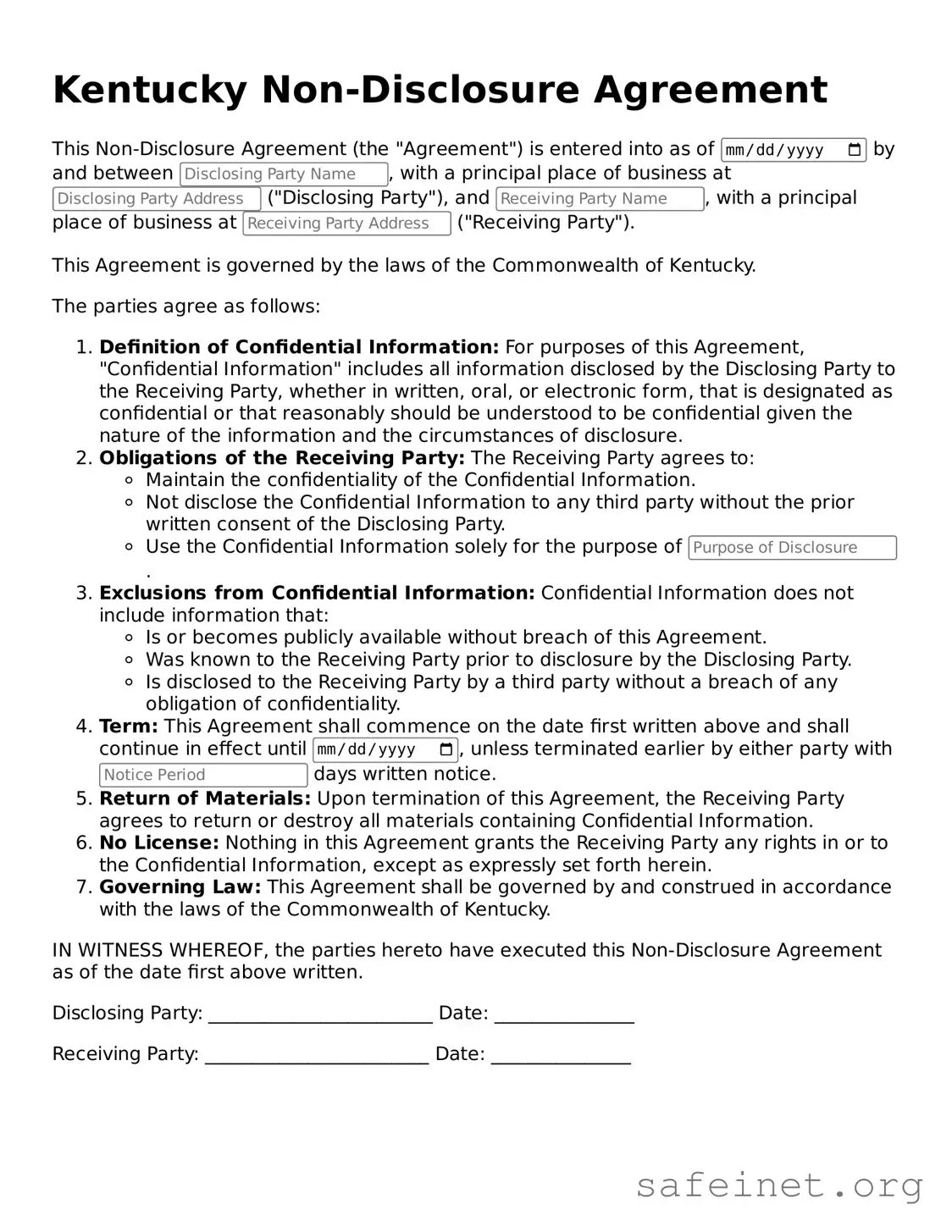
Kentucky Non-Disclosure Agreement
This Non-Disclosure Agreement (the "Agreement") is entered into as of by and between , with a principal place of business at ("Disclosing Party"), and , with a principal place of business at ("Receiving Party").
This Agreement is governed by the laws of the Commonwealth of Kentucky.
The parties agree as follows:
IN WITNESS WHEREOF, the parties hereto have executed this Non-Disclosure Agreement as of the date first above written.
Disclosing Party: ________________________ Date: _______________
Receiving Party: ________________________ Date: _______________
| Fact Name | Description |
|---|---|
| Definition | A Kentucky Non-disclosure Agreement (NDA) is a legal contract that protects confidential information shared between parties. |
| Governing Law | The NDA is governed by Kentucky state law, particularly the Uniform Trade Secrets Act. |
| Parties Involved | The agreement typically involves at least two parties: the disclosing party and the receiving party. |
| Purpose | The primary purpose is to prevent the unauthorized disclosure of sensitive information. |
| Duration | The duration of confidentiality obligations can vary, but it often lasts for a specified number of years. |
| Enforceability | NDAs in Kentucky are generally enforceable as long as they are reasonable in scope and duration. |
| Exceptions | Information that is publicly available or independently developed is usually exempt from confidentiality obligations. |
| Signature Requirement | For the NDA to be binding, it must be signed by all parties involved. |
After obtaining the Kentucky Non-disclosure Agreement form, it is essential to complete it accurately to ensure that all necessary information is provided. This document will require specific details to be filled out, and following the steps carefully will help streamline the process.
What is a Kentucky Non-disclosure Agreement (NDA)?
A Kentucky Non-disclosure Agreement is a legal contract designed to protect confidential information shared between parties. It ensures that sensitive information, such as trade secrets, business strategies, or proprietary data, remains private. When two parties enter into an NDA, they agree not to disclose any confidential information to third parties without permission.
Why would I need an NDA in Kentucky?
Using an NDA is crucial when sharing sensitive information with potential partners, employees, or clients. It provides legal protection if someone breaches the agreement. In Kentucky, having an NDA can help safeguard your business interests, especially in competitive industries where confidentiality is vital to success.
What should be included in a Kentucky NDA?
A well-drafted NDA should clearly define the confidential information being protected. It should also outline the obligations of both parties regarding the handling of that information. Key elements to include are the duration of the confidentiality obligation, the permitted uses of the information, and any exclusions from confidentiality, such as information already in the public domain.
How long does the confidentiality last under a Kentucky NDA?
The duration of confidentiality in an NDA can vary. Generally, it lasts for a specific period, often ranging from two to five years. However, the parties can negotiate this term based on their needs. It's important to note that some information, like trade secrets, may remain confidential indefinitely, even after the agreement expires.
Can I enforce a Kentucky NDA if someone breaches it?
Yes, you can enforce an NDA in Kentucky if someone violates its terms. If a breach occurs, the injured party may seek legal remedies, which could include monetary damages or injunctive relief. It's advisable to consult with a legal professional to understand your options and the best course of action in such situations.
Failing to clearly define the confidential information. It's crucial to specify what information is considered confidential to avoid ambiguity.
Not identifying the parties involved. Ensure that all parties, including individuals and organizations, are properly named and their roles defined.
Overlooking the duration of the agreement. Clearly state how long the confidentiality obligations will last, as this can vary based on the nature of the information.
Neglecting to include the purpose of the disclosure. Specify why the information is being shared, as this adds context and limits misuse.
Using vague language. Precision is key; avoid terms that can be interpreted in multiple ways, which may lead to disputes later.
Failing to address exceptions to confidentiality. There should be clear stipulations regarding what information is not considered confidential, such as publicly available information.
Not including the consequences of breach. Outline the penalties or remedies that will apply if the agreement is violated, which can serve as a deterrent.
Ignoring the governing law clause. Specify which state’s laws will govern the agreement to avoid confusion in case of legal disputes.
Forgetting to include signatures. Ensure that all parties sign the document, as a lack of signatures can render the agreement unenforceable.
Not keeping a copy of the signed agreement. Both parties should retain a copy for their records, ensuring that everyone has access to the agreed terms.
When entering into a Non-disclosure Agreement (NDA) in Kentucky, it is essential to consider other forms and documents that can support your agreement and protect your interests. Here are some commonly used documents that may accompany an NDA:
Using these documents alongside a Kentucky Non-disclosure Agreement can help create a comprehensive framework for protecting sensitive information and ensuring clear communication between parties. It is advisable to consult with a legal professional to tailor these documents to your specific needs and circumstances.
The Kentucky Non-disclosure Agreement (NDA) shares similarities with the Confidentiality Agreement. Both documents serve the primary purpose of protecting sensitive information from being disclosed to unauthorized parties. A Confidentiality Agreement typically outlines the types of information considered confidential and the obligations of the parties involved to maintain secrecy. Like the NDA, it can be used in various contexts, including business negotiations and partnerships, ensuring that proprietary information remains protected throughout the relationship.
Another document comparable to the Kentucky NDA is the Non-circumvention Agreement. This type of agreement is designed to prevent one party from bypassing another to engage directly with a third party. In business dealings, this is crucial when sensitive information is shared. Both agreements aim to safeguard interests and maintain trust between parties. While the NDA focuses on confidentiality, the Non-circumvention Agreement emphasizes the prevention of direct dealings that could undermine one party's position.
The Mutual Non-disclosure Agreement (MNDA) is also similar to the Kentucky NDA. This document is used when both parties wish to share confidential information with each other while protecting their respective interests. Unlike a one-sided NDA, the MNDA ensures that both parties are legally bound to keep each other's information confidential. This fosters a balanced relationship, encouraging open communication while safeguarding sensitive data from unauthorized disclosure.
Lastly, the Proprietary Information Agreement (PIA) is akin to the Kentucky NDA in its intent to protect proprietary information. A PIA often includes specific clauses that define what constitutes proprietary information and the obligations of the receiving party. Both documents are essential in business contexts where intellectual property, trade secrets, or other sensitive information must be protected from unauthorized access. The PIA, like the NDA, creates a legal framework to ensure that proprietary information remains secure during and after business transactions.
When filling out the Kentucky Non-disclosure Agreement form, it’s important to follow certain guidelines to ensure that the process goes smoothly. Here’s a helpful list of things to do and avoid:
Following these guidelines will help you complete the Kentucky Non-disclosure Agreement form correctly and efficiently.
Non-disclosure agreements (NDAs) are important legal tools used to protect sensitive information. However, there are several misconceptions about the Kentucky Non-disclosure Agreement form that can lead to confusion. Here are seven common misconceptions, along with explanations to clarify each one.
Understanding these misconceptions can help individuals and businesses navigate the complexities of NDAs more effectively. Being informed allows for better protection of sensitive information and fosters clearer communication between parties.
When filling out and using the Kentucky Non-disclosure Agreement form, keep these key takeaways in mind: