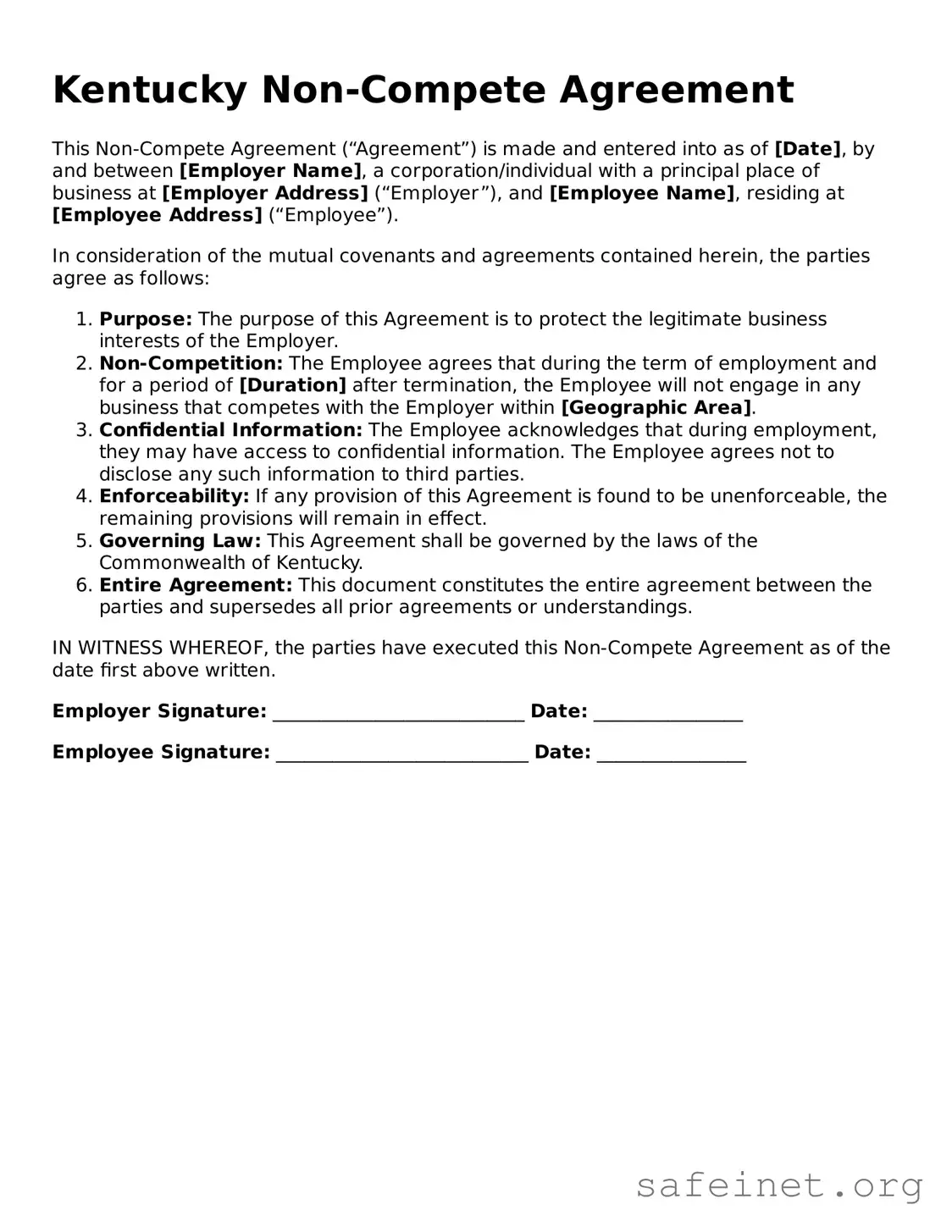
The Kentucky Non-compete Agreement form serves as a crucial tool for employers seeking to protect their business interests while balancing the rights of employees. This form outlines the specific terms under which an employee agrees not to engage in competitive activities after leaving their job. Key aspects include the duration of the non-compete period, the geographical scope of the restriction, and the types of activities that are considered competitive. Employers must ensure that the terms are reasonable and not overly restrictive, as overly broad agreements may be deemed unenforceable by the courts. Additionally, the form often requires clear consideration, such as compensation or benefits, to ensure that the agreement is valid. Understanding the nuances of this form is essential for both employers and employees to navigate the complexities of employment relationships in Kentucky.
Kentucky Non-Compete Agreement
This Non-Compete Agreement (“Agreement”) is made and entered into as of [Date], by and between [Employer Name], a corporation/individual with a principal place of business at [Employer Address] (“Employer”), and [Employee Name], residing at [Employee Address] (“Employee”).
In consideration of the mutual covenants and agreements contained herein, the parties agree as follows:
IN WITNESS WHEREOF, the parties have executed this Non-Compete Agreement as of the date first above written.
Employer Signature: ___________________________ Date: ________________
Employee Signature: ___________________________ Date: ________________
| Fact Name | Details |
|---|---|
| Definition | A non-compete agreement restricts an employee from working for competitors after leaving a job. |
| Governing Law | The agreement is governed by Kentucky state law. |
| Enforceability | Non-compete agreements in Kentucky must be reasonable in scope and duration to be enforceable. |
| Duration | Typically, a duration of one to two years is considered reasonable in Kentucky. |
| Geographic Scope | The geographic area covered by the agreement must be clearly defined and reasonable. |
| Consideration | There must be a valid reason for the agreement, such as a job offer or specialized training. |
| Blue Pencil Rule | Kentucky courts may modify overly broad agreements to make them enforceable. |
| Exceptions | Non-compete agreements may not be enforceable for certain professions, like healthcare providers. |
| Employee Rights | Employees should understand their rights before signing a non-compete agreement. |
| Legal Advice | It is wise to consult a lawyer if you have questions about a non-compete agreement. |
Filling out the Kentucky Non-compete Agreement form is a straightforward process that requires attention to detail. Once completed, this form will serve as an important document in defining the terms of employment and protecting business interests.
What is a Kentucky Non-compete Agreement?
A Kentucky Non-compete Agreement is a legal document that restricts an employee from working for a competitor or starting a competing business for a specified period after leaving their current employer. This agreement is designed to protect the employer's business interests, trade secrets, and customer relationships.
Are Non-compete Agreements enforceable in Kentucky?
Yes, Non-compete Agreements are enforceable in Kentucky, but they must meet certain criteria. The agreement should be reasonable in duration, geographic scope, and the nature of the restricted activities. Courts will assess whether the agreement protects legitimate business interests without imposing undue hardship on the employee.
How long can a Non-compete Agreement last in Kentucky?
The duration of a Non-compete Agreement in Kentucky typically ranges from six months to two years. However, the specific length must be reasonable and justifiable based on the nature of the business and the employee's role. Courts may invalidate agreements that are excessively long.
What happens if I violate a Non-compete Agreement?
If you violate a Non-compete Agreement, your former employer may take legal action against you. This could include seeking an injunction to prevent you from working for a competitor and potentially pursuing monetary damages for any losses incurred due to the violation. It is crucial to understand the terms of your agreement before making any career moves.
Can I negotiate the terms of a Non-compete Agreement?
Yes, you can negotiate the terms of a Non-compete Agreement before signing. Discussing the duration, geographic limitations, and specific activities can lead to a more balanced agreement. It is advisable to seek legal counsel during this process to ensure your rights and interests are protected.
What should I do if I am presented with a Non-compete Agreement?
If you are presented with a Non-compete Agreement, take the time to read it carefully. Consider the implications it may have on your future employment opportunities. Consulting with an attorney who specializes in employment law can provide valuable insights and help you understand your options before signing.
Not Understanding the Terms: Many people rush through the agreement without fully understanding what a non-compete means. This can lead to signing away rights without realizing it.
Incorrect Dates: Failing to fill in the correct start and end dates for the non-compete period can cause confusion later. Ensure the dates are accurate and reflect the intended duration.
Missing Signatures: Forgetting to sign the agreement or have it signed by the employer is a common oversight. Both parties need to sign for the agreement to be valid.
Not Specifying Geographic Scope: Some individuals leave out the geographic area where the non-compete applies. Clearly defining this can prevent future disputes.
Vague Language: Using unclear or ambiguous language can lead to misinterpretations. Be specific about what activities are restricted.
Ignoring State Laws: Each state has different rules regarding non-compete agreements. Failing to consider Kentucky’s specific laws can render the agreement unenforceable.
When entering into a Kentucky Non-compete Agreement, it's important to understand that this document is often accompanied by other forms and agreements that help clarify the relationship between the parties involved. Each of these documents plays a vital role in ensuring that the terms of the non-compete are enforceable and that both parties are protected. Below is a list of commonly used forms and documents that you might encounter alongside the Non-compete Agreement.
Understanding these accompanying documents is crucial for anyone entering into a Non-compete Agreement in Kentucky. Each form serves a specific purpose and helps to create a clear framework for the professional relationship. By familiarizing yourself with these documents, you can better navigate your rights and obligations, ensuring that both you and your employer are protected.
A Non-disclosure Agreement (NDA) is similar to a Non-compete Agreement in that both documents aim to protect sensitive information. An NDA prevents individuals from sharing confidential information learned during their employment or business relationship. This ensures that trade secrets, client lists, and proprietary information remain secure. While a Non-compete Agreement restricts where and how an individual can work after leaving a job, an NDA focuses on the obligation to keep certain information private during and after employment.
An Employment Agreement often includes clauses related to non-compete terms, making it a closely related document. This agreement outlines the terms of employment, including job responsibilities, compensation, and duration of employment. Within this framework, a non-compete clause may specify the limitations on the employee's ability to engage in similar work after leaving the employer. Thus, the Employment Agreement serves as a broader contract that may incorporate non-compete stipulations as part of the overall employment relationship.
A Confidentiality Agreement is another document that aligns with the goals of a Non-compete Agreement. While the latter restricts future employment opportunities, a Confidentiality Agreement emphasizes the importance of safeguarding proprietary information during and after the employment period. It obligates employees to maintain secrecy regarding sensitive business information, similar to how a Non-compete Agreement seeks to protect a company’s interests by limiting where a former employee can work. Both documents are essential in maintaining a competitive edge in the marketplace.
When filling out the Kentucky Non-compete Agreement form, it is essential to approach the task with care. Here’s a list of things you should and shouldn’t do to ensure that the agreement is clear and enforceable.
By following these guidelines, you can navigate the Non-compete Agreement process more effectively and protect your interests.
Understanding non-compete agreements can be challenging. Here are some common misconceptions about the Kentucky Non-compete Agreement form:
When filling out and using the Kentucky Non-compete Agreement form, consider the following key takeaways:
These points can help ensure that the agreement is effective and legally sound.