The Kentucky Motor Vehicle Power of Attorney form serves as a crucial legal document for individuals who need to delegate authority regarding their motor vehicle transactions. This form allows a designated agent to act on behalf of the vehicle owner, streamlining processes such as title transfers, registration, and other necessary dealings with the Kentucky Transportation Cabinet. By utilizing this form, vehicle owners can ensure that their interests are represented, even when they cannot be present to handle these matters personally. It is essential to include specific details, such as the names of both the principal and the agent, as well as a clear description of the powers being granted. The form must be signed and dated to be legally binding, providing peace of mind to those who may be unable to attend to their vehicle-related affairs due to various circumstances. Understanding the importance of this document can help vehicle owners navigate the complexities of motor vehicle laws in Kentucky more effectively.
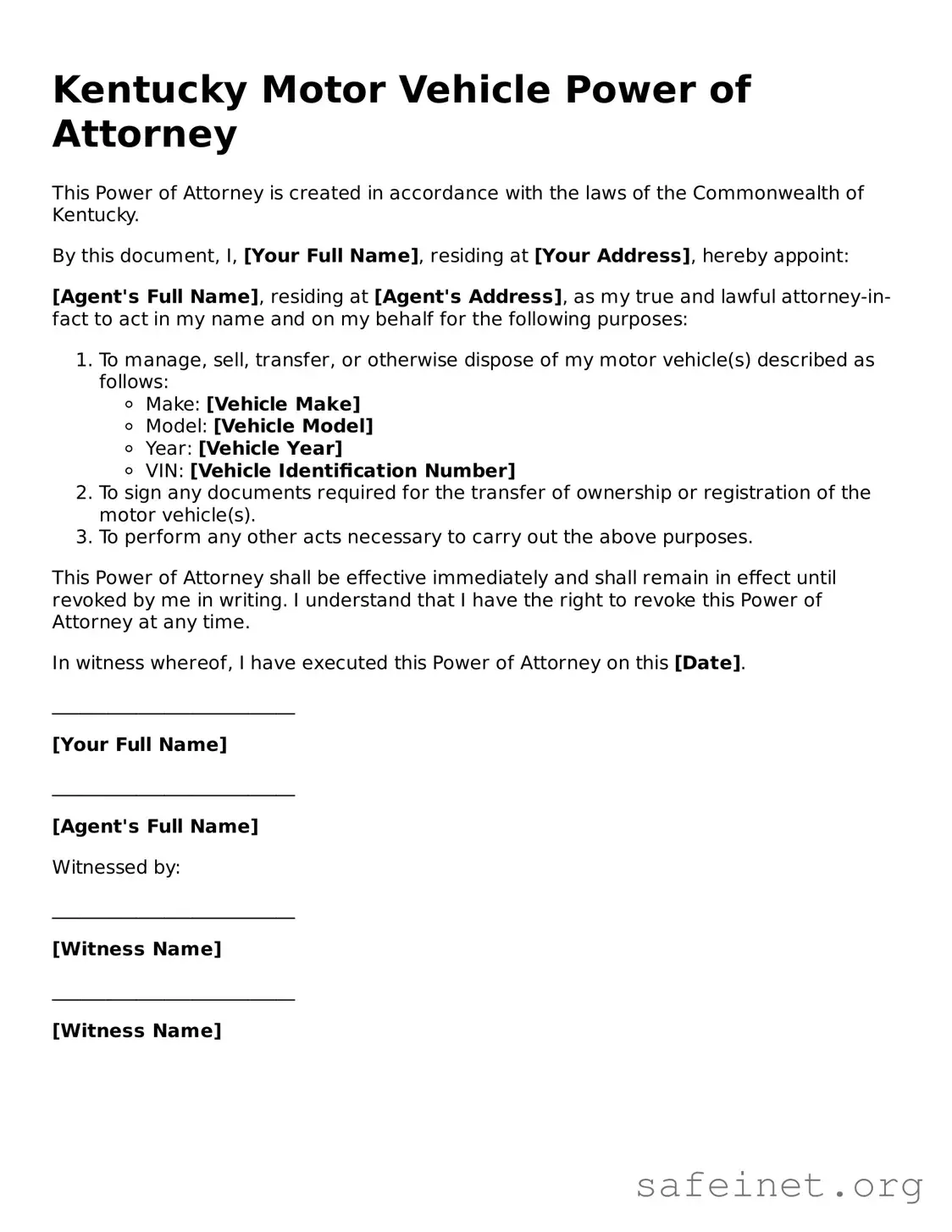
Kentucky Motor Vehicle Power of Attorney
This Power of Attorney is created in accordance with the laws of the Commonwealth of Kentucky.
By this document, I, [Your Full Name], residing at [Your Address], hereby appoint:
[Agent's Full Name], residing at [Agent's Address], as my true and lawful attorney-in-fact to act in my name and on my behalf for the following purposes:
This Power of Attorney shall be effective immediately and shall remain in effect until revoked by me in writing. I understand that I have the right to revoke this Power of Attorney at any time.
In witness whereof, I have executed this Power of Attorney on this [Date].
__________________________
[Your Full Name]
__________________________
[Agent's Full Name]
Witnessed by:
__________________________
[Witness Name]
__________________________
[Witness Name]
| Fact Name | Details |
|---|---|
| Purpose | The Kentucky Motor Vehicle Power of Attorney form allows an individual to authorize another person to handle motor vehicle transactions on their behalf. |
| Governing Law | This form is governed by Kentucky Revised Statutes, specifically KRS Chapter 186A. |
| Who Can Use It | Any vehicle owner in Kentucky can use this form to grant power of attorney to another individual. |
| Common Uses | It is commonly used for tasks such as transferring title, registering a vehicle, or obtaining a duplicate title. |
| Signature Requirement | The form must be signed by the vehicle owner to be valid. |
| Notarization | While notarization is not required, it is recommended to enhance the form's credibility. |
| Validity Period | The power of attorney remains valid until the vehicle owner revokes it or until the specified task is completed. |
Filling out the Kentucky Motor Vehicle Power of Attorney form is a straightforward process that allows you to designate someone to handle vehicle-related matters on your behalf. Once you have completed the form, it will need to be submitted to the appropriate authorities to ensure that your representative can act effectively.
What is a Kentucky Motor Vehicle Power of Attorney form?
The Kentucky Motor Vehicle Power of Attorney form is a legal document that allows one person to authorize another individual to act on their behalf regarding motor vehicle transactions. This can include tasks such as signing titles, registering vehicles, and handling other related matters. The person granting the authority is known as the principal, while the person receiving the authority is called the agent.
Who needs to use this form?
This form is useful for anyone who is unable to manage their motor vehicle transactions due to various reasons, such as being out of state, having health issues, or simply needing assistance. It can be particularly beneficial for elderly individuals, those with disabilities, or anyone who may be traveling or otherwise unavailable to handle these matters personally.
How do I complete the form?
To complete the Kentucky Motor Vehicle Power of Attorney form, you need to provide specific information, including the names and addresses of both the principal and the agent. You will also need to describe the powers being granted, which can be tailored to your needs. Once the form is filled out, it must be signed by the principal in the presence of a notary public to ensure its validity.
Is there a specific format required for the form?
While there is no official state template, the form must include certain key elements to be legally binding. These include clear identification of the parties involved, a detailed description of the powers granted, and the signature of the principal. It is advisable to follow any guidelines provided by the Kentucky Department of Transportation or consult with a legal professional to ensure compliance.
Can I revoke the Power of Attorney once it is granted?
Yes, the principal has the right to revoke the Power of Attorney at any time, as long as they are mentally competent. To do this, the principal should provide a written notice of revocation to the agent and, if possible, any institutions or entities that were relying on the original Power of Attorney. It is also a good idea to destroy any copies of the original document to prevent misuse.
Are there any limitations to the authority granted?
Yes, the authority granted through the Kentucky Motor Vehicle Power of Attorney can be limited to specific transactions or types of vehicles. The principal can specify what powers the agent has and what actions they are not allowed to take. This ensures that the agent acts within the boundaries set by the principal, providing a level of control over the agent's actions.
Not using the correct form: Ensure you have the latest version of the Kentucky Motor Vehicle Power of Attorney form. Using an outdated form can lead to complications.
Incomplete information: Failing to fill in all required fields can invalidate the form. Double-check that all necessary information is provided.
Incorrect signatures: Both the principal and the agent must sign the form. Missing signatures can result in the document being rejected.
Not specifying powers: Clearly outline the powers being granted to the agent. Vague descriptions can lead to misunderstandings.
Forgetting to date the form: Always include the date when the form is signed. An undated form may not be considered valid.
Ignoring witness requirements: Depending on the situation, you may need witnesses or notarization. Check the specific requirements for your case.
Not providing identification: Attach copies of identification for both the principal and the agent. This helps verify identities and avoid disputes.
Failing to notify the agent: Ensure that the agent is aware of their responsibilities. Lack of communication can lead to confusion later.
Not reviewing state laws: Familiarize yourself with Kentucky's laws regarding powers of attorney. Ignorance of the law can lead to mistakes.
Assuming the form is permanent: Understand that a Power of Attorney can be revoked. Keep track of any changes to avoid issues in the future.
The Kentucky Motor Vehicle Power of Attorney form allows an individual to designate another person to act on their behalf regarding motor vehicle matters. This form is often used in conjunction with other documents that facilitate the transfer of vehicle ownership or management. Below is a list of related forms and documents that may be required or beneficial in these situations.
These documents complement the Kentucky Motor Vehicle Power of Attorney form by providing necessary information and legal backing for vehicle transactions. Ensuring that all relevant forms are completed accurately can help facilitate a smoother process for all parties involved.
The Kentucky Motor Vehicle Power of Attorney form shares similarities with the General Power of Attorney. Both documents grant an individual the authority to act on behalf of another person in various matters. While the General Power of Attorney can cover a wide range of decisions, including financial and legal matters, the Motor Vehicle Power of Attorney specifically focuses on matters related to motor vehicles. This specificity allows for streamlined processes when dealing with vehicle registration, title transfers, and other related transactions.
Another similar document is the Durable Power of Attorney. This form also allows one person to act on behalf of another, but it remains effective even if the principal becomes incapacitated. Like the Motor Vehicle Power of Attorney, the Durable Power of Attorney can be tailored to specific needs. However, the Durable Power of Attorney is broader in scope and can encompass a variety of decisions beyond just motor vehicle issues.
The Limited Power of Attorney is another document that resembles the Kentucky Motor Vehicle Power of Attorney. This form restricts the authority granted to specific tasks or situations. For example, a Limited Power of Attorney may allow someone to handle only certain transactions related to a vehicle, such as selling or transferring ownership. This targeted approach is similar to the Motor Vehicle Power of Attorney, which is specifically designed for vehicle-related matters.
A Vehicle Title Transfer form is also akin to the Motor Vehicle Power of Attorney. This document is used to officially transfer ownership of a vehicle from one party to another. While the Vehicle Title Transfer form requires the seller's signature, the Motor Vehicle Power of Attorney allows an appointed individual to sign on behalf of the owner, facilitating the transfer process. Both documents are essential in ensuring the legal transfer of vehicle ownership.
The Bill of Sale is another related document. A Bill of Sale serves as a record of the transaction when a vehicle is sold. It includes details about the buyer, seller, and vehicle specifics. In conjunction with the Motor Vehicle Power of Attorney, a Bill of Sale can provide proof of the sale while allowing the designated agent to complete the necessary paperwork on behalf of the seller.
The Release of Liability form is similar in that it protects the seller from future claims related to the vehicle after the sale. This document is often completed when transferring ownership and is used to notify the Department of Motor Vehicles (DMV) that the seller is no longer responsible for the vehicle. The Motor Vehicle Power of Attorney can help the designated agent complete this form on behalf of the seller, ensuring all necessary steps are taken during the transfer process.
The Consent for Minor to Drive form is another document that bears resemblance to the Motor Vehicle Power of Attorney. This form allows a parent or guardian to grant permission for a minor to operate a vehicle. While the Motor Vehicle Power of Attorney is focused on authorizing someone to act on behalf of the vehicle owner, the Consent for Minor to Drive specifically addresses the permissions needed for a minor to legally drive.
Finally, the Affidavit of Heirship can be compared to the Motor Vehicle Power of Attorney in the context of vehicle inheritance. This document is used to establish the rightful heir to a deceased person's property, including vehicles. When a vehicle is inherited, the Motor Vehicle Power of Attorney can facilitate the transfer of ownership from the deceased to the heir, streamlining the process of obtaining a new title and registration.
When completing the Kentucky Motor Vehicle Power of Attorney form, it's essential to be thorough and careful. Here are eight important do's and don'ts to keep in mind:
Taking these steps can help ensure that the process goes smoothly and that the Power of Attorney is valid. It's crucial to handle this matter with care to avoid potential delays or issues.
Understanding the Kentucky Motor Vehicle Power of Attorney form can be challenging, and several misconceptions often arise. Here are four common misunderstandings about this important legal document:
This is a common misconception. While the Motor Vehicle Power of Attorney form is indeed used for transferring ownership of a vehicle, it also grants authority to handle various other vehicle-related tasks. These tasks can include registering the vehicle, obtaining title, and even dealing with insurance matters.
Many people believe that legal assistance is necessary to fill out the Motor Vehicle Power of Attorney form. However, this form is designed to be user-friendly. Individuals can complete it on their own, provided they understand the requirements and follow the instructions carefully.
While notarization can add an extra layer of authenticity, it is not always a requirement for the Kentucky Motor Vehicle Power of Attorney form to be valid. The key is ensuring that the form is filled out correctly and that the principal's signature is present.
This misconception can lead to confusion. The authority granted through the Motor Vehicle Power of Attorney is not necessarily permanent. The principal retains the right to revoke or modify the power of attorney at any time, as long as they are mentally competent to do so.
By clarifying these misconceptions, individuals can better navigate the complexities of vehicle ownership and the associated legal processes in Kentucky.
Filling out and using the Kentucky Motor Vehicle Power of Attorney form can be a straightforward process if you keep a few key points in mind. Here are some essential takeaways to consider: