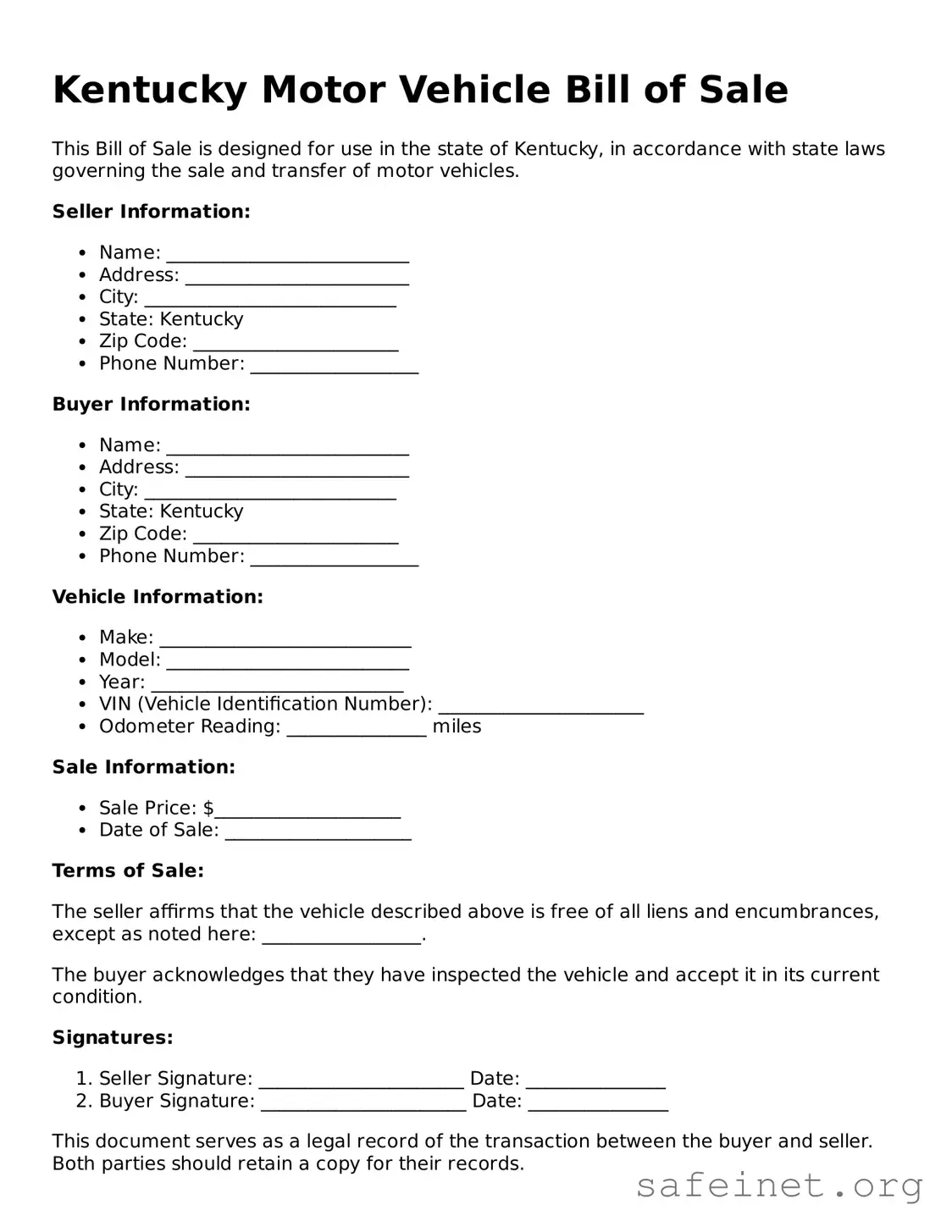
When buying or selling a vehicle in Kentucky, a Motor Vehicle Bill of Sale form plays a crucial role in documenting the transaction. This form serves as a legal record that outlines the details of the sale, including the vehicle's make, model, year, and Vehicle Identification Number (VIN). It also captures important information about the buyer and seller, such as their names, addresses, and signatures, ensuring that both parties agree to the terms of the sale. Additionally, the form often includes the sale price and the date of the transaction, which can be vital for tax purposes and future ownership verification. Having a properly completed Bill of Sale can help protect both the buyer and seller from potential disputes, making it an essential document in the vehicle transfer process. Understanding how to fill out this form accurately can streamline the buying or selling experience, providing peace of mind for everyone involved.
Kentucky Motor Vehicle Bill of Sale
This Bill of Sale is designed for use in the state of Kentucky, in accordance with state laws governing the sale and transfer of motor vehicles.
Seller Information:
Buyer Information:
Vehicle Information:
Sale Information:
Terms of Sale:
The seller affirms that the vehicle described above is free of all liens and encumbrances, except as noted here: _________________.
The buyer acknowledges that they have inspected the vehicle and accept it in its current condition.
Signatures:
This document serves as a legal record of the transaction between the buyer and seller. Both parties should retain a copy for their records.
| Fact Name | Description |
|---|---|
| Purpose | The Kentucky Motor Vehicle Bill of Sale form serves as a legal document to record the sale and transfer of ownership of a motor vehicle between a seller and a buyer. |
| Governing Law | This form is governed by Kentucky Revised Statutes (KRS) Chapter 186, which outlines the requirements for vehicle registration and titling in the state. |
| Required Information | The form typically requires details such as the vehicle identification number (VIN), make, model, year, sale price, and the names and addresses of both the buyer and seller. |
| Notarization | While notarization is not mandatory for the Bill of Sale in Kentucky, it is recommended to provide additional proof of the transaction, especially for high-value vehicles. |
After you complete the Kentucky Motor Vehicle Bill of Sale form, you will need to ensure that both the buyer and seller keep a copy for their records. This document serves as proof of the transaction and may be required for future reference, such as when registering the vehicle or for tax purposes.
What is a Kentucky Motor Vehicle Bill of Sale?
The Kentucky Motor Vehicle Bill of Sale is a legal document that records the sale of a vehicle between a buyer and a seller. It includes essential details such as the vehicle's make, model, year, VIN (Vehicle Identification Number), and the sale price. This document serves as proof of the transaction and can be used for title transfer and registration purposes.
Do I need a Bill of Sale to sell a vehicle in Kentucky?
While a Bill of Sale is not strictly required to sell a vehicle in Kentucky, it is highly recommended. This document protects both the buyer and seller by providing a written record of the transaction. It can help resolve any disputes that may arise after the sale and is often necessary for the buyer to register the vehicle in their name.
What information is needed on the Bill of Sale?
A complete Kentucky Motor Vehicle Bill of Sale should include the following information: the names and addresses of both the buyer and seller, the vehicle's make, model, year, VIN, odometer reading at the time of sale, sale price, and the date of the transaction. Both parties should sign the document to validate the sale.
Is the Bill of Sale required for title transfer?
Yes, a Bill of Sale is often required when transferring a vehicle title in Kentucky. When you go to the county clerk's office to transfer the title, they may ask for the Bill of Sale as proof of the sale. It helps ensure that the transaction is legitimate and that the buyer has the right to register the vehicle.
Can I create my own Bill of Sale?
Yes, you can create your own Bill of Sale as long as it includes all necessary information. However, using a standardized form can simplify the process and ensure that you do not miss any important details. Various templates are available online, or you can obtain one from the Kentucky Transportation Cabinet.
What should I do after completing the Bill of Sale?
After completing the Bill of Sale, both the buyer and seller should keep a signed copy for their records. The seller should provide the buyer with the completed document to assist in the title transfer process. Additionally, the seller should notify the local DMV of the sale to avoid future liability related to the vehicle.
Missing Seller and Buyer Information: One common mistake is not providing complete names and addresses. Ensure both parties' details are accurate and fully filled out.
Incorrect Vehicle Identification Number (VIN): Double-check the VIN. An error here can lead to complications during registration.
Failure to Include Purchase Price: It's essential to state the agreed purchase price clearly. Leaving this blank can create confusion later.
Not Signing the Document: Both the seller and buyer must sign the bill of sale. Without signatures, the document lacks legal validity.
Omitting Date of Sale: Including the date when the transaction occurs is crucial. This date establishes the timeline for ownership transfer.
Not Notarizing the Document: While not always required, having the bill of sale notarized can provide additional protection and authenticity.
Incorrect Odometer Reading: The odometer reading must reflect the vehicle's current mileage accurately. An incorrect reading can lead to disputes.
Failing to Provide Vehicle Description: A detailed description of the vehicle, including make, model, and year, helps avoid confusion over the sold item.
Ignoring State Requirements: Each state may have specific requirements for a bill of sale. Familiarize yourself with Kentucky's regulations to ensure compliance.
Not Keeping a Copy: After filling out the form, both parties should keep a copy. This serves as proof of the transaction and can be useful in future dealings.
When buying or selling a vehicle in Kentucky, the Motor Vehicle Bill of Sale is an essential document. However, it is often accompanied by several other forms and documents that help facilitate a smooth transaction. Below is a list of commonly used documents that complement the Bill of Sale.
Each of these documents plays a crucial role in ensuring that the sale and transfer of a vehicle are conducted legally and efficiently. Being prepared with the necessary paperwork can help avoid complications and delays in the process.
The Kentucky Motor Vehicle Bill of Sale form shares similarities with the general Bill of Sale, which is used across various states for different types of property. This document serves as a legal record of the transaction between a buyer and a seller. It includes essential details such as the names of both parties, a description of the item being sold, and the sale price. Like the Kentucky form, a general Bill of Sale protects both parties by providing proof of ownership transfer and can be used in disputes over ownership or payment issues.
Another document that closely resembles the Kentucky Motor Vehicle Bill of Sale is the Vehicle Title. The title acts as an official record of ownership for a vehicle and must be transferred from the seller to the buyer during a sale. While the Bill of Sale documents the transaction itself, the title signifies legal ownership. Both documents are crucial for ensuring that the buyer has the right to register the vehicle in their name and that the seller is no longer responsible for the vehicle.
The Odometer Disclosure Statement is another important document related to vehicle sales. This form is required by federal law to disclose the mileage on a vehicle at the time of sale. Similar to the Kentucky Motor Vehicle Bill of Sale, it aims to prevent fraud by ensuring that the buyer is informed about the vehicle's condition. Both documents are often completed together during the sale process, providing transparency and protecting the interests of both parties.
A Purchase Agreement for a vehicle also bears similarities to the Kentucky Motor Vehicle Bill of Sale. This document outlines the terms and conditions of the sale, including the purchase price, payment method, and any contingencies. While the Bill of Sale is primarily a receipt of the transaction, the Purchase Agreement serves as a more detailed contract that can help clarify expectations and responsibilities for both the buyer and the seller.
The Affidavit of Vehicle Ownership is another document that can be compared to the Kentucky Motor Vehicle Bill of Sale. This affidavit is often used when the original title is lost or unavailable. It allows the seller to affirm their ownership of the vehicle, similar to how the Bill of Sale confirms the sale and transfer of ownership. Both documents provide a level of legal protection and can help facilitate the registration process for the new owner.
Lastly, the Release of Liability form is akin to the Kentucky Motor Vehicle Bill of Sale in that it protects the seller after the sale is completed. This document notifies the state that the seller is no longer responsible for the vehicle, which can prevent future legal issues related to the vehicle. While the Bill of Sale records the transaction, the Release of Liability ensures that the seller is formally released from any obligations or liabilities associated with the vehicle after the sale.
When filling out the Kentucky Motor Vehicle Bill of Sale form, it's important to follow certain guidelines to ensure accuracy and compliance. Here’s a list of things you should and shouldn’t do:
The Kentucky Motor Vehicle Bill of Sale form is an essential document for anyone buying or selling a vehicle in the state. However, several misconceptions can lead to confusion and potential legal issues. Here are ten common misconceptions about this form, along with clarifications to help you navigate the process more effectively.
This is not true. A Bill of Sale is required for both new and used vehicles. It serves as proof of the transaction regardless of the vehicle's age.
While a title is crucial for vehicle ownership, the Bill of Sale provides additional documentation of the transaction. It can be beneficial for tax purposes and future reference.
Relying solely on a verbal agreement can lead to disputes. Having a written Bill of Sale protects both the buyer and seller by clearly outlining the terms of the sale.
In Kentucky, notarization is not required for the Bill of Sale, but having it notarized can add an extra layer of security and authenticity to the document.
It is advisable to complete the Bill of Sale at the time of the transaction. This ensures that all details are accurate and agreed upon by both parties.
Even dealerships may use a Bill of Sale for transactions. It serves as a record of the sale and is beneficial for both parties, regardless of whether the sale is private or commercial.
The Bill of Sale can be used for various types of vehicles, including motorcycles, trucks, and boats. It is not limited to just cars.
Unless specified in the Bill of Sale, the seller is not required to provide a warranty. Most sales are "as-is," meaning the buyer accepts the vehicle's condition at the time of sale.
While you can find various templates online, it is crucial to use a form that meets Kentucky's legal requirements to ensure it is valid and enforceable.
Both the buyer and seller benefit from having a Bill of Sale. It protects the buyer's rights and provides the seller with proof of the transaction.
Understanding these misconceptions can help you navigate the process of buying or selling a vehicle in Kentucky more effectively. Always ensure you have the proper documentation to protect your interests in any transaction.
Filling out and using the Kentucky Motor Vehicle Bill of Sale form is an essential step in the process of transferring vehicle ownership. Here are some key takeaways to keep in mind:
By following these guidelines, both buyers and sellers can navigate the process of transferring vehicle ownership smoothly and efficiently.