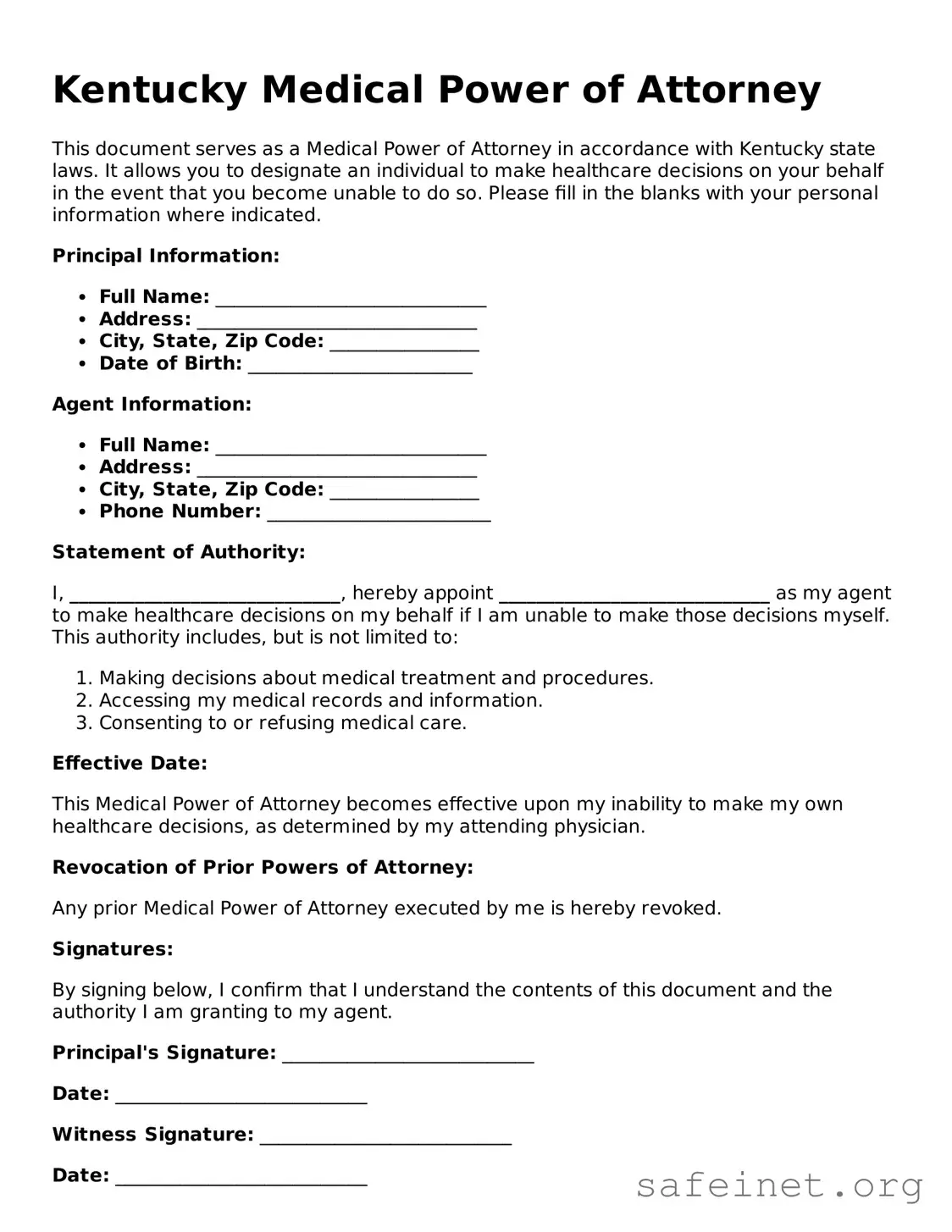
The Kentucky Medical Power of Attorney form serves as a crucial legal document that empowers individuals to designate a trusted person to make medical decisions on their behalf in the event they become unable to communicate their wishes. This form ensures that healthcare providers and family members understand the individual's preferences regarding medical treatment and interventions. It is essential to choose an agent who is not only trustworthy but also understands the individual's values and desires concerning health care. The form outlines the scope of authority granted to the agent, which may include decisions about life-sustaining treatments, surgeries, and other medical procedures. Additionally, it is important for individuals to consider including specific instructions or preferences regarding their care. Proper execution of the form, including signatures and witness requirements, is necessary for it to be valid in Kentucky. By preparing this document, individuals can gain peace of mind knowing that their healthcare decisions will be respected and upheld, even when they are unable to voice them themselves.
Kentucky Medical Power of Attorney
This document serves as a Medical Power of Attorney in accordance with Kentucky state laws. It allows you to designate an individual to make healthcare decisions on your behalf in the event that you become unable to do so. Please fill in the blanks with your personal information where indicated.
Principal Information:
Agent Information:
Statement of Authority:
I, _____________________________, hereby appoint _____________________________ as my agent to make healthcare decisions on my behalf if I am unable to make those decisions myself. This authority includes, but is not limited to:
Effective Date:
This Medical Power of Attorney becomes effective upon my inability to make my own healthcare decisions, as determined by my attending physician.
Revocation of Prior Powers of Attorney:
Any prior Medical Power of Attorney executed by me is hereby revoked.
Signatures:
By signing below, I confirm that I understand the contents of this document and the authority I am granting to my agent.
Principal's Signature: ___________________________
Date: ___________________________
Witness Signature: ___________________________
Date: ___________________________
Notary Public:
State of Kentucky
County of ___________________________
Subscribed, sworn to, and acknowledged before me by _____________________________ this ____ day of ____________, 20__.
Notary Public Signature: ___________________________
My Commission Expires: ___________________________
| Fact Name | Details |
|---|---|
| Definition | The Kentucky Medical Power of Attorney form allows an individual to designate another person to make healthcare decisions on their behalf if they become unable to do so. |
| Governing Law | This form is governed by Kentucky Revised Statutes, Chapter 311, which outlines the regulations regarding advance directives and medical powers of attorney. |
| Eligibility | Any competent adult, aged 18 or older, can create a Medical Power of Attorney in Kentucky. |
| Agent Selection | The individual creating the form (the principal) must select a trusted person as their agent to make healthcare decisions. |
| Witness Requirements | The form must be signed in the presence of two witnesses, who cannot be the appointed agent or related to the principal by blood or marriage. |
| Revocation | The principal can revoke the Medical Power of Attorney at any time, provided they are still competent to do so. |
| Durability | This power of attorney remains effective even if the principal becomes incapacitated, ensuring continuous representation in healthcare decisions. |
| Additional Provisions | Individuals can include specific instructions regarding their medical treatment preferences within the form. |
Filling out the Kentucky Medical Power of Attorney form is an important step in ensuring that your healthcare wishes are honored. After completing the form, you will need to have it signed and witnessed according to Kentucky law. This ensures that your document is valid and can be used when necessary.
What is a Kentucky Medical Power of Attorney form?
The Kentucky Medical Power of Attorney form is a legal document that allows an individual, known as the principal, to designate another person, referred to as the agent, to make healthcare decisions on their behalf. This arrangement is particularly useful in situations where the principal is unable to communicate their wishes regarding medical treatment due to illness or injury. The agent can make decisions about medical procedures, treatments, and end-of-life care according to the principal's preferences.
Who can be designated as an agent in a Medical Power of Attorney?
In Kentucky, any competent adult can be designated as an agent in a Medical Power of Attorney. This may include family members, friends, or trusted individuals. It is important for the principal to choose someone who understands their values and wishes regarding healthcare. The selected agent should be willing to take on this responsibility and be able to make difficult decisions if necessary.
How does one create a Medical Power of Attorney in Kentucky?
To create a Medical Power of Attorney in Kentucky, the principal must complete the appropriate form, which can often be found online or obtained from legal offices. The form must be signed by the principal in the presence of two witnesses or a notary public. It is crucial that the witnesses are not related to the principal and do not have any financial interest in the principal's estate. Once completed, the document should be kept in a safe place, and copies should be provided to the agent and healthcare providers.
Can a Medical Power of Attorney be revoked?
Yes, a Medical Power of Attorney can be revoked at any time by the principal, as long as they are competent to do so. To revoke the document, the principal should inform the agent and any healthcare providers in writing. It is advisable to create a new Medical Power of Attorney if the principal wishes to appoint a different agent or change their healthcare preferences. Proper communication ensures that everyone involved is aware of the changes.
Failing to specify the agent's full name and contact information. It is crucial to provide complete details to ensure the agent can be easily contacted in a medical emergency.
Not clearly defining the powers granted to the agent. Ambiguities can lead to confusion and may hinder the agent's ability to make timely decisions on behalf of the principal.
Overlooking the need for witnesses or notarization. Kentucky law requires that the document be signed in the presence of two witnesses or a notary public to be valid.
Neglecting to update the form when circumstances change. Life events such as divorce, death, or a change in health can affect the validity of the existing document.
Using outdated forms. Legal requirements can change, so it is essential to use the most current version of the Kentucky Medical Power of Attorney form.
Not discussing the document with the appointed agent. Open communication ensures that the agent understands the principal's wishes and can act accordingly when needed.
Failing to keep copies of the completed form. It is important to provide copies to the agent, healthcare providers, and keep a personal copy for reference.
When creating a Kentucky Medical Power of Attorney, it’s important to consider other related documents that can help ensure your healthcare wishes are respected. Here’s a list of forms and documents that are often used alongside the Medical Power of Attorney:
By considering these documents, you can create a comprehensive plan that covers various aspects of your healthcare and financial decisions. It’s always a good idea to consult with a legal expert to ensure that your forms are properly completed and reflect your wishes accurately.
The Kentucky Medical Power of Attorney (MPOA) form is similar to a Durable Power of Attorney (DPOA) in that both documents allow individuals to appoint someone to make decisions on their behalf. While the MPOA specifically focuses on healthcare decisions, the DPOA can cover a broader range of financial and legal matters. This means that if someone becomes incapacitated, their appointed agent can handle not only health-related choices but also financial transactions, ensuring that all aspects of their life are managed according to their wishes.
Another document akin to the MPOA is the Living Will. A Living Will outlines an individual's preferences regarding medical treatment in situations where they are unable to communicate their wishes. This document complements the MPOA by providing guidance on specific medical interventions, such as life support or resuscitation, which the appointed agent can then use to make informed decisions on behalf of the individual. Together, these documents form a comprehensive approach to healthcare decision-making.
The Advance Directive is another related document, which serves as an umbrella term that includes both the MPOA and Living Will. It allows individuals to express their healthcare preferences and designate an agent to make decisions when they are unable to do so. The Advance Directive ensures that a person’s wishes regarding medical treatment and end-of-life care are respected, providing peace of mind to both the individual and their loved ones.
Similar to the MPOA, the Healthcare Proxy allows individuals to appoint someone to make medical decisions for them. However, the Healthcare Proxy is often used in specific states and may not encompass the same breadth of authority as the MPOA. It is crucial to understand the nuances of each document, as the Healthcare Proxy may limit the agent's powers compared to the more comprehensive MPOA.
The Do Not Resuscitate (DNR) order is another document that shares a connection with the MPOA. While the MPOA designates an agent to make healthcare decisions, the DNR specifically instructs healthcare providers not to perform cardiopulmonary resuscitation (CPR) in the event of cardiac arrest. This document is critical for individuals who wish to avoid aggressive life-saving measures, and it can be part of a broader advance care planning strategy that includes the MPOA.
The Physician Orders for Life-Sustaining Treatment (POLST) form is similar to the MPOA in that it translates an individual's healthcare wishes into actionable medical orders. Unlike the MPOA, which designates an agent, the POLST provides specific instructions for healthcare providers regarding treatments such as resuscitation, intubation, and feeding tubes. This document is particularly useful for individuals with serious health conditions who want their preferences clearly outlined for emergency situations.
The Release of Medical Information form is also relevant when discussing the MPOA. While the MPOA allows an agent to make decisions, the Release of Medical Information form grants access to an individual's medical records. This access is vital for the agent to make informed healthcare decisions. Without this document, an agent may struggle to obtain necessary medical history or treatment details, potentially complicating the decision-making process.
Another related document is the Mental Health Power of Attorney. This form specifically designates an individual to make mental health treatment decisions on behalf of someone who may be unable to do so due to a mental health condition. It operates similarly to the MPOA but focuses on mental health care, ensuring that individuals receive appropriate treatment aligned with their preferences.
Lastly, the Financial Power of Attorney shares similarities with the MPOA in terms of delegation of authority. While the MPOA is focused on health-related decisions, the Financial Power of Attorney allows an individual to appoint someone to manage their financial affairs. Both documents empower agents to act on behalf of the principal, but they apply to different aspects of life. Understanding these distinctions is essential for effective estate planning and ensuring that all preferences are honored.
When filling out the Kentucky Medical Power of Attorney form, it is important to follow specific guidelines to ensure the document is valid and effective. Below is a list of things to do and avoid during this process.
Things You Should Do:
Things You Shouldn't Do:
Many individuals hold misconceptions about the Kentucky Medical Power of Attorney form. Understanding the truth behind these misunderstandings is essential for making informed decisions about healthcare and legal representation. Below are six common misconceptions:
Being aware of these misconceptions can help individuals take appropriate steps to ensure their healthcare preferences are respected. It is advisable to consult with a legal professional for personalized guidance.
Filling out a Medical Power of Attorney (MPOA) form in Kentucky is an important step in ensuring your healthcare wishes are respected. Here are some key takeaways to keep in mind:
By following these key points, you can create a Medical Power of Attorney that truly reflects your healthcare preferences and ensures your voice is heard when it matters most.