Creating a Last Will and Testament is a crucial step in ensuring that an individual's wishes regarding their assets and dependents are honored after their passing. In Kentucky, the Last Will and Testament form serves as a legal document that outlines how a person's estate will be distributed, who will serve as the executor, and any specific instructions regarding guardianship for minor children. This form allows individuals to express their desires clearly, providing peace of mind for both the testator and their loved ones. Key components of the Kentucky Last Will and Testament include the identification of beneficiaries, the designation of an executor, and any specific bequests that may be made. Additionally, the form must adhere to state laws regarding execution, including the requirement for witnesses, to ensure its validity. Understanding these elements is essential for anyone looking to create a comprehensive and legally binding will in Kentucky.
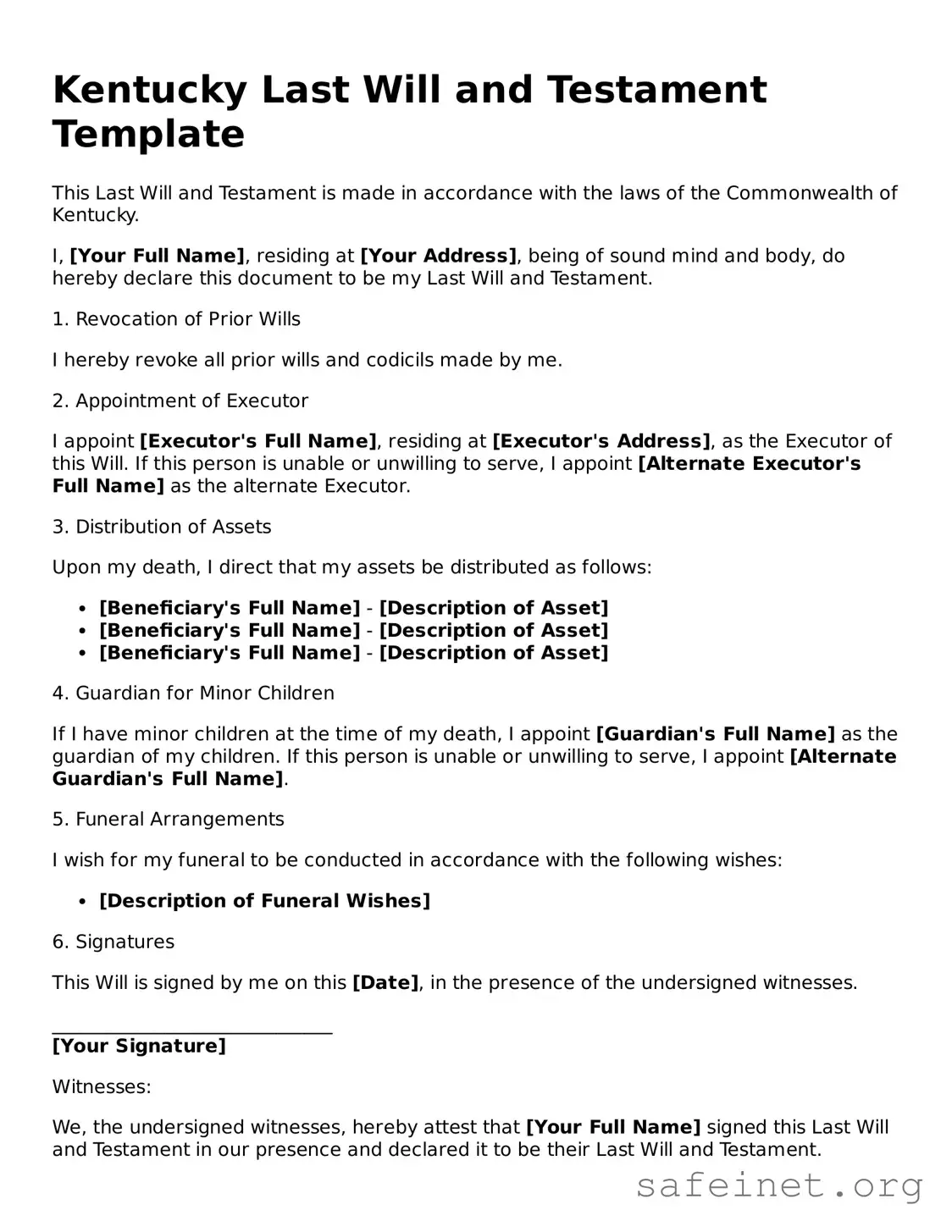
Kentucky Last Will and Testament Template
This Last Will and Testament is made in accordance with the laws of the Commonwealth of Kentucky.
I, [Your Full Name], residing at [Your Address], being of sound mind and body, do hereby declare this document to be my Last Will and Testament.
1. Revocation of Prior Wills
I hereby revoke all prior wills and codicils made by me.
2. Appointment of Executor
I appoint [Executor's Full Name], residing at [Executor's Address], as the Executor of this Will. If this person is unable or unwilling to serve, I appoint [Alternate Executor's Full Name] as the alternate Executor.
3. Distribution of Assets
Upon my death, I direct that my assets be distributed as follows:
4. Guardian for Minor Children
If I have minor children at the time of my death, I appoint [Guardian's Full Name] as the guardian of my children. If this person is unable or unwilling to serve, I appoint [Alternate Guardian's Full Name].
5. Funeral Arrangements
I wish for my funeral to be conducted in accordance with the following wishes:
6. Signatures
This Will is signed by me on this [Date], in the presence of the undersigned witnesses.
______________________________
[Your Signature]
Witnesses:
We, the undersigned witnesses, hereby attest that [Your Full Name] signed this Last Will and Testament in our presence and declared it to be their Last Will and Testament.
______________________________
[Witness 1's Signature]
[Witness 1's Full Name]
[Witness 1's Address]
______________________________
[Witness 2's Signature]
[Witness 2's Full Name]
[Witness 2's Address]
| Fact Name | Description |
|---|---|
| Governing Law | The Kentucky Last Will and Testament is governed by KRS Chapter 394. |
| Age Requirement | Testators must be at least 18 years old to create a valid will in Kentucky. |
| Signature Requirement | The will must be signed by the testator or by another person in their presence and at their direction. |
| Witnesses | At least two witnesses must sign the will, affirming that they witnessed the testator's signature. |
| Holographic Wills | Holographic wills, which are handwritten and signed by the testator, are recognized in Kentucky. |
| Revocation | A will can be revoked by the testator at any time through a new will or by destroying the original document. |
| Self-Proving Wills | Kentucky allows for self-proving wills, which can expedite the probate process. |
| Probate Process | The will must be filed with the probate court in the county where the testator resided at the time of death. |
After obtaining the Kentucky Last Will and Testament form, it is essential to fill it out accurately to ensure your wishes are clearly documented. Following the steps below will guide you through the process of completing the form effectively.
Once the form is completed, store it in a safe place and inform your executor and trusted family members of its location. Regularly review and update the will as necessary to reflect any changes in your circumstances or wishes.
What is a Last Will and Testament in Kentucky?
A Last Will and Testament is a legal document that outlines how a person wishes their assets and property to be distributed after their death. It also allows you to name guardians for any minor children and designate an executor to manage the estate. In Kentucky, having a valid will can help ensure that your wishes are honored and can simplify the probate process for your loved ones.
Who can create a Last Will and Testament in Kentucky?
In Kentucky, any person who is at least 18 years old and of sound mind can create a Last Will and Testament. It’s important to understand that being of sound mind means you are capable of making informed decisions about your assets and understand the implications of your choices.
What are the requirements for a valid will in Kentucky?
For a will to be considered valid in Kentucky, it must be in writing and signed by the person making the will (the testator). Additionally, it should be witnessed by at least two individuals who are present at the same time. These witnesses should not be beneficiaries of the will to avoid any potential conflicts of interest.
Can I change or revoke my Last Will and Testament?
Yes, you can change or revoke your Last Will and Testament at any time while you are still alive and of sound mind. This can be done by creating a new will or by making a codicil, which is an amendment to your existing will. If you wish to revoke your will entirely, you can do so by physically destroying it or by stating your intent in a new will.
What happens if I die without a will in Kentucky?
If you die without a will, you are considered to have died "intestate." In this case, Kentucky law will determine how your assets are distributed. Generally, your estate will be divided among your closest relatives, which may not align with your personal wishes. This can create complications and delays in the distribution process, making it beneficial to have a will in place.
Can I write my own Last Will and Testament?
Yes, you can write your own Last Will and Testament in Kentucky. However, it’s essential to ensure that it meets all legal requirements to be considered valid. While DIY wills can be an option, consulting with a legal professional can help you avoid mistakes and ensure that your wishes are clearly articulated and enforceable.
What should I include in my Last Will and Testament?
Your Last Will and Testament should include your personal information, a declaration that it is your will, and instructions for how you want your assets distributed. Additionally, you should name an executor to manage your estate and appoint guardians for any minor children. It’s also wise to include any specific bequests or gifts you wish to make to individuals or organizations.
How do I ensure my will is properly executed?
To ensure your will is properly executed, follow Kentucky’s legal requirements for signing and witnessing. After creating your will, store it in a safe place and inform your executor and loved ones of its location. Regularly review and update your will as your circumstances change, such as marriage, divorce, or the birth of children.
Not Clearly Identifying the Testator: Failing to include the full legal name and address of the person creating the will can lead to confusion. Ensure that the testator's identity is unmistakable.
Omitting Witness Signatures: A will must be signed by at least two witnesses in Kentucky. If these signatures are missing, the will may not be considered valid.
Inadequate Asset Description: Listing assets without sufficient detail can create disputes. Be specific about property, accounts, and personal belongings.
Failing to Update the Will: Life changes such as marriage, divorce, or the birth of children necessitate updates to the will. Neglecting to revise it may lead to unintended distributions.
Not Including an Executor: An executor is responsible for carrying out the terms of the will. Failing to appoint one can complicate the probate process.
Using Ambiguous Language: Vague terms can lead to misinterpretation. Clear and precise language helps ensure that your wishes are honored.
When preparing a Last Will and Testament in Kentucky, several other documents may also be beneficial to ensure a comprehensive estate plan. Each of these documents serves a unique purpose and can help clarify your wishes and protect your loved ones. Below is a list of commonly used forms and documents that complement the Last Will and Testament.
Incorporating these documents into your estate planning can provide peace of mind and clarity for both you and your loved ones. Each form plays a crucial role in ensuring your wishes are honored and your family is supported during difficult times.
The Kentucky Last Will and Testament is often compared to a Living Will, which serves a different purpose. While a Last Will outlines how a person's assets should be distributed after their death, a Living Will addresses medical decisions during a person's lifetime. This document allows individuals to specify their preferences regarding life-sustaining treatments in case they become unable to communicate their wishes. Both documents reflect personal choices about one’s future, but they apply to different stages of life and circumstances.
Another document similar to the Last Will is the Trust. A Trust can manage a person's assets during their lifetime and after their death. Unlike a Last Will, which goes through probate, a Trust can help avoid this lengthy process. It allows for the direct transfer of assets to beneficiaries without court involvement. While both documents aim to provide for loved ones, a Trust offers greater flexibility and control over how and when assets are distributed.
The Power of Attorney is yet another important document that shares similarities with a Last Will. This legal tool allows an individual to designate someone else to make financial or medical decisions on their behalf if they become incapacitated. While a Last Will takes effect after death, a Power of Attorney is active during a person’s life. Both documents ensure that a person’s wishes are respected, but they operate in different contexts and times.
Lastly, a Codicil is closely related to a Last Will. A Codicil is an amendment or addition that modifies an existing will without the need to create an entirely new document. This can be useful for making small changes, such as updating beneficiaries or altering specific provisions. Both documents work together to ensure that a person's final wishes are clearly articulated and legally binding, providing a way to adapt to changing circumstances.
When filling out the Kentucky Last Will and Testament form, it's important to approach the task with care and attention. Here are some guidelines to help ensure that your will is completed correctly.
When it comes to creating a Last Will and Testament in Kentucky, several misconceptions can lead to confusion. Here are four common misunderstandings:
Misconception 1: A handwritten will is not valid.
Many people believe that a will must be typed to be valid. However, Kentucky law allows for handwritten wills, also known as holographic wills, as long as they are signed by the testator. It’s important that the entire will is in the handwriting of the person making it.
Misconception 2: You don’t need witnesses for a will to be valid.
In Kentucky, a will must be signed in the presence of at least two witnesses to be legally binding. These witnesses should not be beneficiaries of the will to avoid any potential conflicts of interest.
Misconception 3: Once a will is made, it cannot be changed.
This is not true. A will can be amended or revoked at any time before the testator's death. Changes can be made through a codicil, which is an amendment to the original will, or by creating an entirely new will.
Misconception 4: A will covers all assets automatically.
Many assume that a will automatically governs all assets. However, certain assets, like those held in a living trust or accounts with designated beneficiaries, may bypass the will and go directly to the named individuals.
When it comes to creating a Last Will and Testament in Kentucky, there are several important points to keep in mind. Understanding these key takeaways can help ensure that your will is valid and reflects your wishes.
By keeping these takeaways in mind, you can better navigate the process of creating a Last Will and Testament in Kentucky, ensuring that your wishes are honored and your loved ones are taken care of.