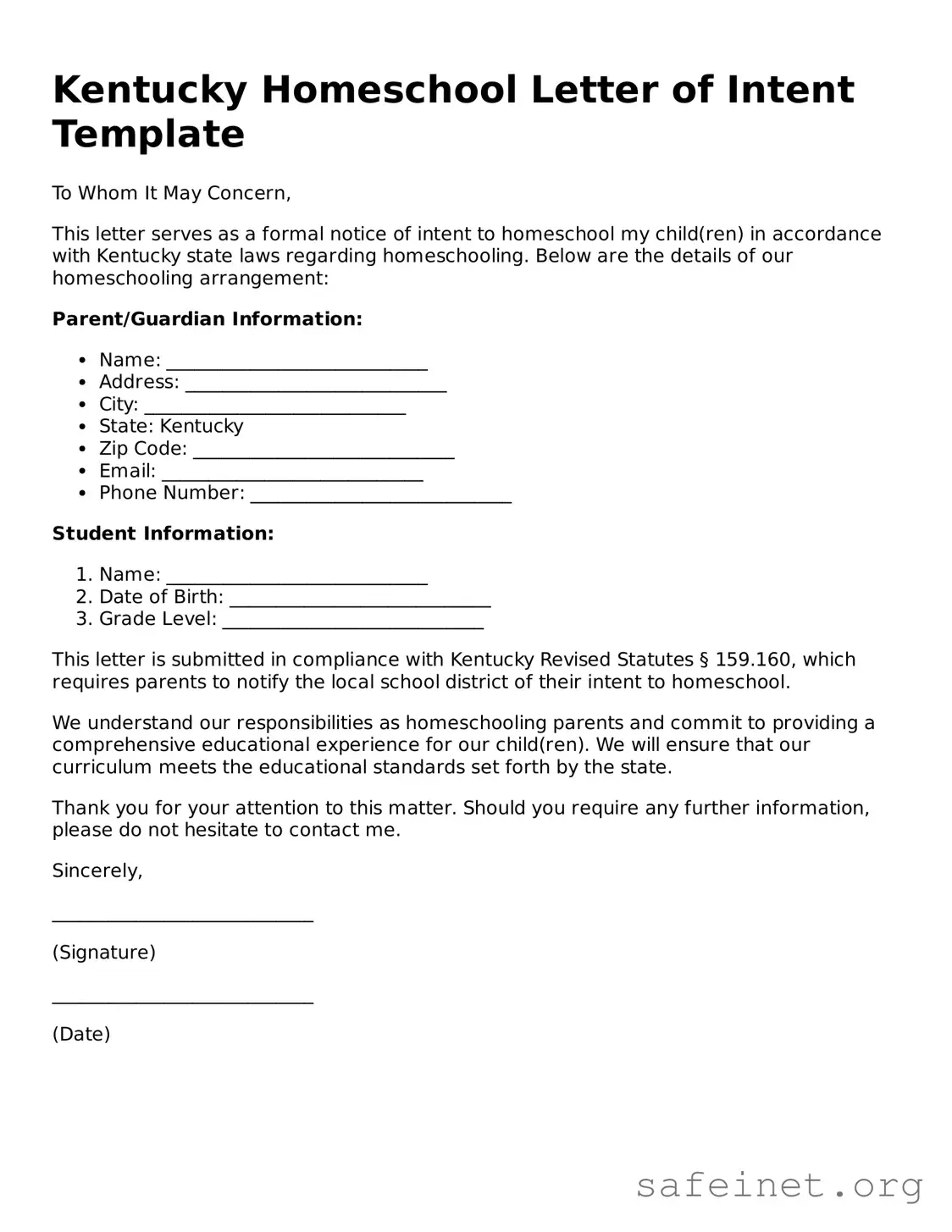
In Kentucky, families seeking to educate their children at home must navigate specific requirements set forth by state law. One essential step in this process is the completion of the Homeschool Letter of Intent form. This form serves as an official notification to the local school district that a parent or guardian intends to homeschool their child. It typically requires basic information such as the names and ages of the children being homeschooled, as well as the educational curriculum that will be used. Additionally, the form may ask for details about the educational background of the parent or guardian, ensuring that they are equipped to provide a suitable learning environment. Submitting this letter is crucial for compliance with state regulations, as it establishes the family's commitment to follow the homeschooling guidelines set by Kentucky law. Understanding the components and significance of the Homeschool Letter of Intent is vital for parents embarking on this educational journey.
Kentucky Homeschool Letter of Intent Template
To Whom It May Concern,
This letter serves as a formal notice of intent to homeschool my child(ren) in accordance with Kentucky state laws regarding homeschooling. Below are the details of our homeschooling arrangement:
Parent/Guardian Information:
Student Information:
This letter is submitted in compliance with Kentucky Revised Statutes § 159.160, which requires parents to notify the local school district of their intent to homeschool.
We understand our responsibilities as homeschooling parents and commit to providing a comprehensive educational experience for our child(ren). We will ensure that our curriculum meets the educational standards set forth by the state.
Thank you for your attention to this matter. Should you require any further information, please do not hesitate to contact me.
Sincerely,
____________________________
(Signature)
____________________________
(Date)
| Fact Name | Description |
|---|---|
| Governing Law | The Kentucky Homeschool Letter of Intent is governed by KRS 159.040. |
| Purpose | This form notifies the local school district of a family's intent to homeschool. |
| Submission Timeline | The form must be submitted at the beginning of each school year. |
| Required Information | Parents must provide their names, addresses, and the names of the children being homeschooled. |
| Signature Requirement | The form must be signed by at least one parent or guardian. |
| Notification of Changes | Families are required to notify the district of any changes in their homeschooling status. |
| Record Keeping | Parents must maintain educational records for their homeschooled children. |
| Curriculum Choice | Families have the freedom to choose their own curriculum and educational materials. |
| Annual Assessment | Students must be assessed annually to ensure educational progress. |
After completing the Kentucky Homeschool Letter of Intent form, you will submit it to the local school district. This step is crucial for officially notifying the district of your intention to homeschool your child. Ensure you keep a copy for your records.
What is the Kentucky Homeschool Letter of Intent?
The Kentucky Homeschool Letter of Intent is a formal document that parents or guardians must submit to notify the local school district of their intention to homeschool their children. This letter serves as the initial step in the homeschooling process, ensuring that the district is aware of the family's educational choice.
Who needs to submit the Letter of Intent?
Any parent or guardian who wishes to homeschool a child between the ages of 6 and 18 in Kentucky must submit this letter. It applies to all children who are not enrolled in a public or private school, ensuring that the local education authorities are informed of the homeschooling arrangement.
When should the Letter of Intent be submitted?
The Letter of Intent should be submitted at the beginning of the homeschooling year or as soon as the decision to homeschool is made. It is advisable to submit the letter before the start of the school year to ensure compliance with state regulations and to avoid any potential issues with truancy.
What information is required in the Letter of Intent?
The Letter of Intent must include specific information such as the names and ages of the children being homeschooled, the address of the family, and the signature of the parent or guardian. It is essential to provide accurate information to facilitate communication with the local school district.
Is there a specific format for the Letter of Intent?
While there is no mandated format for the Letter of Intent, it should be clear and concise. Parents are encouraged to include all required information and to write the letter in a professional tone. A simple template can be used, but it is crucial that all necessary details are present.
Do I need to submit the Letter of Intent every year?
Yes, parents are required to submit a new Letter of Intent for each year they wish to homeschool their children. This annual submission helps maintain updated records with the local school district and ensures ongoing compliance with state homeschooling laws.
What happens after I submit the Letter of Intent?
Once the Letter of Intent is submitted, the local school district will acknowledge receipt of the document. They may provide additional information regarding homeschooling regulations, resources, and support available to families. It is important to maintain communication with the district throughout the homeschooling process.
Are there any penalties for not submitting the Letter of Intent?
Failure to submit the Letter of Intent can lead to complications, including potential truancy issues. School districts may consider children who are not enrolled in a school and whose parents have not submitted the letter as truant. This can result in legal ramifications, so it is crucial to comply with this requirement.
Can I withdraw my child from public school after submitting the Letter of Intent?
Yes, once the Letter of Intent is submitted, parents can withdraw their child from public school. However, it is advisable to inform the school of the withdrawal formally. This ensures that all parties are aware of the child's educational status and helps avoid any misunderstandings.
Where can I find more information about homeschooling in Kentucky?
For more information, parents can visit the Kentucky Department of Education's website, which offers resources and guidance on homeschooling laws and practices. Additionally, local homeschooling groups and associations can provide support, networking opportunities, and valuable information to help families navigate their homeschooling journey.
Failing to include the full name of the child being homeschooled. This information is crucial for identification purposes.
Not providing the birthdate of the child. This detail helps verify the age of the child and ensures compliance with state regulations.
Omitting the address of the homeschooling family. Accurate address information is necessary for official records.
Neglecting to sign the form. A signature is required to validate the intent to homeschool.
Incorrectly stating the school year for which the intent is being filed. This could lead to confusion regarding the homeschooling period.
Providing inaccurate or incomplete contact information. This may hinder communication with local education authorities.
Failing to check for spelling errors in names and addresses. Such mistakes can complicate official records.
Not keeping a copy of the submitted form. Retaining a copy is important for future reference and proof of intent.
Submitting the form after the state’s deadline. Timely submission is essential to avoid penalties.
Overlooking any additional documentation that may be required by local school authorities. It is important to understand all requirements for homeschooling.
When families choose to homeschool their children in Kentucky, they often need to complete several forms and documents to ensure compliance with state regulations. Below is a list of other important documents that are frequently used alongside the Kentucky Homeschool Letter of Intent form. Each document plays a significant role in the homeschooling process, helping to maintain organization and clarity.
By understanding and utilizing these documents, families can create a structured and effective homeschooling experience. Each form plays a vital role in fostering a supportive learning environment that meets both educational goals and legal requirements.
The Kentucky Homeschool Letter of Intent form shares similarities with the Affidavit of Homeschooling. Both documents serve as formal declarations of a parent or guardian's intention to homeschool their child. An Affidavit of Homeschooling typically requires the parent to affirm their commitment to providing an educational experience that meets state standards. This document is often notarized, adding an extra layer of authenticity, similar to how the Letter of Intent must be submitted to the local school district to notify them of the homeschooling decision.
Another document that resembles the Kentucky Homeschool Letter of Intent is the Notice of Intent to Withdraw from Public School. Parents who choose to homeschool often must notify their child's current school of their decision. This notice formally communicates the withdrawal and includes essential information about the child. Like the Letter of Intent, it serves as a clear statement of educational intent, ensuring that all parties are aware of the change in educational setting.
The Individualized Education Program (IEP) can also be compared to the Homeschool Letter of Intent. While an IEP is typically associated with students who have special needs, it outlines the specific educational plan tailored to meet those needs. In a homeschooling context, parents may create their own educational plans to ensure they are addressing their child's unique learning requirements. Both documents emphasize the importance of tailored education and parental involvement in the learning process.
The Enrollment Form for Private School is another document that bears similarities to the Homeschool Letter of Intent. When parents enroll their child in a private school, they must complete an enrollment form that outlines their intent to educate their child in a specific setting. This form often requires details such as the child's name, age, and previous schooling. Both documents reflect a commitment to education and the necessity of informing relevant authorities about the child's educational path.
The Certificate of Completion for Home Education is akin to the Kentucky Homeschool Letter of Intent in that it serves as a record of a student’s educational journey. This certificate is often issued at the end of a homeschooling period, indicating that the student has completed the necessary educational requirements. Similarly, the Letter of Intent marks the beginning of that journey, establishing the framework for what will follow in the child's education.
The Curriculum Plan can also be compared to the Homeschool Letter of Intent. Parents are often required to outline the educational materials and methods they plan to use when homeschooling. This plan is essential for ensuring that the educational experience is structured and meets state requirements. Like the Letter of Intent, it reflects the parent's commitment to providing a comprehensive education for their child.
Lastly, the State Education Department's Homeschool Registration Form is similar to the Kentucky Homeschool Letter of Intent. This registration form is typically required in many states to officially register a child for homeschooling. It collects essential information about the student and the educational plan. Both documents serve to notify educational authorities of a parent's intent to homeschool and ensure compliance with state regulations regarding education.
When filling out the Kentucky Homeschool Letter of Intent form, it’s important to follow certain guidelines to ensure a smooth process. Here’s a list of things you should and shouldn’t do:
By following these guidelines, you can ensure that your Letter of Intent is completed correctly and submitted on time, paving the way for a successful homeschooling experience in Kentucky.
When it comes to homeschooling in Kentucky, many people have misconceptions about the Letter of Intent form. Clearing up these misunderstandings can help parents navigate the process with confidence. Here are ten common misconceptions:
Understanding these misconceptions can empower families to make informed decisions about their homeschooling journey in Kentucky.
When preparing to fill out and use the Kentucky Homeschool Letter of Intent form, there are several important points to keep in mind. These takeaways will help ensure that the process is smooth and compliant with state regulations.
By following these key takeaways, you can navigate the process of submitting the Kentucky Homeschool Letter of Intent with confidence.