In Kentucky, the General Power of Attorney (GPOA) form serves as a crucial legal document that empowers an individual, known as the "agent" or "attorney-in-fact," to act on behalf of another person, referred to as the "principal." This form grants the agent a broad range of authority, which can include managing financial matters, making healthcare decisions, and handling real estate transactions. It is essential for individuals to understand that the powers bestowed upon the agent can be tailored to meet specific needs, allowing for a customized approach to personal and financial management. The GPOA can be effective immediately or can be set to activate upon the principal's incapacitation, providing flexibility depending on the principal's circumstances. As with any legal document, ensuring that the GPOA is executed correctly is vital to its validity. This involves proper signing, witnessing, and, in some cases, notarization. Understanding these components helps individuals navigate the complexities of delegating authority while safeguarding their interests.
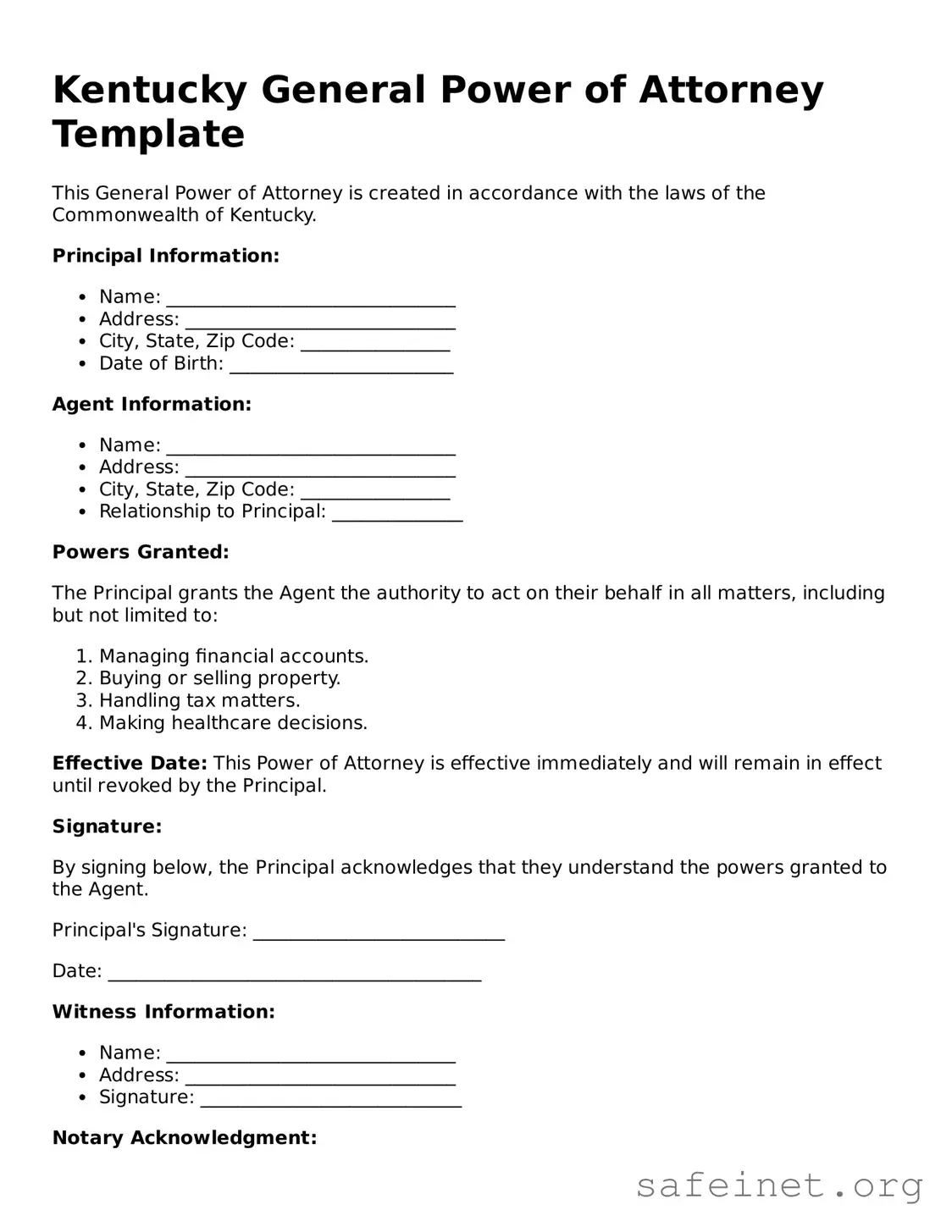
Kentucky General Power of Attorney Template
This General Power of Attorney is created in accordance with the laws of the Commonwealth of Kentucky.
Principal Information:
Agent Information:
Powers Granted:
The Principal grants the Agent the authority to act on their behalf in all matters, including but not limited to:
Effective Date: This Power of Attorney is effective immediately and will remain in effect until revoked by the Principal.
Signature:
By signing below, the Principal acknowledges that they understand the powers granted to the Agent.
Principal's Signature: ___________________________
Date: ________________________________________
Witness Information:
Notary Acknowledgment:
State of Kentucky
County of ___________________________
Subscribed and sworn to before me this _____ day of ____________, 20__.
Notary Public: _________________________
My commission expires: ________________
| Fact Name | Description |
|---|---|
| Definition | A General Power of Attorney in Kentucky allows an individual to appoint another person to manage their financial and legal affairs. |
| Governing Law | The Kentucky General Power of Attorney is governed by KRS Chapter 457. |
| Durability | This form can be made durable, meaning it remains effective even if the principal becomes incapacitated. |
| Agent Authority | The appointed agent can perform a variety of tasks, including handling bank transactions, managing real estate, and making legal decisions. |
| Revocation | The principal can revoke the General Power of Attorney at any time, provided they are mentally competent. |
| Notarization | While notarization is not required, it is recommended to ensure the document's validity and acceptance by third parties. |
Filling out the Kentucky General Power of Attorney form is a straightforward process that allows you to designate someone to act on your behalf in various matters. Once completed, the form will need to be signed and notarized to ensure its validity.
Once you have completed these steps, your General Power of Attorney will be ready for use. Make sure to discuss your decisions with your agent to ensure they understand your wishes and are prepared to act on your behalf.
What is a General Power of Attorney in Kentucky?
A General Power of Attorney (GPOA) is a legal document that allows one person, known as the principal, to appoint another person, called the agent, to make decisions on their behalf. This can include financial decisions, property management, and other personal matters. In Kentucky, the GPOA grants broad authority to the agent, allowing them to act in various capacities as specified in the document.
Who can create a General Power of Attorney in Kentucky?
Any adult who is mentally competent can create a General Power of Attorney in Kentucky. This means that the individual must understand the nature and consequences of their actions when signing the document. It is essential that the principal is not under duress or undue influence when making this decision.
What powers can be granted in a General Power of Attorney?
A General Power of Attorney can grant a wide range of powers to the agent. These powers typically include managing financial accounts, buying or selling property, making investment decisions, and handling tax matters. However, the principal can specify limitations or conditions on the powers granted if desired.
Does a General Power of Attorney need to be notarized in Kentucky?
Yes, in Kentucky, a General Power of Attorney must be notarized to be valid. This means that the principal must sign the document in the presence of a notary public, who will then affix their seal. This step helps ensure the authenticity of the document and protects against fraud.
Can a General Power of Attorney be revoked?
Yes, a General Power of Attorney can be revoked at any time by the principal, as long as they are still mentally competent. To revoke the GPOA, the principal should provide written notice to the agent and any relevant third parties. It is advisable to create a formal revocation document to avoid confusion.
What happens if the principal becomes incapacitated?
If the principal becomes incapacitated, the General Power of Attorney remains in effect unless it is specifically stated otherwise in the document. This means that the agent can continue to make decisions on behalf of the principal. However, if the principal wishes to limit the authority of the agent in such situations, they should consider creating a Durable Power of Attorney instead.
Can an agent be held liable for their actions under a General Power of Attorney?
Generally, an agent is not personally liable for actions taken on behalf of the principal, as long as those actions are within the scope of the authority granted in the General Power of Attorney. However, if the agent acts outside their authority or engages in misconduct, they may be held accountable for those actions.
Is there a specific form required for a General Power of Attorney in Kentucky?
While Kentucky does not require a specific form for a General Power of Attorney, it is advisable to use a standard template that complies with state laws. This ensures that all necessary elements are included and that the document is legally enforceable. Various resources are available online to assist in creating a compliant GPOA.
Can a General Power of Attorney be used for healthcare decisions?
No, a General Power of Attorney is primarily for financial and legal matters. For healthcare decisions, a separate document called a Healthcare Power of Attorney or Advance Directive is needed. This document allows the agent to make medical decisions on behalf of the principal if they are unable to do so themselves.
What should I consider before granting someone a General Power of Attorney?
Before granting someone a General Power of Attorney, it is crucial to consider the level of trust you have in that person. The agent will have significant authority over your financial and personal matters. Additionally, think about the specific powers you wish to grant and whether you want to include any limitations. Consulting with a legal professional can also provide valuable guidance in this process.
Not specifying the powers granted. It is crucial to clearly outline what authority is being given. Without this, the agent may not have the ability to act on your behalf effectively.
Failing to date the document. A date is essential to establish when the power of attorney takes effect. An undated document can lead to confusion and potential disputes.
Not signing in the correct location. Ensure that you sign where indicated. If the signature is placed incorrectly, it may invalidate the document.
Overlooking the need for witnesses or notarization. Depending on the situation, Kentucky may require either witnesses or a notary public to validate the document. Neglecting this step can render the power of attorney ineffective.
Choosing an unreliable agent. It is important to select someone trustworthy and capable. An agent's actions directly impact your affairs, so choose wisely.
Not reviewing the document regularly. Life circumstances change. Regularly revisiting the power of attorney ensures it remains aligned with your current wishes and needs.
When setting up a Kentucky General Power of Attorney, it’s often helpful to consider other related documents. These documents can provide additional clarity and support for your decisions. Here are five commonly used forms that may accompany a General Power of Attorney:
Having these documents in place can help ensure that your wishes are honored and that your affairs are managed according to your preferences. It’s always a good idea to consult with a legal professional to ensure that all documents are properly executed and aligned with your goals.
The Kentucky General Power of Attorney form is similar to the Durable Power of Attorney. Both documents allow an individual, known as the principal, to appoint someone else, called an agent, to make decisions on their behalf. However, the Durable Power of Attorney remains effective even if the principal becomes incapacitated, whereas the General Power of Attorney typically ceases to be effective under such circumstances. This distinction is crucial for individuals looking to ensure their affairs are managed during periods of incapacity.
Another document that resembles the Kentucky General Power of Attorney is the Limited Power of Attorney. This form allows the principal to grant specific powers to the agent for a defined purpose or time period. Unlike the General Power of Attorney, which provides broad authority, the Limited Power of Attorney restricts the agent's powers to particular tasks, making it suitable for situations where only certain decisions need to be delegated.
The Healthcare Power of Attorney is also comparable to the Kentucky General Power of Attorney. While the General Power of Attorney can cover financial and legal matters, the Healthcare Power of Attorney specifically focuses on medical decisions. This document allows the appointed agent to make healthcare choices on behalf of the principal if they are unable to do so themselves, ensuring that their medical preferences are honored.
The Financial Power of Attorney is another similar document. Like the General Power of Attorney, it enables an agent to manage financial matters for the principal. However, the Financial Power of Attorney is often more detailed regarding financial transactions and may include specific instructions about managing bank accounts, investments, and other financial assets. This document is particularly useful for individuals who want to ensure their financial interests are protected.
The Springing Power of Attorney shares similarities with the General Power of Attorney as well. This document only comes into effect under certain conditions, typically when the principal becomes incapacitated. This feature distinguishes it from the General Power of Attorney, which is effective immediately upon signing. The Springing Power of Attorney can provide peace of mind for individuals who want to maintain control over their affairs until they are unable to do so.
Lastly, the Revocable Living Trust can be compared to the Kentucky General Power of Attorney. While a General Power of Attorney allows an agent to act on behalf of the principal, a Revocable Living Trust manages the principal's assets during their lifetime and distributes them after death. Both documents can be used to avoid probate and ensure that the principal’s wishes are carried out, but they serve different purposes in estate planning.
When filling out the Kentucky General Power of Attorney form, it is crucial to proceed with care. Here is a list of ten essential do's and don'ts to guide you through the process:
By following these guidelines, you can ensure that your General Power of Attorney form is completed correctly and serves its intended purpose effectively.
The Kentucky General Power of Attorney form is a powerful legal document, but several misconceptions surround its use and implications. Understanding these misconceptions can help individuals make informed decisions.
While many people associate a General Power of Attorney with financial transactions, it can also cover a range of decisions, including healthcare, property management, and legal affairs. The scope of authority can be tailored to meet specific needs.
It is a common belief that the appointed agent must be someone personally close to the principal. However, the agent can be any trusted individual, including professionals like attorneys or financial advisors, as long as they are willing to act in the principal's best interest.
Many people think that once a General Power of Attorney is established, it cannot be changed. In reality, the principal retains the right to revoke or modify the document at any time, as long as they are mentally competent.
This misconception can lead to significant issues. A standard General Power of Attorney typically becomes invalid if the principal becomes incapacitated. To ensure continued authority, a durable power of attorney must be specified, which remains effective even in such circumstances.
When filling out and using the Kentucky General Power of Attorney form, keep these key takeaways in mind: