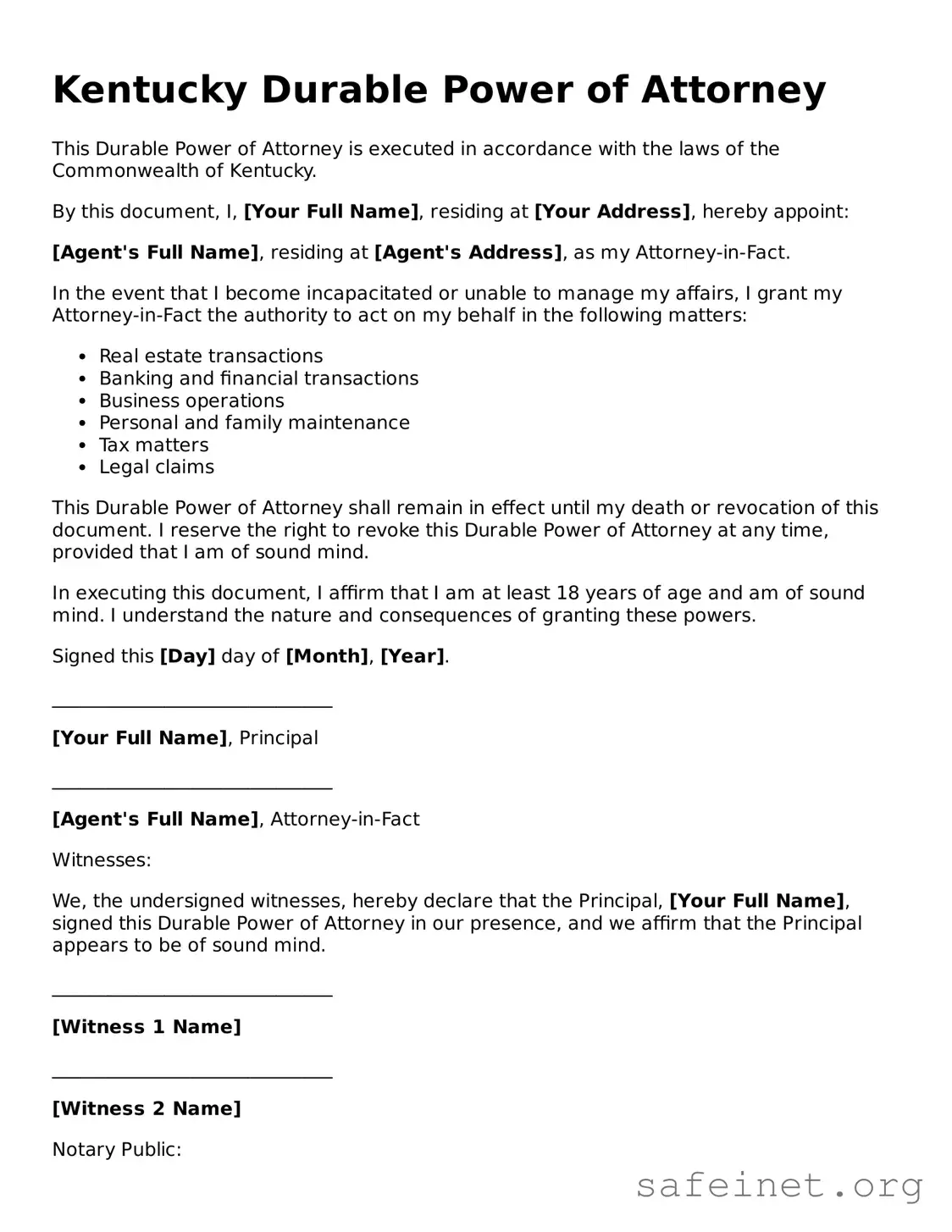
The Kentucky Durable Power of Attorney form serves as a crucial legal document that empowers individuals to designate a trusted person to make financial and legal decisions on their behalf. This form is especially important for those who wish to ensure their affairs are handled according to their wishes, even if they become incapacitated. It allows the appointed agent to manage a variety of tasks, including paying bills, managing investments, and handling real estate transactions. The durable aspect of this power of attorney means that it remains effective even if the principal becomes unable to make decisions due to health issues. Understanding the specific provisions and requirements of this form is vital for anyone considering its use, as it provides clarity and peace of mind regarding future financial management. Additionally, the form can be tailored to fit individual needs, making it a flexible tool for planning ahead.
Kentucky Durable Power of Attorney
This Durable Power of Attorney is executed in accordance with the laws of the Commonwealth of Kentucky.
By this document, I, [Your Full Name], residing at [Your Address], hereby appoint:
[Agent's Full Name], residing at [Agent's Address], as my Attorney-in-Fact.
In the event that I become incapacitated or unable to manage my affairs, I grant my Attorney-in-Fact the authority to act on my behalf in the following matters:
This Durable Power of Attorney shall remain in effect until my death or revocation of this document. I reserve the right to revoke this Durable Power of Attorney at any time, provided that I am of sound mind.
In executing this document, I affirm that I am at least 18 years of age and am of sound mind. I understand the nature and consequences of granting these powers.
Signed this [Day] day of [Month], [Year].
______________________________
[Your Full Name], Principal
______________________________
[Agent's Full Name], Attorney-in-Fact
Witnesses:
We, the undersigned witnesses, hereby declare that the Principal, [Your Full Name], signed this Durable Power of Attorney in our presence, and we affirm that the Principal appears to be of sound mind.
______________________________
[Witness 1 Name]
______________________________
[Witness 2 Name]
Notary Public:
State of Kentucky
County of [County Name]
Subscribed and sworn to before me this [Day] day of [Month], [Year].
______________________________
Notary Public Signature
My commission expires: [Expiration Date]
| Fact Name | Description |
|---|---|
| Definition | A Durable Power of Attorney allows an individual to appoint someone else to make decisions on their behalf, even if they become incapacitated. |
| Governing Law | The Kentucky Durable Power of Attorney is governed by KRS 457.010 to 457.100. |
| Durability | This type of power of attorney remains effective even if the principal becomes mentally incapacitated. |
| Principal and Agent | The person creating the document is called the principal, while the person designated to act is known as the agent or attorney-in-fact. |
| Scope of Authority | The agent can be granted broad or limited powers, depending on the principal's preferences. |
| Signing Requirements | The form must be signed by the principal in the presence of a notary public or two witnesses. |
| Revocation | The principal can revoke the Durable Power of Attorney at any time as long as they are mentally competent. |
| Agent's Duties | The agent has a fiduciary duty to act in the best interests of the principal and must keep accurate records of their actions. |
| Healthcare Decisions | This form does not cover healthcare decisions unless specifically stated; a separate healthcare power of attorney is recommended. |
| Use in Estate Planning | A Durable Power of Attorney is an essential tool in estate planning, helping to ensure that financial matters are managed according to the principal's wishes. |
Filling out the Kentucky Durable Power of Attorney form is a straightforward process that requires careful attention to detail. Once completed, this document will empower your chosen agent to make decisions on your behalf in specified areas. Follow these steps to ensure the form is filled out correctly.
What is a Kentucky Durable Power of Attorney?
A Kentucky Durable Power of Attorney is a legal document that allows an individual, known as the principal, to appoint someone else, called the agent or attorney-in-fact, to make decisions on their behalf. This authority remains in effect even if the principal becomes incapacitated, ensuring that their wishes are honored when they cannot express them themselves.
Who can serve as an agent in a Durable Power of Attorney?
In Kentucky, any competent adult can serve as an agent. This includes family members, friends, or professionals, such as attorneys. It is crucial to choose someone trustworthy and capable of making decisions in your best interest, as they will have significant authority over your financial and medical matters.
What types of decisions can an agent make under a Durable Power of Attorney?
The agent can make a wide range of decisions, including managing financial affairs, handling real estate transactions, and making healthcare decisions if specified. The principal can outline specific powers or limit the authority granted to the agent, tailoring the document to their needs.
How does one create a Durable Power of Attorney in Kentucky?
To create a Durable Power of Attorney, the principal must complete a written document that clearly states their intentions. It should include the names of the principal and agent, the powers granted, and any limitations. The document must be signed by the principal and notarized to ensure its validity.
Can a Durable Power of Attorney be revoked?
Yes, a Durable Power of Attorney can be revoked at any time as long as the principal is competent. To revoke the document, the principal should create a written notice stating their intent to revoke and provide copies to the agent and any institutions that may have relied on the original document.
What happens if the agent cannot serve or is unavailable?
If the appointed agent is unable to serve, the Durable Power of Attorney may specify an alternate agent. If no alternate is named, the principal may need to seek a court-appointed guardian or conservator to manage their affairs, which can be a lengthy and costly process.
Is a Durable Power of Attorney effective immediately?
Typically, a Durable Power of Attorney is effective immediately upon signing unless the principal specifies a different start date. However, some individuals may choose to make it effective only upon their incapacity, which can be accomplished by including specific language in the document.
Do I need a lawyer to create a Durable Power of Attorney?
While it is not legally required to have a lawyer draft a Durable Power of Attorney, consulting with one is highly advisable. A legal professional can ensure that the document complies with state laws and accurately reflects the principal's wishes, reducing the risk of future disputes.
What should I do after creating a Durable Power of Attorney?
After creating a Durable Power of Attorney, it is essential to distribute copies to the agent, relevant family members, and any financial institutions or healthcare providers that may need to recognize the document. Keeping the original in a safe place is also important, as it may be required for certain transactions.
Not Specifying Powers Clearly: One common mistake is failing to clearly outline the powers granted to the agent. This can lead to confusion about what the agent can and cannot do on your behalf. It’s crucial to be specific about financial decisions, healthcare choices, and other important matters.
Neglecting to Date the Document: Some individuals forget to date their Durable Power of Attorney form. Without a date, it may be difficult to determine when the authority was granted, potentially leading to disputes or challenges regarding its validity.
Overlooking the Agent's Acceptance: Another frequent oversight is not ensuring that the chosen agent formally accepts the role. It’s essential to have a conversation with the agent beforehand, confirming their willingness and ability to take on this responsibility.
Failing to Update the Document: Life changes, and so should your Durable Power of Attorney. People often neglect to update the document after significant life events, such as marriage, divorce, or the death of a previously designated agent. Regular reviews can help ensure that your wishes are accurately reflected.
A Kentucky Durable Power of Attorney form allows an individual to designate another person to make decisions on their behalf, particularly in financial or legal matters. This document is often used in conjunction with other forms to ensure comprehensive planning and protection of an individual’s interests. Below are several documents that are commonly associated with the Durable Power of Attorney in Kentucky.
These documents work in tandem with the Kentucky Durable Power of Attorney to provide a comprehensive approach to personal and financial decision-making. Each serves a unique purpose, contributing to an individual's overall estate and health care planning strategy.
The Kentucky Durable Power of Attorney (DPOA) shares similarities with the General Power of Attorney (GPOA). Both documents allow individuals to appoint someone else to make decisions on their behalf. The key difference lies in the durability aspect; while a GPOA becomes ineffective if the principal becomes incapacitated, a DPOA remains in effect even when the principal can no longer make decisions due to health issues. This enduring nature makes the DPOA particularly valuable for long-term planning.
Another document akin to the DPOA is the Healthcare Power of Attorney. This specific form grants authority to a designated person to make medical decisions for someone who is unable to do so. Like the DPOA, it is designed to take effect upon incapacitation. However, the Healthcare Power of Attorney is focused solely on health-related matters, whereas the DPOA can encompass a broader range of financial and legal decisions. This distinction is crucial for individuals wanting to ensure their healthcare preferences are respected.
The Living Will is also comparable to the DPOA, but it serves a different purpose. A Living Will outlines an individual’s wishes regarding medical treatment in situations where they are terminally ill or in a persistent vegetative state. Unlike the DPOA, which designates someone to make decisions, the Living Will communicates the individual’s preferences directly. Both documents work together to provide a comprehensive approach to end-of-life planning, ensuring that an individual’s values and wishes are honored.
The Revocable Trust bears similarities to the DPOA in that it allows for the management of assets. A Revocable Trust can hold property and other assets during a person’s lifetime, and it can be altered or revoked at any time. Upon the individual’s death, the trust assets are distributed according to the terms laid out in the trust document. While the DPOA grants authority to another person to manage affairs, the Revocable Trust allows for direct management of assets, providing a different yet complementary mechanism for estate planning.
Lastly, the Financial Power of Attorney is another document that resembles the DPOA. This form specifically empowers someone to handle financial matters, such as managing bank accounts, paying bills, and making investment decisions. While the DPOA can cover a wide range of decisions, the Financial Power of Attorney is often more limited in scope. Both documents serve the purpose of ensuring that someone can manage affairs when the principal is unable, but the Financial Power of Attorney typically focuses solely on financial issues.
When filling out the Kentucky Durable Power of Attorney form, it is important to approach the task with care. Here are some guidelines to help you navigate the process effectively.
Taking these steps can help ensure that your Durable Power of Attorney is valid and effective when needed. Your choices matter, and being thorough can provide peace of mind for you and your loved ones.
When considering a Kentucky Durable Power of Attorney (DPOA), several misconceptions often arise. Understanding these misconceptions can help individuals make informed decisions.
When filling out and using the Kentucky Durable Power of Attorney form, consider the following key takeaways: