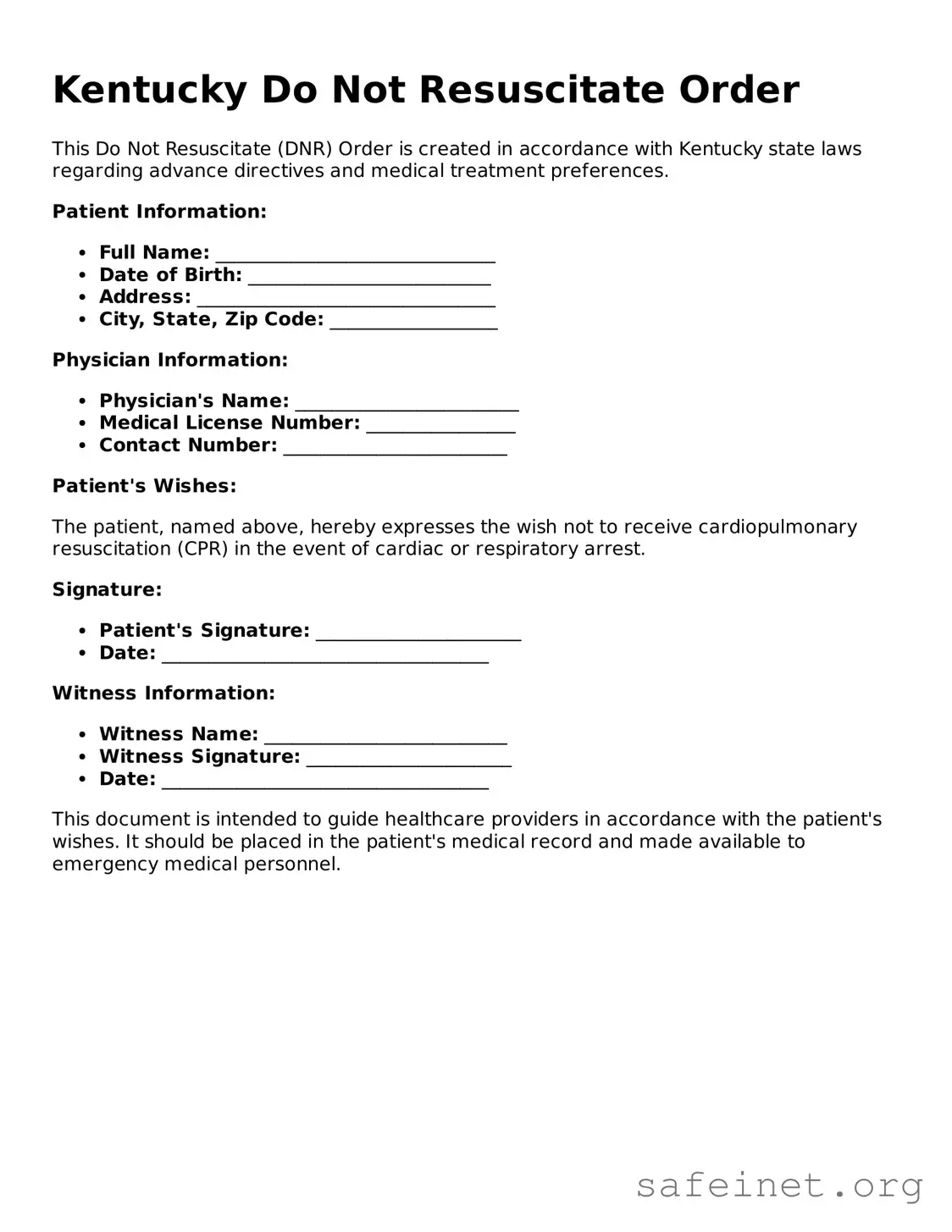
The Kentucky Do Not Resuscitate (DNR) Order form serves as a critical tool for individuals wishing to express their preferences regarding emergency medical interventions in the event of a life-threatening situation. This legally binding document allows patients to decline resuscitation efforts, such as cardiopulmonary resuscitation (CPR), should their heart or breathing stop. It is essential for patients to understand that this form must be completed and signed by a licensed physician, ensuring that the patient's wishes are documented and respected by healthcare providers. The DNR Order is designed to reflect the individual's values and medical circumstances, allowing for personalized healthcare decisions. Additionally, it is important to note that the form must be readily accessible to emergency medical personnel and healthcare providers to be effective. In Kentucky, the DNR Order is recognized across various healthcare settings, making it a vital component of end-of-life planning. Understanding the implications and requirements of the DNR Order is crucial for patients, families, and healthcare professionals alike, as it fosters informed decision-making during critical moments.
Kentucky Do Not Resuscitate Order
This Do Not Resuscitate (DNR) Order is created in accordance with Kentucky state laws regarding advance directives and medical treatment preferences.
Patient Information:
Physician Information:
Patient's Wishes:
The patient, named above, hereby expresses the wish not to receive cardiopulmonary resuscitation (CPR) in the event of cardiac or respiratory arrest.
Signature:
Witness Information:
This document is intended to guide healthcare providers in accordance with the patient's wishes. It should be placed in the patient's medical record and made available to emergency medical personnel.
| Fact Name | Description |
|---|---|
| Definition | The Kentucky Do Not Resuscitate (DNR) Order form allows individuals to express their wishes regarding resuscitation efforts in case of cardiac or respiratory arrest. |
| Governing Law | This form is governed by Kentucky Revised Statutes, specifically KRS 311.623, which outlines the legal framework for DNR orders in the state. |
| Eligibility | Any adult, or a legally authorized representative of a minor or incapacitated person, can complete a DNR order in Kentucky. |
| Signature Requirement | The DNR order must be signed by the individual or their authorized representative, as well as a physician to be considered valid. |
| Document Storage | It is essential for individuals to keep the DNR order in a place where it can be easily accessed by emergency medical personnel. |
| Revocation | A DNR order can be revoked at any time by the individual or their authorized representative, verbally or in writing. |
Filling out the Kentucky Do Not Resuscitate Order (DNR) form is an important step for individuals who wish to express their medical preferences. This document will guide you through the process of completing the form accurately, ensuring that your wishes are clearly understood and respected. Follow these steps carefully to make sure everything is in order.
Once the form is filled out and signed, it’s crucial to communicate your wishes with your loved ones and healthcare team. This ensures everyone is aware of your decisions and can act accordingly when the time comes.
What is a Do Not Resuscitate (DNR) Order in Kentucky?
A Do Not Resuscitate Order is a legal document that allows individuals to refuse certain life-saving medical interventions, specifically cardiopulmonary resuscitation (CPR). In Kentucky, this order ensures that if a person’s heart stops beating or they stop breathing, medical personnel will not perform CPR to revive them. This decision is often made in consultation with healthcare providers, family members, and the individual’s wishes regarding end-of-life care.
Who can request a DNR Order in Kentucky?
In Kentucky, a DNR Order can be requested by any adult who is capable of making their own healthcare decisions. This includes individuals who are terminally ill or have a serious medical condition. If the person is unable to make decisions, a legally authorized representative, such as a family member or healthcare proxy, may request the order on their behalf.
How do I obtain a DNR Order in Kentucky?
To obtain a DNR Order in Kentucky, you should first discuss your wishes with your healthcare provider. They can provide guidance on the process and help you understand the implications of the order. Once you and your provider agree, you will need to complete the official Kentucky DNR Order form, which must be signed by both you and your physician. It is important to keep copies of the signed form in accessible locations, such as with your medical records or at home.
Is a DNR Order valid in all healthcare settings?
Yes, a DNR Order is generally valid across various healthcare settings in Kentucky, including hospitals, nursing homes, and at home. However, it is essential to ensure that the order is properly documented and that healthcare providers are aware of it. Carrying a copy of the DNR Order with you can help ensure that your wishes are respected in an emergency situation.
Can a DNR Order be revoked?
Yes, a DNR Order can be revoked at any time by the individual who signed it. If you decide to change your mind, simply inform your healthcare provider and destroy any copies of the DNR Order. It is advisable to inform family members and caregivers about the revocation to avoid confusion in the future.
Will a DNR Order affect other medical treatments?
A DNR Order specifically addresses the refusal of CPR and does not impact other medical treatments. You will still receive appropriate medical care, including pain management and other interventions, as per your healthcare provider’s recommendations. It is important to discuss your overall treatment preferences with your healthcare team to ensure your wishes are fully understood.
Do I need a lawyer to create a DNR Order?
No, you do not need a lawyer to create a DNR Order in Kentucky. The process is designed to be straightforward and can be completed with the assistance of your healthcare provider. However, if you have complex wishes or concerns, consulting with a legal professional may provide additional peace of mind.
What should I do with my DNR Order once it is completed?
Once your DNR Order is completed and signed, it is crucial to keep it in an easily accessible location. You may want to provide copies to your healthcare provider, family members, and anyone else involved in your care. Additionally, consider placing a copy in a visible spot at home, such as on the refrigerator, so that emergency responders can easily find it if needed.
Are there any specific requirements for the DNR Order form in Kentucky?
Yes, the DNR Order form in Kentucky must be completed and signed by both the patient and a physician. It should include specific information, such as the patient's name, date of birth, and a statement indicating the patient's desire for a DNR Order. The form must be dated and signed to be considered valid. It’s important to ensure that all required information is accurately provided to avoid any issues in an emergency situation.
Failing to include all required information. Make sure to provide all necessary details such as the patient's name, date of birth, and the signature of the physician. Missing any of this information can render the form invalid.
Not having the form signed by a physician. A Do Not Resuscitate Order must be signed by a licensed physician to be legally binding. Without this signature, the order may not be honored.
Using outdated forms. Always check that you are using the most current version of the Kentucky Do Not Resuscitate Order form. Laws and regulations can change, and using an old form may lead to complications.
Not discussing the order with family members. It’s important to have conversations with loved ones about your wishes. Failing to do so can lead to confusion and conflict during critical moments.
Neglecting to keep copies of the form. After completing the form, make sure to keep copies in accessible places. This ensures that healthcare providers can easily find and honor your wishes.
Overlooking state-specific requirements. Each state has its own rules regarding Do Not Resuscitate Orders. Familiarize yourself with Kentucky's specific guidelines to avoid mistakes.
In Kentucky, a Do Not Resuscitate (DNR) Order form is an essential document for individuals who wish to decline resuscitation efforts in the event of cardiac or respiratory arrest. However, several other forms and documents often accompany the DNR to ensure comprehensive end-of-life planning and care. Below is a list of these important documents.
Understanding these documents can help individuals and families navigate the complexities of end-of-life care. Together, they ensure that a person's medical preferences are honored and respected, providing peace of mind during difficult times.
The Kentucky Do Not Resuscitate (DNR) Order form shares similarities with an Advance Directive. Both documents express a person's wishes regarding medical treatment in the event they cannot communicate. An Advance Directive can include a DNR order but also covers other medical decisions, allowing individuals to appoint a healthcare proxy and specify their preferences for life-sustaining treatments.
A Living Will is another document akin to the DNR Order. Like the DNR, a Living Will outlines a person's preferences for medical care when they are unable to express their wishes. However, a Living Will typically addresses a broader range of end-of-life decisions, such as the use of ventilators and feeding tubes, whereas a DNR specifically pertains to resuscitation efforts.
The Medical Power of Attorney is similar to the DNR Order in that it allows individuals to designate someone to make healthcare decisions on their behalf. While a DNR focuses on resuscitation, the Medical Power of Attorney empowers the appointed person to make various medical choices, which may include decisions about resuscitation based on the patient's wishes.
The Physician Orders for Life-Sustaining Treatment (POLST) form is another document that resembles the DNR Order. Both documents are medical orders that communicate a patient's preferences regarding resuscitation and other life-sustaining treatments. However, a POLST is typically used for patients with serious illnesses and provides more detailed instructions than a standard DNR.
An Out-of-Hospital DNR (OH-DNR) is specifically designed for situations outside of a hospital setting. Similar to the Kentucky DNR Order, the OH-DNR directs emergency medical personnel not to perform resuscitation. This document is crucial for individuals who wish to avoid resuscitation efforts in their homes or other non-hospital environments.
The Do Not Intubate (DNI) order is closely related to the DNR Order. While a DNR order states that a patient does not wish to be resuscitated, a DNI specifically indicates that the patient does not want to be intubated or placed on a ventilator. Both documents reflect patient autonomy in making end-of-life decisions.
When filling out the Kentucky Do Not Resuscitate (DNR) Order form, it is essential to approach the process with care and attention. This document can significantly impact medical decisions, so understanding what to do and what to avoid is crucial. Below is a list of ten things to keep in mind.
Understanding the Kentucky Do Not Resuscitate (DNR) Order form is crucial for making informed healthcare decisions. However, several misconceptions exist that can lead to confusion. Here are ten common misconceptions about the Kentucky DNR Order form:
It is important to clarify these misconceptions to ensure that individuals can make informed decisions about their healthcare preferences. Understanding the DNR order can help facilitate meaningful conversations with healthcare providers and loved ones.
When considering the Kentucky Do Not Resuscitate (DNR) Order form, it is essential to understand the following key points: