When starting a business in Kentucky, one of the first steps involves completing the Articles of Incorporation form. This essential document serves as the foundation for establishing a corporation within the state. It outlines key information such as the corporation's name, the purpose of the business, and the address of its principal office. Additionally, the form requires details about the registered agent, who acts as the official point of contact for legal matters. The Articles of Incorporation also specify the number of shares the corporation is authorized to issue, providing clarity on ownership structure. By filing this form with the Kentucky Secretary of State, entrepreneurs can ensure their business is recognized legally and can operate within the regulatory framework of the state. Understanding the requirements and implications of this form is crucial for anyone looking to launch a successful corporation in Kentucky.
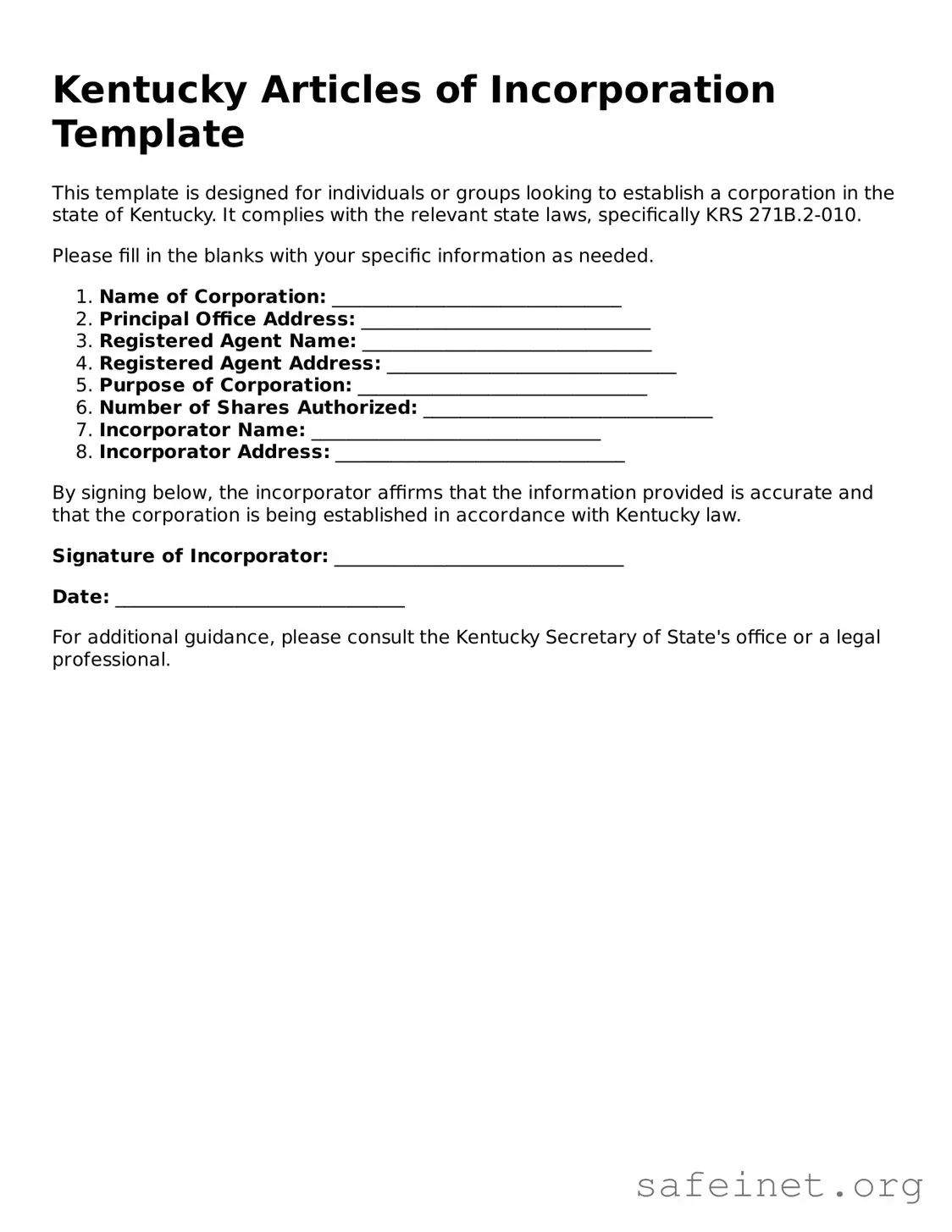
Kentucky Articles of Incorporation Template
This template is designed for individuals or groups looking to establish a corporation in the state of Kentucky. It complies with the relevant state laws, specifically KRS 271B.2-010.
Please fill in the blanks with your specific information as needed.
By signing below, the incorporator affirms that the information provided is accurate and that the corporation is being established in accordance with Kentucky law.
Signature of Incorporator: _______________________________
Date: _______________________________
For additional guidance, please consult the Kentucky Secretary of State's office or a legal professional.
| Fact Name | Description |
|---|---|
| Purpose | The Kentucky Articles of Incorporation form is used to legally establish a corporation in the state of Kentucky. |
| Governing Law | The form is governed by the Kentucky Business Corporation Act, specifically KRS Chapter 271B. |
| Filing Requirement | Filing the Articles of Incorporation with the Kentucky Secretary of State is mandatory for corporation formation. |
| Information Needed | The form requires details such as the corporation's name, purpose, registered agent, and address. |
| Filing Fee | A filing fee is required when submitting the Articles of Incorporation, which varies based on the type of corporation. |
| Effective Date | The Articles of Incorporation can specify an effective date, which can be the filing date or a future date. |
| Amendments | Changes to the Articles of Incorporation can be made through a formal amendment process as outlined in KRS Chapter 271B. |
| Public Record | Once filed, the Articles of Incorporation become part of the public record and are accessible to the public. |
After completing the Kentucky Articles of Incorporation form, the next step is to submit the form to the appropriate state office along with the required filing fee. This process is crucial for establishing your business as a legal entity in Kentucky.
What are the Kentucky Articles of Incorporation?
The Kentucky Articles of Incorporation is a legal document that establishes a corporation in the state of Kentucky. It outlines essential information about the corporation, including its name, purpose, and the names of its initial directors. Filing this document is a crucial step in forming a corporation.
Who needs to file Articles of Incorporation in Kentucky?
What information is required in the Articles of Incorporation?
The form requires several key pieces of information. You will need to provide the corporation's name, its principal office address, the purpose of the corporation, the number of shares it is authorized to issue, and the names and addresses of the initial directors. This information helps define the structure and intent of the corporation.
How do I file the Articles of Incorporation?
To file the Articles of Incorporation, you can submit the form online through the Kentucky Secretary of State's website or send a paper form by mail. Ensure that you include the required filing fee, which varies based on the type of corporation you are establishing. Be sure to keep a copy for your records.
What is the filing fee for the Articles of Incorporation?
The filing fee for the Articles of Incorporation in Kentucky typically ranges from $40 to $100, depending on the type of corporation. It is important to check the current fee schedule on the Kentucky Secretary of State's website, as fees may change.
How long does it take to process the Articles of Incorporation?
Processing times can vary. Generally, if filed online, you may receive confirmation within a few business days. Mail submissions may take longer, often up to two weeks. To expedite the process, consider using online filing options.
Can I amend the Articles of Incorporation after filing?
Yes, you can amend the Articles of Incorporation after they have been filed. To do this, you must submit an amendment form to the Kentucky Secretary of State. This process allows you to update information such as the corporation's name or the number of shares authorized.
What happens if I don’t file the Articles of Incorporation?
If you do not file the Articles of Incorporation, your business cannot operate as a corporation in Kentucky. This means you will miss out on benefits like limited liability protection. Additionally, you may face penalties or legal issues if you conduct business without proper registration.
Is legal assistance necessary for filing the Articles of Incorporation?
While it is not mandatory to seek legal assistance, it can be beneficial. An attorney can help ensure that all information is accurate and compliant with state laws. This can prevent potential issues down the line and provide peace of mind during the incorporation process.
Incorrect Business Name: Many people forget to check if their chosen business name is available. The name must be unique and not already in use by another entity in Kentucky.
Missing Registered Agent Information: Failing to provide accurate details for the registered agent can lead to delays. The registered agent must have a physical address in Kentucky and be available during business hours.
Improper Purpose Statement: Some individuals write vague or overly broad purpose statements. The purpose must clearly define the business activities the corporation intends to pursue.
Omitting Initial Directors: Forgetting to list the initial directors is a common oversight. The form requires names and addresses of the directors who will manage the corporation.
Incorrect Filing Fee: Submitting the wrong filing fee can result in rejection. It’s important to verify the current fee and include payment with the application.
When forming a corporation in Kentucky, the Articles of Incorporation are essential. However, several other forms and documents are typically required to ensure compliance with state regulations and to establish the corporation's operations. Below is a list of common documents that accompany the Articles of Incorporation.
Each of these documents plays a critical role in establishing and maintaining a corporation in Kentucky. It is important to ensure that all necessary forms are completed accurately and submitted on time to avoid any legal issues in the future.
The Articles of Incorporation is a foundational document for establishing a corporation. It is similar to the Certificate of Incorporation, which is used in many states. Both documents serve the purpose of officially creating a corporation and outlining its basic details, such as its name, purpose, and registered agent. However, the Certificate of Incorporation may also include specific provisions mandated by state law, making it a bit more comprehensive in certain jurisdictions.
Another document that shares similarities is the Bylaws. While the Articles of Incorporation establish the corporation's existence, the Bylaws provide the internal rules and procedures for governance. They outline how the corporation will operate, including the roles of officers and directors, meeting protocols, and voting procedures. Together, these documents create a framework for both the legal standing and operational structure of the corporation.
The Operating Agreement is akin to the Articles of Incorporation, especially for Limited Liability Companies (LLCs). This document outlines the management structure and operational guidelines for the LLC. Like the Articles, it is essential for defining the relationship among members and detailing how the company will be run. Both documents are crucial for legal recognition and operational clarity.
The Partnership Agreement is another document that has similarities with the Articles of Incorporation, particularly in the context of partnerships. This agreement outlines the terms of the partnership, including the roles of each partner, profit sharing, and decision-making processes. While the Articles of Incorporation focus on corporate structure, the Partnership Agreement emphasizes the collaborative nature of a partnership.
The Certificate of Good Standing can also be compared to the Articles of Incorporation. This document confirms that a corporation is legally registered and compliant with state regulations. It is often required for various business transactions and can provide reassurance to stakeholders that the corporation is in good standing. Both documents play a role in establishing and maintaining a corporation's legitimacy.
The Business License is similar in that it is a necessary document for operating legally. While the Articles of Incorporation focus on the formation of the corporation, the Business License grants permission to conduct business within a specific jurisdiction. Both are essential for legal compliance and demonstrate a commitment to operating within the law.
The Federal Employer Identification Number (EIN) is another document that complements the Articles of Incorporation. The EIN is required for tax purposes and is used to identify a business entity. While the Articles establish the corporation's legal existence, the EIN is necessary for financial operations, such as opening bank accounts and filing tax returns.
The Statement of Information is similar to the Articles of Incorporation in that it provides essential details about the corporation after its formation. This document typically includes information about the corporation's address, officers, and registered agent. It serves to keep the state informed about the corporation's current status, much like the initial Articles do upon incorporation.
Lastly, the Annual Report shares a relationship with the Articles of Incorporation. This document is filed periodically to update the state on the corporation’s activities and financial status. While the Articles of Incorporation are filed once to create the corporation, the Annual Report ensures ongoing compliance and transparency with state authorities.
When filling out the Kentucky Articles of Incorporation form, it is essential to follow certain guidelines to ensure accuracy and compliance. Below is a list of things to do and avoid during this process.
Things You Should Do:
Things You Shouldn't Do:
When it comes to the Kentucky Articles of Incorporation form, several misconceptions can lead to confusion for those looking to start a business. Here are nine common misunderstandings:
Understanding these misconceptions can help individuals navigate the process of incorporating their business in Kentucky more effectively.
Filling out and using the Kentucky Articles of Incorporation form is a crucial step for anyone looking to establish a corporation in the state. Here are some key takeaways to keep in mind:
Taking these steps will help lay a solid foundation for your new corporation in Kentucky.