The Kansas Transfer-on-Death Deed is a valuable estate planning tool that allows property owners to pass their real estate directly to designated beneficiaries upon their death, bypassing the lengthy and often costly probate process. This form enables individuals to maintain control over their property during their lifetime while ensuring a smooth transition to heirs without the need for court involvement. It is important to note that the deed must be properly executed and recorded with the county register of deeds to be effective. Additionally, property owners can revoke or change beneficiaries at any time before their passing, offering flexibility in estate planning. Understanding the nuances of this form can significantly simplify the transfer of property and provide peace of mind for both the owner and their loved ones. By utilizing the Transfer-on-Death Deed, individuals can ensure their wishes are honored and that their beneficiaries receive their property in a timely manner, making it an essential consideration for anyone looking to secure their legacy in Kansas.
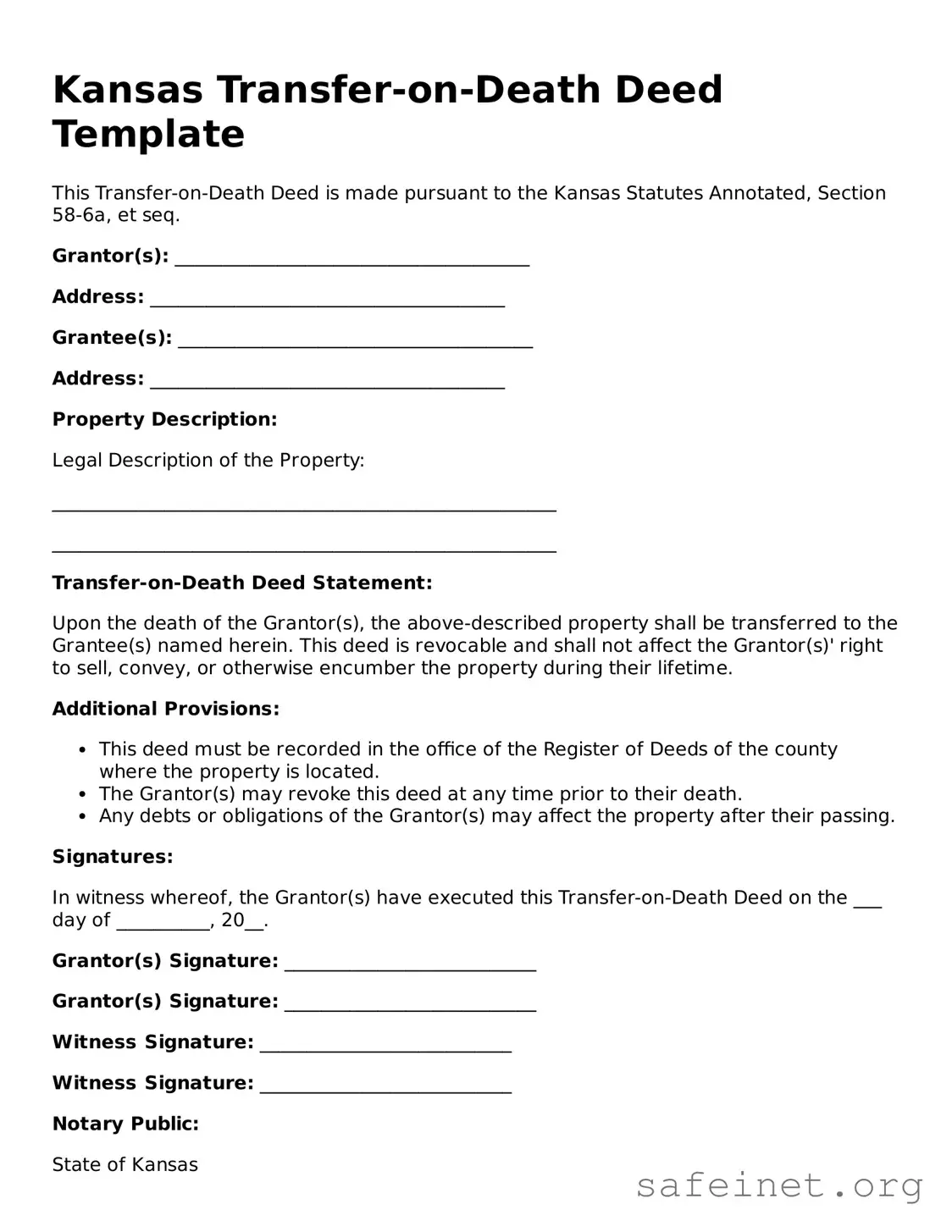
Kansas Transfer-on-Death Deed Template
This Transfer-on-Death Deed is made pursuant to the Kansas Statutes Annotated, Section 58-6a, et seq.
Grantor(s): ______________________________________
Address: ______________________________________
Grantee(s): ______________________________________
Address: ______________________________________
Property Description:
Legal Description of the Property:
______________________________________________________
______________________________________________________
Transfer-on-Death Deed Statement:
Upon the death of the Grantor(s), the above-described property shall be transferred to the Grantee(s) named herein. This deed is revocable and shall not affect the Grantor(s)' right to sell, convey, or otherwise encumber the property during their lifetime.
Additional Provisions:
Signatures:
In witness whereof, the Grantor(s) have executed this Transfer-on-Death Deed on the ___ day of __________, 20__.
Grantor(s) Signature: ___________________________
Grantor(s) Signature: ___________________________
Witness Signature: ___________________________
Witness Signature: ___________________________
Notary Public:
State of Kansas
County of ________________
Subscribed and sworn to before me this ___ day of __________, 20__.
Notary Public Signature: ___________________________
My commission expires: ___________________________
| Fact Name | Details |
|---|---|
| Definition | A Transfer-on-Death Deed allows a property owner to transfer real estate to a beneficiary upon their death, avoiding probate. |
| Governing Law | The Kansas Transfer-on-Death Deed is governed by K.S.A. 58-6a, which outlines the requirements and procedures for creating the deed. |
| Revocation | The property owner can revoke the deed at any time before their death, ensuring flexibility in estate planning. |
| Requirements | The deed must be signed by the property owner and notarized. It must also be recorded in the county where the property is located. |
| Beneficiary Rights | Beneficiaries have no rights to the property until the owner's death, protecting the owner's control during their lifetime. |
Once you have the Kansas Transfer-on-Death Deed form ready, it’s time to fill it out accurately to ensure your intentions are clearly documented. Follow these steps carefully to complete the form correctly.
After completing these steps, you will have officially recorded your Transfer-on-Death Deed. This deed allows the property to pass directly to the named beneficiaries without going through probate, streamlining the process for your loved ones.
What is a Transfer-on-Death Deed in Kansas?
A Transfer-on-Death Deed (TOD Deed) is a legal document that allows property owners in Kansas to transfer their real estate to designated beneficiaries upon their death. This deed does not require the property to go through probate, simplifying the transfer process and potentially saving time and costs for the beneficiaries.
Who can use a Transfer-on-Death Deed?
Any individual who owns real estate in Kansas can utilize a Transfer-on-Death Deed. This includes homeowners, landowners, and individuals with a life estate. However, it’s important to ensure that the deed is executed correctly to be valid.
How do I create a Transfer-on-Death Deed?
To create a Transfer-on-Death Deed, you must fill out the appropriate form, which includes details about the property and the beneficiaries. After completing the form, you must sign it in the presence of a notary public. Finally, the deed must be recorded with the county register of deeds where the property is located to be effective.
Can I change or revoke a Transfer-on-Death Deed?
Yes, you can change or revoke a Transfer-on-Death Deed at any time before your death. To do this, you will need to create a new deed that explicitly revokes the previous one or file a revocation form with the county. It's crucial to ensure that the new or revoked deed is also properly recorded.
What happens if I do not name a beneficiary?
If you do not name a beneficiary in your Transfer-on-Death Deed, the property will not transfer as intended. Instead, it will become part of your estate and will be subject to probate. To avoid this situation, always ensure that you clearly designate beneficiaries when creating the deed.
Are there any limitations on who I can name as a beneficiary?
In Kansas, you can name any individual or entity as a beneficiary in your Transfer-on-Death Deed. This includes family members, friends, or even charities. However, it’s important to ensure that the beneficiaries are capable of inheriting property, as certain restrictions may apply to minors or individuals with legal disabilities.
What are the tax implications of a Transfer-on-Death Deed?
Generally, transferring property via a Transfer-on-Death Deed does not trigger immediate tax consequences. The property is transferred to the beneficiaries without being subject to estate taxes at the time of your death. However, beneficiaries may be responsible for property taxes and any capital gains taxes when they sell the property in the future.
Is legal assistance necessary to create a Transfer-on-Death Deed?
While it is not strictly necessary to have legal assistance, consulting with an attorney can help ensure that your Transfer-on-Death Deed is properly executed and meets all legal requirements. This can prevent potential issues down the line and provide peace of mind that your wishes will be honored.
Not including the legal description of the property. This is essential for identifying the specific property being transferred.
Failing to sign the deed in front of a notary. A notarized signature is required for the deed to be valid.
Using incorrect names for the beneficiaries. Ensure that names are spelled correctly and match legal documents.
Not specifying multiple beneficiaries clearly. If there are multiple beneficiaries, clarify how the property will be divided.
Forgetting to record the deed with the county. A Transfer-on-Death Deed must be filed with the appropriate county office to take effect.
Neglecting to review state-specific requirements. Kansas may have unique rules that differ from other states.
Assuming the deed is irrevocable. Understand that a Transfer-on-Death Deed can be revoked or modified before the owner's death.
The Kansas Transfer-on-Death Deed allows property owners to transfer their real estate to designated beneficiaries upon their death, avoiding probate. While this deed is a crucial document for estate planning, several other forms and documents often accompany it to ensure a smooth transition of assets. Here is a list of related documents that may be necessary or helpful in conjunction with the Transfer-on-Death Deed.
These documents play important roles in the estate planning process. Having them in order can help ensure that the transfer of property occurs smoothly and according to the wishes of the property owner. Proper preparation can save time and reduce stress for beneficiaries during a challenging time.
The Kansas Transfer-on-Death Deed (TODD) form is similar to a will in that both documents allow individuals to dictate how their property will be distributed after their death. A will, however, must go through the probate process, which can be lengthy and costly. In contrast, a TODD allows for the direct transfer of property to designated beneficiaries without the need for probate. This streamlined process can save time and money, making the TODD an appealing option for many individuals looking to simplify their estate planning.
When filling out the Kansas Transfer-on-Death Deed form, it is essential to follow certain guidelines to ensure the document is valid and effective. Here’s a list of things you should and shouldn’t do:
Understanding the Kansas Transfer-on-Death Deed can be challenging, leading to several misconceptions. Below are seven common misunderstandings about this legal document:
Many believe that the Transfer-on-Death Deed immediately transfers property ownership upon the death of the owner. In reality, the transfer occurs only after the owner's death and does not take effect until that time.
Some people think that a Transfer-on-Death Deed serves as a substitute for a will. While it does allow for the transfer of specific property, it does not address other assets or matters of estate planning that a will would cover.
This deed is not applicable to all property types. For example, it cannot be used for real estate held in a trust or for property that is jointly owned with rights of survivorship.
One significant advantage of the Transfer-on-Death Deed is that it allows property to bypass the probate process. This can save time and money for the beneficiaries.
While beneficiaries may be responsible for taxes on the property once they inherit it, the Transfer-on-Death Deed itself does not trigger immediate tax liabilities at the time of transfer.
Contrary to popular belief, a Transfer-on-Death Deed can be revoked or changed by the property owner at any time before their death, as long as the proper procedures are followed.
Many assume that the Transfer-on-Death Deed is overly complicated. In fact, the form is designed to be straightforward, making it accessible for individuals to complete without extensive legal knowledge.
Clarifying these misconceptions can help individuals make informed decisions regarding their estate planning in Kansas.
When considering the Kansas Transfer-on-Death Deed, it's important to understand its implications and requirements. Here are some key takeaways to keep in mind: