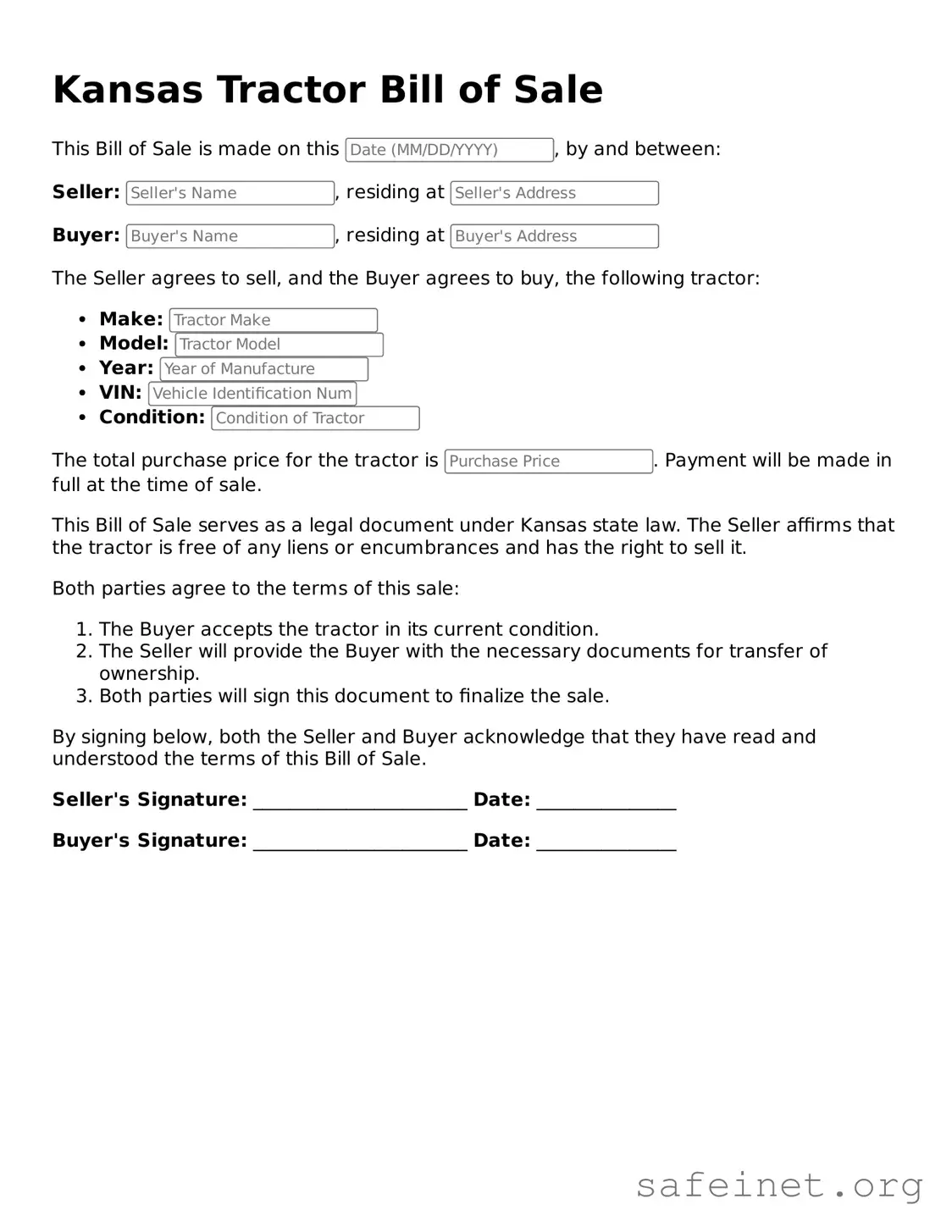
When buying or selling a tractor in Kansas, having the right documentation is crucial. The Kansas Tractor Bill of Sale form serves as a vital record of the transaction between the buyer and the seller. This form typically includes essential details such as the names and addresses of both parties, a description of the tractor, including its make, model, and identification number, as well as the purchase price. It also provides space for signatures, ensuring that both parties agree to the terms of the sale. By completing this form, you create a clear, legal record that can help protect both the buyer and the seller in case of future disputes. Understanding how to fill out this form accurately can simplify the sale process and give peace of mind to everyone involved.
Kansas Tractor Bill of Sale
This Bill of Sale is made on this , by and between:
Seller: , residing at
Buyer: , residing at
The Seller agrees to sell, and the Buyer agrees to buy, the following tractor:
The total purchase price for the tractor is . Payment will be made in full at the time of sale.
This Bill of Sale serves as a legal document under Kansas state law. The Seller affirms that the tractor is free of any liens or encumbrances and has the right to sell it.
Both parties agree to the terms of this sale:
By signing below, both the Seller and Buyer acknowledge that they have read and understood the terms of this Bill of Sale.
Seller's Signature: _______________________ Date: _______________
Buyer's Signature: _______________________ Date: _______________
| Fact Name | Details |
|---|---|
| Purpose | The Kansas Tractor Bill of Sale form is used to document the sale of a tractor between a buyer and a seller. |
| Governing Law | This form is governed by Kansas Statutes Annotated (K.S.A.) 8-135. |
| Required Information | It typically requires details such as the names and addresses of both parties, the tractor's make, model, year, and Vehicle Identification Number (VIN). |
| Signatures | Both the buyer and seller must sign the document to validate the sale. |
| Notarization | Notarization is not required in Kansas, but it can add an extra layer of authenticity. |
| Record Keeping | It is advisable for both parties to keep a copy of the completed bill of sale for their records. |
| Transfer of Ownership | The bill of sale serves as proof of ownership transfer and may be needed for registration purposes. |
Once you have the Kansas Tractor Bill of Sale form in front of you, it's time to fill it out accurately. This document will help you transfer ownership of a tractor from one party to another. Follow the steps below to complete the form correctly.
After completing the form, make sure both parties retain a copy for their records. This will serve as proof of the transaction and help avoid any potential disputes in the future.
What is a Kansas Tractor Bill of Sale form?
The Kansas Tractor Bill of Sale form is a legal document used to record the sale and transfer of ownership of a tractor in the state of Kansas. This form serves as proof of the transaction between the buyer and the seller, detailing important information about the tractor, the parties involved, and the terms of the sale.
What information is required on the form?
The form typically requires essential details such as the names and addresses of both the buyer and the seller, a description of the tractor including its make, model, year, and vehicle identification number (VIN), the sale price, and the date of the transaction. Additionally, both parties may need to sign the document to validate the sale.
Is the Kansas Tractor Bill of Sale form mandatory?
Can I create my own Bill of Sale?
Yes, individuals can create their own Bill of Sale, provided it includes all necessary information. However, using a standardized form can help ensure that all required elements are included and that the document meets legal standards in Kansas. Many online resources offer templates that can be customized for this purpose.
What should I do after completing the Bill of Sale?
Once the Bill of Sale is completed and signed by both parties, it is advisable for the buyer to keep a copy for their records. The seller should also retain a copy as proof of the sale. If the tractor is being registered, the Bill of Sale may need to be submitted to the local Department of Motor Vehicles (DMV) along with other registration documents.
Does the Bill of Sale need to be notarized?
In Kansas, notarization is not a requirement for a Bill of Sale to be valid. However, having the document notarized can add an extra layer of authenticity and may be beneficial if disputes arise in the future. It is often a good practice to have important documents notarized, especially in significant transactions.
What if there are issues after the sale?
If issues arise after the sale, such as disputes over the condition of the tractor or claims of misrepresentation, the Bill of Sale can serve as a critical piece of evidence. It is important for both parties to adhere to the terms outlined in the document. If necessary, legal counsel may be sought to resolve any disputes that cannot be amicably settled.
Failing to include complete buyer and seller information. Ensure that both parties’ names, addresses, and contact details are fully provided.
Not specifying the tractor details. Include the make, model, year, and Vehicle Identification Number (VIN) to avoid confusion.
Omitting the sale price. Clearly state the amount for which the tractor is being sold.
Neglecting to sign the form. Both the buyer and seller must sign to validate the transaction.
Using an outdated version of the form. Always download the most current version to ensure compliance with state regulations.
Not providing a date of sale. Include the exact date to establish when the transaction occurred.
Failing to indicate whether the tractor is being sold as-is or with warranties. This information is crucial for both parties.
Leaving out the notary requirement if applicable. Some transactions may require notarization for added security.
Not keeping a copy of the completed form. Both the buyer and seller should retain a copy for their records.
Ignoring local regulations. Check for any additional requirements specific to your county or city.
When purchasing or selling a tractor in Kansas, several forms and documents may accompany the Kansas Tractor Bill of Sale. Each of these documents serves a specific purpose, ensuring that the transaction is clear and legally binding. Below is a list of commonly used forms that can facilitate the process.
Having these documents ready can streamline the buying or selling process and help avoid potential disputes in the future. It is advisable to ensure that all forms are completed accurately and retained for personal records.
The Kansas Vehicle Bill of Sale is quite similar to the Tractor Bill of Sale. Both documents serve the primary purpose of transferring ownership from one party to another. They include essential details such as the buyer's and seller's names, addresses, and signatures. Additionally, both forms typically require information about the vehicle or tractor, including the make, model, year, and vehicle identification number (VIN). This ensures that the transaction is well-documented and legally binding, providing protection for both parties involved.
The Boat Bill of Sale is another document that shares similarities with the Tractor Bill of Sale. Like the tractor transaction, a boat sale requires a clear record of the exchange of ownership. This document includes pertinent details about the boat, such as its hull identification number, make, model, and year, along with the buyer's and seller's information. Just as with a tractor, having a bill of sale for a boat provides legal proof of ownership, which is crucial for registration and insurance purposes.
When filling out the Kansas Tractor Bill of Sale form, it's important to ensure accuracy and completeness. Below is a list of things you should and shouldn't do to facilitate a smooth transaction.
Understanding the Kansas Tractor Bill of Sale form is essential for anyone involved in buying or selling a tractor in the state. However, several misconceptions can lead to confusion. Here are seven common misconceptions:
Clarifying these misconceptions can help ensure a smooth transaction when buying or selling a tractor in Kansas. Always consider consulting with a legal expert if there are any uncertainties regarding the process.
Filling out and using the Kansas Tractor Bill of Sale form is a straightforward process, but it is essential to understand its components and implications. Here are six key takeaways to consider: