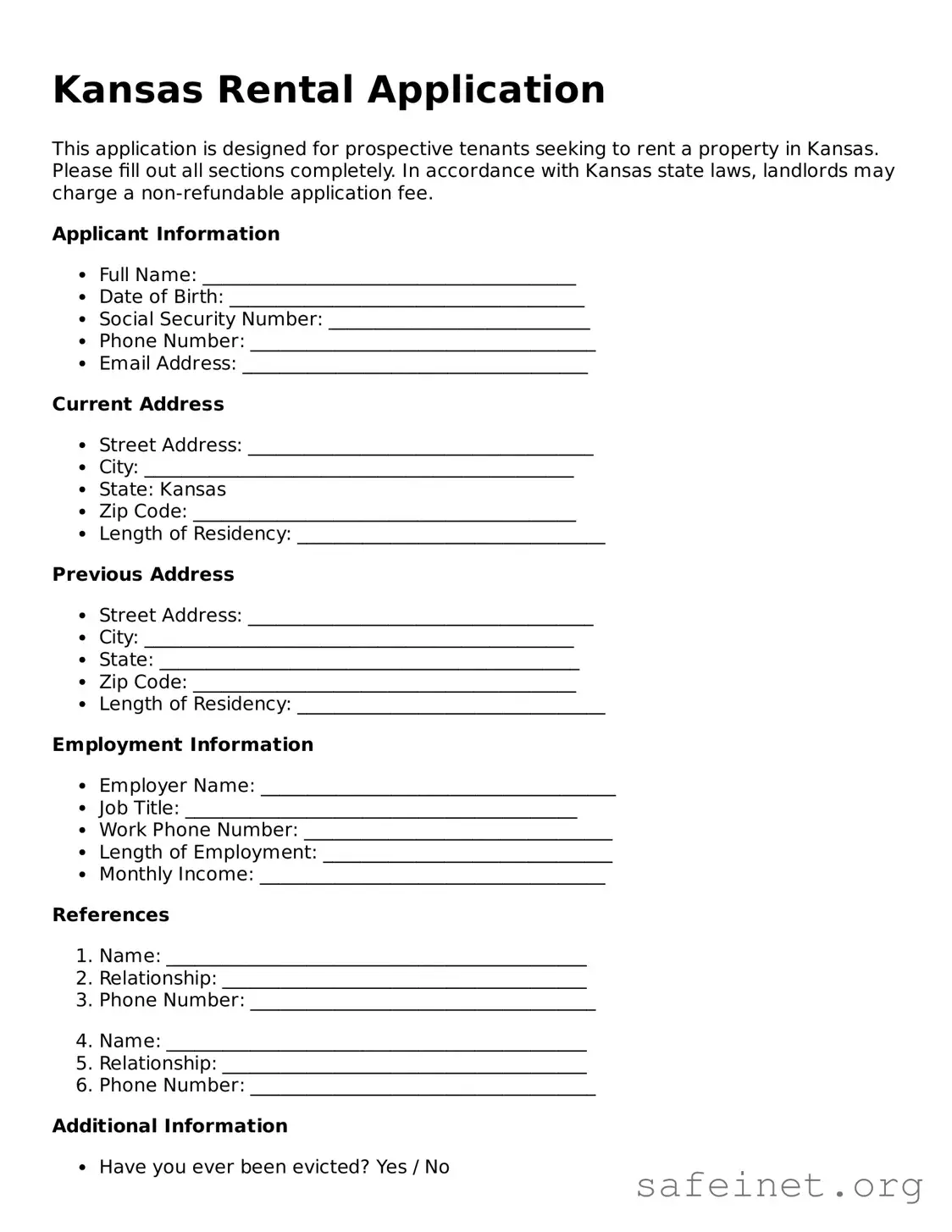
The Kansas Rental Application form serves as a vital tool for both landlords and prospective tenants in the rental process. This form collects essential information that helps landlords evaluate potential tenants, ensuring a good fit for their property. Key aspects of the application include personal details such as the applicant's name, contact information, and social security number. Additionally, it typically requires employment history and income verification to assess financial stability. References from previous landlords may also be requested, providing insight into the applicant's rental history. Moreover, the form often includes questions about pets, smoking habits, and other lifestyle factors that could impact the rental decision. By gathering this information, landlords can make informed choices while applicants can present their qualifications effectively, streamlining the rental process for everyone involved.
Kansas Rental Application
This application is designed for prospective tenants seeking to rent a property in Kansas. Please fill out all sections completely. In accordance with Kansas state laws, landlords may charge a non-refundable application fee.
Applicant Information
Current Address
Previous Address
Employment Information
References
Additional Information
By signing below, you confirm that all information provided is accurate and complete to the best of your knowledge.
Applicant Signature: ____________________________________
Date: _________________________________________________
| Fact Name | Description |
|---|---|
| Purpose | The Kansas Rental Application form is used by landlords to screen potential tenants. |
| Legal Basis | It is governed by the Kansas Residential Landlord and Tenant Act. |
| Information Required | Applicants typically provide personal information, rental history, and income details. |
| Application Fee | Landlords may charge an application fee to cover background checks. |
| Background Check | A background check is often conducted to assess the applicant's credit and rental history. |
| Fair Housing Compliance | The form must comply with the Fair Housing Act, prohibiting discrimination. |
| Signature Requirement | Applicants must sign the form, confirming the accuracy of the information provided. |
| Privacy Considerations | Landlords must handle personal information with care to protect applicants' privacy. |
| Processing Time | Landlords usually process applications within a few days, depending on their policies. |
| Approval Criteria | Approval is based on creditworthiness, rental history, and income verification. |
After obtaining the Kansas Rental Application form, you will need to provide accurate information to ensure a smooth rental process. Follow these steps to complete the form correctly.
Once you have completed the form, submit it to the landlord or property manager as instructed. Ensure you keep a copy for your records.
What is the Kansas Rental Application form?
The Kansas Rental Application form is a document used by landlords to collect information from potential tenants. It typically includes personal details, rental history, employment information, and references. This form helps landlords assess the suitability of applicants for their rental properties.
Who needs to fill out the rental application?
Anyone interested in renting a property in Kansas must complete the rental application. This includes individuals applying for apartments, houses, or any other rental units. All adult occupants are usually required to submit their own applications.
What information is required on the application?
The application generally requires personal information such as your name, contact details, Social Security number, and date of birth. You will also need to provide your employment history, income details, rental history, and references. Some applications may ask for additional information like pet ownership or vehicle details.
Is there a fee to apply?
Many landlords charge an application fee to cover the cost of background checks and processing. This fee varies by property and can range from $25 to $100. Be sure to ask the landlord about any fees before submitting your application.
How long does it take to process the application?
The processing time for a rental application can vary. Typically, it takes anywhere from a few hours to several days. Factors that can affect this time include the landlord's policies, the number of applications received, and the thoroughness of background checks.
What happens if I am denied?
If your application is denied, the landlord is required to provide a reason. Common reasons for denial include poor credit history, insufficient income, or negative rental history. You have the right to request a copy of the report used in the decision-making process.
Can I appeal a denial?
While there is no formal appeal process for rental applications, you can discuss the denial with the landlord. If you believe there was an error in your background check or if you have mitigating circumstances, it may be possible to provide additional information or documentation to support your case.
What if I have a criminal record?
Having a criminal record does not automatically disqualify you from renting a property. Each landlord has their own policies regarding criminal history. Be honest about your record on the application, and if possible, provide context or evidence of rehabilitation.
Can I submit a rental application with a co-signer?
Yes, many landlords allow applicants to have a co-signer. This is often necessary if the primary applicant has insufficient income or credit issues. The co-signer will need to fill out their own application and provide their financial information.
What should I do if I find errors on my application?
If you notice any errors on your application after submission, contact the landlord immediately. Correcting inaccuracies is important, as they can affect your chances of approval. Be prepared to provide the correct information and any supporting documents if necessary.
Failing to provide complete personal information. Applicants often leave out essential details like their full name, current address, or contact information.
Not disclosing rental history. It’s common for applicants to forget to include previous addresses or landlords, which can raise red flags for property managers.
Overlooking employment details. Applicants sometimes neglect to include their current employer or income information, which is crucial for assessing financial stability.
Inaccurate or incomplete references. Providing outdated or incorrect contact information for personal or professional references can hinder the application process.
Skipping the credit check consent. Many applicants forget to sign or initial the section that allows landlords to conduct a credit check, which is often a requirement.
Not disclosing pets. Some applicants may assume it’s acceptable to omit information about pets, but failing to disclose this can lead to issues later.
Ignoring the application fee. Many people forget to include the application fee or fail to check the payment methods accepted by the landlord.
Providing false information. While it might seem tempting, lying on a rental application can lead to immediate disqualification or future legal issues.
Not reading the fine print. Some applicants rush through the application and miss important terms or conditions that could affect their rental agreement.
Submitting the application without proofreading. Spelling errors or unclear information can create confusion and lead to delays in the application process.
When applying for a rental property in Kansas, the rental application form is just one of several important documents you may encounter. These additional forms help landlords assess potential tenants and ensure a smooth leasing process. Below is a list of commonly used documents that accompany the rental application.
These documents collectively create a comprehensive picture of the potential tenant, helping landlords make informed decisions. Understanding each of these forms can empower you as a tenant to navigate the rental application process more effectively.
The Kansas Rental Application form shares similarities with the standard Lease Agreement. Both documents serve to formalize the relationship between a landlord and a tenant. While the rental application collects essential information about potential tenants, the lease agreement outlines the terms of the tenancy, including rent, duration, and responsibilities. Each document plays a crucial role in ensuring that both parties understand their rights and obligations, creating a foundation for a successful rental experience.
Another document akin to the Kansas Rental Application is the Tenant Background Check Authorization form. This form allows landlords to obtain a tenant's background information, including credit history and criminal records. Like the rental application, it requires personal information from the tenant, such as Social Security numbers and previous addresses. Both documents aim to protect the landlord's interests while ensuring that tenants are vetted appropriately before entering into a rental agreement.
The Rental Reference Form is also similar in purpose to the Kansas Rental Application. This document requests information about a tenant's previous rental experiences, often including references from former landlords. Just as the rental application seeks to assess a tenant's suitability, the rental reference form provides additional context regarding the tenant's behavior and reliability in past housing situations. Together, they help landlords make informed decisions.
The Employment Verification Form mirrors the rental application by requiring tenants to disclose their employment status. This document typically asks for details about the tenant's job, including employer name, position, and salary. By verifying employment, landlords can assess a tenant's ability to meet rental payments consistently. Both documents serve as tools for landlords to evaluate financial stability and reliability.
Similar to the Kansas Rental Application is the Pet Application Form. For tenants with pets, this document gathers information about the animal, including breed, size, and vaccination status. Like the rental application, it helps landlords determine if the tenant is suitable for a rental property that may have specific pet policies. This document ensures that both parties are clear on expectations regarding pets in the rental unit.
The Co-Signer Agreement is another document that aligns with the rental application. When tenants have a co-signer, this agreement outlines the responsibilities of the co-signer, who agrees to cover rent if the tenant defaults. The rental application collects information about the tenant and may also require details about the co-signer. Both documents work together to provide security for landlords, especially when tenants may not meet income or credit criteria on their own.
The Security Deposit Agreement is akin to the rental application in that it establishes financial expectations between the landlord and tenant. This document specifies the amount of the security deposit, conditions for its return, and any deductions that may apply. While the rental application assesses tenant qualifications, the security deposit agreement solidifies the financial commitment required to secure the rental unit.
The Move-In Checklist is another related document. This checklist outlines the condition of the rental property at the time of move-in. While the rental application focuses on tenant qualifications, the move-in checklist ensures that both parties agree on the property's state, preventing disputes over damages when the tenant moves out. It is a crucial tool for protecting the interests of both landlords and tenants.
The Rent Payment Agreement also shares similarities with the Kansas Rental Application. This document specifies the terms for rent payments, including due dates and acceptable payment methods. While the rental application collects information to assess tenant suitability, the rent payment agreement formalizes the financial aspect of the landlord-tenant relationship, ensuring clarity and accountability.
Finally, the Eviction Notice can be considered similar to the Kansas Rental Application in that it is a legal document that outlines the consequences of failing to adhere to the rental agreement. While the rental application focuses on the initial stages of the landlord-tenant relationship, the eviction notice serves as a reminder of the obligations that both parties have agreed to. It underscores the importance of understanding the terms laid out in the rental application and subsequent lease agreements.
When filling out the Kansas Rental Application form, it is essential to approach the process with care. Here are some important do's and don'ts to keep in mind:
By following these guidelines, you can improve your chances of securing a rental property in Kansas. Take your time and ensure that every detail is correct before you submit your application.
Understanding the Kansas Rental Application form is essential for both landlords and tenants. However, several misconceptions can lead to confusion. Here are seven common misconceptions:
Many people believe that rental applications across states are identical. In reality, each state, including Kansas, has specific requirements and forms tailored to local laws.
Some think that landlords are prohibited from charging an application fee. In Kansas, landlords may charge a fee, but it must be reasonable and disclosed upfront.
It is a common belief that only tenants need to submit personal details. However, landlords also need to provide their contact information and may need to disclose their rental history.
Some individuals assume that submitting a rental application is optional. In most cases, landlords require a completed application to assess potential tenants.
There is a misconception that landlords cannot perform credit checks. In Kansas, landlords can conduct credit checks as part of the application process, provided they inform the applicant.
Some people believe that lying on a rental application is harmless. However, providing false information can lead to application denial or eviction later on.
Many think that once they submit a rental application, they cannot change their mind. In fact, applicants can withdraw their applications at any time before approval.
Being aware of these misconceptions can help both landlords and tenants navigate the rental process more effectively.
When filling out and using the Kansas Rental Application form, there are several important aspects to keep in mind. Understanding these key points can help streamline the process and ensure a successful application.
Taking these steps can help you navigate the rental application process more effectively and increase your chances of securing your desired rental property.