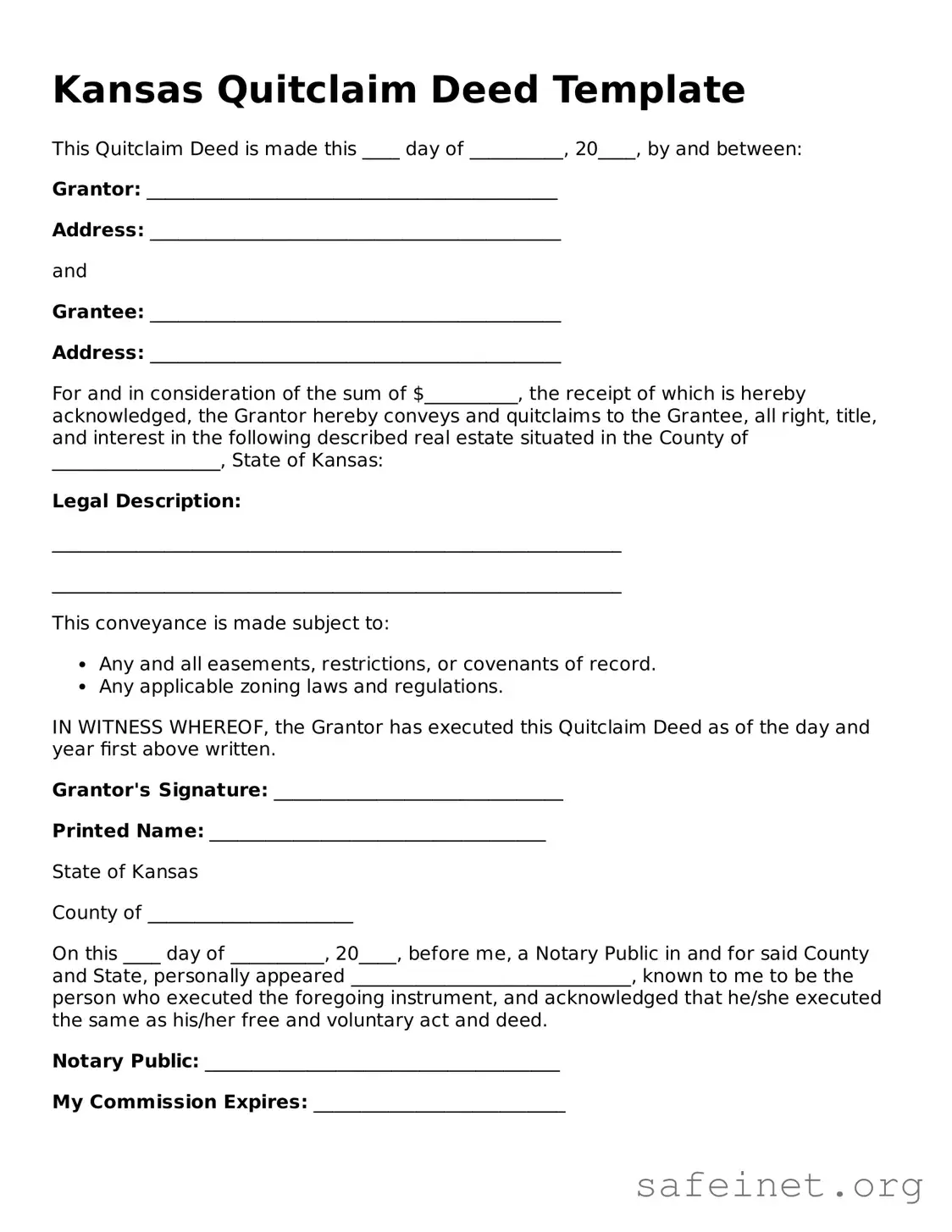
The Kansas Quitclaim Deed form serves as a vital legal document for property transfers, allowing individuals to convey their interest in real estate without guaranteeing the title's validity. This form is particularly useful in situations where the property owner wishes to transfer ownership to a family member, friend, or business partner, often simplifying the process by eliminating the need for extensive title searches. Importantly, the quitclaim deed does not provide any warranties, meaning the grantor only transfers whatever interest they may have in the property, if any. This lack of warranty can be advantageous in certain scenarios, such as transferring property between parties who trust each other. The form must include specific details, such as the names of the grantor and grantee, a legal description of the property, and the date of the transfer. Additionally, it requires notarization to ensure the authenticity of the signatures involved. Understanding these elements is crucial for anyone considering a quitclaim deed in Kansas, as it helps facilitate smoother transactions while clarifying the rights and responsibilities of each party involved.
Kansas Quitclaim Deed Template
This Quitclaim Deed is made this ____ day of __________, 20____, by and between:
Grantor: ____________________________________________
Address: ____________________________________________
and
Grantee: ____________________________________________
Address: ____________________________________________
For and in consideration of the sum of $__________, the receipt of which is hereby acknowledged, the Grantor hereby conveys and quitclaims to the Grantee, all right, title, and interest in the following described real estate situated in the County of __________________, State of Kansas:
Legal Description:
_____________________________________________________________
_____________________________________________________________
This conveyance is made subject to:
IN WITNESS WHEREOF, the Grantor has executed this Quitclaim Deed as of the day and year first above written.
Grantor's Signature: _______________________________
Printed Name: ____________________________________
State of Kansas
County of ______________________
On this ____ day of __________, 20____, before me, a Notary Public in and for said County and State, personally appeared ______________________________, known to me to be the person who executed the foregoing instrument, and acknowledged that he/she executed the same as his/her free and voluntary act and deed.
Notary Public: ______________________________________
My Commission Expires: ___________________________
| Fact Name | Description |
|---|---|
| Definition | A Kansas Quitclaim Deed is a legal document that transfers ownership of real estate from one party to another without guaranteeing the title's validity. |
| Governing Law | The use of Quitclaim Deeds in Kansas is governed by Kansas Statutes Annotated (KSA) 58-2201 et seq. |
| Parties Involved | The deed involves two main parties: the grantor (the person transferring the property) and the grantee (the person receiving the property). |
| Title Guarantee | Unlike a warranty deed, a quitclaim deed does not provide any guarantees about the title; it simply conveys whatever interest the grantor may have. |
| Usage | Quitclaim deeds are often used in situations such as divorce settlements, transferring property between family members, or clearing up title issues. |
| Execution Requirements | The deed must be signed by the grantor, and it is advisable to have the signature notarized to ensure its validity. |
| Recording | To protect the interests of the grantee, it is recommended to record the quitclaim deed with the county register of deeds. |
| Tax Implications | While transferring property via a quitclaim deed typically does not incur transfer taxes, it is essential to consult local regulations to confirm. |
| Revocation | Once a quitclaim deed is executed and delivered, it cannot be revoked unless the grantor retains a specific right to do so, which should be clearly stated. |
After you complete the Kansas Quitclaim Deed form, you will need to file it with the appropriate county office. This step is crucial to ensure that the transfer of property ownership is legally recognized. Make sure to keep a copy for your records.
What is a Kansas Quitclaim Deed?
A Kansas Quitclaim Deed is a legal document used to transfer ownership of real estate from one party to another. This type of deed provides no warranty on the property’s title, meaning the grantor does not guarantee that they hold clear title to the property. It simply conveys whatever interest the grantor has in the property, if any.
When should I use a Quitclaim Deed?
A Quitclaim Deed is often used in situations such as transferring property between family members, adding or removing a spouse from the title after marriage or divorce, or clearing up title issues. It is a quick way to transfer interest without the need for extensive title searches.
What information is required on a Kansas Quitclaim Deed?
The Quitclaim Deed must include the names of the grantor and grantee, a legal description of the property, the date of the transfer, and the signature of the grantor. It should also include the notary’s acknowledgment to ensure its validity.
Do I need to notarize the Quitclaim Deed?
Yes, a Quitclaim Deed must be notarized in Kansas. This step is crucial as it verifies the identity of the grantor and ensures that the document is executed properly. Without notarization, the deed may not be considered valid.
How do I file a Quitclaim Deed in Kansas?
To file a Quitclaim Deed in Kansas, you must take the completed and notarized document to the county register of deeds office in the county where the property is located. There may be a filing fee, and it’s advisable to check with the local office for specific requirements.
Is there a tax associated with a Quitclaim Deed?
In Kansas, transferring property using a Quitclaim Deed may be subject to a real estate transfer tax. The amount can vary by county, so it’s important to consult local regulations to determine if any taxes apply to your specific transaction.
Can I revoke a Quitclaim Deed after it is filed?
Once a Quitclaim Deed is executed and filed, it cannot be revoked unilaterally. If the grantor wishes to reverse the transfer, they would need to execute another deed that transfers the property back to themselves or another party. Legal advice may be necessary for this process.
Are there any risks associated with using a Quitclaim Deed?
Yes, there are risks. Since a Quitclaim Deed does not guarantee the title’s validity, the grantee may inherit potential issues, such as liens or claims against the property. It’s crucial to understand the implications and consider a title search before proceeding with this type of deed.
Can I use a Quitclaim Deed for commercial property?
Yes, a Quitclaim Deed can be used for commercial property in Kansas. However, it is advisable to consult with a legal professional to ensure that all necessary precautions are taken, especially regarding any potential liabilities associated with the property.
Incomplete Information: One common mistake is leaving out essential details. All parties involved must provide their full names, addresses, and any necessary identification numbers. Omitting this information can lead to delays or even invalidation of the deed.
Incorrect Property Description: A precise legal description of the property is crucial. Using vague terms or incorrect boundaries can create confusion and may lead to disputes over ownership.
Not Notarizing the Document: A quitclaim deed must be notarized to be legally binding. Failing to have the document signed in the presence of a notary public can render the deed ineffective.
Improper Execution: All parties must sign the deed. If one party neglects to sign, the document may be considered incomplete. Additionally, signatures should match the names listed on the form.
Ignoring Local Laws: Each state has specific requirements for quitclaim deeds. Not adhering to Kansas laws regarding the filing process can lead to complications. It is important to check local regulations before submission.
Failure to Record the Deed: After completing the quitclaim deed, it must be recorded with the appropriate county office. Neglecting this step can result in challenges to the property transfer and potential legal issues in the future.
A Kansas Quitclaim Deed is a legal document used to transfer ownership of real estate from one party to another without any warranties or guarantees regarding the title. When completing a property transfer, several other forms and documents may be necessary to ensure a smooth process. Here’s a list of commonly used documents that often accompany the Quitclaim Deed:
Each of these documents plays a vital role in ensuring that the transfer of property is conducted legally and efficiently. By preparing the necessary paperwork in advance, parties involved can help avoid potential disputes and ensure a smoother transaction.
A warranty deed is similar to a quitclaim deed in that both are used to transfer property ownership. However, a warranty deed provides a guarantee that the seller holds clear title to the property and has the right to sell it. This means that if any issues arise with the title after the sale, the seller is responsible for resolving them. In contrast, a quitclaim deed offers no such guarantees, making it a riskier option for buyers.
A special warranty deed also serves to transfer property ownership but with limited warranties. The seller guarantees that they have not caused any title issues during their ownership. Unlike a quitclaim deed, which offers no assurances, a special warranty deed provides some level of protection to the buyer, albeit not as comprehensive as a full warranty deed.
A bargain and sale deed is another document that resembles a quitclaim deed. It transfers property ownership but implies that the seller has title to the property, without guaranteeing that the title is clear. This type of deed is often used in transactions where the seller is not providing a warranty, similar to a quitclaim deed, but it does suggest some level of ownership interest.
An executor's deed is used when a property is transferred by an executor of an estate. This document is similar to a quitclaim deed in that it does not guarantee clear title. Instead, it conveys the property as is, which may involve some risks for the buyer. The executor's deed is often used in probate situations, making it distinct from a typical quitclaim deed.
A trustee's deed is issued when property is transferred from a trust. Like a quitclaim deed, it does not provide any warranties regarding the title. The trustee’s deed conveys the property as-is, which means the buyer assumes the risk associated with any potential title issues. This document is common in transactions involving estates and trusts.
A deed in lieu of foreclosure is another document that resembles a quitclaim deed. It allows a borrower to transfer property back to the lender to avoid foreclosure. This type of deed does not guarantee a clear title, similar to a quitclaim deed. The lender accepts the property as-is, which can be a quick way to resolve a distressed situation for both parties.
A leasehold deed conveys rights to a property for a specified period, similar to how a quitclaim deed transfers ownership. However, a leasehold deed does not transfer full ownership but rather the right to use the property for a certain time. While both documents facilitate the transfer of property interests, they serve different purposes in real estate transactions.
Finally, a mineral deed is used to transfer ownership of mineral rights. While it does not convey surface rights like a quitclaim deed, it is similar in that it transfers a specific interest in property without warranties. Buyers of mineral deeds assume the risks associated with any potential title issues, much like with a quitclaim deed.
When filling out the Kansas Quitclaim Deed form, attention to detail is essential. Here are six important do's and don'ts to guide you through the process.
Following these guidelines can help facilitate a smooth property transfer process in Kansas.
When it comes to the Kansas Quitclaim Deed form, there are several misconceptions that can lead to confusion. Understanding these misconceptions can help you navigate property transfers more effectively. Here’s a list of ten common misunderstandings:
By clearing up these misconceptions, you can make more informed decisions when dealing with property transfers using a Kansas Quitclaim Deed.
When dealing with property transfers in Kansas, understanding the Quitclaim Deed form is crucial. Here are some key takeaways to keep in mind: