Entering into a marriage is a significant milestone, often filled with excitement and anticipation. However, it's also a time to consider practical matters, especially when it comes to financial security. One essential tool that couples in Kansas can utilize is the prenuptial agreement form. This legal document serves to outline the distribution of assets and responsibilities in the event of a divorce or separation. It allows both parties to clearly define their individual properties, debts, and expectations regarding spousal support. Additionally, a prenuptial agreement can help protect family inheritances and business interests, ensuring that these assets remain intact. By discussing and agreeing on these matters before tying the knot, couples can foster open communication and reduce potential conflicts down the road. Understanding the nuances of the Kansas prenuptial agreement form is crucial for anyone looking to safeguard their interests while embarking on a new chapter of life together.
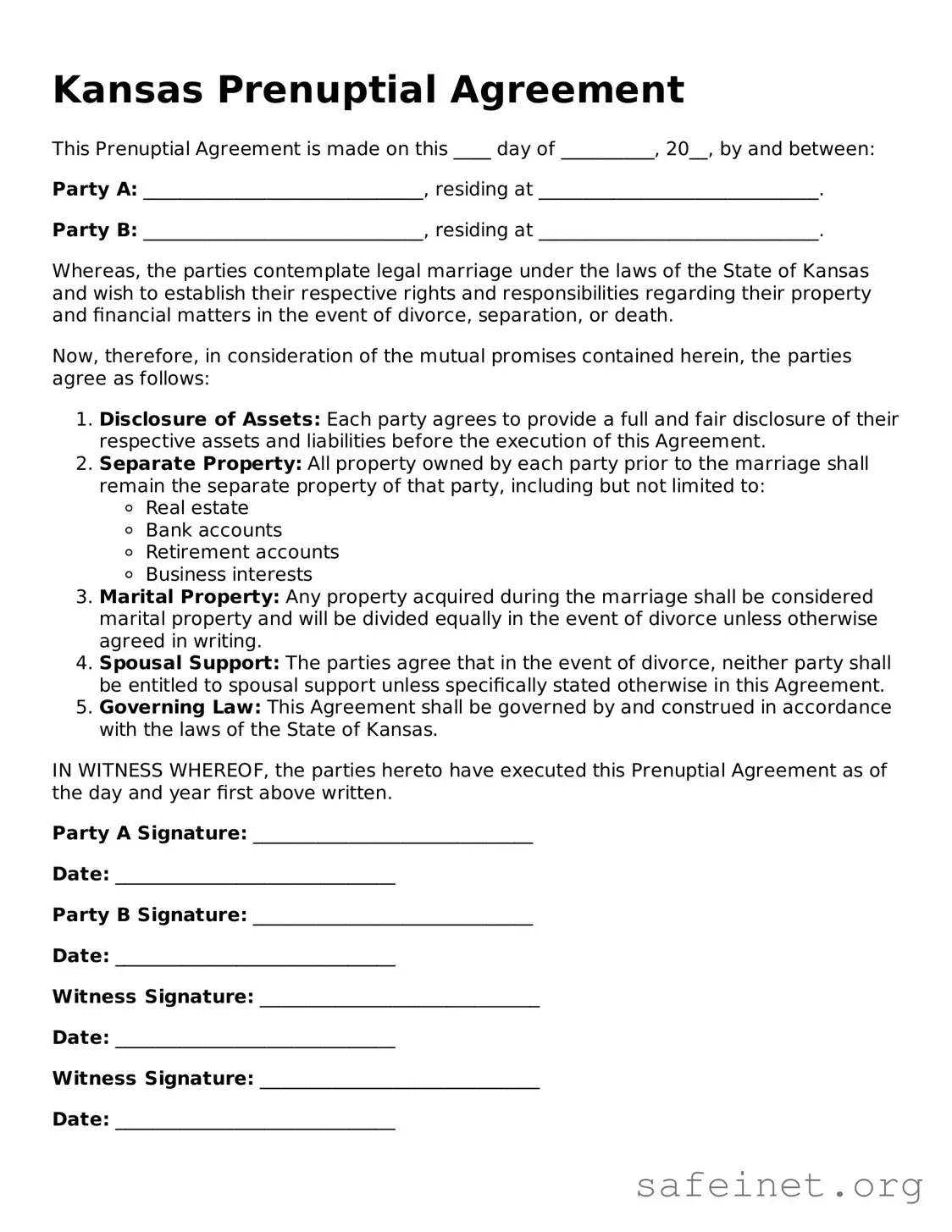
Kansas Prenuptial Agreement
This Prenuptial Agreement is made on this ____ day of __________, 20__, by and between:
Party A: ______________________________, residing at ______________________________.
Party B: ______________________________, residing at ______________________________.
Whereas, the parties contemplate legal marriage under the laws of the State of Kansas and wish to establish their respective rights and responsibilities regarding their property and financial matters in the event of divorce, separation, or death.
Now, therefore, in consideration of the mutual promises contained herein, the parties agree as follows:
IN WITNESS WHEREOF, the parties hereto have executed this Prenuptial Agreement as of the day and year first above written.
Party A Signature: ______________________________
Date: ______________________________
Party B Signature: ______________________________
Date: ______________________________
Witness Signature: ______________________________
Date: ______________________________
Witness Signature: ______________________________
Date: ______________________________
| Fact Name | Description |
|---|---|
| Governing Law | The Kansas Prenuptial Agreement is governed by Kansas Statutes Annotated, Chapter 23, Article 24. |
| Definition | A prenuptial agreement is a contract between two individuals before marriage that outlines the division of assets in the event of divorce or separation. |
| Enforceability | For a prenuptial agreement to be enforceable in Kansas, it must be in writing and signed by both parties. |
| Disclosure Requirement | Both parties must fully disclose their assets and liabilities for the agreement to be valid. |
| Independent Legal Counsel | It is recommended that each party consults with independent legal counsel to ensure fairness and understanding. |
| Modification | A prenuptial agreement can be modified or revoked at any time, provided both parties agree in writing. |
| Judicial Review | Courts in Kansas will review prenuptial agreements for fairness and compliance with state law. |
| Common Misconceptions | Many believe prenuptial agreements are only for the wealthy; however, they can benefit anyone entering a marriage. |
Completing the Kansas Prenuptial Agreement form is an important step in preparing for your upcoming marriage. This document allows both parties to outline their financial rights and responsibilities, providing clarity and peace of mind. By following these steps, you can ensure that your agreement is filled out correctly and reflects your intentions.
What is a prenuptial agreement in Kansas?
A prenuptial agreement, often referred to as a prenup, is a legal contract entered into by two individuals before they marry. This agreement outlines the division of assets and financial responsibilities in the event of divorce or separation. In Kansas, such agreements are governed by state law and must meet specific requirements to be enforceable.
Why should couples consider a prenuptial agreement?
Couples may consider a prenuptial agreement for various reasons. It can help protect individual assets acquired before marriage, clarify financial responsibilities during the marriage, and provide a clear plan for asset division if the marriage ends. This can reduce conflict and uncertainty during what can be a difficult time.
What must be included in a Kansas prenuptial agreement?
In Kansas, a prenuptial agreement should clearly outline the assets and debts of both parties, specify how property will be divided in the event of divorce, and address spousal support, if applicable. It is essential to ensure that the agreement is fair and reasonable at the time of signing.
Are there any requirements for a prenuptial agreement to be valid in Kansas?
Yes, for a prenuptial agreement to be valid in Kansas, it must be in writing and signed by both parties. Additionally, both parties should provide full disclosure of their financial situations. The agreement should not be unconscionable or signed under duress, as these factors can lead to its invalidation.
Can a prenuptial agreement be changed after marriage?
Yes, a prenuptial agreement can be modified or revoked after marriage. Both parties must agree to the changes, and it is advisable to document any amendments in writing. This ensures clarity and helps avoid potential disputes in the future.
How is a prenuptial agreement enforced in Kansas?
A prenuptial agreement is enforced through the court system in Kansas. If a couple divorces, the court will refer to the prenuptial agreement to determine the division of assets and financial responsibilities, provided the agreement is valid and enforceable.
What happens if a prenuptial agreement is deemed invalid?
If a prenuptial agreement is found to be invalid, the court will not enforce its terms. In such cases, the division of assets and debts will be determined according to Kansas state law, which may not align with the couple's wishes as outlined in the prenup.
Do both parties need a lawyer to create a prenuptial agreement?
While it is not legally required for both parties to have a lawyer when creating a prenuptial agreement, it is highly recommended. Having independent legal counsel ensures that both parties understand their rights and obligations, which can help prevent future disputes over the agreement's validity.
When should a prenuptial agreement be created?
It is advisable to create a prenuptial agreement well before the wedding date. This allows both parties ample time to discuss their financial situations and negotiate the terms without the pressure of an impending marriage. Ideally, couples should start this process several months in advance.
Can a prenuptial agreement address child custody and support?
While a prenuptial agreement can address some aspects of child custody and support, Kansas courts typically do not enforce these provisions. Child custody and support arrangements are determined based on the best interests of the child at the time of divorce, making it essential to address these issues separately in the future.
Incomplete Information: Failing to provide all necessary personal details can lead to issues. Ensure that both parties' names, addresses, and other relevant information are fully filled out.
Not Disclosing Assets: Omitting significant assets can create distrust. Both parties should fully disclose their financial situations, including property, debts, and income.
Using Ambiguous Language: Vague terms can lead to misunderstandings. Use clear and specific language to describe the terms of the agreement.
Not Considering Future Changes: Failing to account for potential changes in circumstances can be problematic. Include provisions for future events such as children or changes in income.
Ignoring State Laws: Each state has different laws regarding prenuptial agreements. Familiarize yourself with Kansas laws to ensure compliance.
Not Having Legal Representation: Both parties should consider consulting with their own attorneys. This ensures that each person's rights are protected and understood.
Failing to Sign in Front of Witnesses: Not having the agreement signed in front of witnesses can invalidate it. Follow the proper signing procedures to ensure enforceability.
Not Reviewing the Agreement Periodically: Life circumstances change. Regularly review and update the agreement to reflect any significant life changes.
Rushing the Process: Taking the time to carefully draft the agreement is crucial. Avoid rushing through the process, as this can lead to mistakes and oversights.
When preparing for marriage, many couples consider a prenuptial agreement to outline their financial rights and responsibilities. However, there are several other important documents that can complement this agreement, ensuring a comprehensive approach to financial planning and asset protection. Below is a list of common forms and documents often used alongside a Kansas Prenuptial Agreement.
Incorporating these documents into your marriage planning can provide peace of mind and clarity. Each one serves a unique purpose, helping to protect both partners and ensure that their wishes are honored in various circumstances. Taking the time to understand and prepare these documents can lead to a stronger, more transparent partnership.
A Cohabitation Agreement is similar to a prenuptial agreement in that it outlines the rights and responsibilities of partners who live together but are not married. This document can address property ownership, financial obligations, and other personal matters. It serves to protect both parties and can help clarify expectations, much like a prenuptial agreement does for couples planning to marry.
A Postnuptial Agreement is another document that shares similarities with a prenuptial agreement. While a prenuptial agreement is created before marriage, a postnuptial agreement is drafted after the wedding. It serves the same purpose: to outline how assets and debts will be handled in case of divorce or separation. Both agreements aim to provide clarity and security for both partners.
A Separation Agreement can also be likened to a prenuptial agreement. This document is typically created when a couple decides to live apart but not necessarily divorce. It outlines how property will be divided, child custody arrangements, and financial responsibilities. Like a prenuptial agreement, it helps prevent disputes by clearly defining each party's rights and obligations.
An Estate Plan is another document that parallels a prenuptial agreement in terms of planning for the future. While a prenuptial agreement deals with assets in the event of divorce, an estate plan focuses on what happens to those assets after death. Both documents aim to provide peace of mind and ensure that an individual's wishes are respected regarding their property and finances.
A Will is similar to a prenuptial agreement as both involve the distribution of assets. A will specifies how a person’s belongings should be handled after their death, while a prenuptial agreement outlines asset division in the event of divorce. Both documents are essential for individuals who want to ensure their wishes are honored and can help avoid potential conflicts among heirs or ex-spouses.
An Asset Protection Trust can also be compared to a prenuptial agreement. This type of trust is designed to protect an individual’s assets from creditors or legal judgments. Like a prenuptial agreement, it provides a layer of security for an individual’s wealth. Both documents serve to safeguard assets, although they are used in different contexts and for different purposes.
When filling out the Kansas Prenuptial Agreement form, it is important to approach the process carefully. Here are ten things you should and shouldn't do:
When it comes to prenuptial agreements in Kansas, many people hold misconceptions that can lead to misunderstandings about their purpose and enforceability. Here’s a list of ten common misconceptions:
Understanding these misconceptions can help couples make informed decisions about prenuptial agreements and their potential benefits.
When considering a prenuptial agreement in Kansas, it is essential to understand the process and implications. Below are key takeaways that can help guide individuals through filling out and using the Kansas Prenuptial Agreement form.
By keeping these key points in mind, individuals can navigate the process of creating a prenuptial agreement in Kansas more effectively.