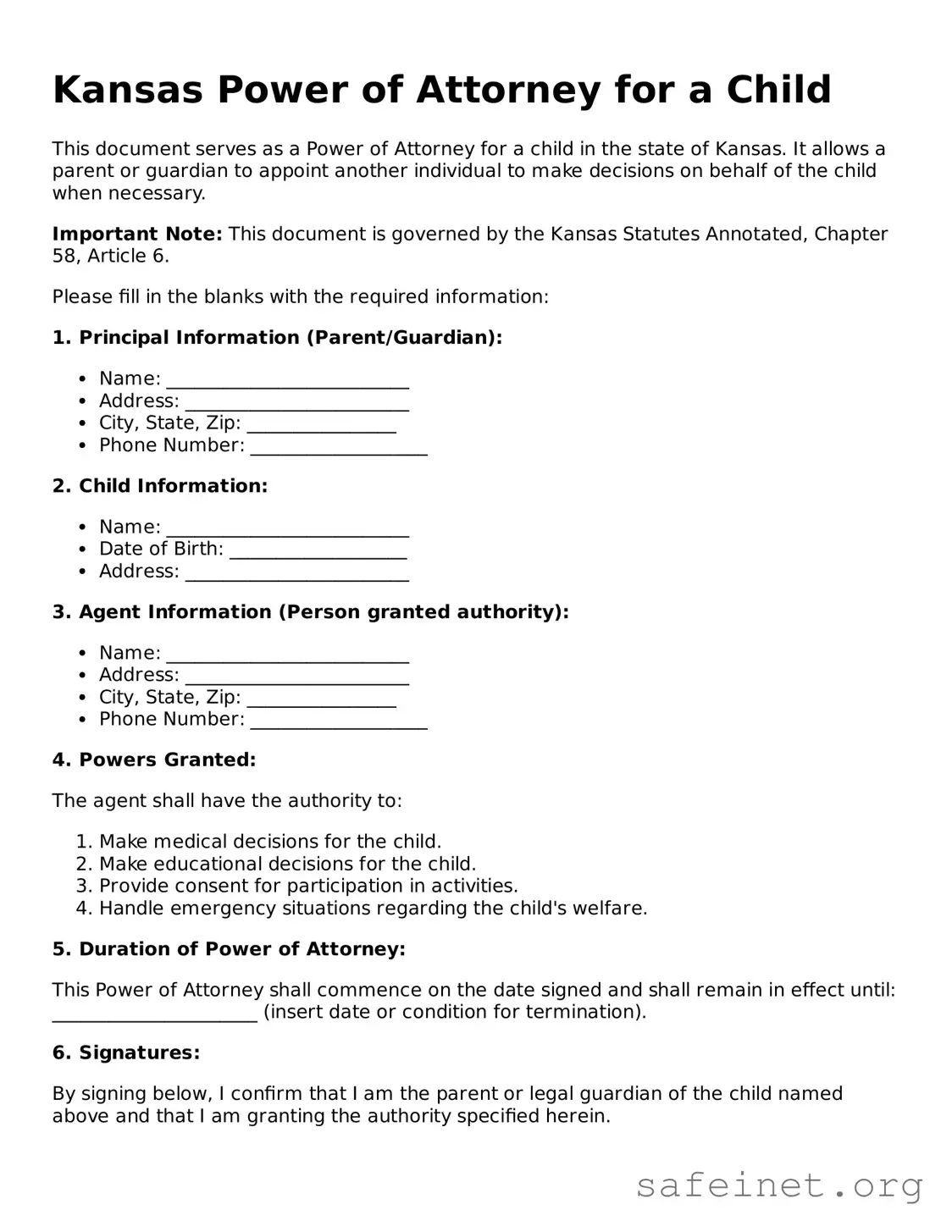
When parents or guardians need to ensure their child's well-being in their absence, the Kansas Power of Attorney for a Child form provides a practical solution. This legal document allows a parent or legal guardian to grant authority to another individual, often a trusted family member or friend, to make decisions on behalf of the child. The form covers essential aspects such as medical care, educational decisions, and general welfare, ensuring that the appointed agent can act in the child's best interest. It is crucial to understand that this power of attorney can be temporary or durable, depending on the needs of the family. Additionally, the form must be signed and notarized to be legally binding, adding an extra layer of protection for both the child and the appointed agent. By utilizing this form, parents can maintain peace of mind, knowing that their child will be cared for and supported, even when they are not physically present.
Kansas Power of Attorney for a Child
This document serves as a Power of Attorney for a child in the state of Kansas. It allows a parent or guardian to appoint another individual to make decisions on behalf of the child when necessary.
Important Note: This document is governed by the Kansas Statutes Annotated, Chapter 58, Article 6.
Please fill in the blanks with the required information:
1. Principal Information (Parent/Guardian):
2. Child Information:
3. Agent Information (Person granted authority):
4. Powers Granted:
The agent shall have the authority to:
5. Duration of Power of Attorney:
This Power of Attorney shall commence on the date signed and shall remain in effect until: ______________________ (insert date or condition for termination).
6. Signatures:
By signing below, I confirm that I am the parent or legal guardian of the child named above and that I am granting the authority specified herein.
___________________________
Signature of Parent/Guardian
Date: ______________________
___________________________
Signature of Agent
Date: ______________________
Witness:
___________________________
Signature of Witness
Date: ______________________
This document must be signed in the presence of a notary public for it to be valid.
| Fact Name | Description |
|---|---|
| Purpose | The Kansas Power of Attorney for a Child form allows a parent or legal guardian to grant authority to another adult to make decisions for their child. |
| Governing Law | This form is governed by Kansas Statutes Annotated, Chapter 38, Article 2201. |
| Duration | The authority granted can last until a specific date or until the child turns 18, unless revoked earlier. |
| Signature Requirements | The form must be signed by the parent or legal guardian and may require notarization for validity. |
| Limitations | This power of attorney does not allow the designated adult to make permanent decisions regarding custody or adoption. |
Filling out the Kansas Power of Attorney for a Child form requires careful attention to detail. After completing the form, it is essential to keep it in a safe place and provide copies to relevant parties, such as caregivers or schools, to ensure that it is readily accessible when needed.
What is a Kansas Power of Attorney for a Child form?
The Kansas Power of Attorney for a Child form is a legal document that allows a parent or legal guardian to grant another adult the authority to make decisions on behalf of their child. This can include decisions about education, healthcare, and general welfare. It is particularly useful when parents are temporarily unable to care for their child due to travel, illness, or other circumstances.
Who can be appointed as an attorney-in-fact for my child?
Any responsible adult can be appointed as an attorney-in-fact. This could be a relative, family friend, or anyone you trust to act in the best interest of your child. However, it is important to choose someone who is willing and able to take on this responsibility.
Do I need to have the form notarized?
Yes, the Kansas Power of Attorney for a Child form must be notarized to be legally valid. This means that you need to sign the document in front of a notary public, who will then verify your identity and witness your signature.
How long does the Power of Attorney for a Child last?
The duration of the Power of Attorney can vary. You can specify a time frame in the document, or it can remain in effect until you revoke it. If you do not set a specific end date, it will typically last until the child reaches the age of 18 or until you decide to revoke it.
Can I revoke the Power of Attorney once it is signed?
Yes, you can revoke the Power of Attorney at any time. To do this, you should provide written notice to the attorney-in-fact and any relevant parties. It's a good idea to also notify the notary if they are involved in the original document.
Are there any limitations on what the attorney-in-fact can do?
Yes, you can specify limitations in the Power of Attorney document. For example, you might want to restrict the attorney-in-fact from making certain medical decisions or from enrolling your child in a particular school. Clearly outlining these limitations can help avoid misunderstandings.
Is there a fee to file the Power of Attorney for a Child?
There is no filing fee to create a Power of Attorney for a Child in Kansas, as it is not filed with the court. However, you may incur costs for notarization or any legal advice you seek while preparing the document.
What happens if the attorney-in-fact cannot fulfill their duties?
If the attorney-in-fact is unable to fulfill their duties, you may need to appoint another person to take over. It is advisable to have a backup person in mind when creating the Power of Attorney to ensure that your child’s needs are always met.
Can the Power of Attorney for a Child be used for medical decisions?
Yes, the Power of Attorney for a Child can include authority for medical decisions, but you must specify this in the document. It is crucial to clearly outline what types of medical decisions the attorney-in-fact can make to ensure they can act effectively in emergencies.
Where can I obtain the Kansas Power of Attorney for a Child form?
You can typically find the Kansas Power of Attorney for a Child form online through state or legal websites. Additionally, you may consult an attorney to help you draft or review the document to ensure it meets your needs.
Failing to provide complete and accurate information about the child. It's essential to include the child's full name, date of birth, and current address to avoid any confusion.
Not specifying the powers granted. Clearly outline what decisions the agent can make on behalf of the child, whether it's related to education, healthcare, or general welfare.
Neglecting to sign and date the form. The document must be signed by the parent or legal guardian and dated to be valid.
Overlooking witness requirements. Kansas law may require that the form be witnessed by one or two individuals. Ensure this step is completed to prevent any challenges.
Not updating the form when necessary. If circumstances change, such as a change in the agent or the child's needs, the form should be revised accordingly.
Using outdated forms. Always check for the most current version of the Kansas Power of Attorney for a Child form to ensure compliance with current laws.
Ignoring the need for notarization. In some cases, having the form notarized can add an extra layer of legitimacy and may be required for certain transactions.
When establishing a Power of Attorney for a Child in Kansas, it is often beneficial to consider additional forms and documents that can enhance the legal framework surrounding the care and custody of a child. These documents can provide clarity and ensure that the child's needs are met in various situations. Below is a list of commonly used forms that may accompany the Power of Attorney for a Child.
Incorporating these documents alongside the Kansas Power of Attorney for a Child can provide a comprehensive approach to ensuring the child's welfare. Each form serves a specific purpose, addressing various aspects of care, custody, and decision-making, ultimately fostering a secure environment for the child.
The Kansas Power of Attorney for a Child form shares similarities with the General Power of Attorney. Both documents allow an individual to appoint someone else to act on their behalf. In the case of the General Power of Attorney, it can cover a wide range of financial and legal decisions, while the Kansas Power of Attorney for a Child is specifically tailored to make decisions regarding a child's care and welfare. This specialized focus ensures that the appointed individual can make informed decisions about the child's education, healthcare, and daily activities.
Another document that resembles the Kansas Power of Attorney for a Child is the Medical Power of Attorney. This form grants a designated person the authority to make healthcare decisions for another individual if they become incapacitated. Similar to the Kansas form, the Medical Power of Attorney emphasizes the importance of having a trusted individual who understands the child's medical needs and can advocate for their best interests in medical situations.
The Child Custody Agreement also parallels the Kansas Power of Attorney for a Child. While the latter allows temporary delegation of parental authority, a Child Custody Agreement outlines the long-term arrangement regarding a child's living situation and visitation rights. Both documents aim to ensure the child's well-being, but the custody agreement typically involves more permanent arrangements, often determined by a court.
The Guardianship Document is another similar instrument. It provides legal authority to an individual to care for a child when the parents are unable to do so. Like the Kansas Power of Attorney for a Child, a guardianship arrangement prioritizes the child's best interests. However, guardianship is often more permanent and involves court oversight, whereas a power of attorney is generally a temporary solution.
The Authorization for Release of Medical Records is also akin to the Kansas Power of Attorney for a Child. This document allows parents or guardians to give permission for healthcare providers to share a child's medical information with designated individuals. Both forms emphasize the importance of communication and trust between caregivers and medical professionals, ensuring that the child's health needs are met effectively.
Similarly, the Temporary Custody Agreement serves a purpose akin to the Kansas Power of Attorney for a Child. This document is often used when parents need someone to care for their child for a short period, such as during a family emergency. Both agreements allow for the temporary transfer of care responsibilities, ensuring that the child remains in a safe and supportive environment.
The Consent for Treatment form also shares a connection with the Kansas Power of Attorney for a Child. This document allows a parent or guardian to authorize medical treatment for a child. Like the power of attorney, it ensures that a trusted individual can make decisions regarding the child's health and safety, particularly in situations where immediate medical care is necessary.
Lastly, the Affidavit of Parentage is similar in that it establishes legal recognition of a child's parentage. While it does not delegate authority like the Kansas Power of Attorney for a Child, it plays a crucial role in defining parental rights and responsibilities. Both documents are essential in clarifying the roles of caregivers and ensuring that the child's best interests are prioritized in legal matters.
When filling out the Kansas Power of Attorney for a Child form, it's important to approach the process with care and attention to detail. Here’s a list of things to do and things to avoid to ensure that the form is completed correctly.
Understanding the Kansas Power of Attorney for a Child form is crucial for parents and guardians. However, several misconceptions can lead to confusion. Below are six common misconceptions, along with clarifications to help clear up any misunderstandings.
Many believe that the Power of Attorney for a Child form is only necessary in emergency situations. In reality, it can be used for various purposes, including temporary care arrangements, travel, and medical decisions.
Some individuals think that once a Power of Attorney is established, it cannot be revoked. This is not true. Parents can revoke the document at any time, as long as they follow the proper procedures.
There is a misconception that signing this form means giving up full custody of the child. In fact, it allows for specific temporary authority while retaining parental rights.
While legal guardians often use this form, biological parents can also create a Power of Attorney for their children. This flexibility is important for various family situations.
Some people believe that notarization is mandatory for the Power of Attorney for a Child form to be valid. In Kansas, while notarization is recommended, it is not always required.
Another common misconception is that the Power of Attorney for a Child form is only valid within Kansas. However, it may be recognized in other states, depending on local laws and regulations.
Being informed about these misconceptions can help ensure that you use the Power of Attorney for a Child form effectively and appropriately. Always consider seeking guidance if you have questions or concerns.
Filling out the Kansas Power of Attorney for a Child form is an important step for parents or guardians who need to authorize someone else to make decisions on behalf of a child. Here are some key takeaways to consider:
Using this form correctly can provide peace of mind and ensure that your child’s needs are met when you are unable to be present.