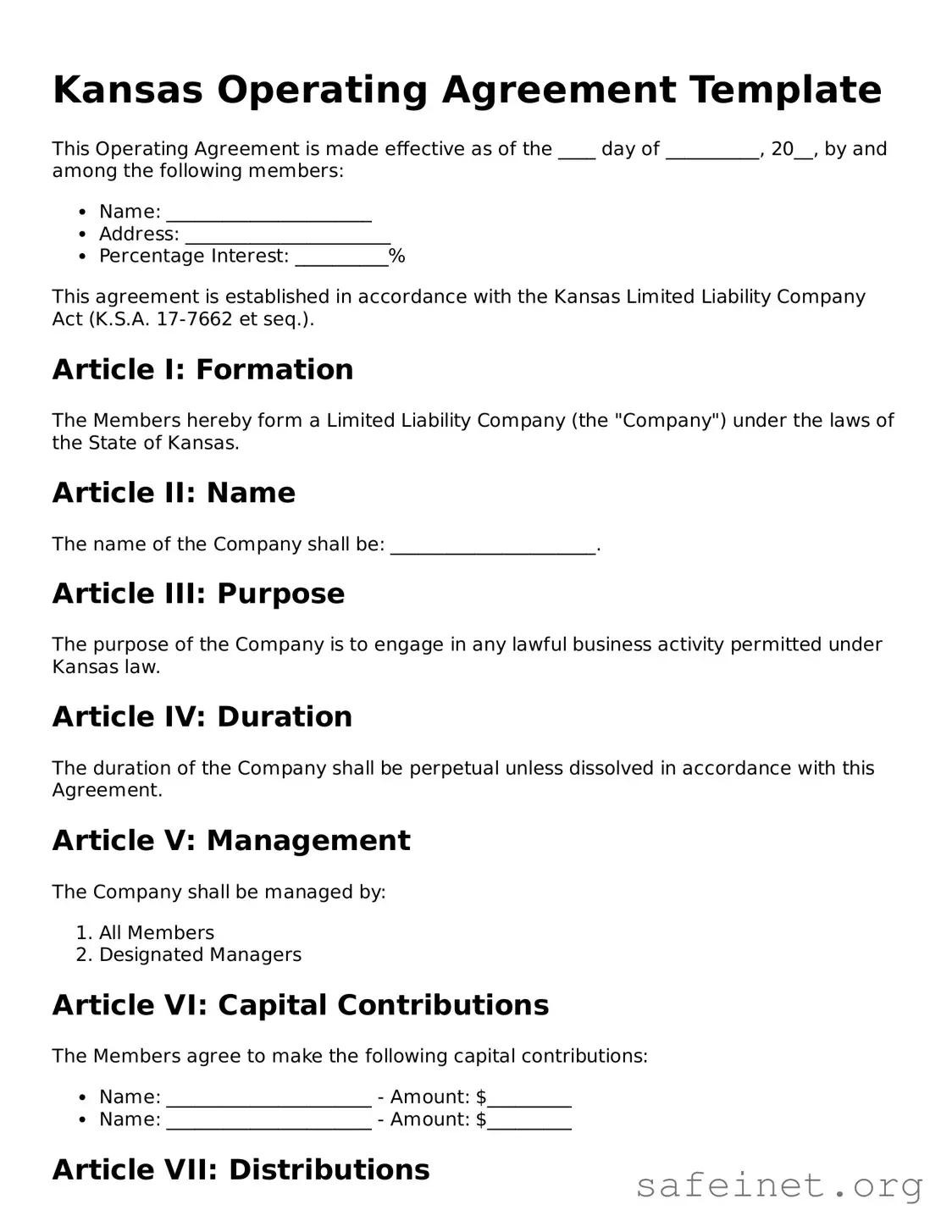
The Kansas Operating Agreement form plays a crucial role in the management and operation of limited liability companies (LLCs) within the state. This essential document outlines the internal structure and rules governing the LLC, ensuring that all members are on the same page regarding their rights and responsibilities. Key aspects of the agreement include the distribution of profits and losses, the roles and duties of each member, and the procedures for decision-making and conflict resolution. Additionally, the form addresses how new members can be added and how existing members may exit the company, providing a clear framework for growth and change. By establishing these guidelines, the Kansas Operating Agreement helps to protect the interests of all members and supports the smooth operation of the business. Understanding the significance of this document is vital for anyone looking to form an LLC in Kansas, as it lays the foundation for a successful partnership and helps prevent misunderstandings down the line.
Kansas Operating Agreement Template
This Operating Agreement is made effective as of the ____ day of __________, 20__, by and among the following members:
This agreement is established in accordance with the Kansas Limited Liability Company Act (K.S.A. 17-7662 et seq.).
Article I: Formation
The Members hereby form a Limited Liability Company (the "Company") under the laws of the State of Kansas.
Article II: Name
The name of the Company shall be: ______________________.
Article III: Purpose
The purpose of the Company is to engage in any lawful business activity permitted under Kansas law.
Article IV: Duration
The duration of the Company shall be perpetual unless dissolved in accordance with this Agreement.
Article V: Management
The Company shall be managed by:
Article VI: Capital Contributions
The Members agree to make the following capital contributions:
Article VII: Distributions
Distributions shall be made to Members in proportion to their respective Percentage Interests, unless otherwise agreed upon.
Article VIII: Meetings
Meetings of the Members shall be held at least annually. Notice of the meeting shall be given to all Members at least ____ days in advance.
Article IX: Indemnification
The Company shall indemnify any Member or Manager to the fullest extent permitted by Kansas law.
Article X: Amendments
This Agreement may be amended only by a written agreement signed by all Members.
Article XI: Governing Law
This Agreement shall be governed by and construed in accordance with the laws of the State of Kansas.
IN WITNESS WHEREOF, the undersigned have executed this Operating Agreement as of the date first above written.
| Fact Name | Description |
|---|---|
| Governing Law | The Kansas Operating Agreement is governed by the Kansas Limited Liability Company Act. |
| Purpose | This agreement outlines the management structure and operating procedures of a limited liability company (LLC) in Kansas. |
| Members | All individuals or entities that own a share in the LLC are referred to as members. |
| Management Structure | The agreement can specify whether the LLC is member-managed or manager-managed. |
| Capital Contributions | It details the initial capital contributions of each member and any future contributions required. |
| Profit Distribution | The agreement outlines how profits and losses will be distributed among members. |
| Voting Rights | It may define the voting rights of members, including how decisions are made. |
| Amendments | The procedure for amending the operating agreement is typically included in the document. |
| Dissolution | It provides guidelines on how the LLC may be dissolved and the process for winding up affairs. |
| Legal Compliance | Having an operating agreement helps ensure compliance with state laws and protects members' interests. |
Completing the Kansas Operating Agreement form is an important step for your business. After filling it out, you will be ready to establish the terms and conditions that govern your company’s operations and relationships among members. Here are the steps to help you fill out the form accurately.
What is a Kansas Operating Agreement?
A Kansas Operating Agreement is a legal document that outlines the management structure and operating procedures of a limited liability company (LLC) in Kansas. It serves as an internal guideline for the members of the LLC, detailing roles, responsibilities, and the distribution of profits and losses among members.
Is an Operating Agreement required in Kansas?
While Kansas law does not mandate that LLCs have an Operating Agreement, it is highly recommended. An Operating Agreement helps clarify the relationships among members and can prevent disputes. Additionally, having this document can provide legal protection for the members' limited liability status.
What should be included in a Kansas Operating Agreement?
A comprehensive Kansas Operating Agreement typically includes the following elements: the name and purpose of the LLC, the names of members, management structure, voting rights, profit and loss distribution, procedures for adding or removing members, and guidelines for dissolving the LLC. Each section should be tailored to the specific needs of the business.
Can the Operating Agreement be amended?
Yes, the Operating Agreement can be amended. Members can decide to modify the document as needed, provided that the amendment process is clearly outlined within the agreement itself. This flexibility allows the LLC to adapt to changes in business circumstances or member relationships.
How does the Operating Agreement affect liability protection?
An Operating Agreement can enhance liability protection for members by demonstrating that the LLC is a separate legal entity. By adhering to the provisions of the agreement, members can help ensure that the LLC maintains its limited liability status, protecting personal assets from business debts and liabilities.
Can a single-member LLC have an Operating Agreement?
Yes, a single-member LLC can and should have an Operating Agreement. Even with one member, this document can clarify the management structure and operational procedures. It can also reinforce the separation between personal and business assets, further protecting the member's personal liability.
Where can I find a template for a Kansas Operating Agreement?
Templates for Kansas Operating Agreements can be found online through various legal service websites, or they may be available through local business organizations. While templates can provide a useful starting point, it is advisable to tailor the agreement to the specific needs of the LLC and consult with a legal professional if necessary.
Omitting Member Information: Many individuals forget to include all members' names and addresses. This can lead to confusion about who is involved in the LLC.
Incorrect Ownership Percentages: Some people miscalculate or misrepresent the ownership percentages of each member. This can create disputes later on.
Failing to Define Roles and Responsibilities: Not clearly outlining each member's role can lead to misunderstandings and inefficiencies in management.
Ignoring Voting Procedures: Many overlook the importance of specifying how votes will be conducted. This can result in deadlocks during decision-making.
Not Including an Amendment Clause: Some individuals neglect to add a clause that allows for future changes to the agreement. This can limit flexibility as the business evolves.
When establishing a business entity in Kansas, particularly a limited liability company (LLC), several forms and documents complement the Kansas Operating Agreement. Each of these documents serves a specific purpose and contributes to the overall governance and operation of the LLC. Below is a list of commonly used documents alongside the Kansas Operating Agreement.
Understanding these documents is crucial for anyone looking to establish and operate an LLC in Kansas. Each form plays a vital role in ensuring that the business runs smoothly and adheres to legal requirements. Properly managing these documents can help prevent disputes and promote a clear understanding among members regarding their rights and responsibilities.
The Kansas Operating Agreement is similar to the Limited Liability Company (LLC) Articles of Organization. Both documents serve as foundational elements for establishing an LLC in Kansas. The Articles of Organization officially register the business with the state, while the Operating Agreement outlines the internal rules and management structure of the LLC. Together, they ensure that the LLC operates smoothly and in accordance with state laws, providing clarity on roles and responsibilities among members.
Another document that resembles the Kansas Operating Agreement is the Partnership Agreement. While the Operating Agreement is specific to LLCs, the Partnership Agreement governs the relationships and responsibilities among partners in a general partnership. Both documents define the roles of members or partners, outline profit-sharing arrangements, and establish procedures for decision-making. They are essential for preventing disputes and ensuring that all parties are on the same page regarding their business operations.
The Corporate Bylaws document shares similarities with the Kansas Operating Agreement as well. While Bylaws are used for corporations, both documents provide a framework for governance. They detail the structure of the organization, including the roles of officers and directors in a corporation, akin to how the Operating Agreement delineates the responsibilities of members in an LLC. Each document aims to facilitate smooth operations and clarify the decision-making process within the respective entities.
The Shareholders Agreement is another document that parallels the Kansas Operating Agreement. This agreement is specifically designed for corporations and outlines the rights and responsibilities of shareholders. Similar to the Operating Agreement, it addresses issues such as voting rights, transfer of shares, and dispute resolution. Both documents are crucial for maintaining harmony among stakeholders and ensuring that everyone understands their rights and obligations within the business structure.
Lastly, the Non-Disclosure Agreement (NDA) can also be seen as related to the Kansas Operating Agreement in terms of protecting sensitive information. While the Operating Agreement focuses on the operational aspects of an LLC, an NDA ensures that proprietary information remains confidential among members and external parties. Both documents serve to protect the interests of the business, fostering a secure environment for collaboration and growth.
When filling out the Kansas Operating Agreement form, it’s essential to approach the task with care. Here are some helpful guidelines to ensure you complete the form correctly:
Following these tips can help streamline the process and ensure that your Operating Agreement is both accurate and complete.
Understanding the Kansas Operating Agreement form is essential for anyone involved in business partnerships or limited liability companies (LLCs) in the state. However, several misconceptions can lead to confusion. Here are eight common myths about the Kansas Operating Agreement form, along with clarifications to help set the record straight.
By dispelling these misconceptions, individuals can better understand the importance of the Kansas Operating Agreement form and how it can serve their business needs effectively.
When filling out and using the Kansas Operating Agreement form, consider the following key takeaways: