The Kansas Notary Acknowledgement form plays a crucial role in the legal landscape of the state, serving as a vital tool for verifying the authenticity of signatures on various documents. This form is essential for individuals who need to ensure that their agreements, contracts, or other important papers hold up in legal contexts. By providing a clear statement that a signer personally appeared before a notary and acknowledged their signature, this form helps prevent fraud and establishes trust in transactions. It includes specific sections for the notary's information, the date of acknowledgment, and the signature of the notary public, ensuring all necessary details are captured. Understanding how to properly complete and utilize this form is important for anyone involved in legal agreements in Kansas, as it can significantly impact the enforceability of those documents.
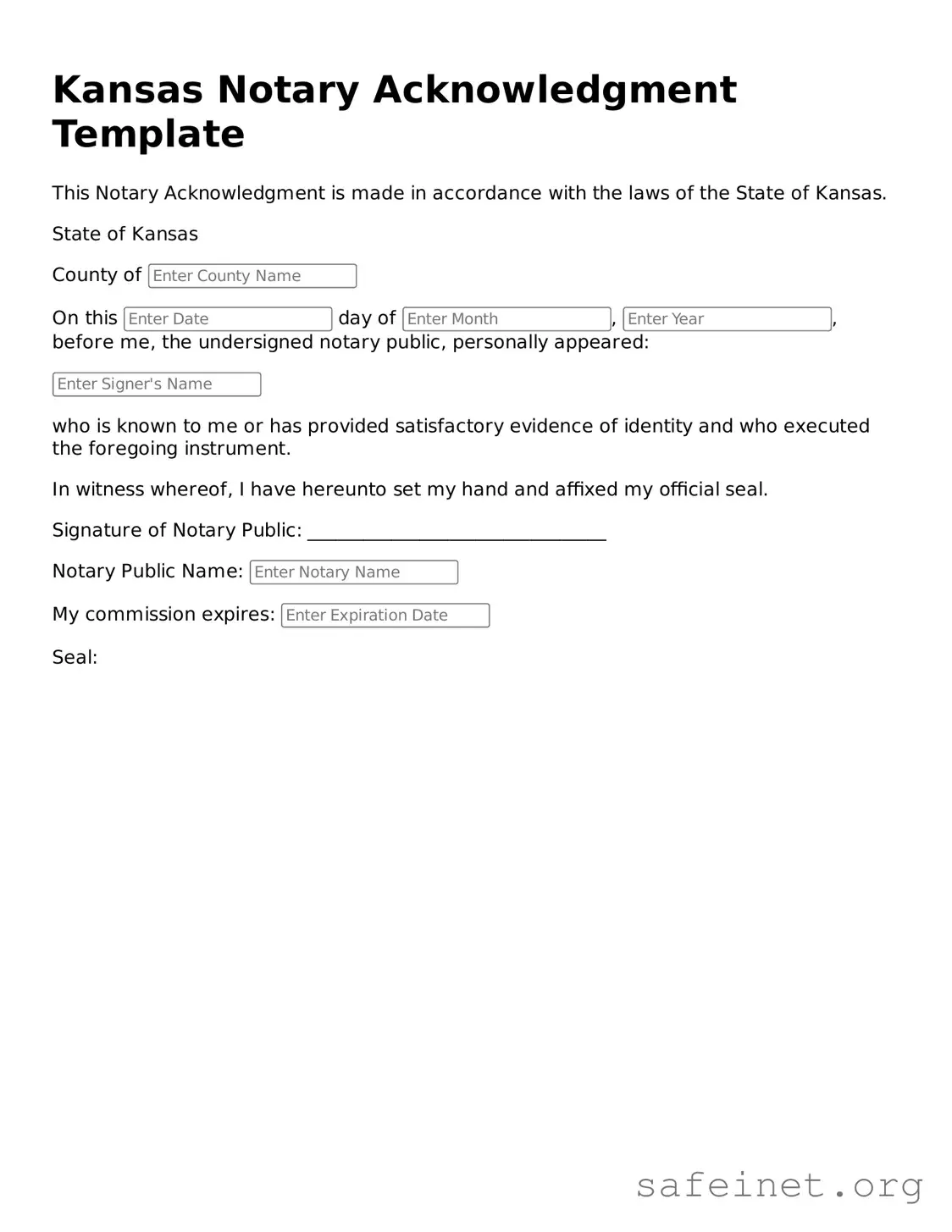
Kansas Notary Acknowledgment Template
This Notary Acknowledgment is made in accordance with the laws of the State of Kansas.
State of Kansas
County of
On this day of , , before me, the undersigned notary public, personally appeared:
who is known to me or has provided satisfactory evidence of identity and who executed the foregoing instrument.
In witness whereof, I have hereunto set my hand and affixed my official seal.
Signature of Notary Public: ________________________________
Notary Public Name:
My commission expires:
Seal:
| Fact Name | Description |
|---|---|
| Purpose | The Kansas Notary Acknowledgement form is used to verify the identity of the signer and confirm their willingness to sign a document. |
| Governing Law | This form is governed by the Kansas Statutes Annotated, specifically K.S.A. 53-601 et seq. |
| Signer's Presence | The signer must be physically present before the notary at the time of the acknowledgment. |
| Identification | A notary must confirm the identity of the signer through a valid form of identification, such as a driver's license or passport. |
| Signature Requirement | The signer must sign the document in the notary's presence for the acknowledgment to be valid. |
| Notary Seal | The notary is required to affix their official seal to the acknowledgment form to validate it. |
| Record Keeping | Notaries in Kansas must maintain a record of each acknowledgment in their notary journal. |
| Expiration | The Kansas Notary Acknowledgment does not have an expiration date but is tied to the validity of the document it accompanies. |
| Usage | This form is commonly used for real estate transactions, legal documents, and other formal agreements requiring notarization. |
Once you have the Kansas Notary Acknowledgement form in hand, it's time to complete it accurately. This form is essential for verifying the identity of individuals signing documents. Follow the steps below to ensure that you fill out the form correctly.
What is a Kansas Notary Acknowledgement form?
The Kansas Notary Acknowledgement form is a legal document used to verify that a person has signed a document in the presence of a notary public. This form provides assurance that the signer is who they claim to be and that they signed voluntarily. It is often required for documents like deeds, contracts, and affidavits.
Why is a Notary Acknowledgement important?
A Notary Acknowledgement is crucial because it helps prevent fraud. It ensures that the person signing the document is doing so willingly and understands the content. This adds a layer of protection for all parties involved, making the document more credible and legally binding.
Who can serve as a notary public in Kansas?
In Kansas, any resident who is at least 18 years old, a U.S. citizen, and has completed the necessary training can become a notary public. They must also apply for a notary commission through the Secretary of State’s office and pass a background check.
How do I complete a Kansas Notary Acknowledgement form?
To complete the form, the signer must appear before the notary public and provide identification. The notary will then fill out the form, including details such as the date, the signer's name, and the type of document being acknowledged. The notary will also sign and seal the form to finalize it.
Is there a fee for notarization in Kansas?
Yes, notaries in Kansas are allowed to charge a fee for their services. The maximum fee is set by the state, and it can vary depending on the type of service provided. It is important to check with the notary beforehand to understand their specific charges.
How long is a Kansas Notary Acknowledgement valid?
The validity of a Kansas Notary Acknowledgement does not have a specific expiration date. However, the document itself may have its own validity period based on its purpose. It is advisable to check the requirements related to the specific document being acknowledged.
Can I use a Notary Acknowledgement for any document?
Not all documents require a Notary Acknowledgement, but many legal documents do. Common examples include property deeds, contracts, and legal affidavits. Always check the specific requirements for the document in question to ensure that a notary acknowledgment is necessary.
What should I do if my Notary Acknowledgement is rejected?
If a Notary Acknowledgement is rejected, it is essential to understand the reason for the rejection. Common issues include missing signatures, incorrect information, or lack of proper identification. Addressing these issues promptly with the notary or the entity requiring the acknowledgment can help resolve the situation.
When filling out the Kansas Notary Acknowledgment form, individuals often encounter several common mistakes. Recognizing these pitfalls can help ensure that the form is completed correctly, preventing delays or complications. Here is a list of seven mistakes to watch out for:
People sometimes fail to match the name on the document with the name on the identification. Always ensure that the name is spelled correctly and matches the ID.
Many forget to include the date of the acknowledgment. This date is crucial as it indicates when the notarization took place.
Some individuals neglect to sign the form themselves. Remember, the notary must witness the signing of the document, and the signer's signature is essential.
A notary's seal is required to validate the acknowledgment. Without it, the form may be considered incomplete.
People sometimes provide inaccurate information about the notary, such as their commission expiration date or notary ID number. Double-check these details for accuracy.
Not all notary forms are the same. Using a form from another state or a different type of acknowledgment can lead to issues.
Before submitting the acknowledgment, it’s important to review the entire document. Errors can often be overlooked, leading to potential problems down the line.
By being aware of these common mistakes, individuals can fill out the Kansas Notary Acknowledgment form more accurately and efficiently. Taking the time to ensure everything is correct can save significant hassle later on.
When preparing documents that require a Kansas Notary Acknowledgement form, several other forms and documents may also be necessary. Each of these documents serves a specific purpose and can help ensure that your legal matters are handled correctly.
Understanding these documents and their purposes can help you navigate the legal process more smoothly. Ensuring that all necessary forms are completed and properly acknowledged is essential for protecting your rights and interests.
The Affidavit is a written statement confirmed by oath or affirmation. It is similar to the Kansas Notary Acknowledgment form in that both documents require a notary public to verify the identity of the signer. An affidavit typically includes a declaration of facts that the affiant swears to be true, while the notary acknowledgment serves to confirm that the signer has willingly signed the document in the presence of the notary.
The Power of Attorney document allows an individual to appoint another person to act on their behalf in legal or financial matters. Like the Kansas Notary Acknowledgment form, this document often requires notarization to ensure that the person granting the power is doing so voluntarily and understands the implications. Both documents are designed to prevent fraud and ensure that the signer's intentions are clear and documented.
The Deed is a legal document that transfers ownership of real property from one party to another. Notarization is typically required for a deed to be valid, similar to the requirements of the Kansas Notary Acknowledgment form. Both documents involve the verification of identities and the signing process, ensuring that the transaction is legitimate and that the parties involved have consented to the terms.
The Certificate of Acknowledgment is a document that verifies the identity of a signer and confirms that the signing took place in the presence of a notary. This is closely related to the Kansas Notary Acknowledgment form, as both serve the purpose of providing proof that a document was signed correctly and voluntarily. They both include information about the notary, the date of the acknowledgment, and the signer's details.
The Will is a legal document that outlines an individual's wishes regarding the distribution of their assets after death. While not always required, notarization can enhance the validity of a will, similar to the Kansas Notary Acknowledgment form. Both documents require the presence of a notary to confirm the identity of the signers, ensuring that the intentions expressed are genuine and legally binding.
The Loan Agreement is a contract between a borrower and a lender that outlines the terms of a loan. Notarization may be required for certain loan agreements, paralleling the Kansas Notary Acknowledgment form in its function. Both documents involve the confirmation of identities and signatures, ensuring that all parties are aware of their commitments and that the agreement is enforceable.
When filling out the Kansas Notary Acknowledgment form, it's important to follow certain guidelines to ensure accuracy and compliance. Here are some dos and don'ts to keep in mind:
Following these simple guidelines will help ensure your Notary Acknowledgment form is filled out correctly and accepted without issues.
Understanding the Kansas Notary Acknowledgement form is essential for anyone needing notarization services. However, several misconceptions often cloud the process. Here’s a list of ten common misunderstandings:
By clarifying these misconceptions, individuals can better navigate the notarization process in Kansas. Understanding the true role and limitations of notaries helps ensure that documents are handled appropriately and legally.
When filling out and using the Kansas Notary Acknowledgement form, it is essential to understand its purpose and requirements. Below are key takeaways that will help ensure the process is smooth and effective.