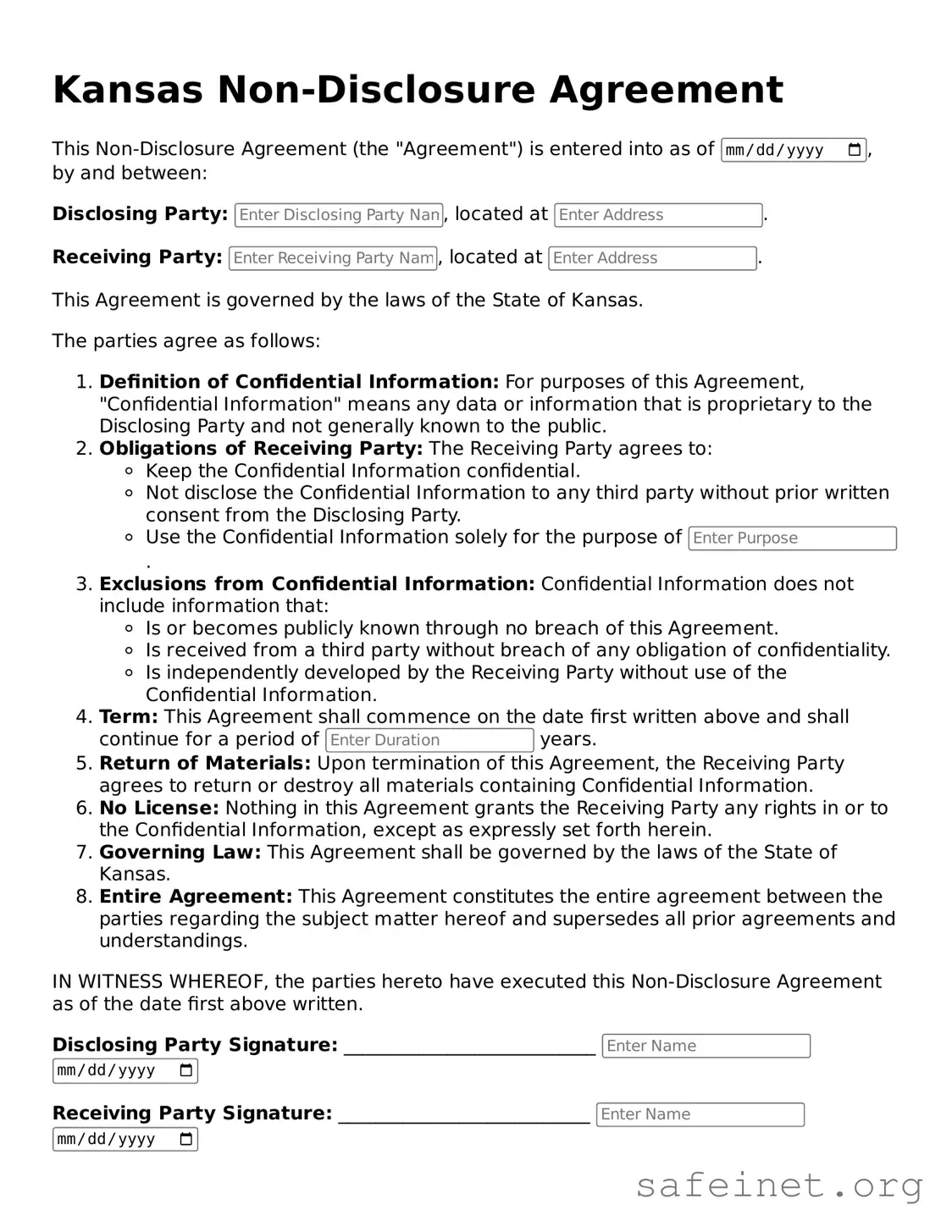
The Kansas Non-disclosure Agreement (NDA) form serves as a crucial tool for individuals and businesses seeking to protect sensitive information. When parties enter into a relationship, whether it be for employment, partnership, or collaboration, they often share proprietary data that must remain confidential. This form outlines the obligations of the parties regarding the handling of this information, ensuring that it is not disclosed to unauthorized individuals or entities. Key aspects of the NDA include the definition of what constitutes confidential information, the duration of the confidentiality obligation, and the consequences of breaching the agreement. By clearly establishing these parameters, the NDA fosters trust and encourages open communication, allowing parties to engage without fear of compromising their intellectual property or trade secrets. Understanding and properly executing this form is essential for anyone looking to safeguard their valuable information in Kansas.
Kansas Non-Disclosure Agreement
This Non-Disclosure Agreement (the "Agreement") is entered into as of , by and between:
Disclosing Party: , located at .
Receiving Party: , located at .
This Agreement is governed by the laws of the State of Kansas.
The parties agree as follows:
IN WITNESS WHEREOF, the parties hereto have executed this Non-Disclosure Agreement as of the date first above written.
Disclosing Party Signature: ___________________________
Receiving Party Signature: ___________________________
| Fact Name | Details |
|---|---|
| Purpose | A Kansas Non-disclosure Agreement (NDA) is designed to protect confidential information shared between parties. |
| Governing Law | The NDA is governed by the laws of the State of Kansas. |
| Duration | The duration of confidentiality is typically specified in the agreement, often ranging from 1 to 5 years. |
| Enforceability | Kansas courts generally enforce NDAs, provided they are reasonable in scope and duration. |
Filling out the Kansas Non-disclosure Agreement form is straightforward. Once you have the form ready, you will need to provide specific information to ensure it is completed correctly. Follow these steps to fill out the form accurately.
Once you have completed these steps, review the form to ensure all information is accurate and legible. After that, you can proceed with the next steps in your process.
What is a Kansas Non-disclosure Agreement (NDA)?
A Kansas Non-disclosure Agreement is a legal document that helps protect confidential information shared between parties. It ensures that sensitive information, such as business plans or trade secrets, remains private and is not disclosed to unauthorized individuals or entities.
Who should use a Non-disclosure Agreement?
Any individual or business that needs to share confidential information can use an NDA. This includes startups sharing ideas with potential investors, companies discussing partnerships, or employers sharing sensitive data with employees.
What types of information are covered by an NDA?
An NDA typically covers proprietary information, trade secrets, business plans, client lists, financial data, and any other sensitive information that the parties wish to keep confidential. It is important to clearly define what constitutes confidential information in the agreement.
How long does the confidentiality obligation last?
The duration of the confidentiality obligation can vary. Most NDAs specify a time frame, which can range from a few years to indefinitely, depending on the nature of the information. It is crucial to agree on a reasonable duration that protects the interests of both parties.
What happens if someone breaches the NDA?
If a party breaches the NDA, the other party may seek legal remedies. This can include monetary damages or injunctive relief, which is a court order to stop the disclosing party from further breaches. The specific consequences should be outlined in the NDA.
Do NDAs need to be notarized in Kansas?
No, NDAs do not need to be notarized in Kansas. However, having the agreement signed in the presence of a witness can add an extra layer of credibility and may help in case of any disputes.
Can an NDA be modified after it is signed?
Yes, an NDA can be modified after it is signed, but both parties must agree to the changes. It is best to document any modifications in writing and have both parties sign the updated agreement to avoid confusion later.
Is it advisable to consult a lawyer before signing an NDA?
Yes, it is advisable to consult a lawyer before signing an NDA. A legal professional can help ensure that the agreement is fair and protects your interests adequately. They can also assist in understanding the implications of the NDA.
Incomplete Information: Many individuals forget to fill out all required fields. This can lead to delays or rejection of the agreement.
Incorrect Names or Titles: Using incorrect names or titles for the parties involved can cause confusion. Ensure that names are spelled correctly and titles are accurate.
Missing Signatures: Some people overlook the importance of signatures. Both parties must sign the document for it to be valid.
Not Specifying Confidential Information: Failing to clearly define what constitutes confidential information can lead to misunderstandings. Be specific about what is protected under the agreement.
Ignoring State Laws: Each state may have specific requirements for non-disclosure agreements. Ignoring Kansas laws can render the agreement unenforceable.
A Kansas Non-disclosure Agreement (NDA) is a crucial document that helps protect sensitive information shared between parties. When entering into an NDA, several other forms and documents may also be relevant to ensure clarity and legal protection. Below is a list of commonly used documents that often accompany a Kansas NDA.
These documents serve various purposes and can enhance the protection of sensitive information and business interests when used alongside a Kansas Non-disclosure Agreement. Understanding each document's role is essential for anyone entering into agreements that involve confidential information.
The Kansas Non-Disclosure Agreement (NDA) shares similarities with the Mutual Non-Disclosure Agreement. Both documents are designed to protect confidential information shared between two parties. In a Mutual NDA, both parties agree not to disclose each other’s sensitive information. This is particularly useful in partnerships where both sides need to share proprietary information to collaborate effectively.
Another document similar to the Kansas NDA is the Confidentiality Agreement. While the terms are often interchangeable, a Confidentiality Agreement may be broader in scope. It not only covers the non-disclosure of information but may also outline the responsibilities of the parties regarding the handling and protection of that information.
The Proprietary Information Agreement is also akin to the Kansas NDA. This document specifically focuses on protecting proprietary information, which can include trade secrets and business processes. It emphasizes the ownership of the information and the obligations of the receiving party to keep it confidential.
A Non-Circumvention Agreement is another related document. While it primarily aims to prevent one party from bypassing the other in business dealings, it often includes confidentiality clauses. This ensures that sensitive information shared during negotiations remains protected, similar to the Kansas NDA.
The Employee Non-Disclosure Agreement is particularly relevant in employment contexts. This document is used to protect a company’s confidential information from being disclosed by its employees. It typically outlines the specific types of information considered confidential and the consequences of unauthorized disclosure.
In the realm of business partnerships, the Joint Venture Agreement often includes confidentiality provisions similar to those found in the Kansas NDA. This agreement governs the relationship between two or more parties working together on a specific project while protecting the sensitive information they share.
The Licensing Agreement also bears similarities to the Kansas NDA. While its primary focus is on granting rights to use intellectual property, it often contains confidentiality clauses to protect sensitive information shared between the licensor and licensee during the negotiation and execution of the agreement.
The Service Agreement can also include confidentiality terms. This document outlines the terms of service between a provider and a client, often necessitating the protection of proprietary information shared during the course of their relationship. This ensures that sensitive business information remains confidential.
Lastly, the Technology Transfer Agreement often includes non-disclosure provisions. This agreement facilitates the transfer of technology between parties while ensuring that proprietary information, trade secrets, and other sensitive data are kept confidential, mirroring the protections provided in the Kansas NDA.
When filling out the Kansas Non-disclosure Agreement form, it's essential to approach the process with care. Here are some important dos and don'ts to keep in mind:
By following these guidelines, you can help ensure that the Non-disclosure Agreement is completed correctly and serves its intended purpose effectively.
Understanding the Kansas Non-disclosure Agreement (NDA) is crucial for anyone looking to protect sensitive information. However, several misconceptions can lead to confusion. Here are six common myths about NDAs in Kansas.
Many believe that all NDAs serve the same purpose. In reality, NDAs can vary significantly in terms of scope, duration, and the specific information they protect. Tailoring the agreement to fit specific needs is essential.
While businesses frequently use NDAs, individuals can also benefit from them. Freelancers, consultants, and employees can use NDAs to safeguard their personal or proprietary information.
This is misleading. NDAs typically focus on specific confidential information. They do not prohibit discussion of all topics. Understanding the limitations of the agreement is vital.
Not every NDA is enforceable. Courts may invalidate an NDA if it is overly broad or unreasonable. It’s important to draft the agreement carefully to ensure it holds up in legal settings.
NDAs often have a specified duration. Some agreements may last for a set number of years, while others might be indefinite. Knowing the terms of the NDA is crucial for both parties.
While written agreements are the most common, verbal NDAs can also be legally binding in certain circumstances. However, proving the terms of a verbal agreement can be challenging.
Being aware of these misconceptions can help individuals and businesses navigate the complexities of NDAs more effectively. Understanding the facts will lead to better protection of sensitive information.
When dealing with sensitive information in Kansas, using a Non-disclosure Agreement (NDA) is essential. Here are some key takeaways to consider when filling out and utilizing the Kansas NDA form:
Taking the time to carefully complete the Kansas NDA form can help protect your interests and foster trust in business relationships. Always consider seeking professional advice if you have any uncertainties.