In the competitive landscape of today's job market, non-compete agreements play a crucial role in protecting a business's interests while balancing the rights of employees. The Kansas Non-compete Agreement form outlines specific terms that govern the relationship between employers and employees, ensuring that sensitive information and trade secrets remain secure even after an employee departs. Key elements of this form include the duration of the non-compete period, the geographic scope within which the agreement applies, and the specific activities that are restricted. By clearly defining these aspects, the form aims to create a fair understanding between both parties, minimizing potential disputes. Understanding the nuances of this agreement is essential for both employers looking to safeguard their business and employees who want to ensure their career opportunities are not unduly limited.
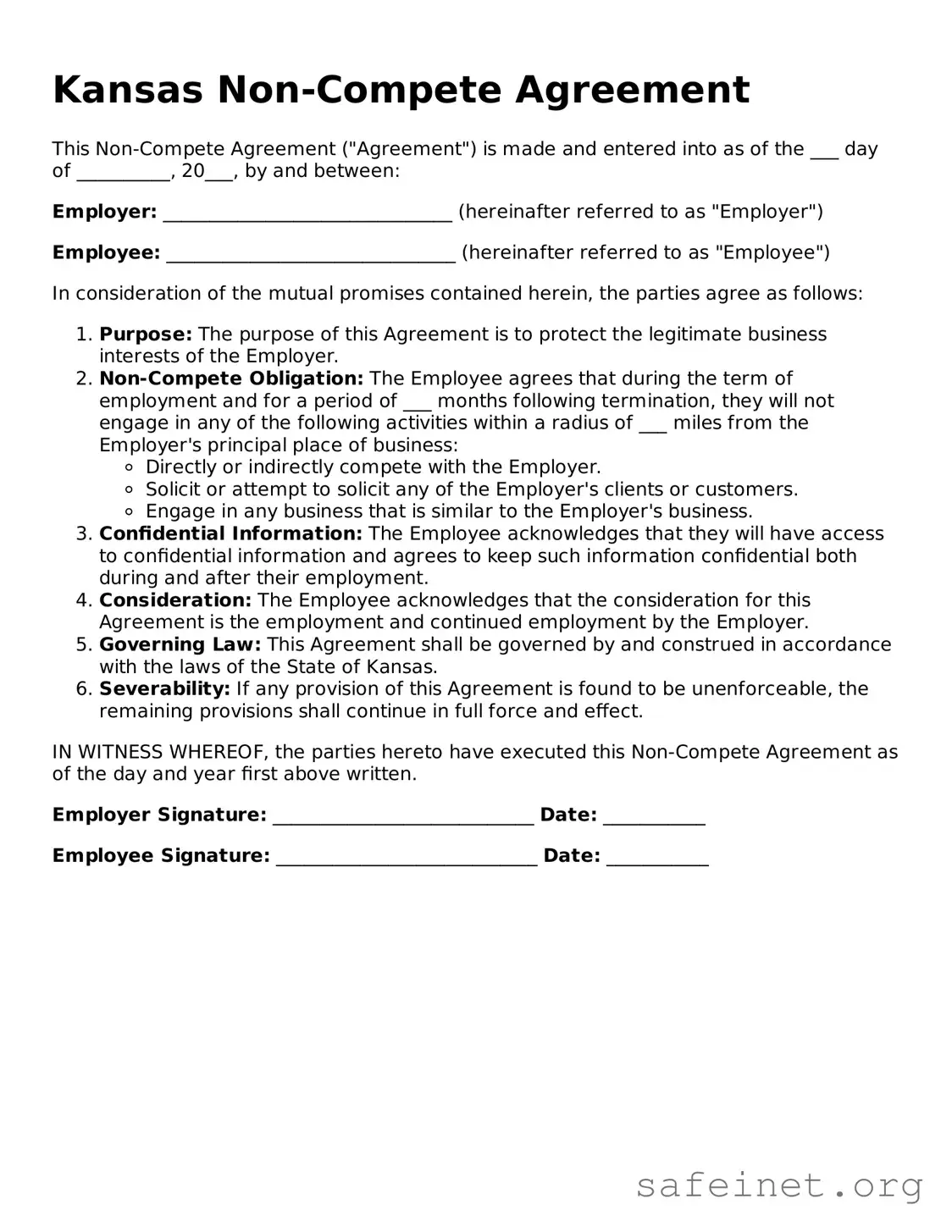
Kansas Non-Compete Agreement
This Non-Compete Agreement ("Agreement") is made and entered into as of the ___ day of __________, 20___, by and between:
Employer: _______________________________ (hereinafter referred to as "Employer")
Employee: _______________________________ (hereinafter referred to as "Employee")
In consideration of the mutual promises contained herein, the parties agree as follows:
IN WITNESS WHEREOF, the parties hereto have executed this Non-Compete Agreement as of the day and year first above written.
Employer Signature: ____________________________ Date: ___________
Employee Signature: ____________________________ Date: ___________
| Fact Name | Description |
|---|---|
| Governing Law | Kansas law governs non-compete agreements, primarily under K.S.A. 50-112. |
| Enforceability | Non-compete agreements in Kansas are enforceable only if they are reasonable in scope and duration. |
| Reasonableness Test | The courts evaluate the reasonableness of a non-compete agreement based on the interests of the employer and the employee. |
| Duration Limitations | Typically, a duration of one to two years is considered reasonable for non-compete agreements in Kansas. |
| Geographic Scope | The geographic area covered by the agreement should be limited to where the employer operates or has a legitimate business interest. |
| Exceptions | Non-compete agreements cannot restrict an employee from working in their profession unless justified by the employer's legitimate business interests. |
Filling out the Kansas Non-compete Agreement form is an important step for both employers and employees to ensure clarity in their working relationship. Once completed, the form should be reviewed carefully to ensure all information is accurate and reflects the intentions of both parties.
What is a Kansas Non-compete Agreement?
A Kansas Non-compete Agreement is a legal document that restricts an employee from working for competitors or starting a competing business for a certain period after leaving their job. This agreement helps protect a company's trade secrets, customer relationships, and other sensitive information. It's essential for both employers and employees to understand the terms before signing.
Are Non-compete Agreements enforceable in Kansas?
Yes, Non-compete Agreements can be enforceable in Kansas, but there are specific conditions. The agreement must be reasonable in scope, duration, and geographic area. Courts will look at whether the agreement protects legitimate business interests without being overly restrictive on the employee's ability to find work.
How long can a Non-compete Agreement last in Kansas?
The duration of a Non-compete Agreement in Kansas can vary. Typically, agreements last anywhere from six months to two years. However, the time frame should be reasonable and related to the nature of the business. Courts may not enforce agreements that are excessively long.
What should be included in a Kansas Non-compete Agreement?
A well-drafted Kansas Non-compete Agreement should include the following elements: the duration of the restriction, the geographic area covered, the specific activities that are restricted, and the legitimate business interests being protected. Clear language helps avoid confusion and potential legal disputes.
Can I negotiate the terms of a Non-compete Agreement?
Yes, you can negotiate the terms of a Non-compete Agreement. If you feel that certain aspects are too restrictive, it's important to discuss your concerns with your employer. Negotiating can lead to a more balanced agreement that protects the company's interests while also allowing you to pursue your career opportunities.
Not understanding the purpose of the agreement: Many individuals fill out the form without fully grasping what a non-compete agreement entails. This can lead to signing an agreement that may limit their future job opportunities.
Failing to specify the geographic scope: A common mistake is not clearly defining the geographic area in which the non-compete applies. Without this detail, the agreement may be deemed overly broad and unenforceable.
Ignoring the duration of the agreement: People often overlook the time period for which the non-compete will be effective. An excessively long duration can make the agreement unreasonable.
Neglecting to include consideration: A non-compete agreement must include something of value exchanged between the parties. Failing to mention this can render the agreement invalid.
Not consulting legal counsel: Many individuals attempt to fill out the form without seeking advice from a lawyer. This can lead to misunderstandings about rights and obligations.
Using vague language: Ambiguities in the wording can create confusion. Clear and precise language is essential to avoid misinterpretation later.
Overlooking state-specific laws: Each state has its own regulations regarding non-compete agreements. Ignoring Kansas-specific laws can lead to an unenforceable agreement.
Not considering future employment: Individuals often fail to think about how the agreement may affect future job prospects. It’s important to evaluate potential career paths before signing.
Signing without reading: Rushing through the process can lead to signing without fully understanding the implications. Always read the entire agreement before signing.
When drafting a Kansas Non-compete Agreement, there are several other documents that are often used to complement it. These forms help clarify the terms of employment, protect intellectual property, and ensure that both parties understand their rights and obligations. Below is a list of related documents that may be beneficial.
Using these documents alongside a Kansas Non-compete Agreement can help ensure a smooth and clear working relationship. It's important to customize each form to fit the specific needs of your business and comply with local laws.
The Kansas Non-compete Agreement form shares similarities with the Non-disclosure Agreement (NDA). Both documents aim to protect sensitive information. While the non-compete agreement restricts an individual from working with competitors after leaving a job, the NDA prevents the sharing of confidential information during and after employment. Both agreements help maintain a company’s competitive edge by safeguarding proprietary information and trade secrets.
Another document comparable to the Kansas Non-compete Agreement is the Employment Agreement. This agreement outlines the terms of employment, including duties, salary, and benefits. While the employment agreement focuses on the relationship between the employer and employee, the non-compete clause within it restricts the employee's future job opportunities to protect the employer's interests. Both documents are essential for establishing clear expectations in the workplace.
The Independent Contractor Agreement is also similar to the Kansas Non-compete Agreement. This document defines the terms of a working relationship between a business and a contractor. Like non-compete agreements, these contracts may include clauses that prevent contractors from working with competitors during or after the project. Both agreements seek to protect business interests while establishing the terms of engagement.
The Confidentiality Agreement is another document that aligns with the Kansas Non-compete Agreement. This agreement ensures that parties involved do not disclose private information. While the non-compete agreement focuses on employment restrictions, confidentiality agreements emphasize the importance of keeping sensitive information secure. Both documents are crucial for maintaining trust and protecting business assets.
The Partnership Agreement can also be compared to the Kansas Non-compete Agreement. This document outlines the roles, responsibilities, and profit-sharing arrangements between partners in a business. Non-compete clauses may be included to prevent partners from pursuing competing interests after the partnership ends. Both agreements are designed to protect the interests of all parties involved and ensure smooth operations.
The Licensing Agreement shares similarities with the Kansas Non-compete Agreement as well. This document allows one party to use another's intellectual property under specific conditions. Licensing agreements may include non-compete clauses to prevent the licensee from using the licensed material to compete directly with the licensor. Both documents aim to protect intellectual property rights and maintain fair competition.
The Franchise Agreement is another document that bears resemblance to the Kansas Non-compete Agreement. This agreement governs the relationship between a franchisor and franchisee. Non-compete clauses are often included to prevent franchisees from opening similar businesses nearby. Both agreements help maintain brand integrity and protect the franchisor's business model.
The Release of Liability Agreement is also comparable to the Kansas Non-compete Agreement. This document protects one party from legal claims made by another party. While the non-compete agreement restricts future employment, the release of liability agreement limits claims related to past activities. Both documents serve to minimize risk and protect parties from potential legal disputes.
The Settlement Agreement can be likened to the Kansas Non-compete Agreement as well. This document resolves disputes between parties, often involving compensation or other terms. Non-compete clauses may be included in settlement agreements to restrict future competition. Both agreements aim to provide closure and protect the interests of the parties involved.
Finally, the Severance Agreement is similar to the Kansas Non-compete Agreement. This document outlines the terms under which an employee is let go, often including severance pay and other benefits. Non-compete clauses may be part of these agreements to prevent former employees from joining competitors. Both documents help clarify the terms of separation and protect the employer’s business interests.
When filling out the Kansas Non-compete Agreement form, it is important to adhere to specific guidelines to ensure the document is completed correctly. Below is a list of ten things to do and not to do during this process.
Things You Should Do:
Things You Shouldn't Do:
Non-compete agreements are often misunderstood, leading to confusion for both employers and employees in Kansas. Here are nine common misconceptions about these agreements:
Understanding these misconceptions is crucial for both employers and employees to navigate the complexities of non-compete agreements effectively.
When considering a Non-compete Agreement in Kansas, it's important to understand the implications and requirements. Here are some key takeaways to keep in mind:
By keeping these points in mind, individuals and businesses can better navigate the complexities of Non-compete Agreements in Kansas.