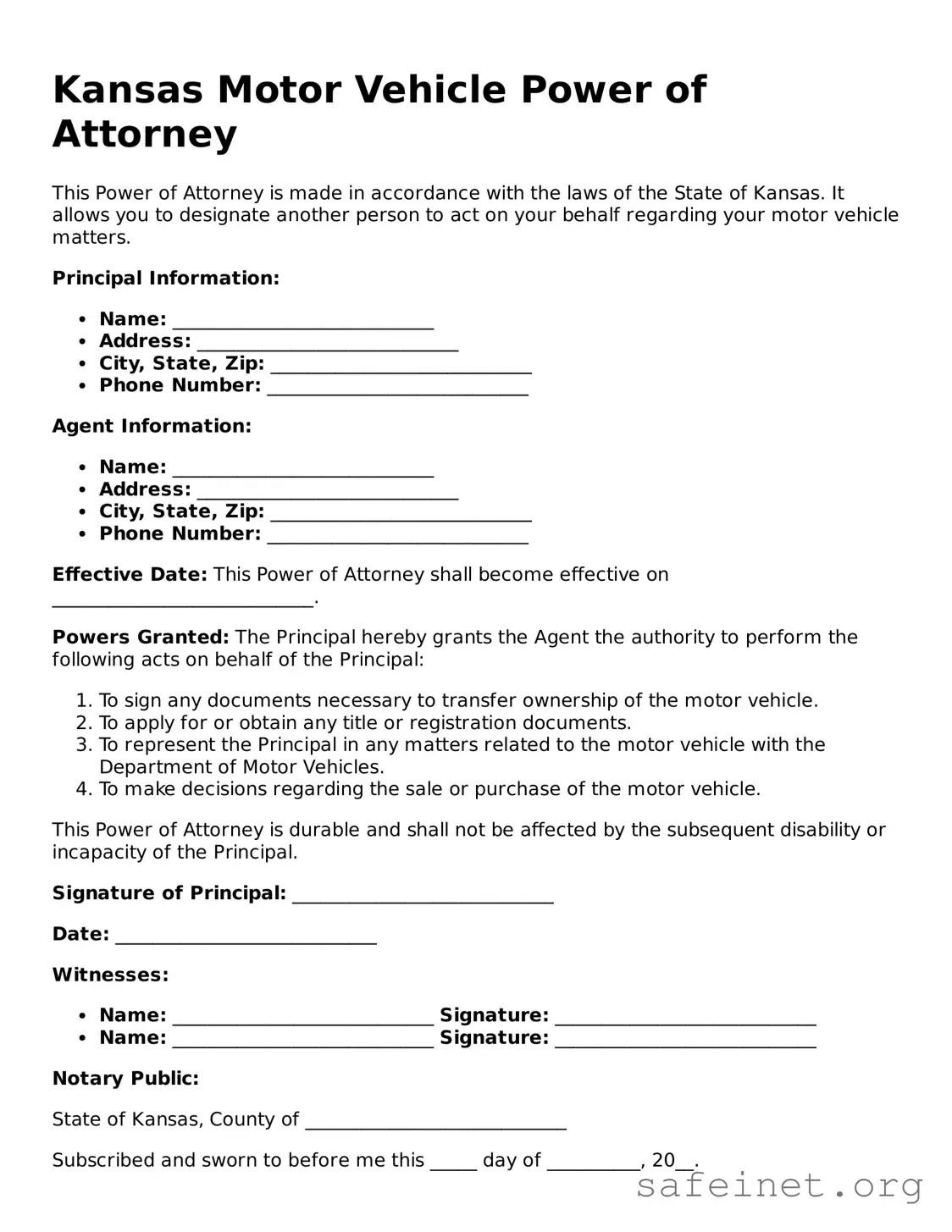
In the state of Kansas, the Motor Vehicle Power of Attorney form serves as a vital legal document that empowers an individual to designate another person to act on their behalf regarding motor vehicle transactions. This form is particularly useful when the vehicle owner is unable to be present for important dealings, such as transferring ownership, registering a vehicle, or handling title issues. By completing this document, the principal grants specific authority to the agent, ensuring that all necessary actions can be executed smoothly and efficiently. The form requires essential details, including the names and addresses of both the principal and the agent, as well as a clear description of the powers being granted. It’s crucial to understand that this power of attorney is limited to motor vehicle matters, providing a focused scope that protects the interests of both parties involved. Additionally, the form must be signed and dated to be valid, and while notarization is not strictly required, it is highly recommended to enhance the legitimacy of the document. Understanding these key aspects can help ensure that the process of managing motor vehicle transactions is handled seamlessly, even in the absence of the vehicle owner.
Kansas Motor Vehicle Power of Attorney
This Power of Attorney is made in accordance with the laws of the State of Kansas. It allows you to designate another person to act on your behalf regarding your motor vehicle matters.
Principal Information:
Agent Information:
Effective Date: This Power of Attorney shall become effective on ____________________________.
Powers Granted: The Principal hereby grants the Agent the authority to perform the following acts on behalf of the Principal:
This Power of Attorney is durable and shall not be affected by the subsequent disability or incapacity of the Principal.
Signature of Principal: ____________________________
Date: ____________________________
Witnesses:
Notary Public:
State of Kansas, County of ____________________________
Subscribed and sworn to before me this _____ day of __________, 20__.
Notary Signature: ____________________________
My Commission Expires: ____________________________
| Fact Name | Description |
|---|---|
| Purpose | The Kansas Motor Vehicle Power of Attorney form allows an individual to designate another person to act on their behalf regarding motor vehicle transactions. |
| Governing Law | This form is governed by the Kansas Statutes Annotated, specifically K.S.A. 8-135. |
| Principal | The person granting authority is referred to as the principal. |
| Agent | The individual receiving authority is known as the agent or attorney-in-fact. |
| Signature Requirement | The principal must sign the form for it to be valid. A witness or notary is not always required but is recommended for added legal standing. |
| Scope of Authority | The agent can perform tasks such as signing documents, transferring titles, and registering vehicles. |
| Duration | The power of attorney remains effective until revoked by the principal or until the principal's death. |
| Revocation | The principal can revoke the power of attorney at any time by providing written notice to the agent. |
| Usage | This form is commonly used in vehicle sales, purchases, and registration processes in Kansas. |
Filling out the Kansas Motor Vehicle Power of Attorney form is a straightforward process. Once completed, this document allows someone you trust to handle specific vehicle-related matters on your behalf. Follow these steps to ensure the form is filled out correctly.
What is a Kansas Motor Vehicle Power of Attorney form?
The Kansas Motor Vehicle Power of Attorney form allows an individual to designate someone else to act on their behalf regarding motor vehicle transactions. This can include signing titles, registering vehicles, and handling other related matters. It is particularly useful when the vehicle owner cannot be present to complete these tasks themselves.
Who can be designated as an agent in this form?
Any adult can be designated as an agent in the Kansas Motor Vehicle Power of Attorney form. This could be a family member, friend, or a trusted professional. It is important to choose someone reliable, as they will have the authority to make decisions regarding your vehicle.
How do I complete the form?
To complete the form, you will need to provide your information as the principal, including your name and address. Next, you will enter the agent's information. Finally, you must specify the powers you are granting to your agent. Make sure to sign and date the form to make it valid.
Do I need to have the form notarized?
While notarization is not strictly required for the Kansas Motor Vehicle Power of Attorney form, it is highly recommended. Having the document notarized adds an extra layer of authenticity and can help prevent disputes regarding its validity.
Can I revoke the Power of Attorney once it is established?
Yes, you can revoke the Power of Attorney at any time, as long as you are mentally competent. To do this, you should create a written notice of revocation and provide it to your agent. It's also a good idea to inform any institutions or individuals who might have a copy of the original Power of Attorney.
Is there a specific time frame for which the Power of Attorney is valid?
The Kansas Motor Vehicle Power of Attorney does not have a specific expiration date unless you specify one when filling out the form. If you want it to be temporary, you can indicate the time frame. Otherwise, it remains in effect until you revoke it or until your death.
What if my agent needs to act on my behalf in multiple counties?
Your agent can act on your behalf in multiple counties within Kansas. The Power of Attorney is valid statewide, so your agent can handle motor vehicle matters wherever necessary, as long as they have the completed form with them.
Where do I submit the completed form?
The completed Kansas Motor Vehicle Power of Attorney form should be submitted to the local Department of Motor Vehicles (DMV) office where the vehicle is registered. Your agent can present it along with any other required documents to complete the transaction.
Neglecting to Specify the Powers Granted: Many individuals fail to clearly outline the specific powers they wish to grant to the agent. This can lead to confusion and limit the agent's ability to act effectively on behalf of the principal.
Not Including the Principal’s Information: Omitting essential details such as the full name, address, and contact information of the principal can render the form incomplete. This information is crucial for identification purposes.
Forgetting to Sign and Date the Form: A common oversight is neglecting to sign and date the Power of Attorney. Without these, the document may not be legally binding, and the agent cannot perform any actions.
Failure to Notarize: Although not always required, notarization can add an extra layer of legitimacy to the document. Many people overlook this step, which can lead to challenges in enforcing the Power of Attorney.
Using Incorrect or Outdated Forms: Some individuals may use outdated versions of the form or incorrect templates. It is essential to ensure that the most current and appropriate form is being utilized.
Not Discussing the Arrangement with the Agent: Failing to communicate with the designated agent about the responsibilities and expectations can lead to misunderstandings. Clear communication is vital for effective representation.
Ignoring State-Specific Requirements: Each state has unique requirements for Power of Attorney forms. Ignoring Kansas-specific regulations can result in an invalid document, making it crucial to understand local laws.
The Kansas Motor Vehicle Power of Attorney form is a crucial document that allows an individual to designate another person to handle motor vehicle-related transactions on their behalf. However, several other forms and documents often accompany this power of attorney to ensure that all necessary legal aspects are covered. Below is a list of these documents, each serving a specific purpose in the vehicle transaction process.
These documents work in conjunction with the Kansas Motor Vehicle Power of Attorney to facilitate smooth vehicle transactions. Understanding each form's purpose can help individuals navigate the legal requirements more effectively.
The Durable Power of Attorney is similar to the Kansas Motor Vehicle Power of Attorney in that both documents allow one person to act on behalf of another. The Durable Power of Attorney remains effective even if the principal becomes incapacitated, ensuring that decisions can continue to be made regarding financial or legal matters. In contrast, the Kansas Motor Vehicle Power of Attorney specifically focuses on vehicle-related transactions, such as title transfers and registration. Both documents empower individuals to manage affairs efficiently, but their scopes differ significantly.
The General Power of Attorney also shares similarities with the Kansas Motor Vehicle Power of Attorney. Like the Kansas form, a General Power of Attorney grants authority to an agent to act on behalf of the principal. However, the General Power of Attorney covers a broader range of decisions, including financial, legal, and health care matters. While both documents facilitate the delegation of authority, the Kansas Motor Vehicle Power of Attorney is limited to vehicle-related issues.
The Limited Power of Attorney is another document that resembles the Kansas Motor Vehicle Power of Attorney. Both allow an agent to perform specific tasks on behalf of the principal. The Limited Power of Attorney can be tailored to a particular situation, such as selling a property or managing a bank account. In this way, the Kansas Motor Vehicle Power of Attorney is a type of Limited Power of Attorney, focused solely on vehicle transactions.
The Vehicle Title Application is a document that relates closely to the Kansas Motor Vehicle Power of Attorney. While the Vehicle Title Application is used to formally request a title for a vehicle, the Kansas Motor Vehicle Power of Attorney authorizes someone else to complete that application on your behalf. Both documents are necessary when dealing with vehicle ownership, but they serve different functions in the process.
The Bill of Sale is another document that can be associated with the Kansas Motor Vehicle Power of Attorney. When selling or buying a vehicle, a Bill of Sale serves as proof of the transaction. The Kansas Motor Vehicle Power of Attorney can empower someone to sign the Bill of Sale on behalf of the seller or buyer, facilitating the transfer of ownership. Both documents work together to ensure that vehicle transactions are legally binding.
The Affidavit of Heirship is somewhat similar to the Kansas Motor Vehicle Power of Attorney in that it can be used to establish ownership of a vehicle after someone has passed away. This affidavit helps clarify the rightful owner when a vehicle is inherited. While the Kansas Motor Vehicle Power of Attorney allows someone to act on your behalf while you are alive, the Affidavit of Heirship addresses ownership issues that arise posthumously.
The Release of Liability form is related to the Kansas Motor Vehicle Power of Attorney as it pertains to the transfer of vehicle ownership. When a vehicle is sold, the seller often submits a Release of Liability to inform the DMV that they are no longer responsible for the vehicle. The Kansas Motor Vehicle Power of Attorney may allow an agent to submit this form on behalf of the seller, ensuring that all necessary paperwork is completed for a smooth transaction.
The Registration Renewal form is another document that aligns with the Kansas Motor Vehicle Power of Attorney. This form is used to renew the registration of a vehicle, which is an essential part of vehicle ownership. If someone is unable to complete this task themselves, the Kansas Motor Vehicle Power of Attorney allows an agent to handle the renewal process on their behalf, ensuring compliance with state regulations.
The Odometer Disclosure Statement is similar to the Kansas Motor Vehicle Power of Attorney in that it is often required during the sale or transfer of a vehicle. This document verifies the mileage on a vehicle at the time of sale. The Kansas Motor Vehicle Power of Attorney can authorize someone to complete and sign this statement for the seller, streamlining the transaction process and ensuring all necessary disclosures are made.
Finally, the Vehicle Transfer Notification is another related document. This form notifies the DMV of a vehicle transfer, protecting the seller from future liabilities. The Kansas Motor Vehicle Power of Attorney can empower someone to file this notification on behalf of the seller, ensuring that all parties are informed of the change in ownership. Both documents are crucial for maintaining accurate vehicle records and protecting the interests of the seller.
When filling out the Kansas Motor Vehicle Power of Attorney form, it’s important to follow certain guidelines to ensure everything is completed correctly. Here are nine things you should and shouldn't do:
By following these guidelines, you can ensure that your Power of Attorney form is filled out correctly and efficiently.
The Kansas Motor Vehicle Power of Attorney form is a useful document, but several misconceptions can lead to confusion. Here are five common misunderstandings about this form:
This is not true. The form can be utilized for various types of motor vehicles, including cars, trucks, motorcycles, and trailers. It is not limited to any particular category.
While legal advice can be helpful, it is not necessary to have a lawyer complete the Kansas Motor Vehicle Power of Attorney form. Individuals can fill it out themselves as long as they understand the requirements.
Many people believe this form is solely for ownership transfers. However, it can also authorize someone to handle various tasks related to the vehicle, such as registration or title changes.
Although notarization can provide additional assurance, it is not always required for the Kansas Motor Vehicle Power of Attorney form to be valid. Check local requirements to determine if notarization is necessary.
This misconception is misleading. The individual who created the Power of Attorney can revoke it at any time, provided they follow the appropriate procedures for revocation.
Understanding these misconceptions can help individuals use the Kansas Motor Vehicle Power of Attorney form effectively and avoid unnecessary complications.
When dealing with the Kansas Motor Vehicle Power of Attorney form, it is essential to understand its purpose and proper usage. Here are key takeaways to keep in mind:
Understanding these points can help ensure that the Kansas Motor Vehicle Power of Attorney form is filled out correctly and used effectively.