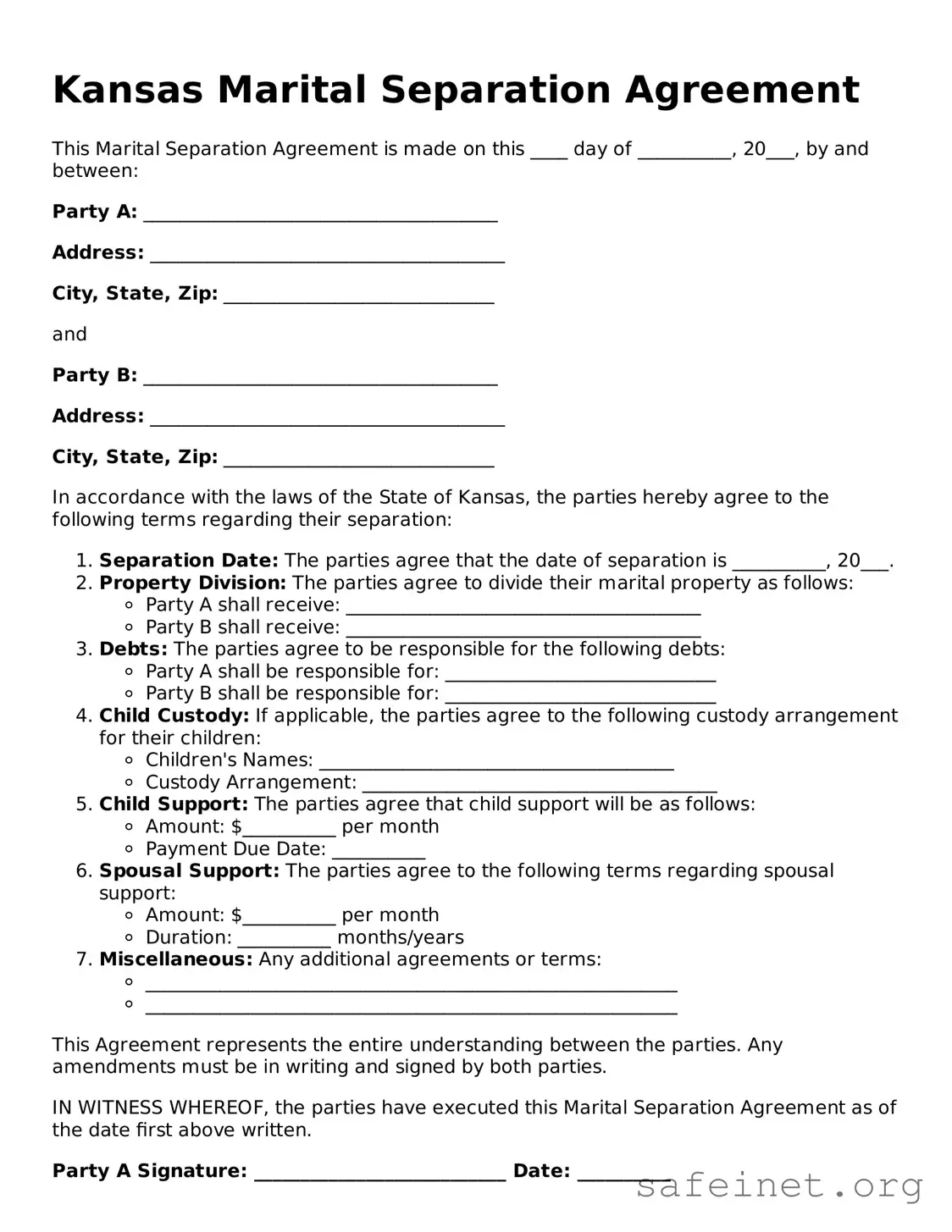
In the state of Kansas, a Marital Separation Agreement serves as a vital document for couples who choose to live apart while navigating the complexities of their relationship. This form outlines essential terms that govern various aspects of the separation, including the division of property, allocation of debts, and arrangements for child custody and support, if applicable. By clearly defining the rights and responsibilities of each party, the agreement aims to minimize conflict and provide a structured framework for the separation process. It is important for both individuals to fully understand the implications of the agreement, as it can significantly impact their financial and personal lives. Additionally, while the form may not require court approval to be valid, having it reviewed by a legal professional can ensure that the terms are fair and comply with state laws. The Marital Separation Agreement can serve as a foundation for a peaceful transition, allowing both parties to move forward with clarity and mutual respect.
Kansas Marital Separation Agreement
This Marital Separation Agreement is made on this ____ day of __________, 20___, by and between:
Party A: ______________________________________
Address: ______________________________________
City, State, Zip: _____________________________
and
Party B: ______________________________________
Address: ______________________________________
City, State, Zip: _____________________________
In accordance with the laws of the State of Kansas, the parties hereby agree to the following terms regarding their separation:
This Agreement represents the entire understanding between the parties. Any amendments must be in writing and signed by both parties.
IN WITNESS WHEREOF, the parties have executed this Marital Separation Agreement as of the date first above written.
Party A Signature: ___________________________ Date: __________
Party B Signature: ___________________________ Date: __________
Witness Signature: ___________________________ Date: __________
| Fact Name | Details |
|---|---|
| Definition | A Kansas Marital Separation Agreement is a legal document that outlines the terms of separation between spouses. |
| Governing Law | This agreement is governed by the laws of the state of Kansas, specifically under the Kansas Statutes Annotated (K.S.A.) § 60-1601 et seq. |
| Purpose | The primary purpose is to clarify the rights and responsibilities of each spouse during the separation period. |
| Content | It typically includes provisions related to child custody, support, division of property, and debt obligations. |
| Voluntary Agreement | Both spouses must voluntarily agree to the terms outlined in the separation agreement. |
| Not a Divorce | This agreement does not terminate the marriage; it is a temporary arrangement until a divorce is finalized. |
| Enforceability | If properly executed, the agreement can be enforceable in court, provided it meets legal standards. |
| Modification | Changes to the agreement can be made if both parties consent and the modifications are documented in writing. |
Completing the Kansas Marital Separation Agreement form is an important step in the process of separating from a spouse. This form outlines the terms of your separation, including issues related to property division, child custody, and support. After filling out the form, you will typically need to file it with the appropriate court and may have to attend a hearing to finalize the terms.
What is a Kansas Marital Separation Agreement?
A Kansas Marital Separation Agreement is a legal document that outlines the terms and conditions under which a couple agrees to live separately. It addresses issues such as property division, child custody, and support obligations. This agreement helps both parties clarify their rights and responsibilities while living apart.
Why should I create a Marital Separation Agreement?
Creating a Marital Separation Agreement can provide clarity and structure during a difficult time. It helps prevent misunderstandings and disputes by clearly outlining each person's rights and obligations. Additionally, having a written agreement can be beneficial if you later decide to divorce, as it can serve as a reference point for negotiations.
Is a Marital Separation Agreement legally binding in Kansas?
Yes, a Marital Separation Agreement is legally binding in Kansas as long as both parties voluntarily sign it and it meets the legal requirements. However, it is advisable to have the agreement reviewed by a lawyer to ensure that it complies with Kansas law and adequately protects your interests.
What should be included in a Kansas Marital Separation Agreement?
Your agreement should include key elements such as the division of marital property, debts, child custody arrangements, visitation schedules, and child support. You may also want to address spousal support and any other relevant issues that may arise during your separation.
Can I modify a Marital Separation Agreement later?
Yes, you can modify a Marital Separation Agreement if both parties agree to the changes. It’s important to put any modifications in writing and have both parties sign the updated agreement. This ensures that the new terms are legally recognized.
Do I need a lawyer to create a Marital Separation Agreement?
While it is not required to have a lawyer, it is highly recommended. A lawyer can help you understand your rights, ensure the agreement is fair, and address any legal complexities. Having professional guidance can save you time and prevent future disputes.
How does a Marital Separation Agreement affect child custody?
The agreement should outline your child custody arrangements, including physical custody, legal custody, and visitation rights. It’s important to consider the best interests of the child when creating these terms. Courts generally look favorably on agreements that prioritize the child's well-being.
What happens if one party violates the Marital Separation Agreement?
If one party violates the terms of the agreement, the other party may seek legal recourse. This could involve going to court to enforce the agreement or seeking modifications. It’s important to document any violations and consult with a lawyer for guidance on how to proceed.
Incomplete Information: One common mistake is failing to provide all required personal details. Ensure that both parties' names, addresses, and contact information are fully filled out.
Neglecting Asset Division: People often overlook the importance of clearly defining how assets and debts will be divided. It’s crucial to list all property, including real estate, vehicles, and bank accounts.
Ignoring Child Custody Arrangements: If children are involved, parents sometimes forget to outline custody and visitation schedules. Clearly stating these arrangements helps prevent future disputes.
Overlooking Spousal Support: Some individuals fail to address spousal support or alimony. If applicable, specify the amount and duration of payments to avoid misunderstandings later.
Not Seeking Legal Advice: Many people attempt to complete the form without consulting a legal expert. Obtaining professional guidance can ensure that all terms are fair and legally binding.
A Kansas Marital Separation Agreement is a critical document for couples who decide to separate but not divorce. It outlines the terms of the separation, including asset division, child custody, and support arrangements. Alongside this agreement, several other forms and documents are commonly used to ensure all aspects of the separation are legally addressed.
Using these documents in conjunction with the Kansas Marital Separation Agreement helps to create a clear and organized approach to separation. This ensures that both parties understand their rights and responsibilities, ultimately leading to a smoother transition during this challenging time.
The Kansas Divorce Agreement is a document that outlines the terms of a divorce between spouses. Similar to the Marital Separation Agreement, it addresses asset division, child custody, and support obligations. Both documents aim to provide a clear understanding of each party's rights and responsibilities, ensuring a smoother transition during a significant life change.
The Child Custody Agreement is another relevant document. This agreement focuses specifically on the arrangements for children following a separation or divorce. Like the Marital Separation Agreement, it addresses custody arrangements, visitation schedules, and child support. The primary difference lies in its exclusive focus on the children's welfare and parental responsibilities.
A Property Settlement Agreement is closely related to the Marital Separation Agreement. This document specifically deals with the division of marital property and debts. Both agreements serve to clarify how assets will be divided, but the Property Settlement Agreement often comes into play when a divorce is imminent, whereas the Marital Separation Agreement can be used during a period of separation.
The Spousal Support Agreement outlines financial support from one spouse to another after separation or divorce. This document shares similarities with the Marital Separation Agreement in that it may include provisions for alimony or spousal support. Both agreements aim to ensure that both parties are financially secure during and after the separation process.
The Parenting Plan is a specific type of agreement that details the responsibilities of each parent regarding their children. Like the Marital Separation Agreement, it is designed to minimize conflict and provide a clear framework for co-parenting. It includes schedules, decision-making authority, and methods for resolving disputes, similar to the custody arrangements found in a Marital Separation Agreement.
A Legal Separation Agreement is another document that resembles the Kansas Marital Separation Agreement. This agreement allows couples to live apart while remaining legally married. It covers similar topics, including asset division and support obligations, but differs in that it does not terminate the marriage, allowing for potential reconciliation.
The Cohabitation Agreement is relevant for couples who choose to live together without marrying. This document outlines the rights and responsibilities of each partner, similar to the Marital Separation Agreement in its aim to clarify expectations. It is particularly useful in protecting individual assets and addressing financial obligations in the event of a breakup.
The Prenuptial Agreement, while typically created before marriage, shares a common goal with the Marital Separation Agreement: to define the financial rights and responsibilities of each party. Both documents seek to prevent disputes over property and support, although the Prenuptial Agreement is proactive, whereas the Marital Separation Agreement is reactive to changes in the relationship.
The Postnuptial Agreement is similar to the Prenuptial Agreement but is executed after marriage. Like the Marital Separation Agreement, it addresses financial and property issues between spouses. Both documents aim to establish clear terms to avoid future disputes, although the Postnuptial Agreement is often used when circumstances change during the marriage.
The Separation Agreement, while a broader term, encompasses various aspects of a couple's separation. It includes elements such as child custody, support, and property division, much like the Marital Separation Agreement. The key difference may lie in the specific terms and conditions tailored to the couple's unique situation, but the overall objectives remain aligned.
When filling out the Kansas Marital Separation Agreement form, it’s important to approach the process with care. Here are some essential dos and don’ts to consider:
Understanding the Kansas Marital Separation Agreement form is essential for couples considering separation. However, several misconceptions can cloud judgment and lead to confusion. Here’s a closer look at eight common misconceptions:
Being aware of these misconceptions can help individuals make informed decisions when navigating the complexities of marital separation in Kansas.
When filling out and using the Kansas Marital Separation Agreement form, consider the following key takeaways: