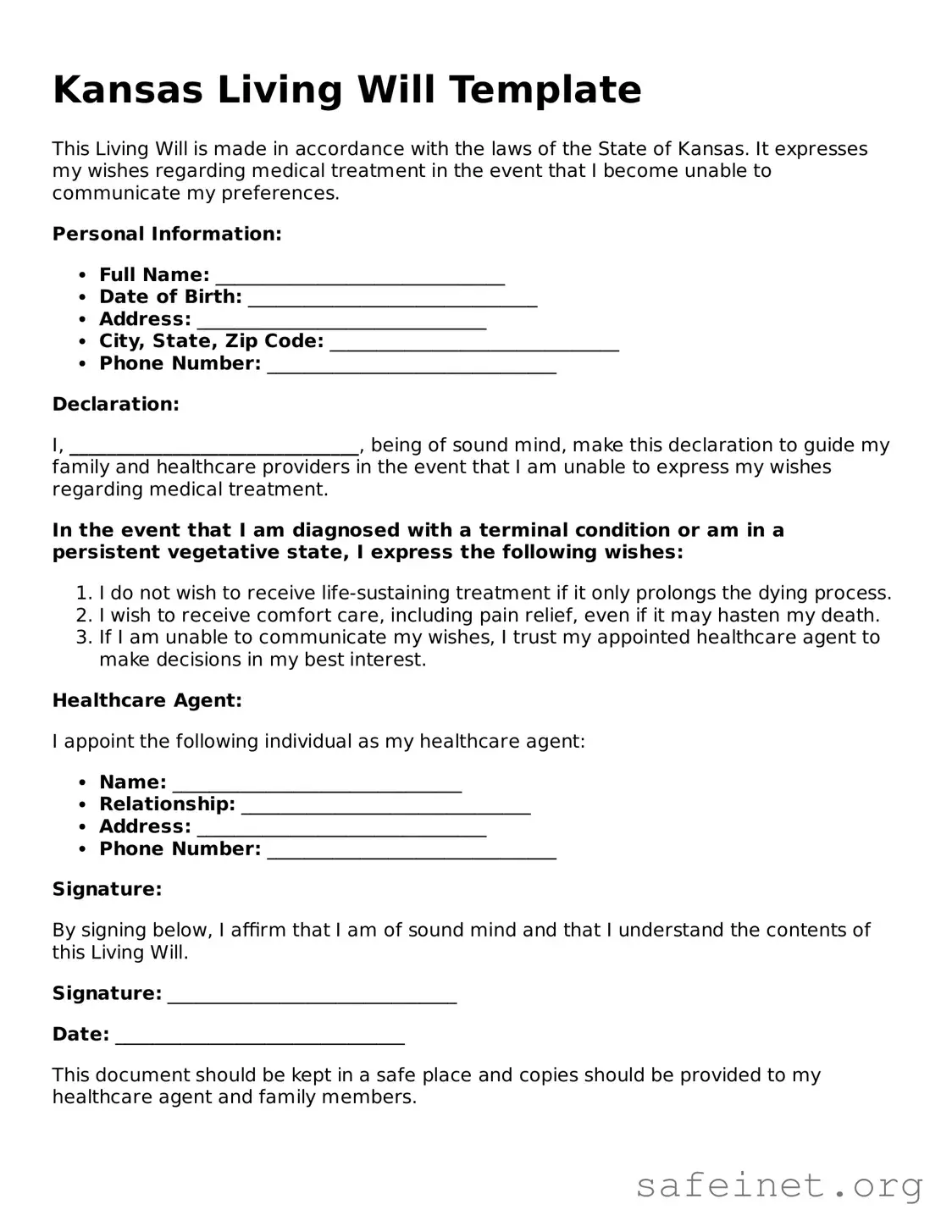
In the state of Kansas, the Living Will form serves as a crucial tool for individuals to communicate their healthcare preferences in the event they become unable to make decisions for themselves. This legal document outlines specific wishes regarding medical treatment, particularly in scenarios involving terminal illness or severe incapacitation. By detailing preferences for life-sustaining measures, such as resuscitation and artificial nutrition, the Living Will empowers individuals to maintain control over their end-of-life care. Moreover, it alleviates the burden on family members and healthcare providers, who may face difficult decisions without clear guidance. Understanding the importance of this form can help ensure that one's values and desires are honored, even when they cannot voice them directly. The process of creating a Living Will in Kansas is straightforward, yet it requires careful consideration and, ideally, discussions with loved ones and medical professionals to ensure that all parties are aligned with the individual's wishes.
Kansas Living Will Template
This Living Will is made in accordance with the laws of the State of Kansas. It expresses my wishes regarding medical treatment in the event that I become unable to communicate my preferences.
Personal Information:
Declaration:
I, _______________________________, being of sound mind, make this declaration to guide my family and healthcare providers in the event that I am unable to express my wishes regarding medical treatment.
In the event that I am diagnosed with a terminal condition or am in a persistent vegetative state, I express the following wishes:
Healthcare Agent:
I appoint the following individual as my healthcare agent:
Signature:
By signing below, I affirm that I am of sound mind and that I understand the contents of this Living Will.
Signature: _______________________________
Date: _______________________________
This document should be kept in a safe place and copies should be provided to my healthcare agent and family members.
| Fact Name | Description |
|---|---|
| Purpose | A Kansas Living Will allows individuals to outline their preferences for medical treatment in the event they become unable to communicate their wishes. |
| Governing Law | The Kansas Living Will is governed by the Kansas Statutes, specifically K.S.A. 65-28,101 through 65-28,113. |
| Eligibility | Any adult resident of Kansas can create a Living Will. This includes individuals aged 18 and older. |
| Witness Requirements | The form must be signed in the presence of two witnesses who are at least 18 years old and not related to the individual. |
| Revocation | A Living Will can be revoked at any time by the individual. This can be done verbally or in writing. |
| Health Care Proxy | While a Living Will outlines treatment preferences, individuals may also appoint a health care proxy to make decisions on their behalf. |
| Notarization | Notarization is not required for a Kansas Living Will, but it may add an extra layer of validation. |
| Storage | It is advisable to keep the Living Will in a safe place and provide copies to family members and health care providers. |
Completing the Kansas Living Will form is an important step in ensuring your healthcare wishes are respected. After filling out the form, keep it in a safe place and share copies with your healthcare provider, family members, and anyone else involved in your care.
What is a Kansas Living Will?
A Kansas Living Will is a legal document that allows individuals to express their wishes regarding medical treatment in the event they become unable to communicate their preferences. This document specifically addresses end-of-life care, detailing the types of medical interventions an individual does or does not want. It serves as a guide for healthcare providers and loved ones, ensuring that a person's values and wishes are respected during critical moments.
Who can create a Living Will in Kansas?
In Kansas, any adult who is at least 18 years old and of sound mind can create a Living Will. This means that the individual must understand the nature and consequences of their decisions regarding medical treatment. It is advisable for individuals to consult with legal or medical professionals to ensure that their wishes are clearly articulated and legally valid.
How do I create a Living Will in Kansas?
To create a Living Will in Kansas, you need to complete a specific form that outlines your preferences for medical treatment. This form must be signed in the presence of two witnesses or a notary public. The witnesses cannot be related to you, cannot be entitled to any part of your estate, and must be competent adults. Once completed, it is essential to keep the document in a safe place and share copies with your healthcare providers and family members.
Can I change or revoke my Living Will?
Yes, you can change or revoke your Living Will at any time, as long as you are mentally competent. To revoke the document, you may simply destroy it or create a new Living Will that explicitly states your updated wishes. It is crucial to inform your healthcare providers and family members about any changes to ensure that they are aware of your current preferences.
What happens if I do not have a Living Will?
If you do not have a Living Will and become unable to communicate your medical preferences, healthcare providers will typically follow standard medical protocols. This may lead to treatments that you might not have wanted. Additionally, family members may face difficult decisions without clear guidance on your wishes, potentially leading to conflict or confusion during an already challenging time.
Is a Living Will the same as a Durable Power of Attorney for Healthcare?
No, a Living Will and a Durable Power of Attorney for Healthcare are different documents. A Living Will focuses specifically on your wishes regarding end-of-life medical treatment. In contrast, a Durable Power of Attorney for Healthcare allows you to designate someone to make healthcare decisions on your behalf if you become incapacitated. Both documents can work together to provide comprehensive guidance for your medical care.
Not clearly stating their wishes. Many individuals fail to articulate their preferences regarding medical treatment, which can lead to confusion for healthcare providers and family members.
Forgetting to sign and date the form. A Living Will is not valid unless it is properly signed and dated. Omitting this step can render the document ineffective.
Neglecting to have witnesses. Kansas requires that the Living Will be signed in the presence of two witnesses, who must also sign the document. Skipping this requirement can invalidate the form.
Choosing inappropriate witnesses. Witnesses cannot be related to the individual or have any financial interest in the individual's estate. Selecting the wrong witnesses can lead to complications.
Failing to update the document. Life circumstances change, and so do personal wishes. Not revisiting the Living Will regularly can result in outdated or unwanted directives.
Using vague language. Phrases like "do everything possible" can be interpreted in various ways. Clear and specific language is essential to ensure that the individual's wishes are understood.
Not discussing the Living Will with family. Open communication about end-of-life preferences can prevent misunderstandings and conflicts among family members when the time comes.
Overlooking storage and accessibility. After completing the Living Will, it should be stored in a safe but accessible location. Family members and healthcare providers should know where to find it.
A Kansas Living Will is an important document that outlines an individual's wishes regarding medical treatment in situations where they cannot communicate their preferences. When preparing a Living Will, it can be beneficial to consider other related documents that support your healthcare decisions. Here are five commonly used forms that often accompany a Kansas Living Will:
Having these documents in place can provide clarity and peace of mind for both you and your loved ones. It ensures that your healthcare preferences are respected and followed, even when you cannot express them yourself.
The Kansas Living Will form is similar to the Advance Directive. Both documents allow individuals to express their wishes regarding medical treatment in the event they become unable to communicate those wishes. An Advance Directive encompasses both a Living Will and a Medical Power of Attorney, providing a comprehensive approach to end-of-life care decisions. This ensures that personal preferences are respected even when one cannot voice them.
Another document akin to the Kansas Living Will is the Durable Power of Attorney for Health Care. This form designates a trusted person to make medical decisions on behalf of the individual if they are incapacitated. While a Living Will outlines specific wishes regarding treatment, the Durable Power of Attorney allows the appointed agent to interpret and make decisions based on the individual's values and preferences.
The Health Care Proxy is also comparable to the Kansas Living Will. It allows individuals to appoint someone to make health care decisions for them. While the Living Will focuses on specific medical treatments, the Health Care Proxy provides broader authority to the designated person, giving them the ability to make real-time decisions based on the individual's best interests.
The Do Not Resuscitate (DNR) order shares similarities with the Kansas Living Will. A DNR specifically instructs medical personnel not to perform CPR in the event of cardiac arrest. While the Living Will addresses a range of medical treatments, the DNR focuses solely on resuscitation efforts, reflecting a person's desire to avoid aggressive life-saving measures.
The Physician Orders for Life-Sustaining Treatment (POLST) form is another document that aligns with the Kansas Living Will. POLST translates a patient’s wishes regarding life-sustaining treatment into actionable medical orders. Unlike the Living Will, which is often used when a person is unable to communicate, POLST is intended for those who are seriously ill or nearing the end of life, providing immediate guidance to healthcare providers.
The Medical Orders for Scope of Treatment (MOST) form serves a similar purpose to the Kansas Living Will. This document provides specific medical orders regarding treatment preferences, especially for patients with advanced illnesses. While both documents express a patient's wishes, MOST is designed to be used by healthcare providers as a direct order, ensuring that preferences are followed in real-time medical situations.
The Advance Care Plan is another related document. It outlines an individual’s healthcare preferences and goals for treatment. Similar to the Kansas Living Will, it encourages discussions about end-of-life care. However, the Advance Care Plan is broader, encompassing not only medical preferences but also values and beliefs that guide those decisions.
The Statement of Wishes is akin to the Kansas Living Will in that it conveys personal preferences regarding medical care. However, it is less formal and may not carry the same legal weight as a Living Will. This document can serve as a supplement to the Living Will, providing additional context about a person's values and desires for their care.
Lastly, the Family Care Plan can be compared to the Kansas Living Will. This document involves family members discussing and documenting their loved one's wishes regarding medical treatment. While it may not have the same legal standing, it fosters communication among family members and ensures that everyone is aware of the individual's preferences, aligning with the intent of the Living Will.
When filling out the Kansas Living Will form, it's essential to approach the process with care and consideration. Here’s a list of things you should and shouldn’t do to ensure your wishes are clearly communicated.
By following these guidelines, you can help ensure that your Living Will accurately reflects your desires and provides clarity for your loved ones during difficult times.
Understanding the Kansas Living Will form is essential for making informed decisions about end-of-life care. Unfortunately, there are several misconceptions surrounding this important document. Here’s a list of common misunderstandings:
While both documents relate to medical decisions, a Living Will specifically outlines your wishes regarding end-of-life care, whereas a Durable Power of Attorney for Health Care designates someone to make decisions on your behalf.
This is not true. Anyone over the age of 18 can create a Living Will, regardless of their health status. It’s about expressing your wishes in advance.
People of all ages can benefit from having a Living Will. Accidents and unexpected illnesses can happen to anyone, making it wise to have your preferences documented.
This is a misconception. You can update or revoke your Living Will at any time, as long as you are mentally competent to do so.
Assuming your family knows your preferences can lead to confusion and conflict. A Living Will clearly communicates your desires, reducing the burden on loved ones.
While it primarily addresses medical care, it can also include preferences for organ donation and other related decisions.
While they generally must honor your wishes, certain circumstances may lead to exceptions. It's important to discuss your Living Will with your healthcare team.
In reality, many resources are available to help you understand and complete a Living Will. It can often be done simply and efficiently.
While it’s best to have one current document, you can create multiple versions as long as you clearly revoke the previous ones.
This is incorrect. In Kansas, a properly executed Living Will is a legally binding document that must be respected by healthcare providers.
Filling out and using the Kansas Living Will form is an important step in planning for your healthcare preferences. Here are some key takeaways to consider: