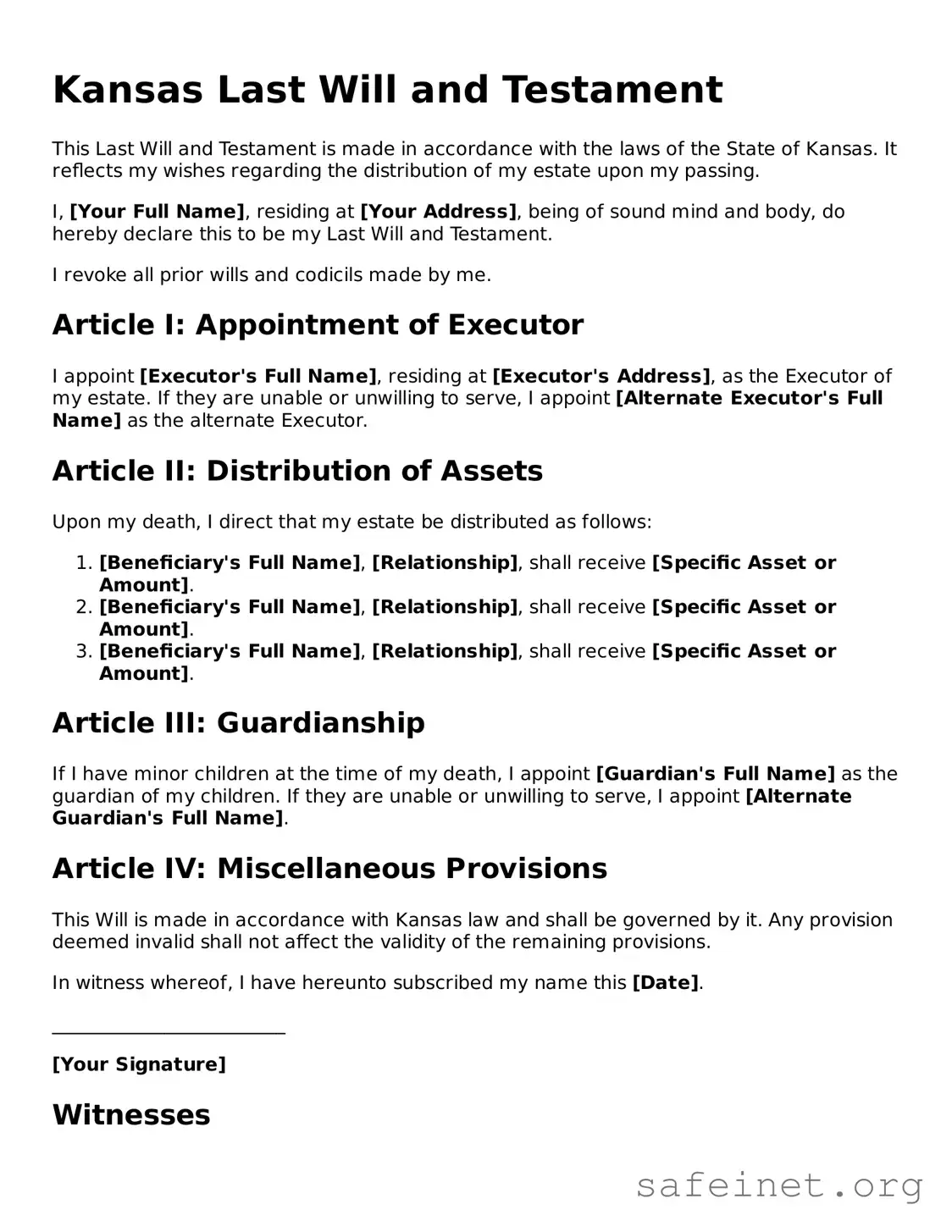
Creating a Last Will and Testament is an essential step in ensuring that your wishes are honored after you pass away. In Kansas, this legal document serves as a blueprint for how your assets will be distributed, who will manage your estate, and guardianship arrangements for any minor children. The Kansas Last Will and Testament form provides a structured way to articulate your intentions clearly and legally. It typically includes sections for naming an executor, detailing specific bequests, and outlining the distribution of remaining assets. Additionally, it allows you to express any personal wishes regarding funeral arrangements. Understanding the components of this form is crucial, as it ensures that your desires are respected and minimizes potential disputes among surviving family members. By taking the time to complete this document, you can provide peace of mind for both yourself and your loved ones, knowing that your affairs will be handled according to your preferences.
Kansas Last Will and Testament
This Last Will and Testament is made in accordance with the laws of the State of Kansas. It reflects my wishes regarding the distribution of my estate upon my passing.
I, [Your Full Name], residing at [Your Address], being of sound mind and body, do hereby declare this to be my Last Will and Testament.
I revoke all prior wills and codicils made by me.
Article I: Appointment of Executor
I appoint [Executor's Full Name], residing at [Executor's Address], as the Executor of my estate. If they are unable or unwilling to serve, I appoint [Alternate Executor's Full Name] as the alternate Executor.
Article II: Distribution of Assets
Upon my death, I direct that my estate be distributed as follows:
Article III: Guardianship
If I have minor children at the time of my death, I appoint [Guardian's Full Name] as the guardian of my children. If they are unable or unwilling to serve, I appoint [Alternate Guardian's Full Name].
Article IV: Miscellaneous Provisions
This Will is made in accordance with Kansas law and shall be governed by it. Any provision deemed invalid shall not affect the validity of the remaining provisions.
In witness whereof, I have hereunto subscribed my name this [Date].
_________________________
[Your Signature]
Witnesses
We, the undersigned witnesses, do hereby declare that the above-named Testator signed this Last Will and Testament in our presence and that we, in their presence, have signed our names as witnesses.
_________________________
[Witness 1's Signature]
[Witness 1's Printed Name]
[Witness 1's Address]
_________________________
[Witness 2's Signature]
[Witness 2's Printed Name]
[Witness 2's Address]
| Fact Name | Details |
|---|---|
| Governing Law | The Kansas Last Will and Testament is governed by the Kansas Statutes Annotated, specifically K.S.A. 59-601 et seq. |
| Age Requirement | Individuals must be at least 18 years old to create a valid will in Kansas. |
| Witness Requirement | A will must be signed by at least two witnesses who are present at the same time. |
| Revocation | A will can be revoked by creating a new will or by physically destroying the original document. |
| Holographic Wills | Kansas recognizes holographic wills, which are handwritten and do not require witnesses if signed by the testator. |
| Self-Proving Wills | A self-proving will includes an affidavit signed by the witnesses, simplifying the probate process. |
| Residency Requirement | There is no residency requirement; any individual can create a will in Kansas regardless of where they live. |
Filling out the Kansas Last Will and Testament form is an important step in ensuring your wishes are honored after your passing. This process involves providing clear and specific information about your assets, beneficiaries, and the person you trust to execute your will.
After completing the form, store it in a safe place. Inform your executor and trusted family members about its location. This will ensure that your wishes are easily accessible when needed.
What is a Last Will and Testament in Kansas?
A Last Will and Testament is a legal document that outlines how a person's assets and property will be distributed after their death. In Kansas, this document allows individuals to specify beneficiaries, appoint guardians for minor children, and name an executor to manage the estate. It serves to ensure that a person's wishes are honored and can help prevent disputes among family members.
Who can create a Last Will and Testament in Kansas?
In Kansas, any person who is at least 18 years old and of sound mind can create a Last Will and Testament. Sound mind means that the individual understands the nature of the document and the implications of their decisions regarding asset distribution. Additionally, individuals must not be under undue influence or duress when drafting their will.
Does a Last Will and Testament need to be notarized in Kansas?
While notarization is not strictly required for a Last Will and Testament in Kansas, it is highly recommended. A will that is signed by the testator and witnessed by at least two individuals can be valid without notarization. However, having the document notarized can simplify the probate process and help establish its authenticity.
What are the requirements for witnesses in Kansas?
In Kansas, a Last Will and Testament must be signed by at least two witnesses who are at least 18 years old and not beneficiaries of the will. This requirement helps ensure that the will is executed properly and can prevent challenges to its validity after the testator's death. Witnesses should be present at the same time when the testator signs the will.
Can I change my Last Will and Testament once it is created?
Yes, individuals can change their Last Will and Testament at any time while they are alive and of sound mind. This can be done by creating a new will or by drafting a codicil, which is an amendment to the existing will. It is important to follow the same formalities for signing and witnessing when making changes to ensure the new document is valid.
What happens if I die without a will in Kansas?
If a person dies without a will in Kansas, they are considered to have died "intestate." In this case, the state's intestacy laws will determine how the deceased's assets are distributed. Typically, assets will go to the closest relatives, such as a spouse, children, or parents. Dying without a will can lead to complications and may not align with the deceased's wishes.
How can I ensure my Last Will and Testament is valid?
To ensure that a Last Will and Testament is valid in Kansas, it should be in writing, signed by the testator, and witnessed by at least two individuals who are not beneficiaries. Keeping the will in a safe place and informing the executor and family members of its location can also help prevent disputes. Additionally, consulting with an attorney can provide guidance and help ensure that all legal requirements are met.
Is it necessary to hire an attorney to create a Last Will and Testament in Kansas?
While it is not legally required to hire an attorney to create a Last Will and Testament in Kansas, doing so can be beneficial. An attorney can provide valuable advice on estate planning, help navigate complex legal issues, and ensure that the will complies with state laws. For individuals with significant assets or complicated family situations, consulting an attorney is often a wise choice.
Failing to clearly identify the beneficiaries. It’s crucial to specify who will inherit your assets. Omitting names or using vague descriptions can lead to confusion and disputes.
Not signing the document properly. A will must be signed in the presence of witnesses. If this step is overlooked, the will may not be considered valid.
Neglecting to update the will after major life events. Changes such as marriage, divorce, or the birth of a child should prompt a review of your will to ensure it reflects your current wishes.
Overcomplicating the language. Using clear and simple language is essential. Complicated terms can lead to misinterpretation and may not convey your true intentions.
When preparing a Kansas Last Will and Testament, it is often helpful to have other related documents ready. Each of these forms serves a specific purpose and can assist in ensuring that your wishes are clearly outlined and respected.
Having these documents prepared alongside your Kansas Last Will and Testament can provide clarity and peace of mind. Each form plays a vital role in ensuring that your wishes are honored and that your loved ones are supported during difficult times.
The Kansas Last Will and Testament is similar to a Living Will, which outlines an individual's preferences for medical treatment in the event they become incapacitated. While a Last Will and Testament deals with the distribution of assets after death, a Living Will focuses on healthcare decisions during life. Both documents ensure that an individual's wishes are respected, but they serve different purposes. A Living Will can provide peace of mind to both the individual and their loved ones, knowing that medical care will align with the person's desires.
Another document that shares similarities with the Kansas Last Will and Testament is a Trust. A Trust allows for the management and distribution of assets during and after a person's life. Like a will, a Trust can dictate how assets are to be handled, but it often avoids the probate process, making it a faster and more private option. Trusts can be particularly useful for individuals with complex financial situations or those who wish to provide for minors or dependents in a more controlled manner.
The Power of Attorney is another important document related to estate planning. It grants someone the authority to make financial or legal decisions on behalf of another person if they become unable to do so themselves. While a Last Will and Testament only takes effect after death, a Power of Attorney is active during a person's lifetime. This document ensures that someone trusted can manage affairs when the individual cannot, providing a layer of protection and support.
A Healthcare Proxy, or Medical Power of Attorney, is closely related to both the Last Will and Living Will. This document designates a specific person to make medical decisions on behalf of someone else if they are unable to communicate their wishes. Like a Living Will, it ensures that an individual's healthcare preferences are honored, but it also allows for flexibility in decision-making during medical emergencies. This can be crucial in situations where immediate decisions are necessary.
Lastly, a Codicil serves as an amendment to an existing Last Will and Testament. This document allows individuals to make changes or updates to their will without creating an entirely new document. A Codicil can address changes in personal circumstances, such as marriage, divorce, or the birth of a child. This flexibility ensures that a person’s will remains current and accurately reflects their wishes over time, while still maintaining the original intent of the Last Will and Testament.
When filling out the Kansas Last Will and Testament form, it's important to be careful and thorough. Here are some essential do's and don'ts to keep in mind:
By following these guidelines, you can help ensure that your Last Will and Testament reflects your intentions clearly and effectively.
Understanding the Kansas Last Will and Testament form is crucial for effective estate planning. However, several misconceptions often arise. Here are six common misunderstandings:
In Kansas, notarization is not a requirement for a will to be valid. A will must be signed by the testator and witnessed by at least two individuals. Notarization can provide additional proof of authenticity but is not mandatory.
While legal assistance can be beneficial, individuals can create a valid will on their own in Kansas. It is essential that the will meets the state's requirements regarding signatures and witnesses.
Kansas does not recognize verbal or oral wills. A will must be in writing to be legally enforceable, so it is important to document your wishes clearly.
This is incorrect. A will can be amended or revoked at any time before the testator's death. It is advisable to review and update the will periodically to reflect any changes in circumstances.
Not all assets are subject to probate in Kansas. Certain assets, such as those held in a living trust or joint accounts, may pass directly to beneficiaries without going through the probate process.
Wills can do more than just distribute property. They can also name guardians for minor children, establish trusts, and outline funeral arrangements, among other directives.
When filling out and using the Kansas Last Will and Testament form, there are several important points to keep in mind. Here are four key takeaways to consider:
By following these guidelines, you can create a clear and effective Last Will and Testament that honors your wishes and protects your loved ones.