In Kansas, families choosing to homeschool their children must navigate specific requirements to ensure compliance with state regulations. One of the essential steps in this process is the completion of the Homeschool Letter of Intent form. This form serves as a formal notification to the local school district of a family's decision to educate their child at home. It includes key information such as the names and ages of the children being homeschooled, as well as the address of the family's residence. By submitting this letter, parents affirm their commitment to providing a structured educational environment that meets the needs of their children. Understanding the components and significance of the Homeschool Letter of Intent is crucial for any family embarking on this educational journey, as it lays the groundwork for a successful homeschooling experience while adhering to Kansas law.
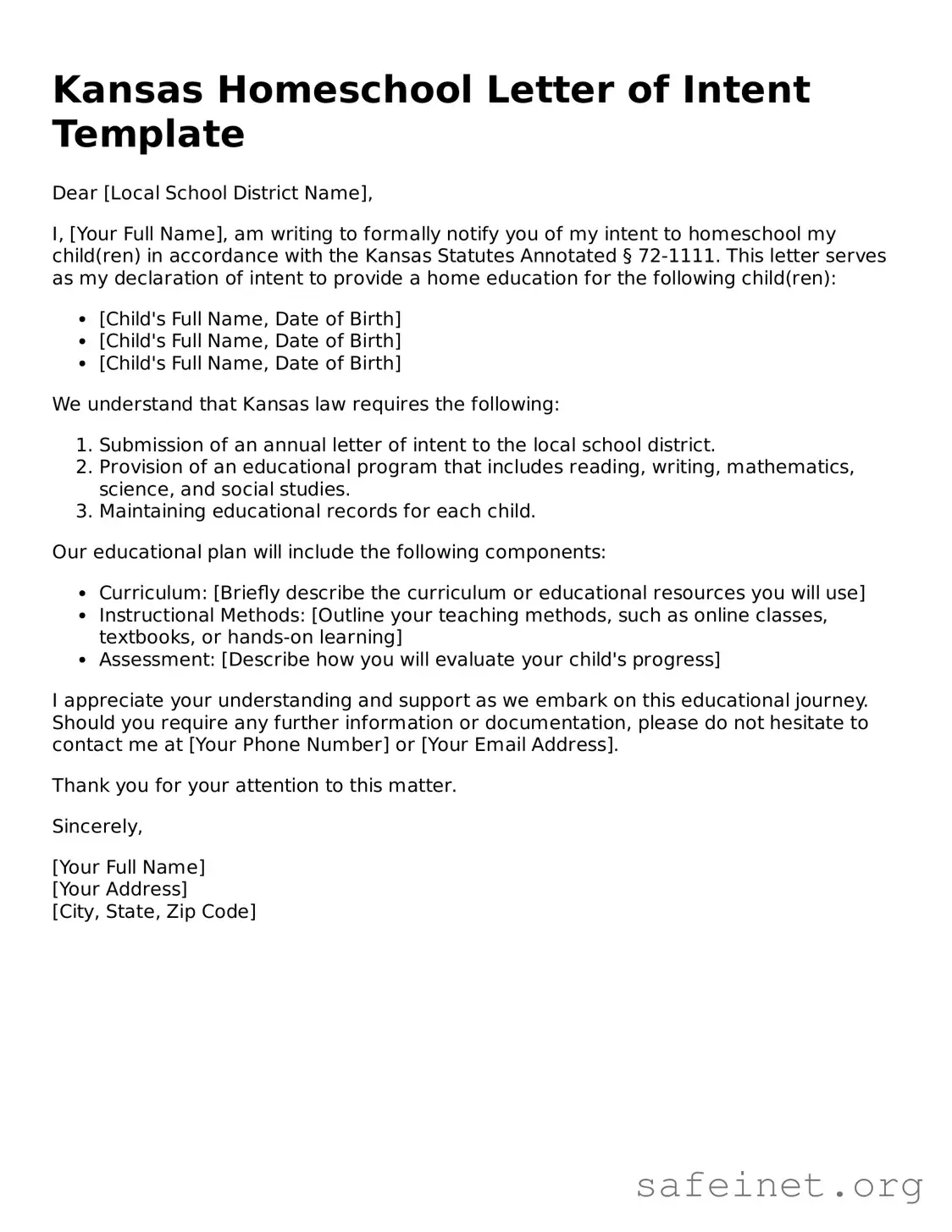
Kansas Homeschool Letter of Intent Template
Dear [Local School District Name],
I, [Your Full Name], am writing to formally notify you of my intent to homeschool my child(ren) in accordance with the Kansas Statutes Annotated § 72-1111. This letter serves as my declaration of intent to provide a home education for the following child(ren):
We understand that Kansas law requires the following:
Our educational plan will include the following components:
I appreciate your understanding and support as we embark on this educational journey. Should you require any further information or documentation, please do not hesitate to contact me at [Your Phone Number] or [Your Email Address].
Thank you for your attention to this matter.
Sincerely,
[Your Full Name]
[Your Address]
[City, State, Zip Code]
| Fact Name | Description |
|---|---|
| Governing Law | The Kansas Homeschool Letter of Intent is governed by K.S.A. 72-977. |
| Purpose | This form notifies the local school district of your intent to homeschool your child. |
| Submission Deadline | The letter must be submitted within 14 days of beginning homeschooling. |
| Required Information | Include the child's name, age, and address in the letter. |
| Format | The letter should be in a written format, either typed or handwritten. |
| Signature | The parent or guardian must sign the letter to validate it. |
| Record Keeping | Keep a copy of the letter for your records after submission. |
| Additional Requirements | Some districts may request additional information or documentation. |
Once you've decided to homeschool your child in Kansas, the next step is to submit a Homeschool Letter of Intent to the local school district. This form is essential for notifying the district of your educational plans. Follow the steps below to ensure you complete the form correctly.
After submitting your Homeschool Letter of Intent, it’s important to stay informed about any additional requirements or regulations your local school district may have. They may provide resources or guidance to help you as you embark on your homeschooling journey.
What is the Kansas Homeschool Letter of Intent form?
The Kansas Homeschool Letter of Intent is a document that parents or guardians must submit to the local school district to formally notify them of their decision to homeschool their children. This letter serves as an official declaration of intent to provide an education outside of the traditional school system. It is an essential first step in the homeschooling process in Kansas.
Who needs to submit the Letter of Intent?
Any parent or guardian who chooses to homeschool their child must submit the Letter of Intent. This requirement applies to children of compulsory school age, which in Kansas is typically between the ages of 7 and 18. If you are starting homeschooling for the first time or if your child is transitioning from a public or private school, you will need to file this letter with your local school district.
When should the Letter of Intent be submitted?
The Letter of Intent should be submitted at the beginning of the school year or as soon as you decide to homeschool your child. It is advisable to send the letter before the school year starts to ensure compliance with state regulations. If you are withdrawing your child from a public or private school, submitting the letter promptly can help avoid any potential truancy issues.
What information is required in the Letter of Intent?
The Letter of Intent must include specific information, such as the name and address of the parent or guardian, the names and ages of the children being homeschooled, and a statement indicating the intent to provide home education. While there is no standard form provided by the state, the letter should be clear and concise, ensuring that all necessary details are included to avoid any misunderstandings with the school district.
Failing to include the parent's name and contact information. This information is essential for communication with the school district.
Not providing the names and ages of all children being homeschooled. Each child's information must be clearly listed.
Leaving out the date of submission. Including the date helps establish the timeline for compliance with state regulations.
Using incorrect or outdated school district information. Verify that the district name and address are accurate before submission.
Not signing the form. A signature is necessary to validate the intent to homeschool.
Submitting the form after the deadline. Be aware of the specific timelines set by the state for submission.
Providing insufficient details about the educational plan. While not mandatory, a brief outline can strengthen the intent.
Neglecting to keep a copy of the submitted form. Retaining a copy is crucial for future reference and proof of compliance.
Overlooking the requirement to update the form if circumstances change. Any significant changes should be communicated to the school district.
Failing to check for spelling and grammatical errors. Errors can create confusion and may delay processing.
When families in Kansas decide to homeschool their children, they typically need to submit a Homeschool Letter of Intent. This form serves as a notification to the local school district of the parents' intention to educate their children at home. However, several other documents and forms may also be beneficial in the homeschooling process. Here are five commonly used documents that often accompany the Kansas Homeschool Letter of Intent.
By preparing these documents alongside the Kansas Homeschool Letter of Intent, families can create a comprehensive framework for their homeschooling journey. This proactive approach not only helps in meeting legal requirements but also enhances the overall educational experience for both parents and children.
The Kansas Homeschool Letter of Intent form is similar to the Notice of Intent to Homeschool form used in many states. Both documents serve as formal notifications to the local education authority that a parent or guardian intends to educate their child at home. They typically require basic information about the student, the educational plan, and the parent’s qualifications, ensuring that the local school district is aware of the homeschooling arrangement.
Another comparable document is the Affidavit of Intent to Homeschool. This document is often used in states that require parents to submit a sworn statement affirming their intention to homeschool. Like the Kansas form, it includes details about the child and the educational approach, but it may also require notarization, adding a layer of legal verification to the intent.
The Home Education Registration form is another document that parallels the Kansas Homeschool Letter of Intent. In some states, this form must be filed to officially register a child for homeschooling. It usually includes similar information about the child and the educational plan, ensuring that the state has a record of the student’s homeschooling status.
The Curriculum Plan Submission is also akin to the Kansas form. While the Letter of Intent primarily states the intention to homeschool, some states require a detailed curriculum plan to be submitted as part of the homeschooling process. This document outlines the subjects to be taught and the educational materials to be used, providing a roadmap for the homeschooling journey.
The Home Schooling Notification form used in various states shares similarities with the Kansas document as well. This form serves as a notification to the school district and often requires parents to provide information about their educational philosophy and the instructional methods they plan to use. It ensures that parents communicate their intentions clearly to local authorities.
The Student Enrollment Form for Homeschooling is another related document. In some jurisdictions, parents must fill out this form to enroll their children in a homeschooling program. It typically requires similar information about the child and the parent’s educational plans, aligning with the purpose of the Kansas Homeschool Letter of Intent.
The Homeschooling Compliance Form is relevant as well. This document is often required to demonstrate that a homeschooling family is meeting state educational standards. It may include information about assessments and educational progress, similar to what is needed in the Kansas form to ensure compliance with local regulations.
The Declaration of Intent to Homeschool form is another document that resembles the Kansas form. This declaration is used in several states to formally announce a parent’s decision to homeschool. It typically includes essential information about the child and may require parents to outline their educational approach, mirroring the structure of the Kansas Letter of Intent.
The Educational Plan for Homeschooling is also comparable. This document outlines the specific educational goals and methods a family plans to use. While the Kansas form states the intent, the Educational Plan goes further by detailing how the education will be delivered, ensuring clarity in educational expectations.
Finally, the Homeschooling Application form can be likened to the Kansas Homeschool Letter of Intent. In states that require an application to start homeschooling, this document collects similar information about the student and the educational approach. It serves as a formal request to begin homeschooling and ensures that the local education authority is informed of the family's plans.
When filling out the Kansas Homeschool Letter of Intent form, it’s essential to follow certain guidelines to ensure a smooth process. Here’s a list of things you should and shouldn’t do:
By following these guidelines, you can help ensure that your homeschooling journey starts off on the right foot.
Many families considering homeschooling in Kansas may encounter various misconceptions regarding the Kansas Homeschool Letter of Intent form. Understanding these misunderstandings can help ensure a smoother transition into homeschooling. Here are eight common misconceptions:
By clearing up these misconceptions, families can approach homeschooling in Kansas with confidence and clarity. Understanding the legal requirements and freedoms can enhance the homeschooling experience for both parents and children.
Filling out and using the Kansas Homeschool Letter of Intent form is an important step for families choosing to homeschool their children. Here are some key takeaways to consider: