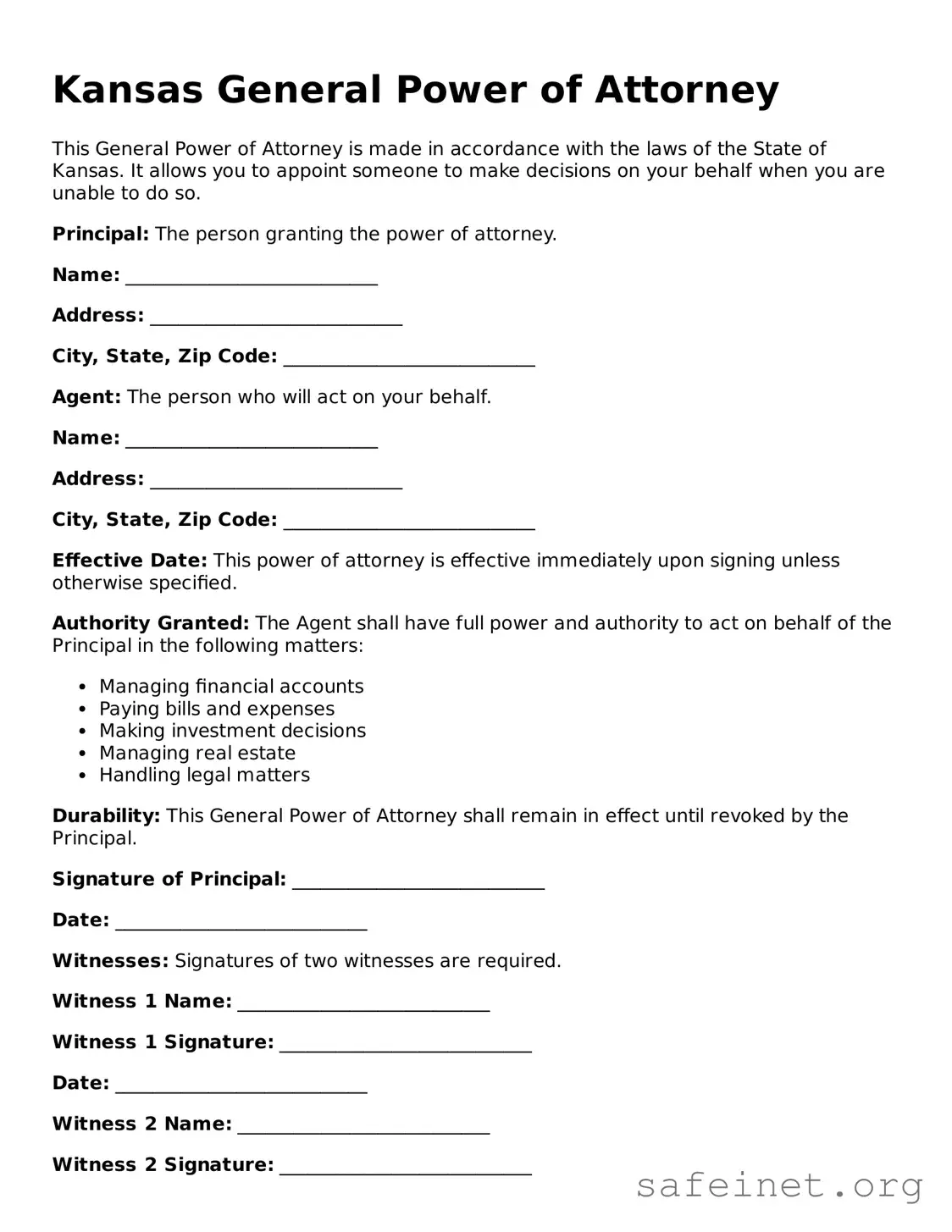
The Kansas General Power of Attorney form is a crucial legal document that allows individuals to appoint someone they trust to make decisions on their behalf. This form grants broad authority to the designated agent, enabling them to handle various financial, legal, and personal matters. It is essential for anyone seeking to ensure their affairs are managed according to their wishes in the event of incapacitation or absence. The document outlines the specific powers granted, which can include managing bank accounts, signing contracts, and making healthcare decisions. Importantly, the powers can be tailored to meet individual needs, offering flexibility in how authority is delegated. Additionally, the form must be signed and notarized to be valid, ensuring that the process is secure and legally binding. Understanding the implications of this form is vital for anyone considering its use, as it can significantly impact one’s financial and personal well-being.
Kansas General Power of Attorney
This General Power of Attorney is made in accordance with the laws of the State of Kansas. It allows you to appoint someone to make decisions on your behalf when you are unable to do so.
Principal: The person granting the power of attorney.
Name: ___________________________
Address: ___________________________
City, State, Zip Code: ___________________________
Agent: The person who will act on your behalf.
Name: ___________________________
Address: ___________________________
City, State, Zip Code: ___________________________
Effective Date: This power of attorney is effective immediately upon signing unless otherwise specified.
Authority Granted: The Agent shall have full power and authority to act on behalf of the Principal in the following matters:
Durability: This General Power of Attorney shall remain in effect until revoked by the Principal.
Signature of Principal: ___________________________
Date: ___________________________
Witnesses: Signatures of two witnesses are required.
Witness 1 Name: ___________________________
Witness 1 Signature: ___________________________
Date: ___________________________
Witness 2 Name: ___________________________
Witness 2 Signature: ___________________________
Date: ___________________________
This document must be signed in the presence of a notary public to be valid.
Notary Public:
Name: ___________________________
Signature: ___________________________
Date: ___________________________
My Commission Expires: ___________________________
| Fact Name | Description |
|---|---|
| Definition | A Kansas General Power of Attorney form allows an individual to appoint someone to manage their financial and legal affairs. |
| Governing Law | The form is governed by the Kansas Statutes Annotated, specifically K.S.A. 58-6501 et seq. |
| Durability | This power of attorney can be durable, meaning it remains effective even if the principal becomes incapacitated. |
| Agent's Authority | The agent can perform a variety of tasks, including managing bank accounts, paying bills, and handling real estate transactions. |
| Revocation | The principal can revoke the power of attorney at any time, as long as they are mentally competent. |
| Witness and Notary Requirements | The form must be signed in the presence of a notary public and may require one or two witnesses, depending on the specific circumstances. |
Filling out the Kansas General Power of Attorney form is an important step in designating someone to manage your financial and legal affairs. After completing the form, you will need to sign it in front of a notary public. This ensures that the document is legally binding and recognized by institutions.
What is a Kansas General Power of Attorney?
A Kansas General Power of Attorney is a legal document that allows an individual, known as the principal, to appoint someone else, called an agent or attorney-in-fact, to make decisions on their behalf. This can include financial matters, legal decisions, and other personal affairs. The document grants broad authority to the agent, which is why it's important to choose someone trustworthy.
What powers does a General Power of Attorney grant?
The powers granted can vary depending on the specific language used in the document. Typically, a General Power of Attorney allows the agent to handle financial transactions, manage real estate, pay bills, and make investment decisions. However, it does not allow the agent to make healthcare decisions unless specified in a separate healthcare power of attorney.
Does a General Power of Attorney need to be notarized in Kansas?
Yes, in Kansas, a General Power of Attorney must be signed in the presence of a notary public to be considered valid. This helps ensure that the document is legally binding and that the principal is signing it voluntarily and with a clear understanding of its implications.
Can I revoke a General Power of Attorney in Kansas?
Absolutely. The principal can revoke a General Power of Attorney at any time as long as they are mentally competent. This can be done by creating a written revocation document or by destroying the original power of attorney document. It is important to notify the agent and any institutions that may have relied on the original document.
What happens if the principal becomes incapacitated?
In Kansas, a General Power of Attorney typically becomes ineffective if the principal becomes incapacitated, unless it is specified as a durable power of attorney. A durable power of attorney remains in effect even if the principal can no longer make decisions for themselves, allowing the agent to continue acting on their behalf.
Can I limit the powers granted in a General Power of Attorney?
Yes, the principal can specify limitations within the General Power of Attorney document. For example, they may restrict the agent's authority to certain transactions or types of decisions. Clearly outlining these limitations helps protect the principal’s interests and ensures the agent understands their boundaries.
Is a General Power of Attorney effective immediately?
A General Power of Attorney can be effective immediately upon signing, or it can be set to activate at a future date or upon the occurrence of a specific event, such as the principal’s incapacity. This flexibility allows the principal to tailor the document to their needs.
Do I need a lawyer to create a General Power of Attorney in Kansas?
While it is not legally required to have a lawyer draft a General Power of Attorney, it is highly recommended. A lawyer can provide guidance on the best practices, ensure that the document complies with Kansas laws, and help avoid potential pitfalls that could arise from improperly executed documents.
Not specifying the powers granted: Many individuals fail to clearly outline the specific powers they wish to grant. This can lead to confusion and limit the effectiveness of the document.
Neglecting to date the form: A common oversight is not including a date on the Power of Attorney form. Without a date, it may be difficult to determine when the authority begins or if it is still valid.
Not signing the document: It may seem obvious, but some forget to sign the form altogether. A signature is essential for the document to be legally binding.
Forgetting to have witnesses: Kansas requires that the General Power of Attorney be signed in the presence of a witness. Failing to have one can invalidate the document.
Ignoring notarization requirements: While not always necessary, notarizing the document can provide an extra layer of protection and validation. Skipping this step might complicate matters later.
Using outdated forms: Laws can change, and using an outdated version of the Power of Attorney form may lead to issues. Always ensure you have the most current version.
Not discussing the document with the agent: It’s crucial to have a conversation with the person you are designating as your agent. They should understand their responsibilities and your wishes.
Overlooking revocation of previous powers: If you have previously granted a Power of Attorney, be sure to revoke it in writing. Failing to do so can lead to conflicts.
Failing to keep copies: After completing the form, it’s important to keep copies for your records and provide copies to your agent and any relevant institutions.
Not considering future changes: Life circumstances change, and the powers granted may need to be adjusted. Regularly reviewing and updating the document is essential.
The Kansas General Power of Attorney form is a crucial document that allows an individual to designate another person to act on their behalf in various matters. However, this form is often used in conjunction with other legal documents that can enhance its effectiveness or address specific needs. Below is a list of related forms and documents commonly associated with the Kansas General Power of Attorney.
These documents serve various purposes and can provide a comprehensive approach to managing personal and financial affairs. Understanding their functions can help individuals make informed decisions about their legal and health care options.
The Kansas General Power of Attorney form shares similarities with the Durable Power of Attorney. Both documents allow an individual, known as the principal, to appoint someone else, called the agent, to manage their affairs. The key difference lies in durability; a Durable Power of Attorney remains effective even if the principal becomes incapacitated, whereas a standard General Power of Attorney may become void under such circumstances. This makes the Durable Power of Attorney particularly useful for long-term planning.
Another document that resembles the Kansas General Power of Attorney is the Medical Power of Attorney. This form specifically grants an agent the authority to make healthcare decisions on behalf of the principal. While the General Power of Attorney can cover a broad range of financial and legal matters, the Medical Power of Attorney focuses solely on health-related issues. This distinction is crucial for individuals who want to ensure their healthcare preferences are honored in case they are unable to communicate them.
The Living Will is another document that has similarities to the Kansas General Power of Attorney. While the General Power of Attorney allows an agent to make decisions on behalf of the principal, a Living Will specifically outlines the principal's wishes regarding medical treatment in end-of-life situations. It serves as a guide for healthcare providers and family members, ensuring that the principal's preferences are respected when they cannot speak for themselves.
The Revocable Trust also shares some characteristics with the Kansas General Power of Attorney. Both documents allow for the management of assets, but they do so in different ways. A Revocable Trust enables the principal to place their assets into a trust, which can be managed by a trustee. This can help avoid probate and provide for smoother asset distribution after the principal's death. In contrast, the General Power of Attorney grants an agent authority to manage the principal's affairs during their lifetime.
The Financial Power of Attorney is closely related to the Kansas General Power of Attorney as well. Both documents allow an agent to handle financial matters on behalf of the principal. However, the Financial Power of Attorney is often more focused, specifically targeting financial transactions such as managing bank accounts, paying bills, and filing taxes. This specificity can be beneficial for individuals who want to limit the scope of authority granted to their agent.
Lastly, the Springing Power of Attorney is similar to the Kansas General Power of Attorney in that it allows for the appointment of an agent. However, the Springing Power of Attorney only becomes effective under certain conditions, typically when the principal becomes incapacitated. This can provide peace of mind for individuals who want to maintain control over their affairs until they are no longer able to do so. The General Power of Attorney, in contrast, is effective immediately upon signing.
When filling out the Kansas General Power of Attorney form, it is important to follow certain guidelines to ensure that the document is valid and effective. Below is a list of things you should and shouldn't do.
The Kansas General Power of Attorney (GPOA) form is a valuable legal document that allows individuals to appoint someone else to manage their financial and legal affairs. However, several misconceptions surround this form. Here are eight common misunderstandings:
Understanding these misconceptions can help individuals make informed decisions about their legal and financial planning. A well-prepared General Power of Attorney can provide peace of mind and ensure that one's affairs are managed according to their wishes.
When considering the Kansas General Power of Attorney form, it is essential to understand its purpose and the implications of its use. Below are key takeaways to keep in mind: