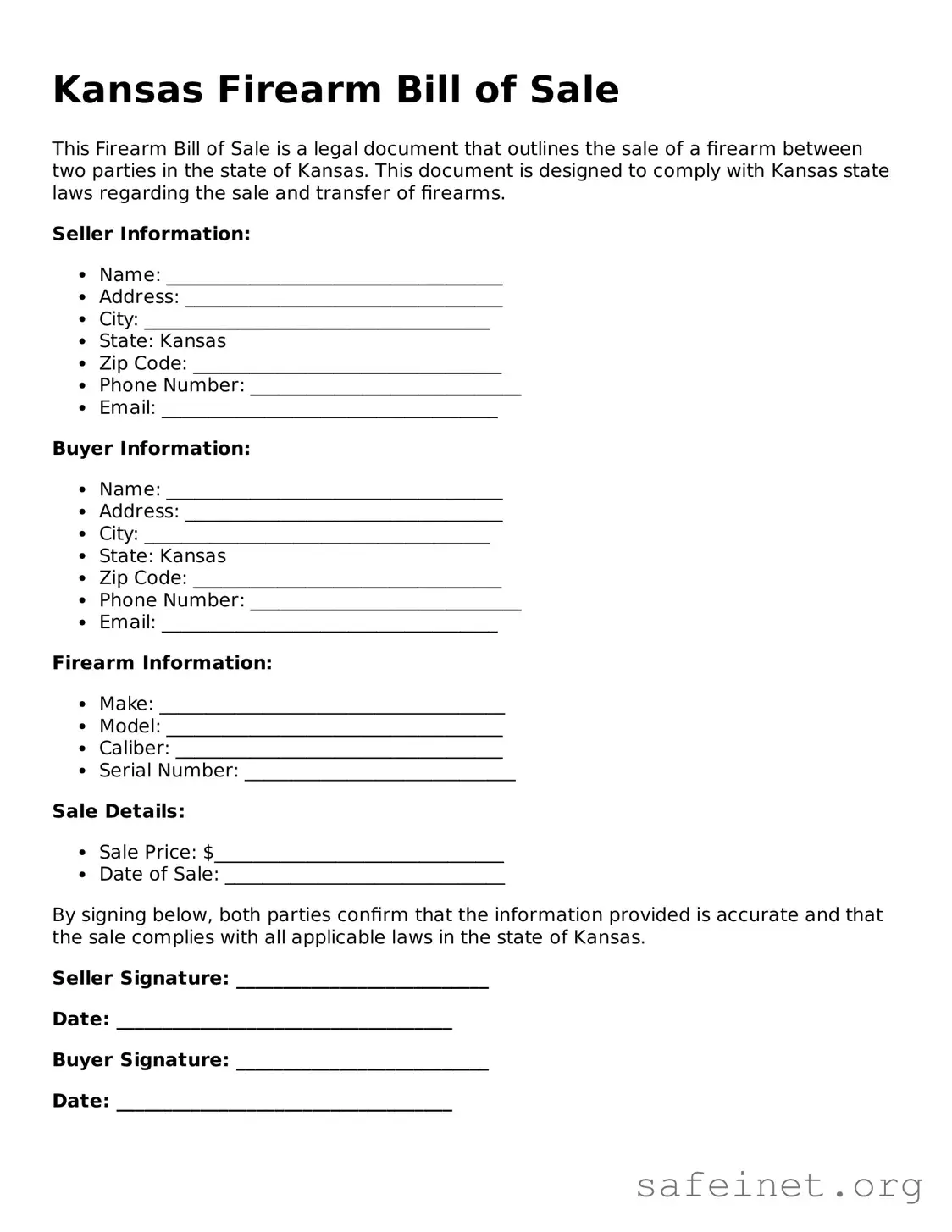
The Kansas Firearm Bill of Sale form serves as an important document for individuals engaged in the private sale or transfer of firearms within the state. This form outlines key details such as the names and addresses of both the seller and the buyer, ensuring that both parties are clearly identified in the transaction. Additionally, it includes essential information about the firearm being sold, such as its make, model, caliber, and serial number, which helps in maintaining accurate records. The form also addresses the legal obligations of both parties, affirming that the seller has the right to sell the firearm and that the buyer is legally eligible to purchase it. This document not only protects the interests of both the buyer and seller but also serves as a safeguard against potential legal issues that may arise from the transfer of ownership. By completing this form, individuals can ensure that their transaction complies with state laws and regulations, promoting responsible firearm ownership and sales practices.
Kansas Firearm Bill of Sale
This Firearm Bill of Sale is a legal document that outlines the sale of a firearm between two parties in the state of Kansas. This document is designed to comply with Kansas state laws regarding the sale and transfer of firearms.
Seller Information:
Buyer Information:
Firearm Information:
Sale Details:
By signing below, both parties confirm that the information provided is accurate and that the sale complies with all applicable laws in the state of Kansas.
Seller Signature: ___________________________
Date: ____________________________________
Buyer Signature: ___________________________
Date: ____________________________________
| Fact Name | Details |
|---|---|
| Purpose | The Kansas Firearm Bill of Sale form is used to document the sale or transfer of a firearm between parties. |
| Legal Requirement | While there is no state law requiring a bill of sale for private firearm sales in Kansas, it is recommended for record-keeping purposes. |
| Governing Law | The relevant laws governing firearm sales in Kansas can be found in K.S.A. 75-7c01 et seq. |
| Information Included | The form typically includes details such as the buyer's and seller's names, addresses, and firearm specifics like make, model, and serial number. |
| Signature Requirement | Both parties are encouraged to sign the form to acknowledge the transaction, although this is not legally required. |
| Record Keeping | It is advisable for both the buyer and seller to keep a copy of the completed bill of sale for their records. |
Once you have the Kansas Firearm Bill of Sale form ready, you will need to complete it accurately to ensure that all necessary information is provided. This form serves as a record of the sale and transfer of ownership of a firearm. Follow the steps below to fill out the form correctly.
What is a Kansas Firearm Bill of Sale?
A Kansas Firearm Bill of Sale is a document that records the transfer of ownership of a firearm from one individual to another. This form serves as proof of the transaction, detailing essential information about the firearm, the buyer, and the seller. It can be particularly important for both parties to have a written record to protect their interests and comply with state laws regarding firearm sales.
Do I need to use a specific form for the Bill of Sale?
While there is no mandated state form for a Kansas Firearm Bill of Sale, it is crucial that the document includes specific details. These details should encompass the names and addresses of both the buyer and seller, a description of the firearm (including make, model, and serial number), and the date of the transaction. Using a clear and comprehensive format helps ensure that all necessary information is documented properly.
Is a Bill of Sale required for private firearm sales in Kansas?
In Kansas, a Bill of Sale is not legally required for private firearm transactions. However, it is highly recommended. Having a Bill of Sale can provide legal protection for both the buyer and seller, especially if any disputes arise in the future. It serves as a record that the firearm was sold and can help establish the legitimacy of ownership.
Can I sell a firearm to someone from another state using a Bill of Sale?
Yes, you can sell a firearm to someone from another state, but it must be done in compliance with federal and state laws. The buyer must be eligible to own a firearm in their state of residence. Additionally, federal law requires that certain firearms be transferred through a licensed dealer. A Bill of Sale can still be used in this situation, but both parties should be aware of the laws governing interstate firearm sales.
What information should I include in the Bill of Sale?
When preparing a Bill of Sale, include the following information: the full names and addresses of both the buyer and seller, a detailed description of the firearm (including make, model, caliber, and serial number), the sale price, and the date of the transaction. Both parties should sign the document, and it may be helpful to have a witness present during the signing to further validate the transaction.
What if the firearm has a defect or issue?
If the firearm has any defects or issues, it is essential to disclose this information to the buyer before the sale is finalized. Transparency helps prevent misunderstandings and potential legal issues down the line. It is advisable to note any known defects in the Bill of Sale to ensure that both parties are aware of the condition of the firearm at the time of sale.
Not providing complete information about the buyer and seller. Both parties should include their full names, addresses, and contact details.
Failing to include the correct firearm details. Make sure to specify the make, model, caliber, and serial number of the firearm being sold.
Leaving out the date of the transaction. It is important to record the date when the sale takes place.
Not signing the form. Both the buyer and seller must sign the document to make it valid.
Using outdated forms. Always check for the latest version of the Kansas Firearm Bill of Sale form to ensure compliance.
Not providing a witness signature if required. Some transactions may need a witness to sign the form.
Neglecting to make copies of the completed form. Keeping a copy for both the buyer and seller is a good practice.
Overlooking local laws and regulations. Be aware of any specific requirements in your area regarding firearm sales.
Assuming the form is unnecessary. Always use a Bill of Sale for firearm transactions to protect both parties.
When completing a firearm transaction in Kansas, having the right documents is essential for a smooth process. Along with the Kansas Firearm Bill of Sale form, several other forms and documents may be beneficial. Below is a list of commonly used documents that can help facilitate the sale or transfer of firearms.
Having these documents prepared can enhance the transparency and legality of your firearm transaction. Always ensure that all parties involved understand and agree to the terms outlined in each document to foster a smooth and responsible exchange.
The Kansas Firearm Bill of Sale form is similar to a standard Bill of Sale used for various personal property transactions. Both documents serve as proof of transfer of ownership from one party to another. They typically include details such as the names of the buyer and seller, a description of the item being sold, and the date of the transaction. This ensures that both parties have a clear record of the exchange, which can be useful for future reference or legal purposes.
Another document that shares similarities is the Vehicle Bill of Sale. Like the Firearm Bill of Sale, it provides a written record of the sale of a vehicle, detailing the buyer, seller, and vehicle information. Both documents are important for establishing ownership and may be required for registration or titling purposes. They help protect both parties by documenting the transaction and can serve as evidence in case of disputes.
The Lease Agreement is also comparable in that it outlines the terms of a rental arrangement between a landlord and tenant. While it deals with property rather than a sale, it similarly specifies the parties involved, the item in question (property), and the conditions of the agreement. Both documents protect the interests of the parties by clearly stating their rights and responsibilities.
The Promissory Note is another related document, as it involves a promise to pay a specified amount of money. While it does not involve the transfer of physical property, it does require clear identification of the parties and the terms of the agreement. Both the Promissory Note and the Firearm Bill of Sale establish a legal framework for a transaction, ensuring clarity and accountability.
The Gift Receipt serves a similar purpose when property is transferred without a sale. It provides evidence that a gift was given, including details about the item and the parties involved. While the Firearm Bill of Sale indicates a transaction, both documents highlight the importance of documenting the transfer of ownership to avoid potential misunderstandings.
A Purchase Agreement is akin to the Firearm Bill of Sale as it outlines the terms of a sale before the transaction occurs. This document details the responsibilities of both the buyer and seller, including payment terms and delivery details. Both documents are essential for ensuring that all parties understand the terms of the sale, which helps prevent disputes later on.
In the realm of real estate, a Property Transfer Deed is similar in that it formally documents the transfer of property ownership. It includes the names of the parties, a description of the property, and must be signed for it to be valid. Like the Firearm Bill of Sale, this document is crucial for establishing legal ownership and can be used to resolve any future claims regarding the property.
The Warranty Deed shares characteristics with the Firearm Bill of Sale by ensuring that the seller guarantees clear title to the property being transferred. This document provides assurance to the buyer that they are receiving legitimate ownership rights. Both documents serve to protect the interests of the parties involved and establish a clear record of the transaction.
Lastly, a Service Agreement can be compared to the Firearm Bill of Sale in that it outlines the terms under which services will be provided. While it does not involve the sale of goods, it still requires clarity regarding the parties involved and the terms of the agreement. Both documents emphasize the importance of having a written record to protect the rights of those involved.
When filling out the Kansas Firearm Bill of Sale form, it’s important to follow certain guidelines to ensure everything is done correctly. Here’s a helpful list of things you should and shouldn’t do:
By following these guidelines, you can help ensure a smooth transaction and protect both parties involved.
Here are seven common misconceptions about the Kansas Firearm Bill of Sale form, along with explanations to clarify each point:
Many people believe that a Bill of Sale is optional for firearm transactions. However, having a Bill of Sale provides legal documentation of the sale, which can be important for both the buyer and the seller.
Some individuals think that every firearm sale must involve a background check. In Kansas, private sales between individuals do not require a background check, although it is recommended for safety.
There is a misconception that the Bill of Sale needs to be notarized to be valid. While notarization can add an extra layer of authenticity, it is not a legal requirement in Kansas.
Some believe that only licensed firearm dealers can issue a Bill of Sale. In reality, any individual can create and use a Bill of Sale for their private transactions.
People often think they must file the Bill of Sale with a state agency. However, in Kansas, the Bill of Sale is a private document and does not need to be submitted to any government entity.
There is a belief that the information contained in a Bill of Sale is public. In fact, the details of the transaction remain private and are not accessible to the public.
Some individuals think that any generic Bill of Sale will suffice for firearms. It's important to use a Bill of Sale that specifically addresses firearms to ensure all necessary details are included.
When filling out and using the Kansas Firearm Bill of Sale form, there are several important points to consider. Here are four key takeaways: