The Kansas Durable Power of Attorney form is an essential legal document that allows individuals to designate someone they trust to make decisions on their behalf, particularly in matters related to financial and healthcare choices. This form becomes especially important in situations where a person is unable to make decisions due to illness, injury, or other incapacitating circumstances. By completing this document, the principal—the person granting the authority—can ensure that their wishes are respected and that their affairs are managed according to their preferences. The form typically includes specific powers granted to the agent, who is the individual appointed to act on the principal's behalf. This can encompass a wide range of responsibilities, from managing bank accounts and investments to making medical decisions when the principal is unable to communicate. Importantly, the Kansas Durable Power of Attorney remains effective even if the principal becomes incapacitated, distinguishing it from other types of powers of attorney that may become void under such circumstances. Understanding the nuances of this form is crucial for anyone looking to safeguard their interests and ensure that their personal and financial matters are handled effectively during challenging times.
Kansas Durable Power of Attorney
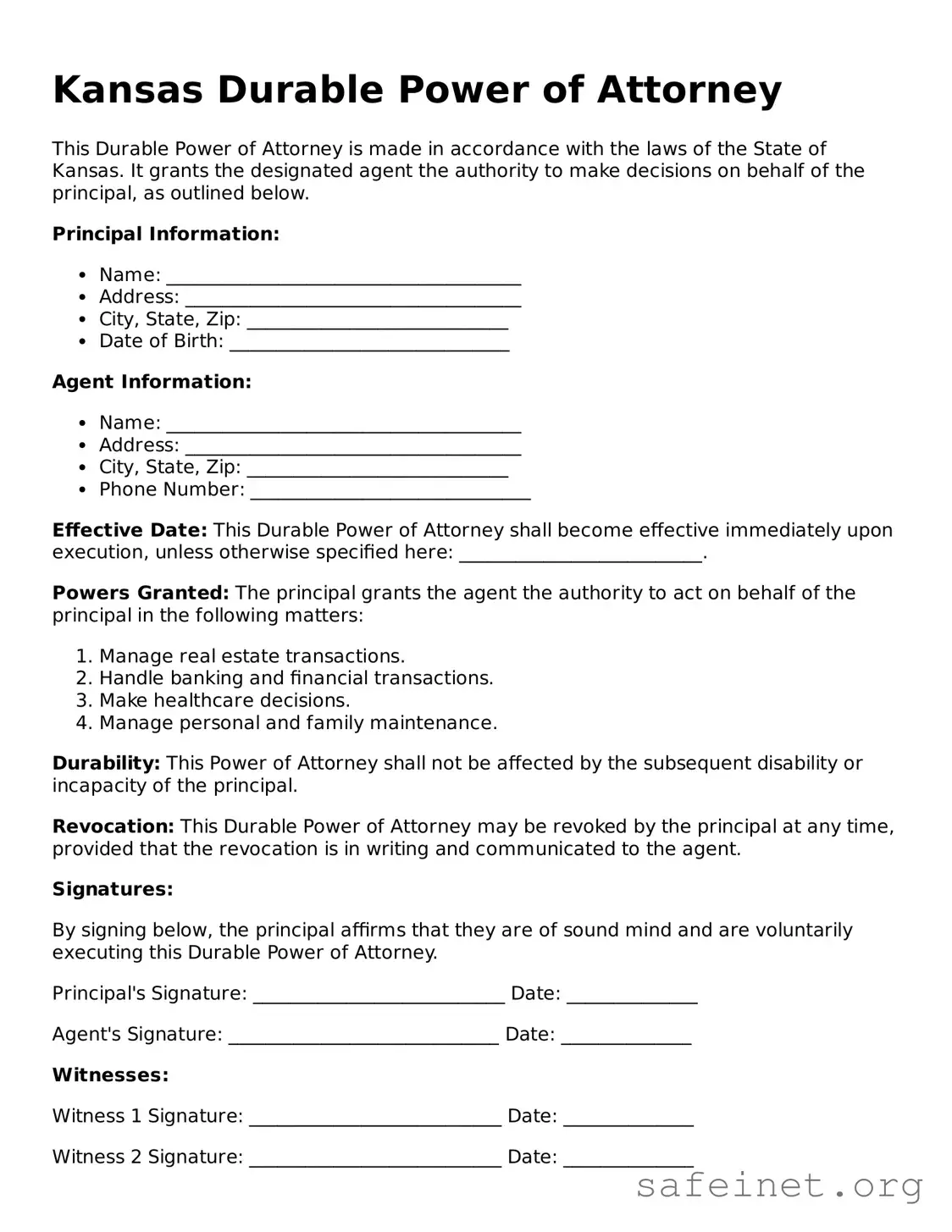
This Durable Power of Attorney is made in accordance with the laws of the State of Kansas. It grants the designated agent the authority to make decisions on behalf of the principal, as outlined below.
Principal Information:
Agent Information:
Effective Date: This Durable Power of Attorney shall become effective immediately upon execution, unless otherwise specified here: __________________________.
Powers Granted: The principal grants the agent the authority to act on behalf of the principal in the following matters:
Durability: This Power of Attorney shall not be affected by the subsequent disability or incapacity of the principal.
Revocation: This Durable Power of Attorney may be revoked by the principal at any time, provided that the revocation is in writing and communicated to the agent.
Signatures:
By signing below, the principal affirms that they are of sound mind and are voluntarily executing this Durable Power of Attorney.
Principal's Signature: ___________________________ Date: ______________
Agent's Signature: _____________________________ Date: ______________
Witnesses:
Witness 1 Signature: ___________________________ Date: ______________
Witness 2 Signature: ___________________________ Date: ______________
Notarization:
State of Kansas
County of ___________________________
Subscribed and sworn to before me this _____ day of ______________, 20____.
Notary Public Signature: ______________________
My Commission Expires: ______________________
| Fact Name | Description |
|---|---|
| Definition | A Kansas Durable Power of Attorney allows an individual to appoint someone else to manage their financial affairs in case they become incapacitated. |
| Governing Law | This document is governed by the Kansas Statutes Annotated, specifically K.S.A. 58-650 et seq. |
| Durability | The power of attorney remains effective even if the principal becomes incapacitated, which distinguishes it from a regular power of attorney. |
| Principal | The person who creates the Durable Power of Attorney is referred to as the principal. |
| Agent | The individual appointed to act on behalf of the principal is known as the agent or attorney-in-fact. |
| Limitations | The principal can specify limitations on the powers granted to the agent within the document. |
| Revocation | The principal retains the right to revoke the Durable Power of Attorney at any time as long as they are mentally competent. |
| Witnesses and Notarization | The form must be signed in the presence of two witnesses or a notary public to be considered valid. |
Filling out the Kansas Durable Power of Attorney form is an important task that requires careful attention to detail. Once completed, this document will allow you to designate someone to make decisions on your behalf when you are unable to do so.
What is a Kansas Durable Power of Attorney?
A Kansas Durable Power of Attorney is a legal document that allows you to appoint someone to make decisions on your behalf if you become unable to do so. This authority can cover financial matters, healthcare decisions, or both, depending on how the document is drafted.
Why should I create a Durable Power of Attorney?
Creating a Durable Power of Attorney ensures that your affairs are managed according to your wishes if you become incapacitated. It provides peace of mind, knowing that someone you trust will handle your financial and medical decisions when you cannot.
Who can be appointed as my agent?
You can appoint any competent adult as your agent. This could be a family member, friend, or professional advisor. It’s essential to choose someone who understands your values and is willing to act in your best interest.
How do I create a Durable Power of Attorney in Kansas?
To create a Durable Power of Attorney in Kansas, you must complete the appropriate form, which can often be found online or through legal offices. You must sign the document in front of a notary public to ensure its validity. It’s advisable to discuss your intentions with your chosen agent before finalizing the document.
Can I revoke my Durable Power of Attorney?
Yes, you can revoke your Durable Power of Attorney at any time as long as you are mentally competent. To do so, you should create a written revocation and inform your agent and any relevant institutions where the original document was presented.
What happens if I do not have a Durable Power of Attorney?
If you do not have a Durable Power of Attorney and become incapacitated, a court may appoint a guardian or conservator to manage your affairs. This process can be time-consuming and may not align with your preferences.
Does a Durable Power of Attorney expire?
A Durable Power of Attorney remains in effect until you revoke it, become competent again, or pass away. Unlike a regular Power of Attorney, a Durable Power of Attorney is designed to remain valid even if you become incapacitated.
Can I limit the powers granted to my agent?
Yes, you can specify the powers you want to grant to your agent in the Durable Power of Attorney. You can limit their authority to specific tasks or decisions, ensuring that your agent acts within the boundaries you set.
Not Choosing the Right Agent: Selecting an agent who is not trustworthy or lacks the necessary skills can lead to complications. It’s crucial to choose someone who understands your wishes and can act in your best interest.
Failing to Specify Powers: Some people leave the powers vague or too broad. Clearly outlining what decisions your agent can make ensures they act within your intentions and limits any potential misuse.
Not Signing the Document Properly: A common mistake is neglecting to sign the form correctly. Ensure that your signature is present, and if required, have it notarized to validate the document.
Ignoring State-Specific Requirements: Each state has its own rules regarding Durable Power of Attorney forms. Failing to follow Kansas-specific requirements can render the document invalid.
Overlooking Alternate Agents: Life is unpredictable. If your primary agent cannot serve, it’s wise to name alternate agents. This prevents delays in decision-making when it matters most.
Not Reviewing Regularly: Circumstances change. Failing to review and update your Durable Power of Attorney can lead to outdated information or a misalignment with your current wishes.
Assuming It’s Only for Financial Matters: Many think Durable Power of Attorney is limited to financial decisions. However, it can also cover health care decisions. Be sure to specify what powers you wish to grant.
A Kansas Durable Power of Attorney is a vital document that allows individuals to designate someone to make decisions on their behalf, particularly in financial or medical matters. However, it is often used in conjunction with other important documents that can further clarify and support an individual’s wishes. Below is a list of five commonly associated forms and documents.
Incorporating these documents into estate planning can significantly enhance clarity and ensure that an individual’s wishes are honored. Each document serves a unique purpose and collectively, they provide a comprehensive framework for decision-making and asset management.
The Kansas Durable Power of Attorney (DPOA) form shares similarities with the General Power of Attorney. Both documents allow one person to appoint another to manage their financial and legal affairs. The key difference lies in the durability aspect; while a General Power of Attorney may become invalid if the principal becomes incapacitated, a Durable Power of Attorney remains effective even in such situations, ensuring that the designated agent can continue to act on behalf of the principal.
A Medical Power of Attorney is another document that resembles the DPOA. This form specifically grants an agent the authority to make healthcare decisions for the principal if they are unable to do so themselves. Like the DPOA, it is designed to ensure that the principal's wishes are honored, but it focuses solely on medical and health-related decisions rather than financial matters.
The Living Will is similar to the Kansas Durable Power of Attorney in that it addresses the principal's wishes regarding medical treatment. While the DPOA allows an agent to make decisions, a Living Will outlines specific preferences for end-of-life care. Both documents work together to provide comprehensive guidance on a person's healthcare choices.
The Revocable Trust can also be compared to the DPOA. Both documents allow for the management of assets, but a Revocable Trust is a legal entity that holds assets during the principal's lifetime and can be modified or revoked. In contrast, a Durable Power of Attorney appoints an agent to manage the principal's affairs directly, providing flexibility and control over financial decisions.
The Advance Directive is another document that shares similarities with the Kansas Durable Power of Attorney. An Advance Directive encompasses both a Living Will and a Medical Power of Attorney, allowing individuals to outline their healthcare preferences and appoint an agent for medical decisions. This document ensures that a person's healthcare wishes are respected, similar to how a DPOA secures their financial interests.
A Financial Power of Attorney is closely related to the DPOA, as both grant authority to an agent to handle financial matters. However, a Financial Power of Attorney may not necessarily be durable, meaning it could become ineffective if the principal becomes incapacitated. The DPOA specifically addresses this concern by remaining in effect during such circumstances.
The Healthcare Proxy is similar to the Medical Power of Attorney, as it designates someone to make healthcare decisions on behalf of the principal. Both documents aim to ensure that medical choices align with the principal's values and preferences. The distinction often lies in the terminology used and the specific legal requirements in different states.
Lastly, the Guardianship document has some parallels with the DPOA, particularly in situations where an individual becomes incapacitated. A Guardianship appoints a person to make decisions for someone who cannot make them independently. While a DPOA is created by the principal to designate an agent, a Guardianship is typically established through a court process, reflecting a more formal intervention in the individual's affairs.
When filling out the Kansas Durable Power of Attorney form, it is important to approach the task with care. The following list outlines key actions to take and avoid during this process.
By adhering to these guidelines, individuals can help ensure that their Durable Power of Attorney form is completed correctly and effectively. This document serves an important role in managing one's affairs and should be treated with the necessary attention and respect.
Understanding the Kansas Durable Power of Attorney form is crucial for effective planning. However, several misconceptions can lead to confusion. Here are five common misunderstandings:
This is not true. While many use it for financial decisions, a Durable Power of Attorney can also cover health care decisions.
This is incorrect. Any competent adult can serve as an agent, including family members or trusted friends.
This is a common belief, but a Durable Power of Attorney can be effective immediately if specified by the principal.
This is false. The principal can revoke the document at any time as long as they are competent.
This is misleading. Each state, including Kansas, has its own requirements and formats for Durable Power of Attorney forms.
Addressing these misconceptions can help ensure that individuals make informed decisions regarding their Durable Power of Attorney in Kansas.
Filling out and using a Kansas Durable Power of Attorney (DPOA) form is an important step in planning for the future. Here are seven key takeaways to consider:
Understanding these key points can help you make informed decisions about your Durable Power of Attorney in Kansas.