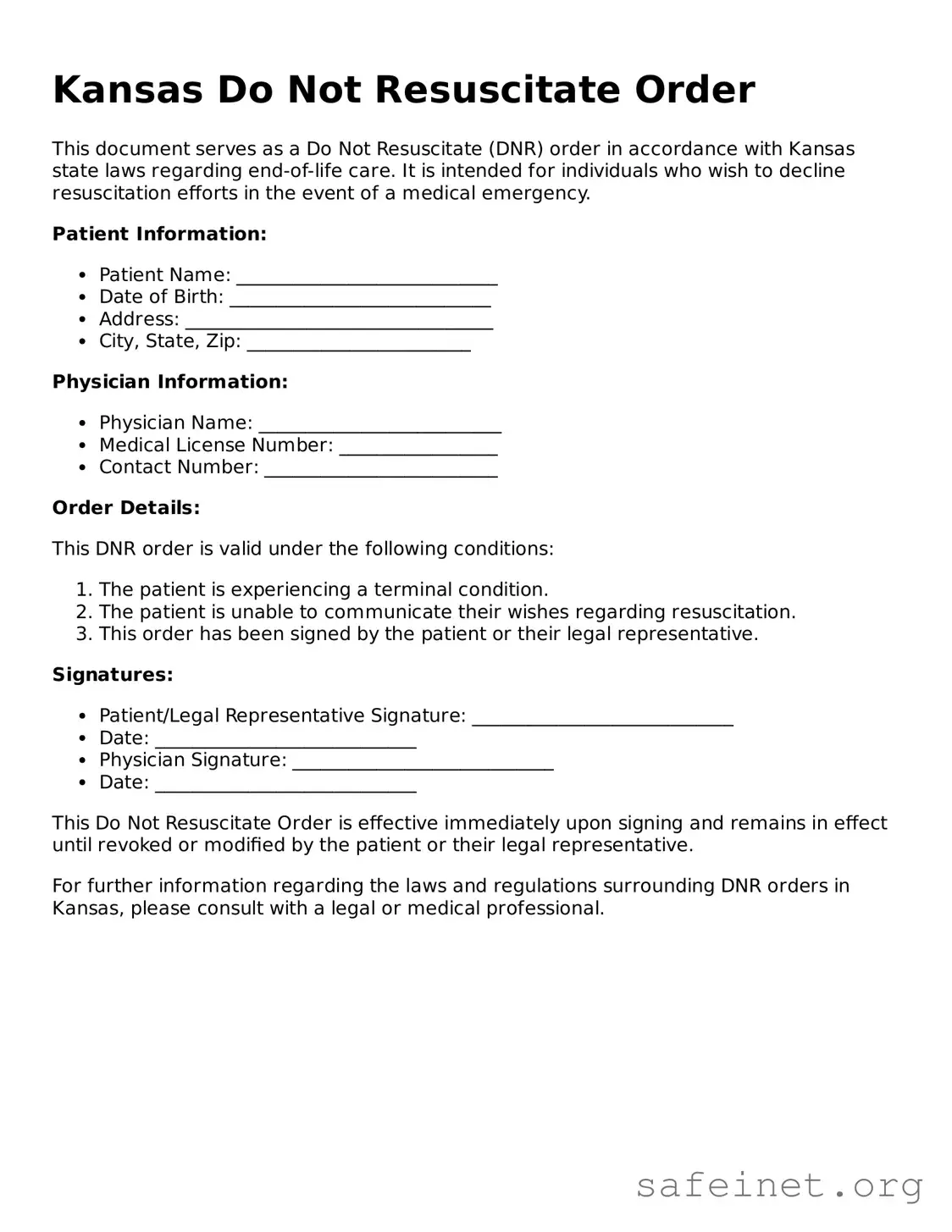
The Kansas Do Not Resuscitate Order (DNR) form serves as a critical document for individuals who wish to make their preferences known regarding resuscitation efforts in the event of a medical emergency. This form is particularly important for patients with terminal illnesses or those who have a clear understanding of their healthcare goals. It allows individuals to specify that they do not want cardiopulmonary resuscitation (CPR) or other life-saving measures to be performed if their heart stops beating or if they stop breathing. The form must be signed by a physician, ensuring that the decision is made in consultation with a qualified medical professional. In addition to the physician's signature, the form requires the patient's signature or the signature of a legal representative, affirming that the patient has the capacity to make such a decision. It is also essential for the DNR order to be readily available to emergency medical personnel and healthcare providers, as this ensures that the patient’s wishes are respected in urgent situations. Understanding the implications of the Kansas DNR form can empower individuals to take control of their healthcare decisions, providing peace of mind for both patients and their families.
Kansas Do Not Resuscitate Order
This document serves as a Do Not Resuscitate (DNR) order in accordance with Kansas state laws regarding end-of-life care. It is intended for individuals who wish to decline resuscitation efforts in the event of a medical emergency.
Patient Information:
Physician Information:
Order Details:
This DNR order is valid under the following conditions:
Signatures:
This Do Not Resuscitate Order is effective immediately upon signing and remains in effect until revoked or modified by the patient or their legal representative.
For further information regarding the laws and regulations surrounding DNR orders in Kansas, please consult with a legal or medical professional.
| Fact Name | Description |
|---|---|
| Governing Law | The Kansas Do Not Resuscitate (DNR) Order is governed by Kansas Statutes Annotated (K.S.A.) 65-4942. |
| Purpose | The DNR Order allows individuals to refuse resuscitation in the event of cardiac or respiratory arrest. |
| Eligibility | Any adult can complete a DNR Order, provided they are competent to make medical decisions. |
| Signature Requirement | The form must be signed by the patient or their legal representative to be valid. |
| Healthcare Provider's Role | A physician must sign the DNR Order for it to be recognized by medical personnel. |
| Form Availability | The Kansas DNR Order form is available through healthcare providers and state health departments. |
| Revocation | Patients can revoke the DNR Order at any time, verbally or in writing. |
| Emergency Medical Services (EMS) Compliance | EMS personnel are required to honor a valid DNR Order during emergencies. |
| Documentation | It is crucial to keep a copy of the DNR Order accessible to ensure its enforcement in medical situations. |
Completing the Kansas Do Not Resuscitate Order form is an important step in expressing your healthcare preferences. After filling out the form, it should be signed and dated before being shared with your healthcare provider and kept in an accessible location.
What is a Kansas Do Not Resuscitate Order (DNR) form?
A Kansas Do Not Resuscitate Order (DNR) form is a legal document that allows individuals to express their wishes regarding resuscitation efforts in the event of a medical emergency. It specifically instructs healthcare providers not to perform cardiopulmonary resuscitation (CPR) if the individual stops breathing or their heart stops beating. This form is intended to respect the individual's preferences for end-of-life care.
Who can complete a DNR form in Kansas?
In Kansas, any adult who is capable of making their own medical decisions can complete a DNR form. This includes individuals who are at least 18 years old and are of sound mind. If a person is unable to complete the form themselves, a legally authorized representative, such as a healthcare proxy or a family member, may complete it on their behalf.
How is a DNR form created in Kansas?
To create a DNR form in Kansas, an individual must fill out the official Kansas DNR order form. This form can typically be obtained from healthcare providers, hospitals, or online through state health department resources. It must be signed by the individual or their authorized representative and a physician to be valid. Once completed, copies of the form should be shared with healthcare providers and kept in accessible locations.
Is a DNR form valid in all healthcare settings?
Yes, a properly completed and signed DNR form is valid across all healthcare settings in Kansas. This includes hospitals, nursing homes, and emergency medical services. However, it is important to ensure that the form is readily available to healthcare providers in case of an emergency.
Can a DNR order be revoked?
Yes, an individual can revoke a DNR order at any time. This can be done verbally or in writing. If the individual decides to revoke the order, it is crucial to inform all healthcare providers and ensure that any copies of the DNR form are destroyed or marked as revoked. Clear communication is essential to ensure that the individual's current wishes are respected.
What should be done if a DNR order is not available during an emergency?
If a DNR order is not available during an emergency, standard resuscitation efforts will typically be initiated by healthcare providers. It is important for individuals to discuss their wishes with family members and healthcare providers ahead of time to ensure that everyone is aware of their preferences. Carrying a copy of the DNR form or having it accessible can help avoid confusion in urgent situations.
Where should a DNR form be kept?
A DNR form should be kept in a location that is easily accessible to both the individual and healthcare providers. Common places include a refrigerator door, a bedside table, or with other important medical documents. Additionally, individuals may consider informing family members, caregivers, and healthcare providers about the location of the DNR form to ensure it can be quickly located if needed.
Not including the patient's full name. It's crucial to provide the complete legal name to avoid any confusion.
Failing to sign and date the form. The absence of a signature can render the document invalid, so always ensure it is signed and dated.
Using incorrect or outdated forms. Always check that you have the most current version of the Kansas Do Not Resuscitate Order form.
Not having the form witnessed or notarized when required. Some situations may necessitate a witness or notarization for the document to be legally binding.
Leaving out the patient's medical information. Including relevant medical details can help healthcare providers understand the context of the order.
Failing to discuss the order with healthcare providers. Communication with medical professionals ensures that everyone is on the same page regarding the patient's wishes.
Not providing copies of the form to all relevant parties. Distributing copies to family members and healthcare providers is essential for ensuring that the order is followed.
In the context of healthcare, especially for patients with serious medical conditions, various forms and documents complement the Kansas Do Not Resuscitate Order (DNR) form. Each of these documents serves a distinct purpose, helping to clarify the patient’s wishes and ensure that their healthcare preferences are respected. Understanding these documents can provide clarity for both patients and healthcare providers.
These documents work together to create a comprehensive plan for medical care, ensuring that a patient's wishes are honored during critical times. By understanding and utilizing these forms, individuals can navigate the complexities of healthcare decisions with greater confidence and clarity.
The Kansas Do Not Resuscitate (DNR) Order form is similar to an Advance Directive, which allows individuals to outline their preferences for medical treatment in advance. An Advance Directive can include a living will and a healthcare proxy, giving clear instructions about what types of medical interventions a person does or does not want. This document ensures that a person’s wishes are respected even if they are unable to communicate them later.
Another document that shares similarities is a Living Will. This legal document specifically addresses a person’s preferences regarding life-sustaining treatment in situations where they are terminally ill or in a persistent vegetative state. Like the DNR, a Living Will provides guidance to healthcare providers about the patient’s wishes, helping to avoid unwanted medical procedures.
A Healthcare Proxy, also known as a Durable Power of Attorney for Healthcare, is another important document. This allows individuals to designate someone they trust to make medical decisions on their behalf if they are unable to do so. While a DNR focuses on resuscitation specifically, a Healthcare Proxy can cover a broader range of medical decisions, ensuring that the appointed person understands and respects the individual’s wishes.
Physician Orders for Life-Sustaining Treatment (POLST) forms are also similar to the Kansas DNR Order. POLST forms translate a patient’s wishes about treatment into actionable medical orders. Unlike a DNR, which is often a standalone document, POLST forms can cover a wider array of medical interventions, including preferences about resuscitation and other life-sustaining measures.
Another related document is the Do Not Intubate (DNI) order. This order specifically instructs healthcare providers not to place a patient on a ventilator if they stop breathing or their heart stops. While a DNR focuses on not performing cardiopulmonary resuscitation, a DNI emphasizes the choice to avoid mechanical ventilation, reflecting the patient’s wishes regarding their end-of-life care.
In some cases, a Comfort Care Order may be issued. This document prioritizes comfort and palliative care over aggressive treatment measures. It aligns closely with the philosophy behind a DNR, as both documents aim to respect the patient’s desire for a peaceful and dignified end-of-life experience without unnecessary medical interventions.
Lastly, the Five Wishes document is a comprehensive tool that combines elements of an Advance Directive and a Living Will. It allows individuals to express their wishes regarding medical care, as well as their personal, emotional, and spiritual needs. Similar to the Kansas DNR, Five Wishes ensures that healthcare providers and loved ones understand and honor the individual’s preferences in various scenarios, including end-of-life care.
When filling out the Kansas Do Not Resuscitate Order form, it's important to approach the process with care. Here are some key things to keep in mind:
By following these guidelines, you can ensure that your preferences are respected and clearly communicated.
Understanding the Kansas Do Not Resuscitate (DNR) Order form is essential for patients and their families. However, several misconceptions can lead to confusion. Here are five common misunderstandings:
This is not true. A DNR order specifically addresses resuscitation efforts in the event of cardiac arrest. Other medical treatments, including pain management and comfort care, will still be provided.
This misconception overlooks the fact that anyone can request a DNR order if they wish to avoid resuscitation in certain circumstances. It is not limited to those who are terminally ill.
In reality, a DNR order can be revoked or modified at any time by the patient or their legal representative. It is important to communicate any changes to your healthcare provider.
While most healthcare providers will honor a valid DNR order, there may be specific situations where they are unable to do so. It is important to discuss your wishes with your healthcare team.
These are distinct documents. A living will outlines a person's wishes regarding medical treatment in various situations, while a DNR order specifically addresses resuscitation efforts.
Clarifying these misconceptions can help ensure that patients and their families make informed decisions about their healthcare preferences.
Understanding the Kansas Do Not Resuscitate (DNR) Order form is essential for individuals who wish to make their end-of-life care preferences known. Here are some key takeaways regarding the form: