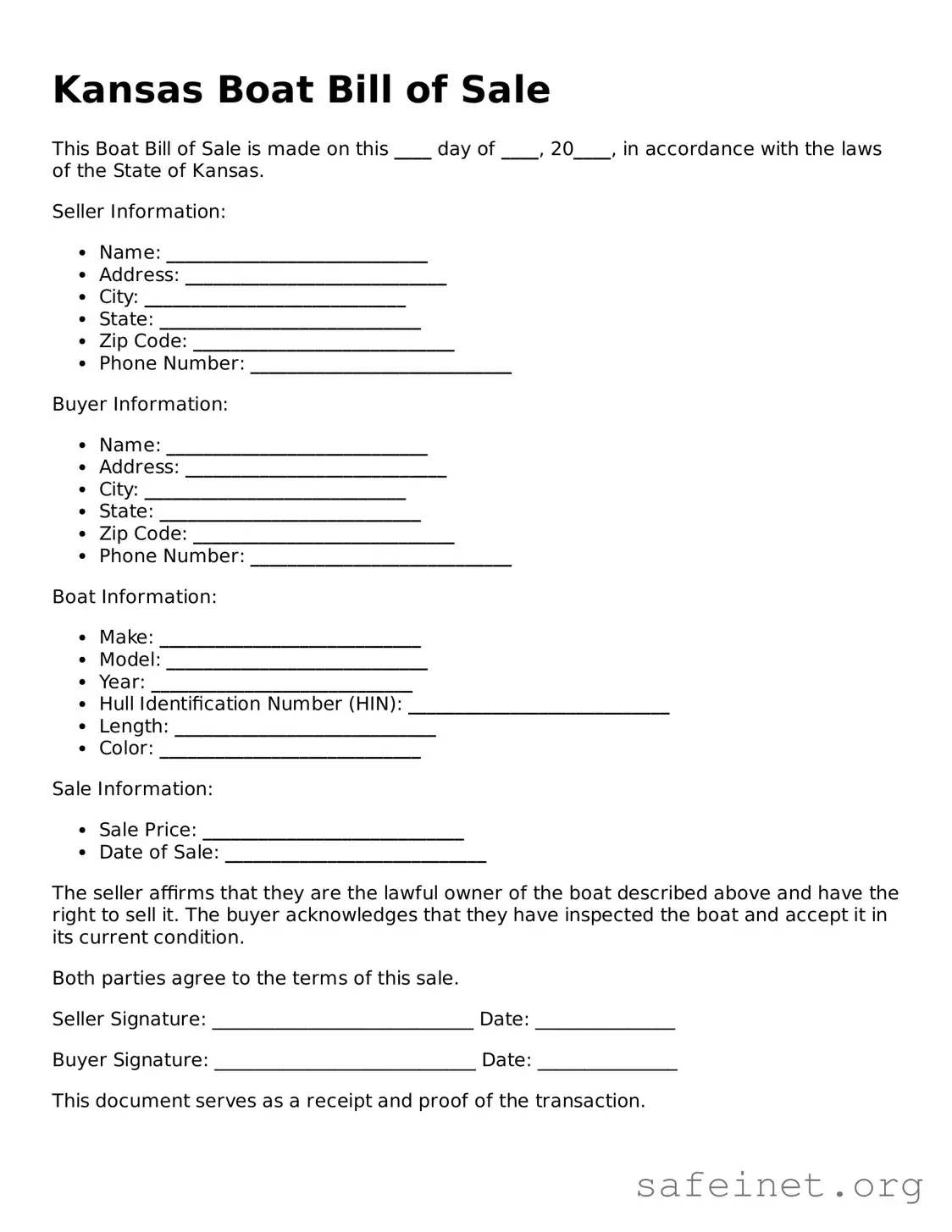
The Kansas Boat Bill of Sale form is an essential document for anyone involved in the buying or selling of a boat in the state. This form serves as a legal record of the transaction, detailing important information such as the names and addresses of both the buyer and seller, the boat's identification number, and its make and model. Additionally, it outlines the sale price and any conditions related to the sale, ensuring that both parties are clear about the terms of the agreement. By providing a clear and concise account of the transaction, the Boat Bill of Sale helps protect the interests of both the buyer and seller, facilitating a smoother transfer of ownership. It is crucial to complete this form accurately, as it may be required for registration purposes with the Kansas Department of Wildlife, Parks and Tourism. Understanding the key components and requirements of the Kansas Boat Bill of Sale can greatly simplify the process of boat ownership transfer.
Kansas Boat Bill of Sale
This Boat Bill of Sale is made on this ____ day of ____, 20____, in accordance with the laws of the State of Kansas.
Seller Information:
Buyer Information:
Boat Information:
Sale Information:
The seller affirms that they are the lawful owner of the boat described above and have the right to sell it. The buyer acknowledges that they have inspected the boat and accept it in its current condition.
Both parties agree to the terms of this sale.
Seller Signature: ____________________________ Date: _______________
Buyer Signature: ____________________________ Date: _______________
This document serves as a receipt and proof of the transaction.
| Fact Name | Description |
|---|---|
| Purpose | The Kansas Boat Bill of Sale is used to document the sale and transfer of ownership of a boat from one party to another. |
| Required Information | This form typically requires details such as the buyer's and seller's names, addresses, the boat's make, model, year, and hull identification number (HIN). |
| Governing Laws | The form is governed by Kansas Statutes, specifically K.S.A. 32-1130, which outlines the requirements for the sale and registration of boats. |
| Notarization | While notarization is not mandatory for the bill of sale in Kansas, having it notarized can provide additional legal protection and verification of the transaction. |
| Usage | The completed Bill of Sale is often required when registering the boat with the Kansas Department of Wildlife, Parks and Tourism. |
After obtaining the Kansas Boat Bill of Sale form, it is essential to ensure that all required information is accurately filled out. This document serves as a record of the transaction between the buyer and seller, and it is important to keep it for future reference. Below are the steps to complete the form effectively.
What is a Kansas Boat Bill of Sale?
A Kansas Boat Bill of Sale is a legal document that records the transfer of ownership of a boat from one party to another. This form serves as proof of the sale and includes essential details such as the buyer's and seller's names, the boat's description, and the sale price. It protects both parties by providing a clear record of the transaction.
Is a Boat Bill of Sale required in Kansas?
While a Boat Bill of Sale is not legally required for every transaction, it is highly recommended. Having this document can help prevent disputes over ownership and provides evidence for registration purposes. Additionally, the Kansas Department of Wildlife, Parks and Tourism may request a bill of sale when registering a boat.
What information should be included in the Kansas Boat Bill of Sale?
The form should include the following details: the full names and addresses of both the buyer and seller, a description of the boat (including make, model, year, and hull identification number), the sale price, and the date of the transaction. Both parties should sign the document to validate the sale.
Can I create my own Boat Bill of Sale?
Yes, you can create your own Boat Bill of Sale as long as it includes all necessary information. However, using a standardized form can simplify the process and ensure that you don’t miss any critical details. Many online resources offer templates that comply with Kansas laws.
Do I need to have the Boat Bill of Sale notarized?
Notarization is not a requirement for the Kansas Boat Bill of Sale. However, having the document notarized can add an extra layer of authenticity and may be beneficial if any disputes arise in the future. It is advisable to check with local authorities for specific requirements.
How do I use the Boat Bill of Sale after it is completed?
Once the Boat Bill of Sale is completed and signed by both parties, the buyer should keep it for their records. The seller may also want to retain a copy. The buyer will need this document when registering the boat with the Kansas Department of Wildlife, Parks and Tourism, as it serves as proof of ownership.
Incomplete Information: Many individuals fail to provide all necessary details on the form. It's crucial to include the full names and addresses of both the buyer and seller. Missing this information can lead to issues down the line.
Incorrect Boat Details: When describing the boat, errors often occur. Be sure to accurately list the boat's make, model, year, and hull identification number (HIN). An incorrect HIN can create significant problems when registering the boat.
Not Signing the Document: A common oversight is neglecting to sign the form. Both the buyer and seller must sign the Boat Bill of Sale for it to be valid. Without signatures, the document lacks legal enforceability.
Failure to Date the Sale: Some people forget to include the date of the transaction. This date is important for establishing when the sale took place, which can be crucial for tax purposes and future ownership disputes.
When buying or selling a boat in Kansas, the Boat Bill of Sale form is a crucial document. However, it is not the only paperwork involved in the transaction. Several other forms and documents can help ensure that the sale is conducted smoothly and legally. Here are four important documents often used alongside the Kansas Boat Bill of Sale.
In summary, while the Kansas Boat Bill of Sale form is a vital part of the boat-buying process, it is important to consider these additional documents. Each plays a role in ensuring a transparent and legally sound transaction, protecting both the buyer and the seller.
The Kansas Vehicle Bill of Sale is a document used to transfer ownership of a motor vehicle. Like the Boat Bill of Sale, it serves as proof of the transaction between the seller and the buyer. Both documents include essential information such as the names and addresses of the parties involved, a description of the item being sold, and the sale price. This ensures clarity and protects the rights of both parties in the transaction.
The Kansas Motorcycle Bill of Sale is another similar document. It specifically applies to the sale of motorcycles and shares many characteristics with the Boat Bill of Sale. Both forms require details such as the vehicle identification number (VIN), make, model, and year. This information is crucial for the buyer to establish ownership and for the seller to document the sale.
The Kansas Trailer Bill of Sale also mirrors the Boat Bill of Sale in its purpose and structure. This document is used for the sale of trailers, whether they are utility, travel, or recreational. Similar to the Boat Bill of Sale, it includes the buyer's and seller's information, a description of the trailer, and the sale price, ensuring a smooth transfer of ownership.
The Kansas Snowmobile Bill of Sale is another relevant document. This form is specifically designed for the sale of snowmobiles and contains comparable elements to the Boat Bill of Sale. It includes the details of the snowmobile, such as its make, model, and identification number, along with the names and addresses of both parties. This helps to confirm the legitimacy of the transaction and provides necessary documentation for registration.
Finally, the Kansas ATV Bill of Sale is similar in nature to the Boat Bill of Sale. It facilitates the transfer of ownership for all-terrain vehicles (ATVs). Like the Boat Bill of Sale, it requires essential information, including the buyer's and seller's details, a description of the ATV, and the sale price. This document is important for both parties to ensure that the transaction is properly recorded and that ownership is clearly established.
When filling out the Kansas Boat Bill of Sale form, attention to detail is crucial. Below is a list of things you should and shouldn't do to ensure the process goes smoothly.
Following these guidelines will help facilitate a smooth transaction and protect both parties involved.
Here are five common misconceptions about the Kansas Boat Bill of Sale form:
Many people believe that a Bill of Sale is only required for larger vessels. However, any boat transfer, regardless of size, should be documented to protect both the buyer and seller.
Some think that a verbal agreement is sufficient for a boat sale. In Kansas, a written Bill of Sale is essential to provide proof of ownership and the terms of the sale.
Many assume that only the seller's signature is necessary. In fact, both the buyer and seller should sign the Bill of Sale to validate the transaction.
Some believe notarization is optional. While it may not be required, having the Bill of Sale notarized can add an extra layer of authenticity and protection.
There is a misconception that a Bill of Sale is unnecessary for boat registration. However, it is typically required to register the boat with the state.
When engaging in the sale or purchase of a boat in Kansas, understanding the Boat Bill of Sale form is crucial. Here are some key takeaways to keep in mind:
By following these guidelines, both buyers and sellers can navigate the process of transferring boat ownership smoothly and legally.