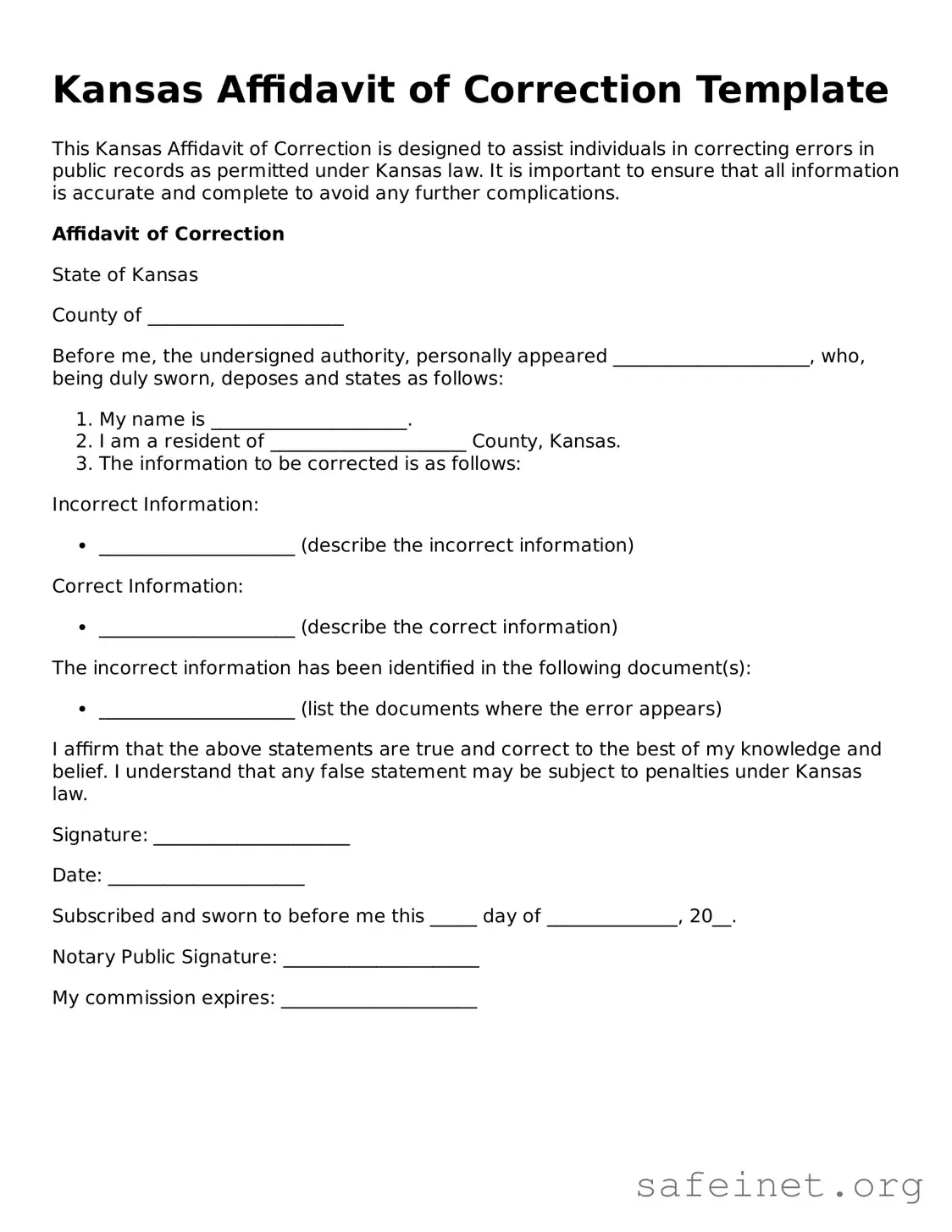
The Kansas Affidavit of Correction form serves as a vital tool for individuals seeking to rectify inaccuracies in public records. This form is particularly useful when errors occur in documents such as deeds, mortgages, or other legal instruments that have been filed with the county clerk or register of deeds. By utilizing this affidavit, individuals can formally declare that a mistake exists and provide the necessary corrections to ensure that the public record accurately reflects the intended information. The process typically involves completing the form with specific details about the original document, including the nature of the error and the correct information that should replace it. Once properly executed, the affidavit must be filed with the appropriate county office, allowing for the correction to be officially recognized and recorded. This mechanism not only aids in maintaining the integrity of public records but also protects the interests of individuals and entities relying on accurate information in legal and financial matters.
Kansas Affidavit of Correction Template
This Kansas Affidavit of Correction is designed to assist individuals in correcting errors in public records as permitted under Kansas law. It is important to ensure that all information is accurate and complete to avoid any further complications.
Affidavit of Correction
State of Kansas
County of _____________________
Before me, the undersigned authority, personally appeared _____________________, who, being duly sworn, deposes and states as follows:
Incorrect Information:
Correct Information:
The incorrect information has been identified in the following document(s):
I affirm that the above statements are true and correct to the best of my knowledge and belief. I understand that any false statement may be subject to penalties under Kansas law.
Signature: _____________________
Date: _____________________
Subscribed and sworn to before me this _____ day of ______________, 20__.
Notary Public Signature: _____________________
My commission expires: _____________________
| Fact Name | Description |
|---|---|
| Purpose | The Kansas Affidavit of Correction is used to correct errors in recorded documents. |
| Governing Law | Kansas Statutes Annotated (K.S.A.) 58-2220 governs the use of affidavits for correction. |
| Eligibility | Any party involved in the original document can file an affidavit of correction. |
| Common Errors | Common corrections include misspellings, incorrect dates, and inaccurate legal descriptions. |
| Filing Process | The completed affidavit must be filed with the county register of deeds. |
| Signature Requirement | The affidavit must be signed by the person who prepared the original document or their representative. |
| No Fee | Filing an affidavit of correction typically does not require a fee in Kansas. |
| Public Record | Once filed, the affidavit becomes part of the public record. |
| Limitations | The affidavit cannot change the substantive rights of the parties involved. |
Filling out the Kansas Affidavit of Correction form is straightforward. Once completed, you will need to submit it to the appropriate office to correct any errors. Follow these steps to ensure you fill it out correctly.
What is the Kansas Affidavit of Correction form?
The Kansas Affidavit of Correction form is a legal document used to correct errors in previously filed documents, such as deeds or other public records. It allows individuals to clarify or amend specific information without having to refile the entire document.
Who can file an Affidavit of Correction in Kansas?
Any individual or entity that has a vested interest in the document being corrected can file an Affidavit of Correction. This includes property owners, their legal representatives, or other interested parties who may be affected by the inaccuracies in the original filing.
What types of errors can be corrected using this form?
The form can be used to correct typographical errors, misspellings, incorrect legal descriptions, or any other factual inaccuracies that do not change the intent of the original document. However, it cannot be used for substantive changes that alter the rights or obligations of the parties involved.
How do I obtain the Kansas Affidavit of Correction form?
The form can typically be obtained from the Kansas Secretary of State’s website, local county clerk’s office, or through legal document service providers. Ensure you have the most current version of the form to avoid any issues during filing.
Is there a fee associated with filing the Affidavit of Correction?
Yes, there may be a filing fee associated with submitting the Affidavit of Correction. Fees can vary by county, so it’s advisable to check with the local clerk's office for the exact amount. Payment methods may also differ, so be prepared with the appropriate form of payment.
Do I need to provide supporting documentation when filing?
Supporting documentation is typically not required when filing an Affidavit of Correction. However, including a copy of the original document being corrected can be helpful. This helps clarify the nature of the correction for the filing office.
How long does it take for the Affidavit of Correction to be processed?
Processing times can vary by county. Generally, it may take anywhere from a few days to several weeks. It’s best to check with the local clerk’s office for specific timelines regarding processing and recording.
Can I file the Affidavit of Correction electronically?
Some counties in Kansas may allow electronic filing of the Affidavit of Correction. Check with your local county clerk's office to determine if this option is available and what the requirements are for electronic submissions.
What happens after the Affidavit of Correction is filed?
Once filed, the Affidavit of Correction becomes part of the public record. It serves to officially document the corrections made and ensures that future inquiries or transactions reflect the accurate information. Interested parties can then access the corrected records as needed.
Can I contest an Affidavit of Correction?
Yes, if you believe that an Affidavit of Correction has been filed incorrectly or without proper authority, you may contest it. This process usually involves filing a formal objection with the appropriate legal authority or court, depending on the situation.
Incomplete Information: Failing to provide all necessary details can lead to delays. Ensure that every section of the form is filled out completely.
Incorrect Personal Information: Double-check names, addresses, and other identifying details. Mistakes can cause confusion and may invalidate the affidavit.
Not Notarizing the Document: A common oversight is neglecting to have the affidavit notarized. This step is crucial for the document's validity.
Using Inappropriate Language: Avoid legal jargon or complex terms. The affidavit should be clear and straightforward to ensure understanding.
Ignoring State-Specific Requirements: Each state may have unique rules. Familiarize yourself with Kansas-specific requirements to avoid mistakes.
Failing to Include Supporting Documentation: If applicable, include any necessary documents that support the corrections being made.
Not Reviewing the Final Draft: Skipping the review process can lead to unnoticed errors. Always take the time to read through the completed form before submission.
Missing Submission Deadlines: Be aware of any deadlines for submitting the affidavit. Late submissions may result in additional complications.
When dealing with the Kansas Affidavit of Correction form, it's essential to understand the other documents that may accompany it. These forms help ensure that any corrections made are properly documented and legally recognized. Below is a list of commonly used forms that you might encounter alongside the Affidavit of Correction.
Understanding these forms and their purposes can streamline the correction process. Each document plays a vital role in ensuring that corrections are made accurately and legally, providing peace of mind for all parties involved.
The Kansas Affidavit of Correction form is similar to the Affidavit of Identity. Both documents serve to clarify or correct information that may have been previously misrepresented. The Affidavit of Identity specifically addresses issues regarding an individual’s name or identity, allowing the person to affirm their true identity. This is particularly useful in situations where a name change or identity theft has occurred. Like the Affidavit of Correction, it requires the individual to provide a sworn statement, ensuring the accuracy of the information presented.
Another document similar to the Kansas Affidavit of Correction is the Declaration of Homestead. This document allows homeowners to declare their property as a homestead, thereby protecting it from certain creditors. Both documents require a formal declaration, and both serve to correct or clarify information related to ownership or property rights. The Declaration of Homestead must be filed with the county, similar to how the Affidavit of Correction is submitted to rectify errors in public records.
The Affidavit of Correction also shares similarities with the Quitclaim Deed. A Quitclaim Deed transfers ownership of property from one party to another. If there are errors in the property title, a Quitclaim Deed can be used to correct those mistakes. Both documents require signatures and must be notarized. The primary difference lies in their purpose: the Quitclaim Deed transfers ownership, while the Affidavit of Correction aims to amend existing records.
The Affidavit of Correction is comparable to the Certificate of Correction. This document is often used to correct errors in corporate filings or business documents. Both forms serve to rectify inaccuracies and ensure that the official records are correct. A Certificate of Correction typically requires filing with the Secretary of State, while the Affidavit of Correction addresses personal or property-related errors. Both documents help maintain the integrity of public records.
The Kansas Affidavit of Correction is also akin to the Statement of Claim. This document is used in various legal contexts to assert a claim against another party. Both documents require factual information to support the claim or correction being made. The Statement of Claim often initiates legal action, while the Affidavit of Correction seeks to amend existing records without necessarily initiating litigation. Both documents emphasize the importance of accuracy in legal and public records.
Lastly, the Affidavit of Correction can be compared to the Power of Attorney. While the Power of Attorney grants authority to another individual to act on one’s behalf, it can also include provisions to correct or manage errors in legal documents. Both require a formal declaration and must be executed according to state law. The Power of Attorney allows for the correction of errors by an appointed representative, whereas the Affidavit of Correction is a direct action taken by the individual to rectify inaccuracies.
When filling out the Kansas Affidavit of Correction form, it’s important to approach the task with care. Here are some key dos and don'ts to ensure your form is completed correctly.
By following these guidelines, you can navigate the process more smoothly and ensure that your affidavit is properly submitted.
The Kansas Affidavit of Correction form is often misunderstood. Here are ten common misconceptions about this form, along with clarifications to help you better understand its purpose and use.
The Affidavit of Correction is specifically designed for correcting clerical or typographical errors in certain legal documents, such as deeds or mortgages, not for all documents.
Not every mistake requires an affidavit. In some cases, the error may be minor enough that it does not impact the legal validity of the document.
Typically, only the person who executed the original document or their legal representative can file this affidavit.
The affidavit serves as a formal declaration of the correction but does not change the original document itself. It must be filed with the original document to be effective.
There may be a filing fee associated with submitting the affidavit, depending on the county or jurisdiction.
The affidavit is limited to correcting specific types of errors, such as spelling mistakes or incorrect dates. It cannot be used to change substantive information.
While notarization is common, it is not always a requirement. Check local regulations to determine if notarization is necessary.
Each state has its own rules and procedures regarding affidavits of correction. It is important to follow Kansas-specific guidelines.
While the affidavit serves to correct the record, it does not prevent future disputes over the original document's validity.
Although commonly used for real estate documents, the Affidavit of Correction can apply to various types of legal documents that require correction.
When filling out and using the Kansas Affidavit of Correction form, it's important to keep several key points in mind. This document serves to correct errors in public records, ensuring that the information accurately reflects the intended details. Here are some essential takeaways:
By following these guidelines, you can effectively use the Kansas Affidavit of Correction form to address any discrepancies in your public records.