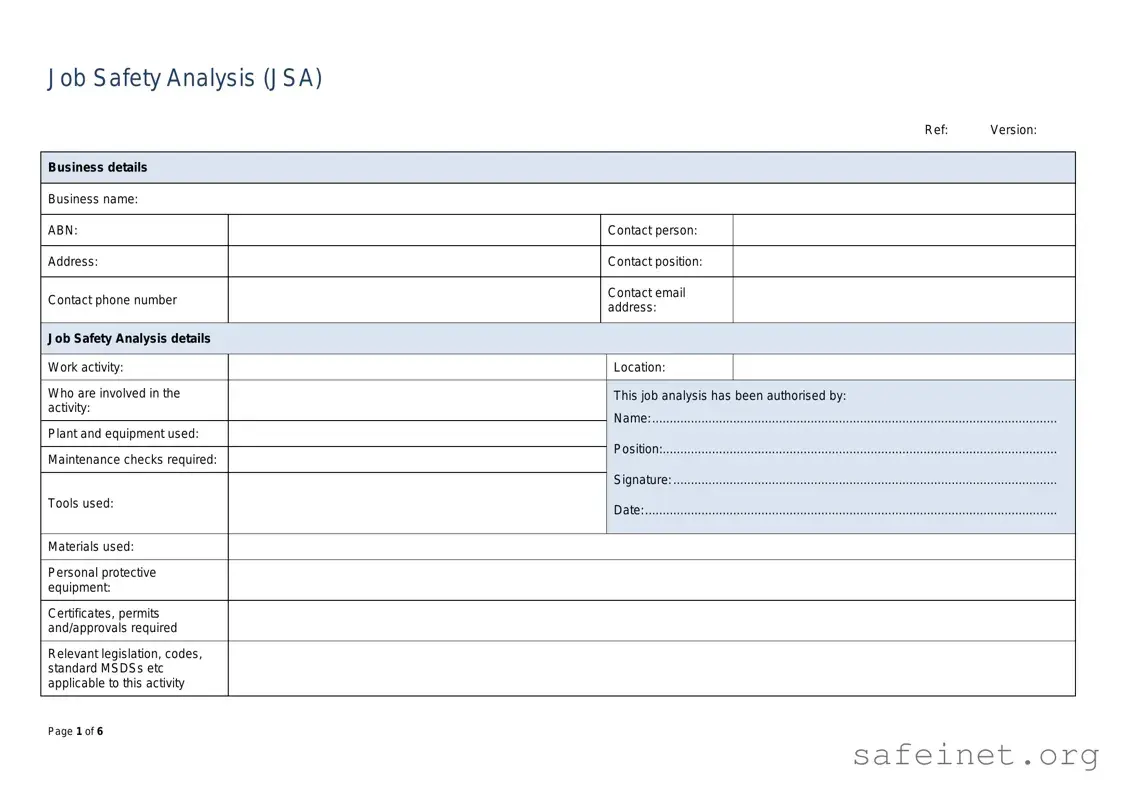
The Job Safety Analysis (JSA) form serves as a vital tool in promoting workplace safety and ensuring that all employees are aware of potential hazards associated with specific job activities. This comprehensive document outlines essential business details, including the name, contact information, and address of the organization, as well as the specific work activity and its location. It identifies all individuals involved in the task and requires authorization from a designated person, ensuring accountability. The JSA form also details the equipment, tools, and materials required for the job, alongside the necessary personal protective equipment (PPE) to safeguard workers. A critical component of the JSA is the risk assessment section, which employs a systematic approach to evaluate the likelihood and consequences of potential hazards. By using a risk rating table, users can categorize risks as low, moderate, high, critical, or catastrophic, guiding them in determining the appropriate level of action needed. Furthermore, the form emphasizes the importance of implementing risk controls based on a hierarchy of measures, ranging from elimination and substitution to engineering controls and administrative strategies. Lastly, it requires the documentation of action steps, potential hazards, risk ratings, and responsible individuals, creating a clear plan for managing safety in the workplace.

Job Safety Analysis (JSA)
|
|
|
|
Ref: |
Version: |
|
|
|
|
|
|
Business details |
|
|
|
|
|
|
|
|
|
|
|
Business name: |
|
|
|
|
|
|
|
|
|
|
|
ABN: |
|
|
Contact person: |
|
|
|
|
|
|
|
|
Address: |
|
|
Contact position: |
|
|
|
|
|
|
|
|
Contact phone number |
|
|
Contact email |
|
|
|
|
address: |
|
|
|
|
|
|
|
|
|
|
|
|
|
|
|
Job Safety Analysis details |
|
|
|
|
|
|
|
|
|
|
|
Work activity: |
|
|
Location: |
|
|
|
|
|
|
|
|
Who are involved in the |
|
|
This job analysis has been authorised by: |
|
|
activity: |
|
|
Name: |
||
|
|
|
|||
Plant and equipment used: |
|
|
|||
|
|
|
|
|
|
|
|
|
Position: |
|
|
Maintenance checks required: |
|
|
|||
|
|
|
|
|
|
|
|
|
Signature: |
|
|
Tools used: |
|
|
|||
|
|
Date: |
|||
|
|
|
|||
|
|
|
|
|
|
Materials used: |
|
|
|
|
|
|
|
|
|
|
|
Personal protective |
|
|
|
|
|
equipment: |
|
|
|
|
|
|
|
|
|
|
|
Certificates, permits |
|
|
|
|
|
and/approvals required |
|
|
|
|
|
|
|
|
|
|
|
Relevant legislation, codes, |
|
|
|
|
|
standard MSDSs etc |
|
|
|
|
|
applicable to this activity |
|
|
|
|
|
|
|
|
|
|
|
Page 1 of 6
Risk assessment
**Use the risk rating table to assess the level of risk for each job step.
|
|
|
|
|
|
|
|
|
Likelihood |
|
|
|
|
|
|
|
|
|
1 |
|
2 |
|
3 |
|
4 |
|
5 |
|
|||||
|
Consequence |
|
Rare |
|
Unlikely |
|
Moderate |
|
Likely |
|
Almost Certain |
|||||
|
|
The event may occur in |
|
The event could occur |
|
The event should occur |
|
The event will probably occur |
|
The event is expected to |
||||||
|
|
|
exceptional circumstances |
|
sometimes |
|
sometimes |
|
in most circumstances |
|
occur in most circumstances |
|||||
1 |
Insignificant |
|
LOW |
|
|
LOW |
|
|
LOW |
|
|
LOW |
|
|
MODERATE |
|
|
No injuries or health |
|
|
|
|
|
|
|
|
|
|
|||||
|
|
|
|
|
|
|
|
|
|
|
|
|
|
|
|
|
|
|
|
|
|
|
|
|
|
|
|
|
|
|
|
|
|
|
issues |
|
|
|
|
|
|
|
|
|
|
|
|
|
|
|
2 |
Minor |
|
|
|
|
|
|
|
|
|
|
|
|
|
|
|
|
First aid treatment |
|
LOW |
|
|
LOW |
|
|
MODERATE |
|
|
MODERATE |
|
|
HIGH |
|
|
|
|
|
|
|
|
|
|
|
|
|
|
|
|
|
|
|
|
|
|
|
|
|
|
|
|
|
|
|
|
|
|
|
|
|
|
|
|
|
|
|
|
|
|
|
|
|
|
|
|
3 |
Moderate |
|
|
|
|
|
|
|
|
|
|
|
|
|
|
|
|
Medical treatment, |
|
LOW |
|
|
MODERATE |
|
|
HIGH |
|
|
HIGH |
|
|
CRITICAL |
|
|
|
|
|
|
|
|
|
|
|
|
|
|
|
|
|
|
|
|
|
|
|
|
|
|
|
|
|
|
|
|
|
|
|
|
potential LTI |
|
|
|
|
|
|
|
|
|
|
|
|
|
|
|
4 |
Major |
|
|
|
|
|
|
|
|
|
|
|
|
|
|
|
|
Permanent disability or |
|
LOW |
|
|
MODERATE |
|
|
HIGH |
|
|
CRITICAL |
|
|
CATASTROPHIC |
|
|
|
|
|
|
|
|
|
|
|
|
|
|
|
|
|
|
|
|
|
|
|
|
|
|
|
|
|
|
|
|
|
|
|
|
disease |
|
|
|
|
|
|
|
|
|
|
|
|
|
|
|
5 |
Extreme |
|
|
|
|
|
|
|
|
|
|
|
|
|
|
|
|
Death |
|
MODERATE |
|
|
HIGH |
|
|
CRITICAL |
|
|
CATASTROPHIC |
|
|
CATASTROPHIC |
|
|
|
|
|
|
|
|
|
|
|
|
|
|
|
|
|
|
|
|
|
|
|
|
|
|
|
|
|
|
|
|
|
|
|
|
|
|
|
|
|
|
|
|
|
|
|
|
|
|
|
|
Risk rating:
Low risk:Acceptable risk and no further action required as long as risk has been minimised as possible. Risk needs to be reviewed periodically.
Moderate risk:Tolerable with further action required to minimise risk. Risk needs to be reviewed periodically.
High risk:Tolerable with further action required to minimise risk. Risk needs to be reviewed continuously.
Critical risk:Unacceptable risk and further action required immediately to minimise risk.
Catastrophic:Unacceptable risk and urgent action required to minimise risk.
Page 2 of 6
Risk controls
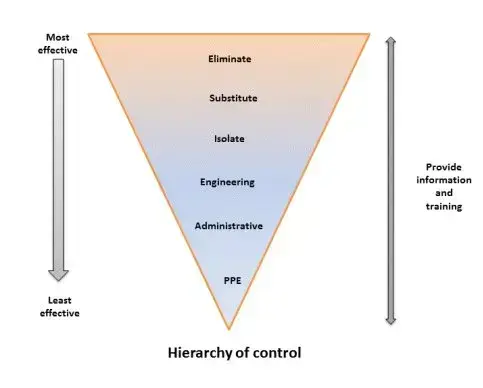
The hierarchy of control can be used as an effective tool to deal with health and safety issues at work. Use the type of control suggested as measures to deal with the hazard. Aim to use control measures from as high on the hierarchy of control list as possible. If that is not possible the next option down the list or a combination of the measures should be implemented. The least effective control measure is the use of personal protective equipment (PPE) and it should be used as a last resort or a support to other control measures. Information and training should be integrated with all levels of control to explain how controls work.
1.Eliminate – if it is possible, the hazard should be removed completely. For example, get rid of dangerous machines.
2.Substitute – replace something that produces the hazard with something that does not produce a hazard. For example, replacing solvent based paint with water based paint. Risk assessment on the substitution must be conducted to ensure that it will not pose another hazard.
3.Engineering control – isolate a person from the hazard by creating physical barrier or making changes to process, equipment or plant to reduce the hazard. For example, install ventilation systems.
4.Administrative control – change the way a person works by establishing policies and procedures to minimise the risks. For example, job scheduling to limit exposure and posting hazard signs.
5.Use personal protective equipment (PPE) – protect a person from the hazard by wearing PPE. For example, wearing gloves, safety glasses, hard hats and
Page 3 of 6

JSA – Action steps
|
Step No |
|
|
Job step details |
|
|
Potential hazards |
|
|
|
|
|
|
|
|||
|
|
|
|
|
|
|
|
|
|
|
|
|
|
|
|
|
|
|
|
|
|
|
|
|
|
|
Risk rating**
How to control risks***
Name of persons responsible for work
Review number: |
Version: |
Page 4 of 6

|
Step No |
|
|
Job step details |
|
|
Potential hazards |
|
|
|
|
|
|
|
|||
|
|
|
|
|
|
|
|
|
|
|
|
|
|
|
|
|
|
|
|
|
|
|
|
|
|
|
|
|
|
|
|
|
|
|
|
Risk rating**
How to control risks***
Name of persons responsible for work
Review number: |
Version: |
Page 5 of 6

This job safety analysis has been developed through consultation with our employees and has been read, understood and signed by all employees undertaking the works:
Print Names: |
Signatures: |
Dates: |
|
|
|
|
|
|
|
|
|
|
|
|
|
|
|
|
|
|
|
|
|
|
|
|
|
|
|
|
|
|
|
|
|
|
|
|
Review No |
01 |
02 |
03 |
04 |
05 |
06 |
07 |
08 |
09 |
|
|
|
|
|
|
|
|
|
|
Initial: |
|
|
|
|
|
|
|
|
|
|
|
|
|
|
|
|
|
|
|
Date: |
|
|
|
|
|
|
|
|
|
|
|
|
|
|
|
|
|
|
|
A10592057 |
|
|
|
|
|
|
|
|
|
Page 6 of 6
| Fact Name | Description |
|---|---|
| Purpose | The Job Safety Analysis (JSA) form is designed to identify and assess hazards associated with specific job activities. |
| Business Information | The form requires essential business details, including name, ABN, contact person, and contact information. |
| Risk Assessment | A risk assessment section helps evaluate the likelihood and consequences of potential hazards during the job. |
| Risk Rating | The form categorizes risks into five levels: Low, Moderate, High, Critical, and Catastrophic, guiding necessary actions. |
| Hierarchy of Control | The JSA emphasizes using a hierarchy of control measures to manage health and safety risks effectively. |
| Personal Protective Equipment | PPE is mentioned as a last resort and should be used to support other control measures. |
| Authorization | The JSA must be authorized by a responsible person, ensuring accountability for the job analysis. |
| Relevant Legislation | The form includes a section for noting applicable legislation and standards relevant to the job activity. |
Completing the Job Safety Analysis (JSA) form is crucial for ensuring workplace safety. By accurately filling out this form, you will help identify potential hazards and outline necessary precautions. Follow the steps below to ensure that all required information is provided correctly.
Once the JSA form is filled out, it is essential to review it periodically to ensure that the information remains relevant and accurate. This process will help maintain a safe working environment and minimize risks associated with the job.
What is a Job Safety Analysis (JSA) form?
A Job Safety Analysis (JSA) form is a tool used to identify and assess potential hazards associated with specific job tasks. It outlines the necessary steps to complete a job safely while ensuring that all involved parties are aware of the risks and the measures in place to mitigate them.
Who should complete the JSA form?
The JSA form should be completed by the person responsible for overseeing the work activity, often referred to as the contact person. This individual should have a good understanding of the job, the associated risks, and the safety measures required. Input from all team members involved in the job is also encouraged to ensure comprehensive risk assessment.
What information is required on the JSA form?
The JSA form requires detailed information including the business name, contact details, work activity, location, individuals involved, equipment used, maintenance checks, tools and materials, personal protective equipment needed, and any relevant certifications or permits. This information helps in creating a complete picture of the job and its associated risks.
How is risk assessed in the JSA form?
Risk is assessed using a risk rating table that evaluates both the likelihood of an event occurring and its potential consequences. Each job step is rated based on these factors, leading to a classification of the risk as low, moderate, high, critical, or catastrophic. This assessment helps determine the necessary controls to implement for safety.
What are the hierarchy of controls mentioned in the JSA form?
The hierarchy of controls is a system used to minimize or eliminate exposure to hazards. It includes five levels: elimination of the hazard, substitution with a safer alternative, engineering controls to isolate workers from hazards, administrative controls to change work practices, and the use of personal protective equipment (PPE) as a last resort. The goal is to use the most effective controls possible.
How often should the JSA be reviewed?
The JSA should be reviewed periodically, especially when there are changes in the work process, equipment, or personnel involved. If a job is assessed as having moderate, high, critical, or catastrophic risks, continuous review is essential to ensure that safety measures remain effective and relevant.
What should be done if a critical or catastrophic risk is identified?
If a critical or catastrophic risk is identified, immediate action is required to minimize the risk. This may involve halting the job until appropriate controls are put in place. It is crucial to address these risks urgently to protect the health and safety of all individuals involved.
Can personal protective equipment (PPE) be the only control measure used?
No, personal protective equipment should not be the only control measure. While PPE is important for providing an additional layer of protection, it is considered the least effective control measure. It should be used in conjunction with other higher-level controls to ensure comprehensive safety.
Failing to provide complete business details. This includes the business name, ABN, contact person, address, contact position, phone number, and email address. Missing any of these details can lead to confusion and delays.
Not specifying all participants involved in the work activity. It is essential to list everyone who will be part of the job analysis to ensure safety measures apply to all involved.
Overlooking the risk assessment section. It is crucial to accurately assess the level of risk for each job step using the provided risk rating table. Inaccurate assessments can lead to inadequate safety measures.
Neglecting to outline risk controls appropriately. Control measures should be chosen from the hierarchy of control. Using the least effective measures first can compromise safety.
Forgetting to include the signature of the person authorizing the JSA. This signature confirms that the analysis has been reviewed and approved, which is vital for accountability.
When conducting a Job Safety Analysis (JSA), several other forms and documents may also be necessary to ensure a comprehensive approach to workplace safety. Each of these documents serves a specific purpose in identifying, assessing, and managing risks associated with various job activities. Below is a list of commonly used forms that complement the JSA.
Utilizing these forms and documents in conjunction with the JSA enhances workplace safety by providing a structured approach to risk management. Each document plays a vital role in fostering a culture of safety and ensuring compliance with relevant regulations.
The Job Safety Analysis (JSA) form shares similarities with the Risk Assessment form. Both documents aim to identify potential hazards associated with specific work activities. The Risk Assessment form includes a systematic evaluation of risks, similar to the JSA's risk rating table. Each document emphasizes the need for control measures to mitigate identified risks, ensuring a safer working environment. Additionally, both forms require input from individuals involved in the work process, promoting a collaborative approach to safety management.
Another document akin to the JSA is the Safe Work Method Statement (SWMS). Like the JSA, the SWMS outlines the steps involved in a particular job and identifies potential hazards. However, the SWMS goes further by detailing the specific methods and controls to be implemented for each step. Both documents serve as essential tools for ensuring that workers are aware of the risks and the procedures in place to manage them, fostering a culture of safety on the job site.
The Hazard Identification form is also comparable to the JSA. This document focuses on pinpointing hazards that may arise during work activities, similar to the JSA's emphasis on identifying risks. While the JSA incorporates risk ratings and control measures, the Hazard Identification form serves as an initial step in the safety process. Both documents are crucial for creating a comprehensive safety plan and ensuring that all potential dangers are considered before work begins.
Additionally, the Incident Report form is relevant to the JSA. While the JSA is proactive, aiming to prevent incidents before they occur, the Incident Report addresses situations that have already happened. Both documents are vital for improving workplace safety. The insights gained from incident reports can inform future JSAs, helping to identify areas for improvement and ensuring that similar incidents do not recur.
The Training Record form bears similarities to the JSA as well. Both documents highlight the importance of education and training in workplace safety. The JSA outlines the necessary precautions and procedures, while the Training Record ensures that employees have received the appropriate training to recognize and manage risks effectively. Together, they contribute to a well-informed workforce capable of adhering to safety protocols.
Lastly, the Personal Protective Equipment (PPE) Assessment form is closely related to the JSA. Both documents address the importance of safety equipment in protecting workers from identified hazards. The JSA specifies the PPE required for a job, while the PPE Assessment evaluates the adequacy and appropriateness of the equipment. By using both documents, employers can ensure that workers are not only aware of the risks but also equipped to handle them safely.
When filling out the Job Safety Analysis (JSA) form, it’s essential to approach the task with care and attention to detail. Here are five things to keep in mind:
By following these guidelines, you can create a comprehensive and effective JSA that enhances workplace safety.
Misconceptions about the Job Safety Analysis (JSA) form can lead to misunderstandings and inadequate safety measures in the workplace. Here are five common misconceptions:
Understanding these misconceptions is vital for fostering a culture of safety in the workplace. Properly utilizing the JSA form can significantly reduce risks and enhance overall safety for all employees.
When filling out and using the Job Safety Analysis (JSA) form, it is crucial to keep the following key takeaways in mind: