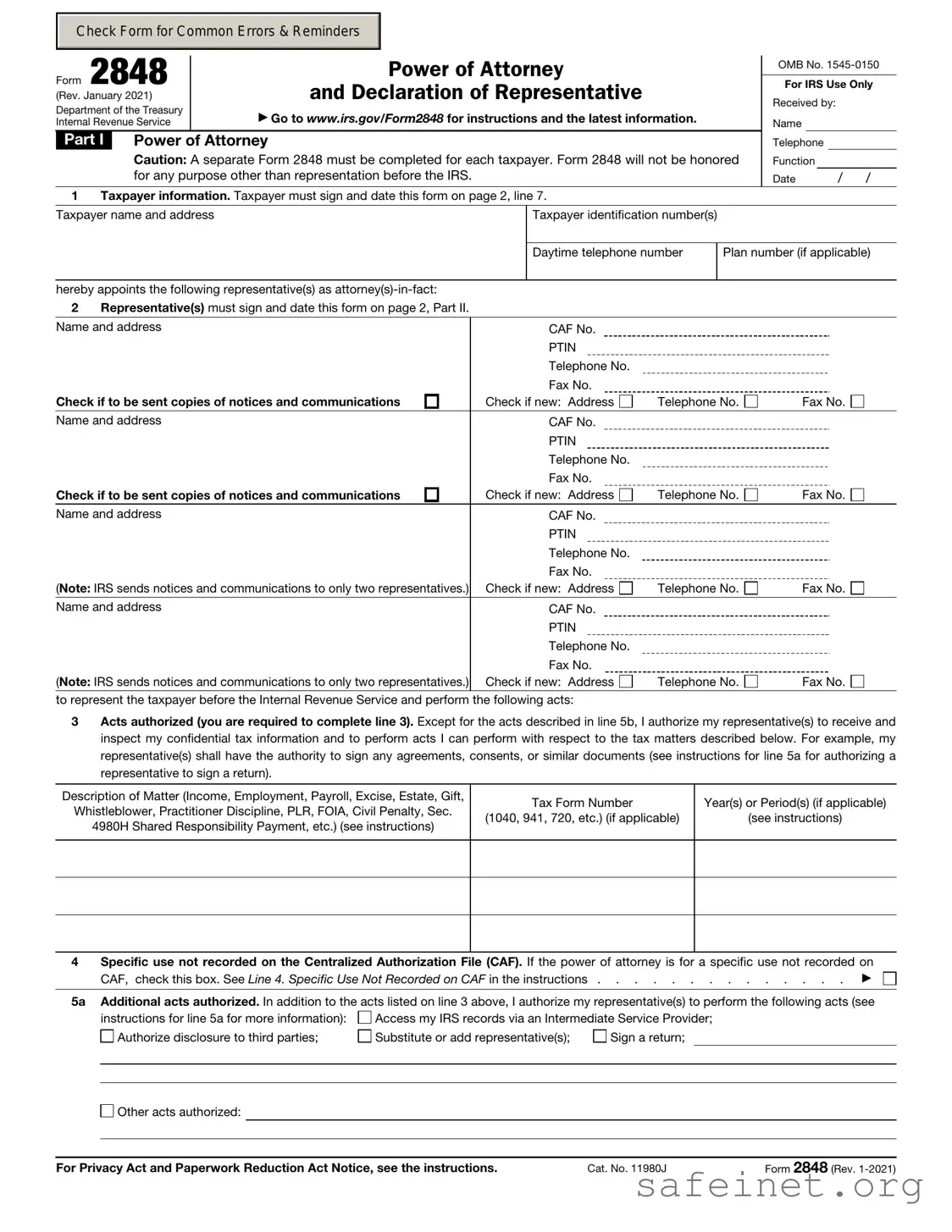
When dealing with tax matters, having the right representation can make all the difference. The IRS Power of Attorney (Form 2848) is a crucial tool that allows individuals to authorize someone else—often a tax professional or attorney—to act on their behalf in front of the Internal Revenue Service. This form enables your designated representative to receive confidential tax information, discuss your tax situation, and even make decisions regarding your tax matters. By completing Form 2848, you ensure that your chosen representative has the authority to handle various issues, such as negotiating tax debts or addressing audits. It’s important to note that this form is not just a one-time solution; it can be tailored to cover specific tax years or particular tax matters, providing flexibility depending on your needs. Understanding how to properly fill out and submit this form can empower you to manage your tax obligations more effectively, allowing you to focus on what truly matters while ensuring that your interests are protected.

Check Form for Common Errors & Reminders
Form 2848 |
|
Power of Attorney |
For IRS Use Only |
|||||
|
|
|
|
OMB No. |
||||
(Rev. January 2021) |
and Declaration of Representative |
|
|
|
|
|
||
Received by: |
|
|||||||
Department of the Treasury |
|
|
|
|||||
▶ Go to www.irs.gov/Form2848 for instructions and the latest information. |
|
|
|
|
|
|||
Internal Revenue Service |
Name |
|
|
|||||
|
|
|
||||||
Part I |
Power of Attorney |
Telephone |
|
|
||||
|
Caution: A separate Form 2848 must be completed for each taxpayer. Form 2848 will not be honored |
Function |
|
|
||||
|
for any purpose other than representation before the IRS. |
Date |
/ / |
|||||
1Taxpayer information. Taxpayer must sign and date this form on page 2, line 7.
Taxpayer name and address |
Taxpayer identification number(s) |
Daytime telephone number
Plan number (if applicable)
Name and address |
CAF No. |
|
|
|
PTIN |
|
|
|
Telephone No. |
|
|
|
Fax No. |
|
|
Check if to be sent copies of notices and communications |
Check if new: Address |
Telephone No. |
Fax No. |
Name and address |
CAF No. |
|
|
|
PTIN |
|
|
|
Telephone No. |
|
|
|
Fax No. |
|
|
Check if to be sent copies of notices and communications |
Check if new: Address |
Telephone No. |
Fax No. |
Name and address |
CAF No. |
|
|
|
PTIN |
|
|
|
Telephone No. |
|
|
|
Fax No. |
|
|
(Note: IRS sends notices and communications to only two representatives.) |
Check if new: Address |
Telephone No. |
Fax No. |
Name and address |
CAF No. |
|
|
|
PTIN |
|
|
|
Telephone No. |
|
|
|
Fax No. |
|
|
(Note: IRS sends notices and communications to only two representatives.) |
Check if new: Address |
Telephone No. |
Fax No. |
to represent the taxpayer before the Internal Revenue Service and perform the following acts:
3Acts authorized (you are required to complete line 3). Except for the acts described in line 5b, I authorize my representative(s) to receive and inspect my confidential tax information and to perform acts I can perform with respect to the tax matters described below. For example, my representative(s) shall have the authority to sign any agreements, consents, or similar documents (see instructions for line 5a for authorizing a representative to sign a return).
Description of Matter (Income, Employment, Payroll, Excise, Estate, Gift, |
Tax Form Number |
Year(s) or Period(s) (if applicable) |
|
Whistleblower, Practitioner Discipline, PLR, FOIA, Civil Penalty, Sec. |
|||
(1040, 941, 720, etc.) (if applicable) |
(see instructions) |
||
4980H Shared Responsibility Payment, etc.) (see instructions) |
|||
|
|
||
|
|
|
|
|
|
|
|
|
|
|
|
|
|
|
4 |
Specific use not recorded on the Centralized Authorization File (CAF). If the power of attorney is for a specific use not recorded on |
|||
|
CAF, check this box. See Line 4. Specific Use Not Recorded on CAF in the instructions . |
. . . . . . . . . . . . . ▶ |
||
|
|
|
||
5a |
Additional acts authorized. In addition to the acts listed on line 3 above, I authorize my representative(s) to perform the following acts (see |
|||
|
instructions for line 5a for more information): |
Access my IRS records via an Intermediate Service Provider; |
||
|
Authorize disclosure to third parties; |
Substitute or add representative(s); |
Sign a return; |
|
|
|
|
|
|
|
|
|
|
|
Other acts authorized:
For Privacy Act and Paperwork Reduction Act Notice, see the instructions. |
Cat. No. 11980J |
Form 2848 (Rev. |

Form 2848 (Rev. |
Page 2 |
bSpecific acts not authorized. My representative(s) is (are) not authorized to endorse or otherwise negotiate any check (including directing or accepting payment by any means, electronic or otherwise, into an account owned or controlled by the representative(s) or any firm or other entity with whom the representative(s) is (are) associated) issued by the government in respect of a federal tax liability.
List any other specific deletions to the acts otherwise authorized in this power of attorney (see instructions for line 5b):
6Retention/revocation of prior power(s) of attorney. The filing of this power of attorney automatically revokes all earlier power(s) of attorney on file with the Internal Revenue Service for the same matters and years or periods covered by this form. If you do not want to
revoke a prior power of attorney, check here . . . . . . . . . . . . . . . . . . . . . . . . . . . ▶
YOU MUST ATTACH A COPY OF ANY POWER OF ATTORNEY YOU WANT TO REMAIN IN EFFECT.
7Taxpayer declaration and signature. If a tax matter concerns a year in which a joint return was filed, each spouse must file a separate power of attorney even if they are appointing the same representative(s). If signed by a corporate officer, partner, guardian, tax matters partner, partnership representative (or designated individual, if applicable), executor, receiver, administrator, trustee, or individual other than the taxpayer, I certify I have the legal authority to execute this form on behalf of the taxpayer.
▶ IF NOT COMPLETED, SIGNED, AND DATED, THE IRS WILL RETURN THIS POWER OF ATTORNEY TO THE TAXPAYER.
Signature |
Date |
Title (if applicable) |
Print name |
|
Print name of taxpayer from line 1 if other than individual |
Part II Declaration of Representative
Under penalties of perjury, by my signature below I declare that:
•I am not currently suspended or disbarred from practice, or ineligible for practice, before the Internal Revenue Service;
•I am subject to regulations in Circular 230 (31 CFR, Subtitle A, Part 10), as amended, governing practice before the Internal Revenue Service;
•I am authorized to represent the taxpayer identified in Part I for the matter(s) specified there; and
•I am one of the following:
a
bCertified Public
cEnrolled
d
e
fFamily
gEnrolled
hUnenrolled Return
kQualifying Student or Law
rEnrolled Retirement Plan
▶IF THIS DECLARATION OF REPRESENTATIVE IS NOT COMPLETED, SIGNED, AND DATED, THE IRS WILL RETURN THE POWER OF ATTORNEY. REPRESENTATIVES MUST SIGN IN THE ORDER LISTED IN PART I, LINE 2.
Note: For designations
Designation—
Insert above
letter
Licensing jurisdiction
(State) or other
licensing authority
(if applicable)
Bar, license, certification, registration, or enrollment number (if applicable)
Signature
Date
Form 2848 (Rev.
| Fact Name | Description |
|---|---|
| Purpose | The IRS Form 2848, also known as the Power of Attorney and Declaration of Representative, allows taxpayers to authorize an individual to represent them before the IRS. |
| Who Can Be Designated | Taxpayers can designate an attorney, certified public accountant, enrolled agent, or other qualified individuals to act on their behalf. |
| Scope of Authority | The form can grant broad or limited powers, allowing representatives to receive and inspect confidential information, sign documents, and represent the taxpayer in various matters. |
| Duration | Unless revoked, the authority granted remains in effect until the taxpayer cancels it or the IRS processes a new Form 2848. |
| Filing Requirements | The completed form must be signed by both the taxpayer and the representative. It can be submitted electronically or by mail. |
| State-Specific Forms | Some states have their own power of attorney forms for tax matters, governed by state tax laws. For example, California uses Form FTB 3520. |
| Revocation | Taxpayers can revoke the authority granted by submitting a written notice to the IRS, specifying the representative's name and the date of revocation. |
Filling out the IRS Power of Attorney (Form 2848) is an important step in designating someone to represent you in tax matters. Once you complete the form, you will need to submit it to the IRS for processing. This will allow your designated representative to act on your behalf regarding your tax issues.
What is the IRS Power of Attorney (Form 2848)?
The IRS Power of Attorney (Form 2848) allows you to authorize someone to represent you before the IRS. This could be a tax professional, family member, or friend. The designated person can handle tax matters on your behalf, such as discussing your tax returns and negotiating on your behalf.
Why would I need to fill out Form 2848?
Filling out Form 2848 is useful if you want someone to manage your tax issues without your direct involvement. This can be especially helpful during audits, disputes, or when you need help understanding complex tax situations. It ensures that your representative can communicate with the IRS effectively.
How do I complete Form 2848?
To complete Form 2848, you need to provide your personal information, such as your name, address, and Social Security number. Next, you’ll enter the details of the person you are authorizing, including their name and address. Finally, you must sign and date the form to validate it.
Do I need to submit Form 2848 to the IRS?
Yes, you must submit Form 2848 to the IRS. You can do this by mailing it to the appropriate address listed in the form instructions. Alternatively, you can also submit it electronically if your representative is using e-Services to file on your behalf.
How long does it take for the IRS to process Form 2848?
Processing times can vary. Generally, the IRS will process Form 2848 within a few weeks. However, during peak tax season or due to other factors, it may take longer. It’s wise to follow up if you haven’t received confirmation after a reasonable period.
Can I revoke a Power of Attorney once it is submitted?
Yes, you can revoke a Power of Attorney at any time. To do this, you need to submit a written statement to the IRS indicating that you are revoking the previous authorization. You may also want to fill out a new Form 2848 if you are appointing someone else as your representative.
What happens if I don’t submit Form 2848?
If you do not submit Form 2848, your representative will not be able to communicate with the IRS on your behalf. This means they cannot obtain information about your tax situation or negotiate any tax matters for you. It is essential to have this form on file if you wish for someone else to act on your behalf.
Can multiple representatives be listed on Form 2848?
Yes, you can list multiple representatives on Form 2848. Each representative must provide their information, and you can specify the type of matters they are authorized to handle. This flexibility allows you to have a team of professionals working on your tax issues if needed.
Is there a fee for using Form 2848?
There is no fee to submit Form 2848 to the IRS. However, your representative may charge you for their services. It’s important to discuss any fees upfront to avoid surprises later on.
Incorrect Identification of the Taxpayer: Failing to provide the correct name, Social Security number, or Employer Identification Number (EIN) can lead to processing delays.
Improper Designation of the Representative: Not clearly identifying the representative’s name and credentials can result in the IRS rejecting the form.
Missing Signatures: Both the taxpayer and the representative must sign the form. Omitting a signature can invalidate the Power of Attorney.
Failure to Specify Tax Matters: Leaving the tax matters section blank or vague may limit the authority granted to the representative.
Not Indicating the Years or Periods: If the applicable years or periods are not specified, the representative may not be authorized to act for those specific tax years.
Ignoring State-Specific Requirements: Some states may have additional requirements for a Power of Attorney. Failing to comply can lead to issues.
Submitting an Outdated Form: Using an old version of Form 2848 can cause confusion. Always ensure you have the most recent version.
Inadequate Instructions for the Representative: Not providing clear guidance on what the representative is authorized to do can create misunderstandings.
Neglecting to Keep Copies: Failing to retain a copy of the submitted form can complicate matters if questions arise later regarding the authority granted.
The IRS Power of Attorney (Form 2848) allows individuals to designate someone to represent them before the IRS. This form is often used alongside other documents to ensure comprehensive representation and to facilitate communication with the IRS. Below are some commonly used forms and documents that complement the Power of Attorney.
Using these forms alongside the IRS Power of Attorney can streamline the process of handling tax matters. Each document plays a specific role in ensuring that the taxpayer's needs are met effectively and efficiently.
The IRS Power of Attorney (Form 2848) allows individuals to designate someone else to represent them before the IRS. This form is similar to a general Power of Attorney, which grants broad authority to another person to act on behalf of someone else in various legal matters. Both documents require the principal’s consent and can be used for a wide range of decisions, from financial transactions to legal proceedings. However, the general Power of Attorney is not limited to tax matters and can cover many aspects of personal and business affairs.
Another document similar to Form 2848 is the Limited Power of Attorney. This form is used when someone wants to give another person specific authority to act on their behalf, but only in certain situations. For example, a Limited Power of Attorney might allow someone to handle a real estate transaction while not granting them authority over other financial matters. Like Form 2848, it requires the principal's signature and can specify the scope of authority granted.
The IRS also recognizes Form 8821, which is a Tax Information Authorization. While Form 2848 allows someone to represent a taxpayer in dealings with the IRS, Form 8821 permits an individual to receive tax information without the authority to represent the taxpayer. This distinction is crucial for those who need access to tax records but do not require the power to act on behalf of the taxpayer.
Similar to the IRS forms, a Healthcare Power of Attorney allows an individual to appoint someone to make medical decisions on their behalf if they become unable to do so. This document is essential for ensuring that a person's healthcare preferences are honored. Like Form 2848, it requires the principal's consent and outlines the authority granted to the appointed individual, but it specifically pertains to health-related matters.
A Durable Power of Attorney is another document that shares similarities with Form 2848. This form remains in effect even if the principal becomes incapacitated. It allows someone to manage the principal's financial affairs. While Form 2848 is specific to tax issues, the Durable Power of Attorney can cover a broader range of financial decisions, making it a vital tool for long-term planning.
In the realm of business, a Corporate Power of Attorney allows a corporation to designate an individual to act on its behalf. This document is similar to Form 2848 in that it provides authority to represent the entity in specific matters. The appointed individual can make decisions or sign documents, just as a representative can do for an individual taxpayer with Form 2848.
Another related document is the Financial Power of Attorney. This form allows someone to manage another person's financial affairs, such as paying bills or managing investments. Like Form 2848, it is a formal agreement that specifies the powers granted, but it focuses solely on financial matters rather than tax representation.
A Special Power of Attorney is also akin to Form 2848. This document allows someone to act on behalf of another person for a specific task or event. For instance, it might be used for a single real estate transaction or to handle a particular legal issue. While Form 2848 is limited to tax matters, a Special Power of Attorney can apply to various situations, depending on the principal's needs.
Lastly, a Consent to Release Information form is similar to Form 8821, as it allows a taxpayer to authorize the IRS to disclose their tax information to a third party. While it does not grant the authority to represent the taxpayer like Form 2848, it facilitates communication between the IRS and the designated individual, ensuring that they can access necessary information without the ability to act on behalf of the taxpayer.
When filling out the IRS Power of Attorney (Form 2848), it's important to follow specific guidelines to ensure accuracy and compliance. Here’s a list of things you should and shouldn't do:
By adhering to these guidelines, you can help ensure that your Power of Attorney form is processed smoothly and effectively.
Understanding the IRS Power of Attorney (Form 2848) is crucial for anyone seeking to authorize someone to represent them before the IRS. Unfortunately, several misconceptions can lead to confusion about this important document. Here are five common misconceptions:
This is not true. While many people choose to appoint attorneys, you can also designate certified public accountants, enrolled agents, or even family members as your representative. The key is that the person you choose must be qualified to represent you before the IRS.
This is a misunderstanding. By filing this form, you are granting someone the authority to act on your behalf, but you still retain ultimate control over your tax matters. You can revoke the Power of Attorney at any time if you feel it is no longer necessary.
This is incorrect. The IRS Power of Attorney does not last indefinitely. It remains in effect until you revoke it, or until the representative withdraws from representation. It is essential to keep track of the status of your Power of Attorney and update it as needed.
This is a misconception. Form 2848 can be used for a wide range of tax matters, including audits, collections, and appeals. It allows your representative to discuss any issue related to your tax account, as long as it falls within the scope you specify on the form.
This is not necessary. You only need to file Form 2848 when you want to appoint a new representative or when you want to update the details of an existing Power of Attorney. There is no annual requirement to refile unless changes occur.
Being informed about these misconceptions can help you make better decisions regarding your representation before the IRS. Always ensure that you understand the implications of granting Power of Attorney and choose a representative who aligns with your needs.
When considering the IRS Power of Attorney (Form 2848), it is important to understand its purpose and how to complete it effectively. Here are key takeaways to keep in mind:
By following these guidelines, you can effectively utilize the IRS Power of Attorney (Form 2848) to ensure that your tax matters are handled with care and attention.