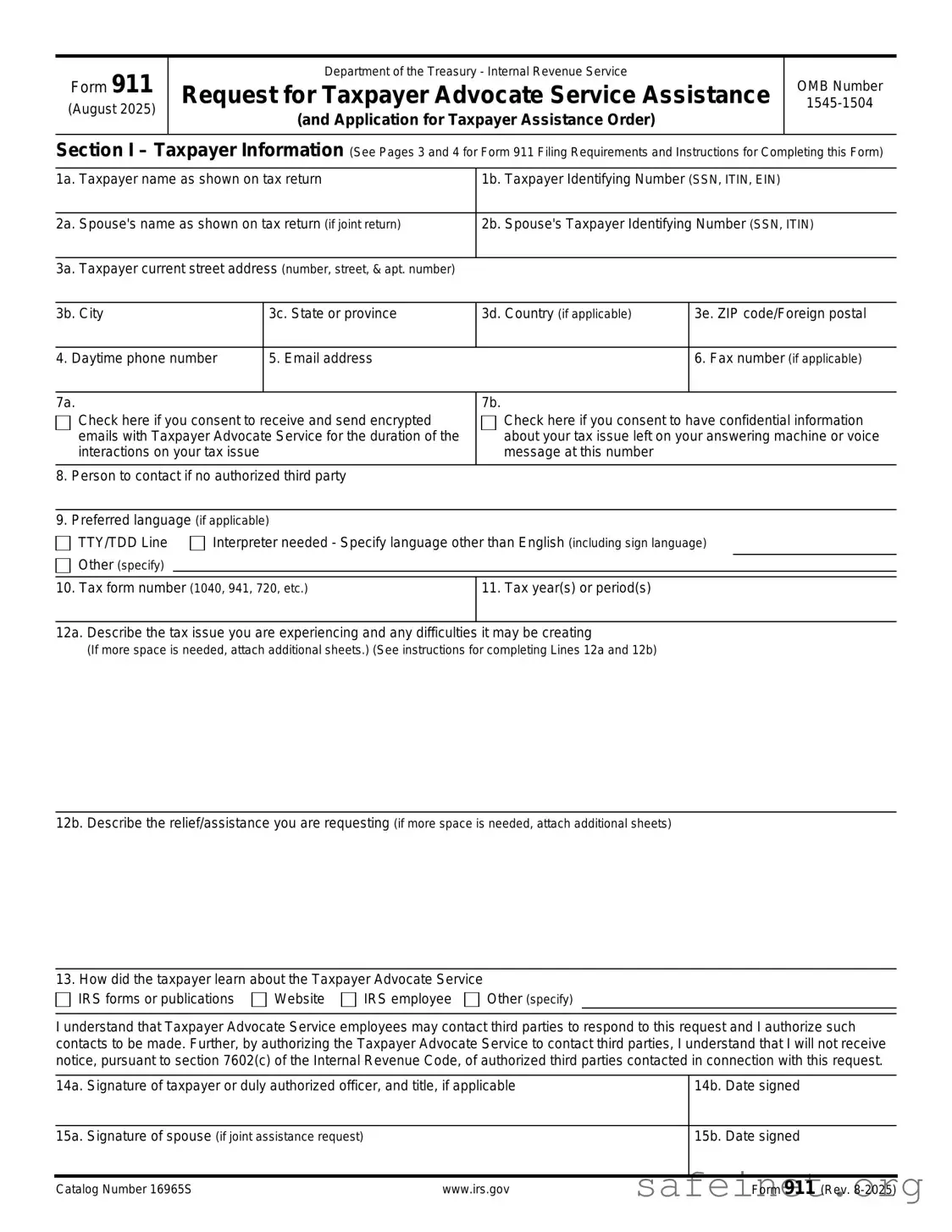
The IRS 911 form plays a crucial role in helping taxpayers navigate challenging financial situations. When individuals or businesses face hardships that hinder their ability to meet tax obligations, this form serves as a request for assistance. It allows taxpayers to communicate their circumstances to the IRS, seeking relief from penalties or extensions for filing and paying taxes. Understanding the key components of the IRS 911 form is essential for anyone in distress over their tax responsibilities. This form not only outlines the necessary information required for submission but also provides a pathway for individuals to explain their specific situations, such as illness, natural disasters, or economic difficulties. By utilizing this form, taxpayers can potentially alleviate some of the stress associated with tax payments and find a way to regain financial stability.

Form 911
(August 2025)
Department of the Treasury - Internal Revenue Service
Request for Taxpayer Advocate Service Assistance
(and Application for Taxpayer Assistance Order)
OMB Number
Section I – Taxpayer Information (See Pages 3 and 4 for Form 911 Filing Requirements and Instructions for Completing this Form)
1a. Taxpayer name as shown on tax return |
1b. Taxpayer Identifying Number (SSN, ITIN, EIN) |
2a. Spouse's name as shown on tax return (if joint return)
2b. Spouse's Taxpayer Identifying Number (SSN, ITIN)
3a. |
Taxpayer current street address (number, street, & apt. number) |
|
|
|
|
|
|
|
|
3b. |
City |
3c. State or province |
3d. Country (if applicable) |
3e. ZIP code/Foreign postal |
|
|
|
|
|
4. Daytime phone number |
5. Email address |
|
6. Fax number (if applicable) |
|
|
|
|
|
|
7a. |
|
|
7b. |
|
|
Check here if you consent to receive and send encrypted |
Check here if you consent to have confidential information |
||
|
emails with Taxpayer Advocate Service for the duration of the |
about your tax issue left on your answering machine or voice |
||
|
interactions on your tax issue |
|
message at this number |
|
8.Person to contact if no authorized third party
9.Preferred language (if applicable)
TTY/TDD Line |
Interpreter needed - Specify language other than English (including sign language) |
||
Other (specify) |
|
|
|
|
|
|
|
|
|
|
|
10. Tax form number (1040, 941, 720, etc.) |
11. Tax year(s) or period(s) |
||
|
|
|
|
12a. Describe the tax issue you are experiencing and any difficulties it may be creating
(If more space is needed, attach additional sheets.) (See instructions for completing Lines 12a and 12b)
12b. Describe the relief/assistance you are requesting (if more space is needed, attach additional sheets)
13. How did the taxpayer learn about the Taxpayer Advocate Service
IRS forms or publications
Website
IRS employee
Other (specify)
I understand that Taxpayer Advocate Service employees may contact third parties to respond to this request and I authorize such contacts to be made. Further, by authorizing the Taxpayer Advocate Service to contact third parties, I understand that I will not receive notice, pursuant to section 7602(c) of the Internal Revenue Code, of authorized third parties contacted in connection with this request.
14a. |
Signature of taxpayer or duly authorized officer, and title, if applicable |
14b. Date signed |
||
|
|
|
|
|
15a. |
Signature of spouse (if joint assistance request) |
|
15b. Date signed |
|
|
|
|
|
|
Catalog Number 16965S |
www.irs.gov |
Form 911 (Rev. |
|
|

Page 2
Section II – Third Party Information (See instructions before completing this section)
A. Form 2848, Power of Attorney
1. Name of authorized third party
2. Centralized Authorization File (CAF) number
3a. Current mailing address (number, street, & apt. number)
3b. City
3c. State or province
3d. Country (if applicable)
3e. ZIP code/Foreign postal
4. Daytime phone number
5. Fax number
6. Signature of third party (representative only)
7. Date signed (representative only)
B. Form 8821, Authorization to Receive Notices
Form 8821 does not authorize your appointee to advocate your position with respect to the federal tax laws, to execute waivers, consents, or closing agreements, or to otherwise represent you before the IRS. Form 8821 authorizes anyone you designate to inspect and/or receive your confidential tax information in any office of the IRS, for the type of tax and tax periods you list on Form 8821.
1. Name of authorized third party
2. Centralized Authorization File (CAF) number
3a. Current mailing address (number, street, & apt. number)
3b. City
3c. State or province
3d. Country (if applicable)
3e. ZIP code/Foreign postal
4. Daytime phone number
5. Fax number
6. Signature of third party (representative only)
7. Date signed (representative only)
Catalog Number 16965S |
www.irs.gov |
Form 911 (Rev. |

Page 3
Instructions for Form 911, Request for Taxpayer Advocate Service Assistance
(and Application for Taxpayer Assistance Order)
Important Things You Should Know
•Remember to submit any documentation you believe would assist us in resolving the issue, as this may result in a quicker resolution of your issue.
•The Taxpayer Advocate Service will let you know if your request for assistance has been accepted and may contact you to discuss your tax issue. If unable to reach you by phone, the employee will mail you a letter or leave a voicemail if you provided consent on line 7b. Email is not available as a method of communication until a case has been created, and you have consented to receive and send encrypted email during the duration of your case.
•If you are a
Information About the Taxpayer Advocate Service
The Taxpayer Advocate Service (TAS) is an independent organization within the Internal Revenue Service (IRS) that helps taxpayers resolve federal tax issues and protects taxpayers' rights. TAS may be able to assist if your federal tax problem is causing a financial difficulty, you’ve tried and been unable to resolve your issue with the IRS, or if an IRS system, process, or procedure just isn't working as it should. If you qualify for our assistance, which is always free, we will do everything possible to help you. Visit www.taxpayeradvocate.irs.gov for more information.
How to Send this Form:
•Mail: 7940 Kentucky Dr, MS 11 G, Florence, KY 41042
•Fax: (855)
•
•Sending the form from overseas:
-Fax: 1 (304)
-
Disclaimer Notice: Email submissions to TAS of Form 911 and attachments are not encrypted for security. If you submit a Form 911 through email TAS will not reply to your email. Instead, you will be contacted by a TAS employee by either phone or letter about your request for assistance.
What Happens Next?
If you don't receive a response within 30 days of submitting Form 911, call
Caution: TAS will not consider frivolous arguments raised on this form. You can find examples of frivolous arguments in Publication 2105, Why do I have to Pay Taxes?, or the Truth About Frivolous Arguments at
Paperwork Reduction Act Notice: We ask for the information on this form to carry out the Internal Revenue laws of the United States. Your response is voluntary. You are not required to provide the information requested on a form that is subject to the Paperwork Reduction Act unless the form displays a valid OMB control number. Books or records relating to a form, or its instructions must be retained if their contents may become material in the administration of any Internal Revenue law. Generally, tax returns and return information are confidential, as required by Code section 6103. Although the time needed to complete this form may vary depending on each taxpayer’s circumstances, the estimated average time is 30 minutes.
Should you have comments concerning the accuracy of this time estimate or suggestions for making this form simpler, send us comments through www.IRS.gov/FormsComments.
Instructions for Section I
1a. Enter the taxpayer's name as shown on the tax return relating to this request for assistance.
1b. Enter the Taxpayer Identifying Number. If you're an individual this will be either a Social Security Number (SSN) or Individual Taxpayer Identification Number (ITIN). If you're a business entity this will be your Employer Identification Number (EIN) (e.g., a partnership, corporation, trust or
2a. Enter the spouse's name (if applicable) if this request relates to a jointly filed return.
2b. Enter the spouse's Taxpayer Identifying Number (SSN or ITIN) if this request relates to a jointly filed return.
Instructions for Section I ► continue on the next page
Catalog Number 16965S |
www.irs.gov |
Form 911 (Rev. |

Page 4
4.Enter your daytime telephone number, including the area code.
5.Enter your email address. TAS may use email to receive and share information with you if you checked the box in 7a consenting to receive and send encrypted email with the TAS for the duration of the interactions on your tax issue. See line 7(a).
6.Enter your fax number, including area code. (If applicable)
7a. Check the box if you consent to receive and send encrypted email with the Taxpayer Advocate Service for the duration of the interactions on your tax issue. You are not obligated to receive or send encrypted email with the Taxpayer Advocate Service.
7b. Check the box If you have an answering machine or voice mail at this number and you consent to TAS leaving confidential information about your tax issue at this number. You are not obligated to have information about your tax issue left at this number. If other individuals have access to the answering machine or the voice mail and you do not wish for them to receive any confidential information about your tax issue, please do not check the box.
8.For an entity (partnerships, corporations, trusts, estates,
For an individual taxpayer you will need an authorized third party as discussed in Section II and its instructions before TAS can share your information with someone else. Information can be shared between married taxpayers as long as both were included on the return(s) at issue and a filing status of married filing a joint return was used.
9.Indicate any special communication needs (such as sign language). Specify any language other than English.
10.Enter the number of the federal tax return or form relating to this request. For example, an individual taxpayer with an income tax issue would enter Form 1040.
11.Enter the quarterly, annual, or other tax year or period relating to this request. For example, if this request involves an income tax issue, enter the calendar or fiscal year. If in involves an employment tax issue, enter the calendar quarter.
12a. Describe the federal tax issue you are experiencing and any difficulties it may be creating. Specify the actions the IRS has taken (or not taken) to resolve the issue. If the issue involves an IRS delay of more than 30 days in resolving your issue, indicate the date you first contacted the IRS for assistance. For further information on the services TAS provides, see Publication 1546, The Taxpayer Advocate Service Is Your Voice at the IRS, available at
12b. Describe the relief/assistance you are requesting. Specify the action you want taken and believe necessary to resolve the issue. Submit any documentation you believe would assist TAS in resolving the issue.
13.Specify how you learned about the Taxpayer Advocate Service.
Note: The signing of this request is not a substitute for any legal or administrative action applicable to your situation and does not suspend any applicable periods for you to perform acts related to assessment or collection, such as petitioning the Tax Court for redetermination of a deficiency or requesting a Collection Due Process hearing.
Instructions for Section II
Taxpayers: If you wish to have a representative act on your behalf, you must give him/her power of attorney via a Form 2848, Power of Attorney and Declaration of Representative. If you wish to only have someone receive tax notices on your tax account, you must have the third party sign a Form 8821, Tax Information Authorization. Read through the instructions on both forms carefully.
•Complete this section only if you have a representative acting on your behalf. Leave any field blank if you don’t know the requested information. Only representatives sign in this section. This is for information purposes only to assist TAS in the case creation process. Include a copy of the Form 2848 or 8821, if available.
Representatives: If you are an authorized representative submitting this request on behalf of the taxpayer identified in Section I, complete Blocks 1 through 7 of Section II. Attach a copy of Form 2848, Form 8821, or other power of attorney. Enter your Centralized Authorization File (CAF) number in Block 2 of Section II. The CAF number is the unique number the IRS assigns to a representative after Form 2848 or Form 8821 is filed with an IRS office. Sign the Form 911 in this section. The taxpayer does not need to sign the Form 911 if it is being submitted by an authorized representative.
Catalog Number 16965S |
www.irs.gov |
Form 911 (Rev. |
| Fact Name | Description |
|---|---|
| Purpose | The IRS 911 form is used to request assistance from the IRS for issues related to tax matters, such as financial hardship or urgent situations. |
| Eligibility | Any taxpayer facing a significant financial burden or urgent tax issue may use this form to seek help from the IRS. |
| Submission Method | The form can be submitted via mail or fax, depending on the specific circumstances and the urgency of the request. |
| Processing Time | Processing times can vary, but urgent requests are typically prioritized by the IRS. |
| State-Specific Forms | Some states have their own forms for tax relief; check state laws for specifics, such as California's Revenue and Taxation Code. |
After obtaining the IRS Form 911, you will need to carefully fill it out to ensure that your request is processed efficiently. Following the steps outlined below will help you complete the form accurately.
Once you have submitted the form, you can expect to receive communication from the IRS regarding the next steps or any additional information they may need. Keep an eye on your mail and email for updates on your request.
What is the IRS Form 911?
The IRS Form 911, also known as the Request for Taxpayer Advocate Service Assistance, is a form that taxpayers can use to ask for help from the Taxpayer Advocate Service (TAS). This service is designed to assist individuals who are experiencing difficulties with the IRS and need additional support to resolve their tax issues.
Who can use Form 911?
Any taxpayer who is facing challenges with the IRS can use Form 911. This includes individuals, businesses, and tax-exempt organizations. If you feel that your tax problem is causing financial hardship or if you believe you are not receiving proper assistance from the IRS, you can submit this form.
What types of issues can I get help with using Form 911?
Form 911 can be used for various issues, including but not limited to, delays in processing your tax return, difficulties in resolving tax debts, or problems with IRS notices. If you are experiencing a significant hardship due to your tax situation, the Taxpayer Advocate Service can help you navigate the complexities of the IRS.
How do I fill out Form 911?
Filling out Form 911 is straightforward. You will need to provide your personal information, including your name, address, and Social Security number. Additionally, you should describe your tax issue in detail and explain why you need assistance. Make sure to include any relevant IRS notices or correspondence that support your case.
Where do I send Form 911?
Once you have completed Form 911, you can submit it to the Taxpayer Advocate Service office in your area. You can find the appropriate address on the IRS website or by contacting the TAS directly. It’s important to keep a copy of the form for your records.
What happens after I submit Form 911?
After you submit Form 911, a representative from the Taxpayer Advocate Service will review your case. They will reach out to you to discuss your situation and determine the best course of action. The TAS aims to resolve your issue as quickly and efficiently as possible, keeping you informed throughout the process.
Is there a cost to use the Taxpayer Advocate Service?
No, there is no cost to use the Taxpayer Advocate Service. This service is provided by the IRS as a resource for taxpayers in need. The TAS is dedicated to ensuring that taxpayers receive fair treatment and assistance without any fees involved.
Incorrect Personal Information: Many individuals fail to provide accurate personal details, such as their name, address, and Social Security number. This can lead to delays in processing the form.
Missing Signature: A common oversight is neglecting to sign the form. Without a signature, the IRS cannot process the request.
Inadequate Explanation of Hardship: Some filers do not clearly describe their financial situation. A vague explanation may result in the IRS not fully understanding the need for assistance.
Failing to Attach Supporting Documentation: Many people forget to include necessary documents that verify their claims. This can include income statements or evidence of financial hardship.
Not Following Submission Guidelines: Some individuals do not adhere to the specific submission instructions provided by the IRS. This includes not sending the form to the correct address.
Submitting After Deadlines: A frequent mistake is submitting the form after the deadline. Timeliness is crucial for the IRS to consider the request.
The IRS Form 911, known as the Request for Taxpayer Advocate Service Assistance, is often used by individuals seeking help with tax issues. When navigating the complexities of the tax system, several other forms and documents may be required to support a taxpayer's case. Below is a list of forms commonly used alongside the IRS 911 form, each serving a specific purpose in the tax resolution process.
Understanding these forms can significantly aid taxpayers in resolving their issues with the IRS. Each document plays a crucial role in the process, ensuring that individuals can effectively communicate their needs and secure the assistance they require.
The IRS Form 911, also known as the Request for Taxpayer Advocate Service Assistance, serves as a crucial tool for taxpayers facing financial difficulties or other tax-related issues. One similar document is Form 1040, the individual income tax return. While Form 1040 is used to report income and calculate tax liability, Form 911 is specifically designed to address situations where taxpayers need help resolving problems with the IRS. Both forms require personal information and are essential for navigating the tax system, but they serve distinct purposes.
Another related document is Form 843, the Claim for Refund and Request for Abatement. This form allows taxpayers to request a refund of overpaid taxes or to challenge penalties imposed by the IRS. Like Form 911, Form 843 seeks to provide relief to taxpayers, but it focuses on refund requests rather than assistance in resolving ongoing issues. Both forms emphasize the taxpayer's rights and the importance of clear communication with the IRS.
Form 2848, the Power of Attorney and Declaration of Representative, is also similar in that it allows taxpayers to appoint someone to represent them before the IRS. While Form 911 helps individuals directly address their concerns, Form 2848 enables taxpayers to authorize a representative to act on their behalf. Both forms require careful attention to detail and serve to empower taxpayers in their dealings with the IRS.
Form 8821, the Tax Information Authorization, is another document that shares similarities with Form 911. This form allows taxpayers to authorize someone to receive and inspect their tax information. While Form 911 focuses on seeking assistance for specific issues, Form 8821 is about granting access to sensitive information. Both forms enhance communication and support for taxpayers in managing their tax matters.
Form 9465, the Installment Agreement Request, is relevant as it provides a way for taxpayers to request a payment plan for their tax liabilities. Like Form 911, it addresses financial challenges but is specifically tailored for individuals who cannot pay their taxes in full. Both forms aim to ease the burden on taxpayers, but they target different aspects of tax-related difficulties.
Lastly, Form 13768, the Request for Taxpayer Advocate Service Assistance, is closely related to Form 911. This form is used when a taxpayer believes they are experiencing a significant hardship due to IRS actions. While both forms serve similar purposes, Form 13768 is often used in more severe cases where immediate intervention is required. They both highlight the importance of the Taxpayer Advocate Service in providing support and advocacy for individuals navigating the complexities of the tax system.
When filling out the IRS Form 911, it’s important to approach the process carefully to ensure that your request for assistance is clear and accurate. Here are some essential dos and don’ts to consider:
The IRS 911 form, also known as the Request for Taxpayer Advocate Service Assistance, often comes with a set of misconceptions that can lead to confusion. Here are seven common misunderstandings about this important form:
This is not true. The IRS 911 form is available to anyone who is facing tax-related issues, regardless of income level.
While the form can help bring attention to your situation, it does not guarantee a specific outcome. The Taxpayer Advocate Service will review your case and determine the best course of action.
This is a misconception. The IRS 911 form can be used for a variety of issues, including delays in processing, problems with refunds, and more.
In many cases, filing the IRS 911 form can actually expedite assistance. The Taxpayer Advocate Service is designed to help resolve issues more efficiently.
Anyone can fill out and submit the IRS 911 form. You do not need a tax professional to seek help from the Taxpayer Advocate Service.
The IRS 911 form is not a complaint form. Instead, it is a request for assistance when you are facing significant difficulties with the IRS.
You can withdraw your request for assistance at any time. Simply contact the Taxpayer Advocate Service to inform them of your decision.
Understanding these misconceptions can help you navigate the process more effectively. If you find yourself in need of assistance, the IRS 911 form can be a valuable resource.
The IRS Form 911 is used to request a delay in the collection of tax debts. Here are some key takeaways regarding its completion and use: