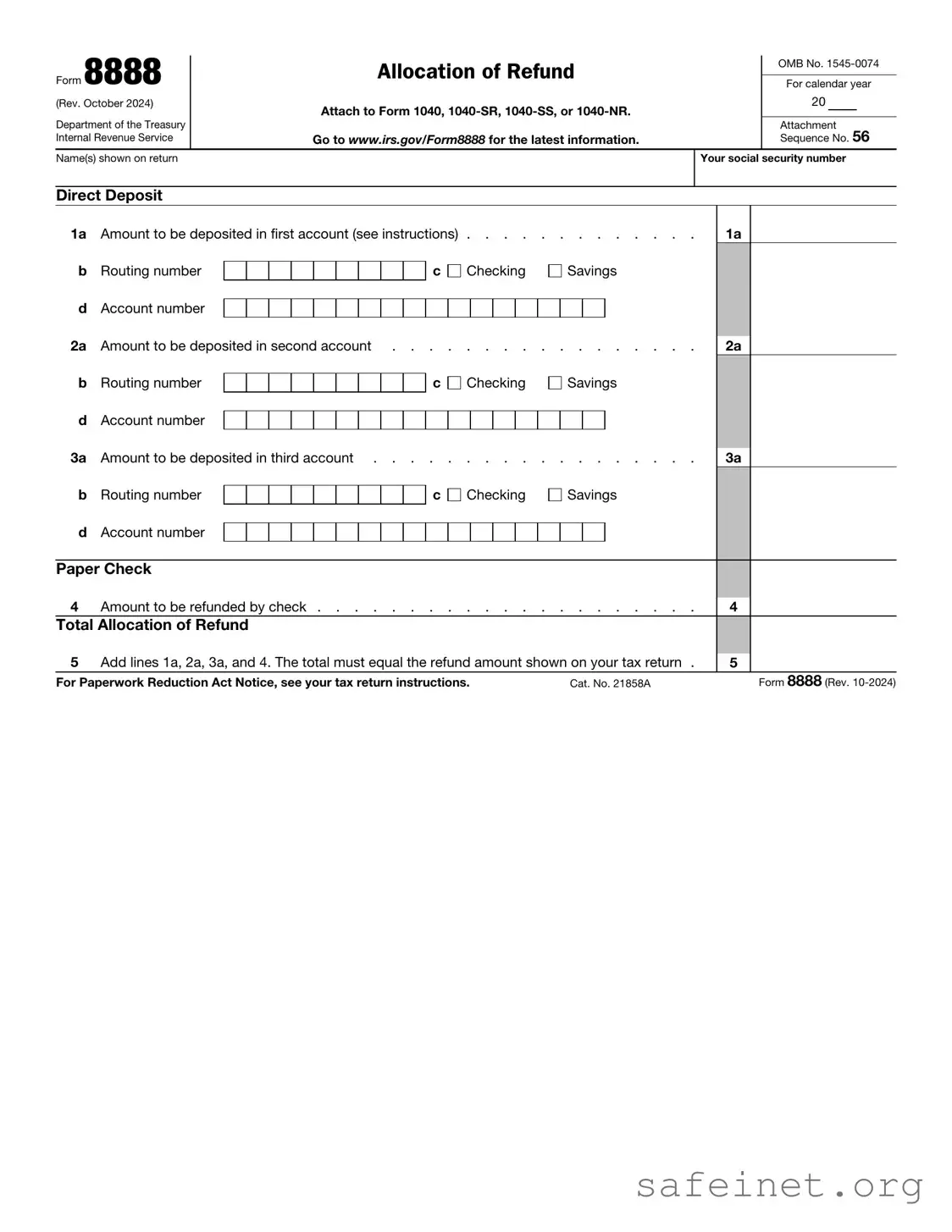
The IRS 8888 form plays a vital role for taxpayers looking to manage their tax refunds effectively. This form allows individuals to specify how they would like their refund distributed, offering options such as direct deposit into multiple bank accounts or the purchase of U.S. Savings Bonds. By utilizing this form, taxpayers can ensure that their funds are allocated according to their financial needs, whether that means splitting the refund among different accounts for savings, spending, or investment purposes. Additionally, the IRS 8888 form is particularly useful for those who want to maximize their savings by directing a portion of their refund into a savings bond, a secure investment that can yield interest over time. Understanding how to properly fill out this form can help taxpayers streamline their refund process and make the most of their hard-earned money.
Form 8888 |
|
|
|
|
|
|
|
|
Allocation of Refund |
|
|
|
OMB No. |
|||||||||||||||
|
|
|
|
|
|
|
|
|
|
|
|
|
|
|||||||||||||||
|
|
|
|
|
|
|
|
|
|
|
For calendar year |
|||||||||||||||||
(Rev. October 2024) |
|
|
|
|
|
Attach to Form 1040, |
|
|
|
20 |
|
|
|
|||||||||||||||
Department of the Treasury |
|
|
|
|
|
|
|
|
|
|
|
|
||||||||||||||||
|
|
|
|
|
|
|
|
|
|
|
|
|
|
|
|
|
|
|
|
|
|
|
Attachment |
56 |
||||
Internal Revenue Service |
|
|
|
|
Go to www.irs.gov/Form8888 for the latest information. |
|
|
|
Sequence No. |
|||||||||||||||||||
Name(s) shown on return |
|
|
|
|
|
|
|
|
|
|
|
|
|
|
|
|
|
|
|
Your social security number |
|
|
||||||
|
|
|
|
|
|
|
|
|
|
|
|
|
|
|
|
|
|
|
|
|
|
|
|
|
|
|
||
Direct Deposit |
|
|
|
|
|
|
|
|
|
|
|
|
|
|
|
|
|
|
|
|
|
|
|
|
|
|
||
1a |
Amount to be deposited in first account (see instructions) . . . . |
. . . . . . . . . |
|
1a |
|
|
||||||||||||||||||||||
b |
Routing number |
|
|
|
|
|
|
|
|
|
|
c |
Checking |
|
Savings |
|
|
|
|
|
|
|
||||||
|
|
|
|
|
|
|
|
|
|
|
|
|
|
|
|
|
|
|||||||||||
d |
Account number |
|
|
|
|
|
|
|
|
|
|
|
|
|
|
|
|
|
|
|
|
|
|
|
|
|
|
|
|
|
|
|
|
|
|
|
|
|
|
|
|
|
|
|
|
|
|
|
|
|
|
|
|
|
|||
|
|
|
|
|
|
|
|
|
|
|
|
|
|
|
|
|
|
|
|
|
|
|
|
|
|
|
|
|
2a Amount to be deposited in second account |
. . . . . . . . |
. . . . . . . . . |
|
2a |
|
|
||||||||||||||||||||||
b |
Routing number |
|
|
|
|
|
|
|
|
|
|
c |
Checking |
|
Savings |
|
|
|
|
|
|
|
||||||
|
|
|
|
|
|
|
|
|
|
|
|
|
|
|
|
|
|
|||||||||||
d |
Account number |
|
|
|
|
|
|
|
|
|
|
|
|
|
|
|
|
|
|
|
|
|
|
|
|
|
|
|
|
|
|
|
|
|
|
|
|
|
|
|
|
|
|
|
|
|
|
|
|
|
|
|
|
|
|||
|
|
|
|
|
|
|
|
|
|
|
|
|
|
|
|
|
|
|
|
|
|
|
|
|
|
|
|
|
3a Amount to be deposited in third account |
. . . . . . . . . |
. . . . . . . . . |
|
3a |
|
|
||||||||||||||||||||||
b |
Routing number |
|
|
|
|
|
|
|
|
|
|
c |
Checking |
|
Savings |
|
|
|
|
|
|
|
||||||
|
|
|
|
|
|
|
|
|
|
|
|
|
|
|
|
|
|
|||||||||||
d |
Account number |
|
|
|
|
|
|
|
|
|
|
|
|
|
|
|
|
|
|
|
|
|
|
|
|
|
|
|
|
|
|
|
|
|
|
|
|
|
|
|
|
|
|
|
|
|
|
|
|
|
|
|
|
|
|||
Paper Check
4 |
Amount to be refunded by check |
4 |
|
|
Total Allocation of Refund |
|
|
|
|
5 |
Add lines 1a, 2a, 3a, and 4. The total must equal the refund amount shown on your tax return . |
|
|
|
5 |
|
|||
For Paperwork Reduction Act Notice, see your tax return instructions. |
Cat. No. 21858A |
|
Form 8888 (Rev. |
|
Form 8888 (Rev. |
Page 2 |
Future Developments
Information about any future developments affecting Form 8888 (such as legislation enacted after we release it) will be posted on www.irs.gov/Form8888.
What’s New
Purchase of savings bonds discontinued. The program allowing for your refund to be deposited into your TreasuryDirect® account to buy savings bonds, as well as the ability to buy paper bonds with your refund, has been discontinued. Form 8888 is now only used to split your direct deposit refund between two or more accounts or to split your refund between a direct deposit and a paper check. For more information, go to
Reminder
General Instructions
Purpose of Form
Use Form 8888 if you want us to directly deposit your refund (or part of it) to either two or three accounts at a bank or other financial institution (such as a mutual fund, brokerage firm, or credit union) in the United States.
An account can be a checking, savings, or other account such as:
• A traditional individual retirement |
arrangement (IRA), Roth IRA, Roth SEP or |
SEP IRA, but not a SIMPLE IRA; |
• A health savings account (HSA); |
• An Archer MSA; or |
• A Coverdell education savings account |
(ESA). |
Deposit of refund to only one account. If |
you want your refund deposited to only one |
Why Use Direct Deposit?
•You get your refund faster by direct deposit than you do by check.
•Payment is more secure. There is no check that can get lost or stolen.
•It saves tax dollars because it costs the government less.
•It’s more convenient. You don’t have to make a trip to the bank to deposit your check.
•It’s proven itself. Nearly 98% of social security and veterans benefits are sent electronically using direct deposit.
IRA
You can have your refund (or part of it) directly deposited to a traditional IRA, Roth IRA, or SEP IRA, but not a SIMPLE IRA. You must establish the IRA at a bank or other eligible financial institution before you request direct deposit. Make sure your direct deposit will be accepted. You must also notify the trustee or custodian of your account of the year to which the deposit is to be applied (unless the trustee or custodian won’t accept a deposit for the prior year). If you don’t, the trustee or custodian can assume the deposit is for the year during which you are filing
your return.
For example, if you file your 2023 return during 2024 and don’t notify the trustee or custodian in advance, the trustee or custodian can assume the deposit to your IRA is for 2024. If you designate your deposit to be for 2023, you must verify that the deposit was actually made to the account by the due date of the return (not counting extensions). If the deposit isn’t made by that date, the deposit isn’t an IRA contribution for 2023. In that case, you must file an amended 2023 return and reduce any IRA deduction and any retirement savings contributions credit you claimed.
Specific Instructions
If you file a joint return and ▲! complete Form 8888, your
spouse may get at least part of CAUTION the refund.
Lines 1a, 2a, and 3a
Enter the portion of your refund you want directly deposited to each account. Each deposit must be at least $1.
Your entire deposit may be deposited in one account. If there are any delays in the processing of your return by the IRS, your entire refund will be deposited in the first account listed on Form 8888. Make sure the first account you list on Form 8888 is an account you would want the entire refund deposited in if this happens.
An account can be a checking, savings, or other account such as a traditional IRA, Roth IRA, Roth SEP or SEP IRA, but not a SIMPLE IRA, HSA, Archer MSA, or ESA.
Lines 1b, 2b, and 3b
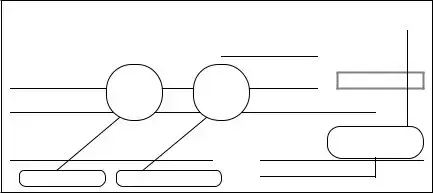
The routing number must be nine digits. The first two digits must be 01 through 12 or 21 through 32. On the sample check below, the routing number is 250250025. Tony and Bobby Maple would use that routing number unless their financial institution instructed them to use a different routing number for direct deposits.
Ask your financial institution for the correct routing number to enter if:
•The routing number on a deposit slip is different from the routing number on your checks,
•Your deposit is to a savings account that doesn’t allow you to write checks, or
•Your checks state they are payable through a financial institution different from the one at which you have your account.
account, don’t complete this form. Instead, |
request direct deposit on your tax return. |
Account must be in your name. Don’t |
request a deposit of your refund to an |
account that isn’t in your name, such as |
your tax return preparer’s account. |
Although you may owe your tax return |
preparer a fee for preparing your return, |
don’t have any part of your refund |
deposited into the preparer’s account to |
pay the fee. |
The number of refunds that can be directly deposited to a single account or prepaid debit card is limited to three a year. After this limit is reached, paper checks will be sent instead. Learn more at https://www.irs.gov/Refunds/Direct-
TONY MAPLE |
|
SAMPLE |
1234 |
BOBBY MAPLE |
|
|
|
123 Pear Lane |
|
|
|
Anyplace, GA 00000 |
|
|
|
PAY TO THE |
|
|
|
ORDER OF |
Routing |
Account |
$ |
|
|||
|
number |
number |
DOLLARS |
|
|
|
|
ANYPLACE BANK |
|
|
|
Anyplace, GA 00000 |
|
|
Don’t include |
For |
|
|
the check number. |
|
|
|
|
|:250250025 |
|:202020"'86". 1234 |
|
|
Note: The routing and account numbers may be in different places on your check.
Form 8888 (Rev. |
Page 3 |
Lines 1c, 2c, and 3c
Check the appropriate box for the type of account. Don’t check more than one box for each line. If your deposit is to an account such as an IRA, HSA, brokerage account, or other similar account, ask your financial institution whether you should check the “Checking” or “Savings” box. You must check the correct box to ensure your deposit is accepted.
Lines 1d, 2d, and 3d
The account number can be up to 17 characters (both numbers and letters). Include hyphens but omit spaces and special symbols. Enter the number from left to right and leave any unused boxes blank. On the sample check in these instructions, the account number is 20202086. Don’t include the check number.
Line 4
If any portion of your refund remains after completing lines 1a, 2a, and 3a, you can request this portion be sent to you in the form of a check. Enter the amount on line 4 that you would like to be sent by check.
Line 5
The total on line 5 must equal the total amount of the refund shown on your tax return. It must also equal the total of the amounts on lines 1a, 2a, 3a, and 4. If the total on line 5 is different, a check will be sent instead.
Direct Deposit Request Rejected
If your financial institution rejects one or two but not all of your direct deposit requests, you may get part of your refund as a paper check and part as a direct deposit.
Example. You complete lines 1 and 2 correctly but forget to enter an account number on line 3d. You will get a paper check for any amount shown on line 3a.
The parts of your refund shown on lines 1a and 2a will be directly deposited to the accounts you indicated.
Reasons your direct deposit request will be rejected. If any of the following apply, your direct deposit request will be rejected, and a check will be sent instead.
•You are asking to have a joint refund deposited to an individual account, and your financial institution(s) won’t allow this. The IRS isn’t responsible if a financial institution rejects a direct deposit.
•The name on your account doesn’t match the name on the refund, and your financial institution(s) won’t allow a refund to be deposited unless the name on the refund matches the name on the account.
•Three direct deposits of tax refunds already have been made to the same account or prepaid debit card.
•You haven’t given a valid account number or routing transit number.
•Any numbers or letters on lines 1a through 3d are crossed out or whited out.
|
The IRS isn’t responsible for a |
▲ |
|
! |
lost refund if you enter the |
wrong account information. |
|
CAUTION |
Check with your financial |
institution to get the correct routing and account numbers and to make sure your direct deposit will be accepted.
Changes in Refund Due to Math Errors or Refund Offsets
The rules below explain how your direct deposits may be adjusted.
Math Errors
The following rules apply if your refund is increased or decreased due to a math error.
Refund increased. If you made an error on your return and the amount of your refund is increased, the additional amount will be deposited to the last account listed. If you asked that your refund be split among three accounts, any increase will be deposited to the account on line 3. If you asked that your refund be split among two accounts, any increase will be deposited to the account on line 2.
Example. Your return shows a refund of $300 and you ask that the refund be split among three accounts with $100 to each account. Due to an error on the return, your refund is increased to $350. The additional $50 will be added to the deposit to the account on line 3.
Refund decreased. If you made an error on your return and the amount of your refund is decreased, the decrease will be taken first from any deposit to an account on line 3, next from the deposit to the account on line 2, and finally from the deposit to the account on line 1.
Example. Your return shows a refund of $300, and you ask that the refund be split among three accounts with $100 to each account. Due to an error on your return, your refund is decreased by $150. You won’t receive the $100 you asked us to deposit to the account on line 3, and the deposit to the account on line 2 will be reduced by $50.
Note: If you appeal the math error adjustment and your appeal is upheld, the resulting refund will be deposited to the account on line 1.
Refund Offset
The following rules apply if your refund is offset (used) to pay
Other offsets. If you owe other
If the deposit to one or more of ▲! your accounts is changed due to a math error or refund offset,
CAUTION and that account is subject to contribution limits, such as an IRA, HSA, Archer MSA, or Coverdell ESA, or the deposit was deducted as a contribution to a
Example. You deduct $1,000 on your 2024 tax return for an IRA contribution. The contribution is to be made from a direct deposit of your 2024 refund. Due to an offset by the Bureau of the Fiscal Service, the direct deposit isn’t made to your IRA. You need to correct your contribution by contributing $1,000 to the IRA from another source by the due date of your return (determined without regard to any extension) or file an amended return without the IRA deduction.
▲Don’t file a Form 8888 on which ! you have crossed out or whited
out any numbers or letters. If
CAUTION you do, the IRS will reject your allocation of refund, and send you a check instead.
| Fact Name | Description |
|---|---|
| Purpose | The IRS Form 8888 is used to allocate a tax refund to multiple accounts, allowing taxpayers to split their refund among different financial institutions or accounts. |
| Eligibility | Any taxpayer who is eligible for a refund can use Form 8888, provided they file a federal tax return and choose to receive their refund via direct deposit. |
| Filing Requirements | Taxpayers must complete Form 8888 and attach it to their federal tax return. The form cannot be filed separately. |
| Governing Law | Form 8888 is governed by federal tax laws, specifically under the Internal Revenue Code, which outlines the procedures for tax refunds. |
After you have gathered all necessary information and documents for your tax return, you will need to fill out IRS Form 8888. This form will help you manage your refund and ensure it is processed correctly. Follow the steps below to complete the form accurately.
Once you have completed the form, you are ready to submit your tax return. Make sure to keep a copy of your completed forms for your records. This will help you track your refund and address any issues that may arise.
What is IRS Form 8888?
IRS Form 8888, officially known as the "Direct Deposit of Refund to More Than One Account," allows taxpayers to split their tax refund into multiple bank accounts. This form is particularly useful for those who want to allocate their refunds for different purposes, such as savings, paying off debts, or covering specific expenses.
Who should use Form 8888?
This form is ideal for individuals who are expecting a tax refund and wish to divide it among various accounts. Whether you are a taxpayer looking to save some money, pay bills, or invest in a retirement account, Form 8888 provides a convenient way to manage your refund effectively.
How do I fill out Form 8888?
Filling out Form 8888 is straightforward. You will need to provide your personal information, including your name, address, and Social Security number. Next, indicate the amount of your refund you want to deposit into each account. You can designate up to three different accounts. Just make sure to provide the correct routing and account numbers for each account to avoid any delays.
Can I use Form 8888 if I file my taxes electronically?
Yes, you can use Form 8888 when you file your taxes electronically. Most tax software programs include the option to fill out Form 8888 as part of the e-filing process. Just follow the prompts to enter your direct deposit information, and your refund will be deposited into the designated accounts once your return is processed.
What happens if I don’t use Form 8888?
If you choose not to use Form 8888, your entire tax refund will be deposited into a single bank account. While this may be sufficient for some, it limits your ability to allocate funds for specific purposes. Using Form 8888 gives you more control over how your refund is distributed.
Is there a fee for using Form 8888?
No, there is no fee for using IRS Form 8888. It is a free service provided by the IRS to help taxpayers manage their refunds more effectively. Just ensure that you are using the form correctly to avoid any issues with your refund distribution.
What should I do if I make a mistake on Form 8888?
If you realize that you made a mistake on Form 8888 after submitting your tax return, don’t panic. You can file an amended return using Form 1040-X to correct any errors. It’s essential to act promptly to ensure that your refund is directed to the right accounts. Always double-check your information before submitting to minimize the chances of mistakes.
Not providing accurate personal information. Ensure that your name, Social Security number, and address are correct.
Forgetting to sign and date the form. An unsigned form is considered incomplete and will delay processing.
Incorrectly calculating refund amounts. Double-check all calculations to avoid mistakes that could lead to delays.
Not specifying the correct bank account information. Ensure that the account number and routing number are accurate for direct deposit.
Failing to include all necessary forms. Attach any required documents to avoid processing issues.
Using outdated forms. Always use the most current version of the IRS 8888 form to ensure compliance.
Neglecting to check for prior year issues. If there are unresolved tax matters from previous years, address them before submitting.
Overlooking eligibility for direct deposit. Confirm eligibility to ensure that your refund can be deposited directly into your account.
Not keeping a copy of the completed form. Always retain a copy for your records in case you need to reference it later.
Missing deadlines. Submit the form on time to avoid penalties or delays in receiving your refund.
The IRS Form 8888, also known as the "Direct Deposit of Refund to More Than One Account," is primarily used to allocate a tax refund into multiple bank accounts. While this form is important for managing your tax refund, several other documents and forms may be needed in conjunction with it. Below is a list of commonly used forms that can help streamline your tax filing process.
Understanding these forms can help ensure that you complete your tax return accurately and efficiently. Each document serves a specific purpose, making it easier to navigate the tax filing process and maximize your refund.
The IRS Form 1040 is the standard individual income tax return form used by U.S. taxpayers. Like Form 8888, it is essential for reporting income and calculating tax liability. Both forms require personal information, including Social Security numbers and filing status. While Form 1040 focuses on income and deductions, Form 8888 specifically addresses the allocation of a tax refund, allowing taxpayers to direct their refund to multiple accounts or purchase U.S. savings bonds.
The IRS Form 8862 is used by taxpayers who have previously claimed the Earned Income Tax Credit (EITC) and had their claim denied. Similar to Form 8888, it requires detailed personal information and is submitted with the tax return. Both forms aim to ensure accurate processing of taxpayer information. However, while Form 8888 deals with refund allocation, Form 8862 focuses on reestablishing eligibility for the EITC.
The IRS Form 8889 is for reporting Health Savings Account (HSA) contributions and distributions. Both Form 8889 and Form 8888 require taxpayers to provide information about their financial accounts. Form 8889 specifically addresses health-related financial matters, while Form 8888 is used for directing tax refunds. Each form serves distinct purposes but shares the commonality of managing taxpayer finances.
The IRS Form 8863 is used to claim education credits. It is similar to Form 8888 in that both forms require detailed information about the taxpayer and their financial situation. While Form 8888 is about managing tax refunds, Form 8863 focuses on educational expenses and credits. Both forms are critical for maximizing potential financial benefits during tax filing.
The IRS Form 8880 is utilized to claim the Retirement Savings Contributions Credit. Like Form 8888, it requires personal and financial information. Both forms help taxpayers optimize their financial outcomes. Form 8880 specifically addresses retirement savings, while Form 8888 deals with the distribution of tax refunds, showcasing different aspects of taxpayer financial management.
The IRS Form 1040-SR is designed for seniors and is similar to Form 1040, but it features a larger font and a simplified layout. Both forms require comprehensive personal and financial information from taxpayers. Form 1040-SR, like Form 8888, is part of the overall tax filing process. However, while Form 8888 is focused on refund allocation, Form 1040-SR is tailored to meet the needs of older taxpayers, making tax filing more accessible for them.
When filling out the IRS Form 8888, it's important to follow certain guidelines to ensure your submission is accurate and processed smoothly. Here are four things to keep in mind:
Following these simple guidelines can help you avoid common mistakes and ensure that your tax refund is processed as quickly as possible.
The IRS Form 8888, also known as the "Direct Deposit of Refund to More Than One Account," is often misunderstood. Here are six common misconceptions about this form:
Form 8888 is only for large refunds. Many believe that this form is only necessary for those expecting a substantial tax refund. In reality, anyone who wishes to split their refund into multiple accounts can use this form, regardless of the refund amount.
You must have multiple bank accounts to use Form 8888. Some people think they need to have several bank accounts to fill out this form. However, it is possible to use Form 8888 to deposit a refund into just one account or to split it between two or three accounts.
Form 8888 delays your refund. There is a misconception that filing this form will slow down the processing of your tax refund. In fact, as long as the form is completed accurately, it does not affect the speed of your refund.
You cannot use Form 8888 with direct deposit for a tax return filed electronically. Some taxpayers believe that they can only use this form for paper returns. However, Form 8888 can be used with both electronic and paper tax filings.
Form 8888 is only for individual taxpayers. This form is often thought to be exclusive to individual taxpayers. In reality, it can also be used by those filing jointly or by dependents who qualify for a refund.
You need to file Form 8888 every year. Many assume that they must submit this form annually if they want to continue splitting their refund. Once you set up direct deposits with Form 8888, you do not need to file it each year unless you want to change the account details.
Understanding these misconceptions can help taxpayers make informed decisions about their refunds and how to manage their finances effectively.
The IRS Form 8888 is used to allocate your tax refund to multiple accounts or purchase U.S. Savings Bonds. Here are some key takeaways to keep in mind when filling out and using this form: